Table of Contents
- Why Upper Funnel Matters More Than Most Amazon Brands Realize
- What Is Amazon Brand+?
- Brand+ vs Traditional DSP Awareness Campaigns: What Actually Changes
- Brand+ and Performance+: The Full-Funnel Pair
- Which Brands Should Actually Use Brand+?
- How Brand+ Actually Works: The AI Under the Hood
- Ad Formats and Placements for Brand+ Campaigns
- Creative Strategy for Brand+ Campaigns
- What Upper Funnel Investment Actually Produces: Real Examples
- Measuring Brand+ Performance: The Metrics That Actually Tell the Story
- Setting Up a Brand+ Campaign: Practical Steps
- How Brand+ Connects to the Rest of Your Amazon Advertising
- Frequently Asked Questions
- Final Thoughts
Why Upper Funnel Matters More Than Most Amazon Brands Realize
There’s a pattern I see with almost every established Amazon brand that comes to us feeling stuck. Their Sponsored Products are running well. ACoS is under control. They’ve optimized listings, gotten reviews in order, and they’re defending their branded keywords. But growth has plateaued. Revenue is relatively flat, new customer acquisition has slowed, and they’re not sure what to do next.
The answer, almost every time, is the top of the funnel. These brands have spent years optimizing for the moment of purchase — catching shoppers who are already searching, already comparing, already close to buying. What they haven’t built is the system that creates those shoppers in the first place.
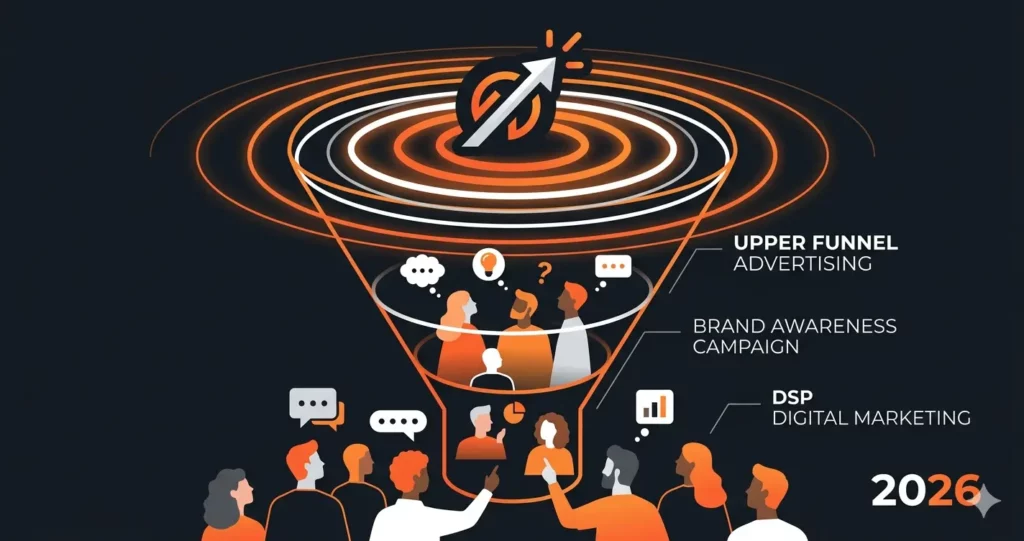
Amazon Brand+ is designed specifically for that gap. It’s Amazon’s AI-powered awareness campaign type within DSP, built to reach people before they start searching, build brand recognition among new audiences, and create the demand that Sponsored Products then captures. This article covers how it works, when it makes sense to use it, and how to structure it as part of a coherent full-funnel strategy.
What Is Amazon Brand+?
Brand+ is an AI-powered campaign type within Amazon DSP, launched globally in early 2025 alongside its conversion-focused counterpart, Performance+. Where Performance+ is built to drive immediate action from audiences close to purchase, Brand+ is built for the opposite end of the funnel — reaching people who are likely to become interested in your brand over time, not just those who are ready to buy now.
It uses Amazon’s AdRelevance predictive AI to identify audiences who are likely to engage with your brand and become customers in the future — based on Amazon’s first-party shopping, browsing, and streaming data. Rather than asking you to manually select demographic or lifestyle segments, Brand+ uses machine learning to find the audiences most likely to respond to your brand message over a longer conversion window.
Amazon describes the approach as using ‘glass box’ AI — giving you transparency into how campaigns are optimized, not just the outcomes. You can see insight cards showing which audience signals are driving delivery, how long users typically take to move from first ad exposure to consideration, and how the creative is performing across placements.
By automating the traditional 70-step campaign creation process, Brand+ and Performance+ reduce complexity while providing real-time reporting and AI-driven optimizations — making upper-funnel investment more accessible for brands of all sizes.
Source: Amazon Ads — Brand+ and Performance+ Global Launch, March 2025
Brand+ vs Traditional DSP Awareness Campaigns: What Actually Changes
If you’ve already run upper-funnel campaigns through Amazon DSP — lifestyle targeting, in-market prospecting at broad scale — you might be wondering what Brand+ actually adds. The difference is meaningful.
| Dimension | Traditional DSP Awareness | Amazon Brand+ |
| Audience selection | You choose the segments (lifestyle, in-market, demographic) | AI selects and optimizes audiences based on predicted brand engagement |
| Optimization target | Impressions and reach | Long-term brand engagement and eventual conversion probability |
| Prediction horizon | Current moment — who is in market now | Future — who is likely to become interested in your brand over time |
| Setup complexity | High — multiple segments, audience logic, bid configurations | Simplified — AI handles most targeting decisions |
| Transparency | You see what you set up | ‘Glass box’ insight cards showing audience signals and time-to-convert patterns |
| Placement access | Amazon-owned and third-party supply | Amazon’s full inventory including Prime Video ads |
| Creative optimization | Manual creative rotation | Integrated AI-driven creative optimization |
| Best use case | Precise prospecting with defined audience hypotheses | Scalable brand awareness without requiring audience expertise |
The key practical difference is this: traditional DSP awareness requires you to make audience hypothesis decisions upfront — you’re betting that ‘fitness enthusiasts aged 25-44 with household income over $75K’ is a good target for your brand. Brand+ lets the AI make and test those hypotheses continuously, using signals that go deeper than any manually built segment.
For brands that have the time and expertise to manage detailed audience logic, traditional DSP awareness still has a place. For brands that want to build upper-funnel presence without dedicating significant internal resources to audience architecture, Brand+ is a genuine step forward.
Brand+ and Performance+: The Full-Funnel Pair
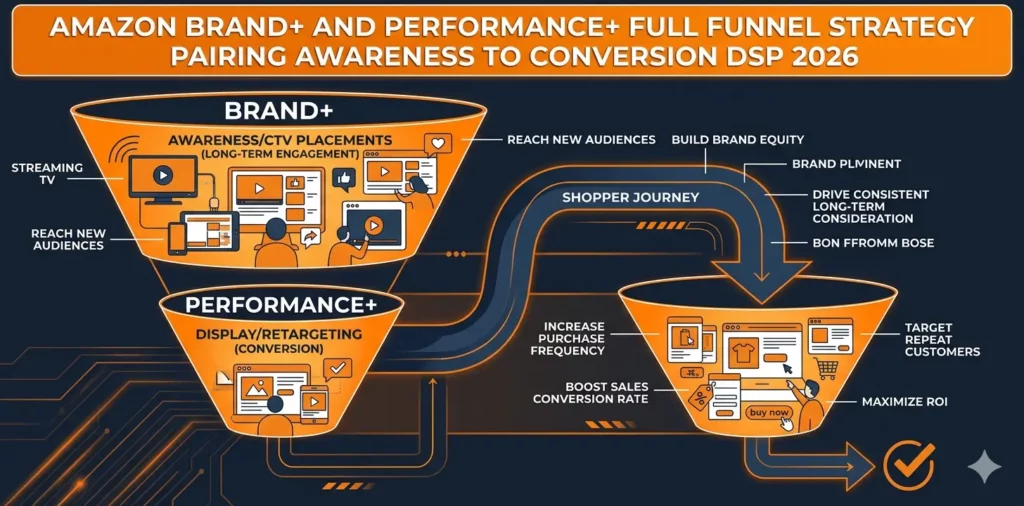
Brand+ was designed to work alongside Performance+, and understanding that relationship is key to using either tool well. They’re not interchangeable — they do completely different jobs in the funnel, and they produce noticeably better results when run together than either does in isolation.
| Brand+ | Performance+ | |
| Primary job | Build brand recognition and long-term engagement | Convert engaged users into buyers |
| Funnel stage | Top and upper-mid funnel | Mid and lower funnel |
| AI optimization target | Who is likely to engage with the brand over time | Who is most likely to convert soon |
| Ad formats | Video, CTV, display for storytelling | Display, dynamic ecommerce ads for direct response |
| Best audience | People who haven’t yet interacted with your brand | People who have shown awareness or interest signals |
| What to measure | Branded search lift, brand favorability, NTB intent | ROAS, cost per acquisition, conversion rate |
| Time horizon | 30-90 days before impact is measurable | 7-30 days for direct conversion signals |
Amazon’s case study with H&R Block remains the clearest example of what the two tools do together. During tax season — a period with intense competition for attention — H&R Block combined Brand+ for awareness with Performance+ for conversion. The result was a 144% lift in full-funnel conversion rate and a 35% improvement in cost per acquisition compared to non-Brand+ tactics. (Source: Amazon Ads — unBoxed 2025 Enhancement Announcement)
The logic behind those numbers is straightforward. Performance+ is better at converting people who have already encountered the brand. Brand+ creates more of those people. Running both means the top of the funnel continuously feeds the bottom, rather than the bottom funnel struggling with a pool of prospects it never helped build.
Which Brands Should Actually Use Brand+?
Brand+ is not the right next step for every Amazon brand. Understanding who benefits most — and who should wait — saves a lot of wasted budget.
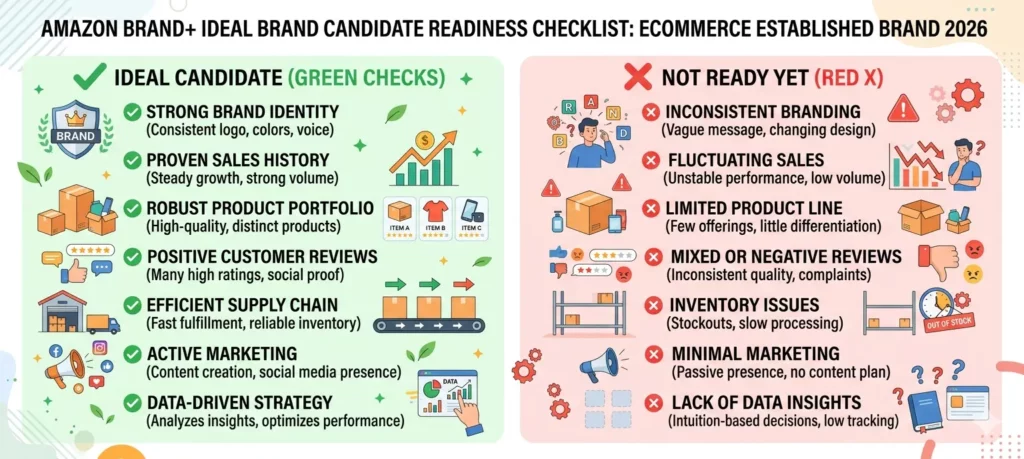
Good candidates for Brand+
- Established Amazon brands with 12 or more months of sales history and a clear brand identity worth building awareness around
- Brands in competitive categories where Sponsored Products alone can’t create differentiation — you’re winning some auctions but not building brand preference
- CPG, beauty, health, and lifestyle brands where brand trust and recognition materially affect purchase decisions
- Brands launching new product lines who need to build category awareness among audiences not yet in the consideration funnel
- Brands whose branded search volume has plateaued — a sign that the top of the funnel isn’t generating new demand
- Companies with a meaningful product story — Brand+ works best when there’s something genuine to communicate, not just a product listing to amplify
Brands that should wait
- New-to-Amazon sellers with fewer than 6-12 months of sales history — you don’t yet have the conversion foundation that awareness feeds into
- Brands where listings still need optimization — low review counts, poor images, below-average conversion rates. Brand awareness driving traffic to a weak listing is expensive and ineffective.
- Very niche products with a small addressable audience on Amazon — Brand+ needs reach to work. A highly specialized B2B or technical product may not have the audience size to justify CPM-based awareness spend.
- Brands with no existing Sponsored Products or DSP infrastructure — Brand+ works best as an addition to an existing advertising system, not a starting point
How Brand+ Actually Works: The AI Under the Hood
Amazon describes Brand+ as using its AdRelevance AI, which draws on signals from shopping behavior, streaming content preferences, search patterns, and category browsing history to predict which users are likely to develop genuine brand affinity over time.
This is different from standard in-market targeting in an important way. In-market targeting identifies people who are actively shopping in your category right now. Brand+ identifies people who are not yet shopping in your category but whose behavioral profile suggests they are likely to become interested — which is a longer-term, and often more valuable, acquisition signal.
| What Brand+ AI Analyzes | What It Predicts | What This Enables |
| Category browsing patterns over 3-6 months | Who is starting to show early interest in adjacent categories | Reaching shoppers before they enter the active consideration phase |
| Streaming content preferences on Fire TV and Prime Video | Which content viewers are likely to respond to brand storytelling formats | More effective CTV and video creative placement |
| Life stage signals from purchase history | Who is entering a life transition that creates category need | Timing brand awareness to life moments that matter |
| Branded search behavior across the category | Who is comparing brands but hasn’t yet formed a preference | Reaching genuinely undecided category shoppers |
| Response to previous brand ad exposures | Which creative and message types build engagement for this audience | AI-optimized creative rotation within the campaign |
One of the updates Amazon made to Brand+ at unBoxed 2025 was the addition of consideration tactics — new audience segments that target shoppers at decision points in their journey, not just at the very top of the funnel. This expanded Brand+ from a pure awareness tool to something that bridges awareness and mid-funnel consideration more seamlessly. (Source: Amazon Ads — unBoxed 2025 Brand+ and Performance+ Enhancement)
Ad Formats and Placements for Brand+ Campaigns
Brand+ campaigns access Amazon’s full inventory — including placements that aren’t available in standard Sponsored Ads and that are specifically built for brand storytelling rather than direct response.
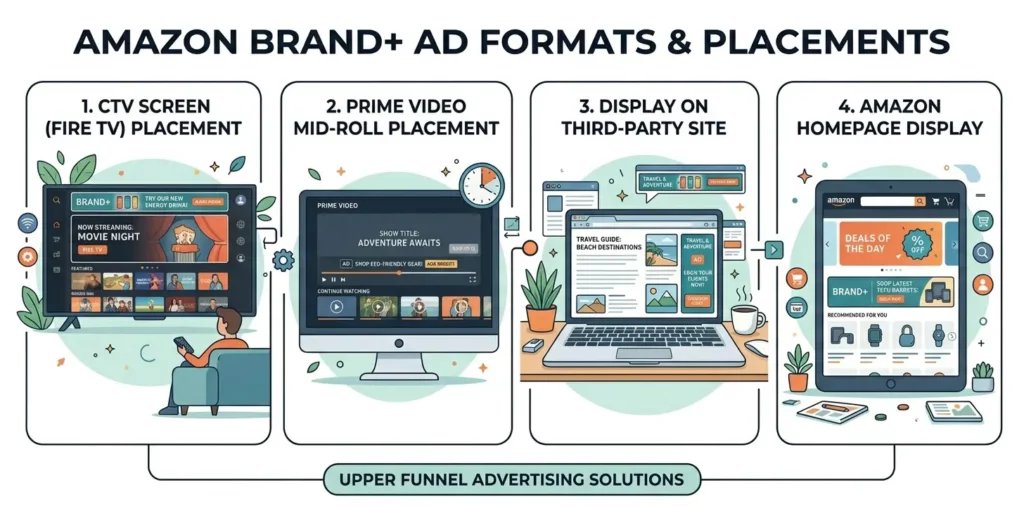
| Format | Where It Appears | Upper Funnel Role | Creative Requirement |
| Streaming TV / CTV video | Prime Video, Fire TV, Freevee, Twitch, third-party CTV | Primary awareness format — non-skippable, high attention environment | 15 or 30-second video. Brand-forward, single message, professional production quality. |
| Online video (OLV) | Third-party streaming sites and apps | Broad reach awareness outside Amazon-owned properties | 15 or 30-second video. Can be lighter production than CTV but should still be brand-led. |
| Display ads | Amazon homepage, product pages, off-Amazon sites and apps | Mid-awareness and consideration bridge — keeps brand visible post-video exposure | Static or dynamic display. Clean product imagery with brand name prominent. |
| Audio ads | Amazon Music, Alexa devices | Ambient brand presence for audio-first environments | 15 or 30-second audio spot with verbal brand mention and clear CTA |
The most effective Brand+ campaigns almost always combine video (for the top-of-funnel story) with display (for follow-up and frequency). Video builds the initial brand impression. Display keeps the brand visible as the shopper moves through their consideration journey. Relying on only one format limits both reach and recall.
Combining display and video ads in an Amazon DSP awareness campaign drives a 2.5x higher lift in brand awareness for consumer goods brands compared to using video alone — showing that format combination, not just video quality, is what drives recall.
Source: Amazon Ads — Full-Funnel Advertising Success Guide, 2024
Creative Strategy for Brand+ Campaigns
The creative bar for Brand+ is higher than for retargeting or conversion campaigns, because you’re doing something genuinely harder — convincing someone who doesn’t know your brand to care about it. That’s a different task from nudging someone who already visited your product page to come back.
What works in Brand+ creative
- Lead with the brand problem you solve, not the product features. Upper funnel audiences don’t know or care about your product specs yet. They respond to the problem being named clearly and the brand being positioned as the solution.
- Establish brand visual identity immediately. Colors, logo, brand voice should be identifiable in the first 3 seconds. Brand+ campaigns are often viewed without click-through — the impression itself needs to do the recall work.
- Tell one coherent story across formats. If your CTV ad tells a brand story and your display ad looks like a completely different brand, you’re wasting the CTV impression. Visual consistency across formats compounds recall significantly.
- Use lifestyle context, not product isolation. Upper funnel audiences respond better to seeing your product in a real context — someone using it, a moment it enables — than to a white-background product shot.
- End with a light CTA, not a hard sell. ‘Discover the range on Amazon’ or ‘See what makes us different’ is appropriate for awareness. ‘Buy Now — Limited Stock’ is not. Mismatched CTAs signal to cold audiences that you don’t understand where they are in the journey.
Common creative mistakes in upper funnel campaigns
- Using the same creative as your retargeting campaigns — cold audiences haven’t seen your brand before, so ‘welcome back’ messaging confuses them
- Packing the video with too many product features or SKUs — upper funnel is about brand impression, not catalog breadth
- Inconsistent visual branding across CTV and display placements — defeats the recall-building purpose of running both formats
- Making the CTA too aggressive — ‘Shop Now’ or ‘Add to Cart’ creative on an awareness placement creates friction for audiences not yet ready to buy
Creative tip for brand+ video
For your 30-second Brand+ CTV video, structure it as: 3 seconds of brand/problem hook, 20 seconds of brand story or product-in-context, 7 seconds of brand name and light CTA. That pacing matches how attention works in a non-skippable streaming environment. Front-load the brand, let the story breathe in the middle, close clean.
What Upper Funnel Investment Actually Produces: Real Examples
Abstract arguments about brand awareness are easy to dismiss. Concrete numbers are harder to ignore. Here are documented examples of what upper funnel Amazon DSP campaigns have delivered for real brands.
Waken Mouthcare: New brand awareness drives 27% ad revenue lift
Waken Mouthcare — a premium mouthcare brand — initially focused entirely on Sponsored Products and Sponsored Brands. When growth plateaued, their agency Unicorn Orange introduced Amazon DSP awareness campaigns targeting in-market and contextual audiences who had never encountered the brand. After 3 months of upper-funnel investment, Waken’s monthly Amazon revenue exceeded targets by 8.5%, ad revenue was up 27%, new-to-brand customers grew 24%, and subscription orders more than doubled. Roughly 33% of those subscriptions were directly attributed to the DSP awareness campaigns.
Neutrogena Hydro Boost: Full-funnel DSP drives 25% sales increase
Neutrogena ran a full-funnel Amazon DSP campaign for their Hydro Boost range in India — starting with video awareness ads targeting beauty consumers, moving through mid-funnel consideration display ads to purchasers of peer brands, and closing with conversion-focused display retargeting. The awareness phase achieved an 85% video completion rate, which was around 10% better than category benchmarks. The full campaign drove a 50% increase in product detail page views and a 25% increase in product sales in the months following. Overall customers for the brand increased by 22%. (Source: Amazon Ads — Neutrogena Case Study)
Sika: Awareness campaign produces 20% branded search growth year over year
Sika, a specialty chemical brand, ran an Amazon DSP upper-funnel campaign in Spain targeting DIY home improvement shoppers. They ran Brand Lift studies via Nielsen alongside the campaign. Results included a 5% lift in aided brand awareness versus a 2% benchmark, a 9% lift in purchase intent versus a 2% benchmark, a 36% lift in ad recall for video assets versus a 23% benchmark, and branded searches grew 20% year over year while category searches declined in the same period — showing brand preference building within the category. (Source: Amazon Ads — Sika Case Study)
DSP awareness + Sponsored Ads: 25x higher purchase probability
Amazon’s own research across multiple brand campaigns found that audiences exposed to both DSP awareness campaigns and Sponsored Ads were 25 times more likely to purchase than those who only saw one format. And brands that added DSP awareness to their existing Sponsored Ads mix saw 21% more new-to-brand sales. The awareness layer doesn’t just build brand recognition — it makes the bottom funnel more efficient.
Measuring Brand+ Performance: The Metrics That Actually Tell the Story
This is where brands often stumble when they first try upper funnel advertising. The reflex is to apply the same ROAS lens used for Sponsored Products. When Brand+ campaigns don’t show 5x ROAS in 30 days, the conclusion is that it isn’t working. That conclusion is almost always wrong.
Brand awareness campaigns work over longer time horizons and through different mechanisms than conversion campaigns. The right metrics reflect that reality.
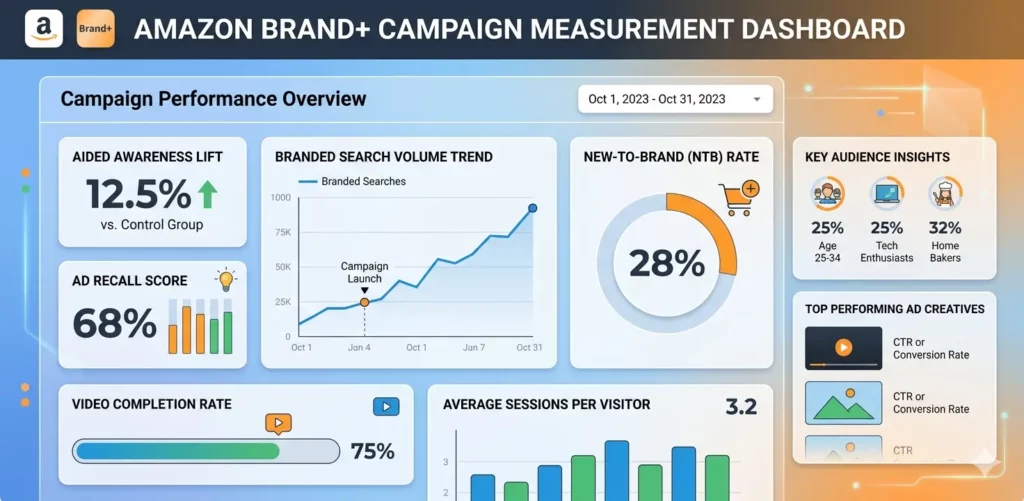
| Metric | What It Measures | How to Get It | Healthy Benchmark |
| Branded Search Lift | Increase in Amazon searches for your brand name after campaign launch | Amazon Marketing Cloud (AMC) custom query or Brand Analytics | Measurable increase over baseline after 30-45 days of spend |
| Brand Lift Score (Aided Awareness) | Survey-based measure of ad recall and brand favorability post-exposure | Amazon Brand Lift study (available via DSP) | Compare against category benchmark provided in study results |
| Purchase Intent Lift | Survey-based measure of intent to buy after campaign exposure | Amazon Brand Lift study | Sika saw 9% vs 2% benchmark — aim to beat category norm |
| Video Completion Rate (VCR) | Percentage of viewers who watch your Brand+ video to completion | Standard DSP reporting | 85-95% for non-skippable placements. Below 80% suggests creative issue. |
| New-to-Brand (NTB) Rate — downstream | Share of Sponsored Products conversions from customers new to your brand (tracked via AMC) | Amazon Marketing Cloud | If NTB rate increases after Brand+ launch, awareness is working |
| Unique Reach | Number of distinct users exposed to the Brand+ campaign | Standard DSP reporting | Track as a scaling metric — wider reach means broader awareness building |
| Time-to-Convert data | How long after Brand+ exposure users typically convert in Sponsored Products | AMC multi-touch attribution query | Typical range is 14-45 days — shows the delay between awareness and action |
Amazon Brand Lift studies are the most direct way to measure what Brand+ is doing to brand perception. These are survey-based studies run inside Amazon DSP that ask a test group (exposed to your ads) and a control group (not exposed) the same questions about brand awareness, ad recall, favorability, and purchase intent. The difference between the two groups is your lift. They are available to DSP advertisers and are one of the most credible upper-funnel measurement tools available in the Amazon ecosystem. (Source: Amazon Ads — Amazon Brand Lift Measurement)
High-attention DSP placements drove a 37% lift in brand favorability, 19% higher ad recall, and 9% higher purchase intent versus low-attention inventory in a Haleon study — showing that where an awareness ad appears is as important as the creative itself.
Source: Adelaide Metrics — Amazon DSP Attention Study with Haleon, November 2025
Setting Up a Brand+ Campaign: Practical Steps
Brand+ is accessed through Amazon DSP, and the setup process is considerably simpler than building a traditional DSP awareness campaign with full manual audience configuration. Here’s how it looks in practice.
- Access Amazon DSP. Brand+ is available to all advertisers currently using Amazon DSP, whether or not they sell on Amazon.
- Create a new campaign order and select Brand+. When setting up a new DSP campaign, choose Brand+ as the campaign type. This tells the system to optimize for brand engagement and long-term awareness signals.
- Set your campaign goal. Brand+ optimization goals typically center on reach, brand engagement, and new audience exposure. You can set a target CPM or let the AI optimize within a budget cap.
- Choose your inventory. Brand+ gives you access to Amazon’s full inventory including Prime Video ads, Fire TV, third-party CTV, and display. For maximum awareness impact, include CTV/video placements. For consideration bridging, include display.
- Upload your creative assets. Prepare 15 or 30-second video for streaming placements, and display banner variations (300×250, 728×90, 160×600 are standard). Creative consistency across formats matters — use the same visual language and brand elements in both.
- Configure suppression lists. Exclude your existing customers and current warm retargeting audiences. Brand+ is for new audience acquisition — you don’t want it serving awareness ads to people who already know and buy from you.
- Set your budget. Brand+ needs enough budget to generate meaningful reach. A practical minimum for a test campaign is $10,000-15,000 per month. Below that, the reach is too narrow to build genuine awareness at scale.
- Set up a Brand Lift study. Do this at campaign launch, not after. Brand Lift studies need to run concurrently with the campaign to capture the control vs exposed group comparison. Set it up in DSP under the Studies section.
- Let it run for 60-90 days minimum. Brand awareness campaigns build over time. Pulling Budget at 30 days because branded search hasn’t moved yet ignores the typical 14-45 day lag between first exposure and measurable brand behavior change.
Budget allocation between Brand+ and Performance+
A common starting ratio for brands new to the Brand+/Performance+ pairing is 40% Brand+, 60% Performance+. As Brand+ builds your awareness pool, the Performance+ audience of people who have interacted with your brand will grow — at which point you can shift more budget into Performance+ to capitalize on that warm audience.
How Brand+ Connects to the Rest of Your Amazon Advertising
Brand+ is most powerful when it’s treated as the starting point of a system, not a standalone campaign. Here’s how it connects to everything else in your advertising stack.
Brand+ creates the audience that Performance+ converts
Someone who saw your Brand+ CTV ad last week is far more likely to respond to a Performance+ display retargeting ad than someone who has never encountered your brand. Brand+ and Performance+ are designed to run simultaneously for exactly this reason — one warms the audience, the other closes.
Brand+ lifts Sponsored Products performance
As Brand+ campaigns build branded search volume — more people searching your brand name on Amazon — Sponsored Brands and Sponsored Products campaigns benefit directly. Branded keywords have lower CPCs and higher conversion rates. A rising branded search volume is a measurable downstream effect of effective Brand+ spend, and it makes your lower-funnel campaigns more efficient.
Brand+ audiences can be retargeted in DSP
Users who were exposed to your Brand+ ads can be built into a retargeting audience in DSP — specifically targeting people who saw your awareness campaign with a mid-funnel product-focused message. This video-to-display sequence is one of the highest-performing creative strategies in the Amazon ecosystem.
Brand+ data feeds AMC analysis
AMC can show you how Brand+ exposures influenced subsequent behavior — whether shoppers who saw your Brand+ ad were more likely to search your brand, click a Sponsored Product, or ultimately purchase. This cross-channel attribution data is how you build the business case for continued upper-funnel investment.
Frequently Asked Questions
Regular DSP awareness campaigns require you to manually define audience segments, set bids, and configure targeting logic. Brand+ uses AI to handle most of those decisions automatically — it identifies audiences likely to engage with your brand using Amazon’s full data stack and optimizes delivery without requiring the same level of hands-on audience architecture. Brand+ also offers the ‘glass box’ transparency feature, showing you insight cards about what’s driving delivery.
Yes. Brand+ is available to all advertisers using Amazon DSP, whether or not they sell products on Amazon’s marketplace. Non-endemic brands can use Brand+ to build awareness and drive traffic to their own website or any other destination, while still leveraging Amazon’s first-party behavioral data for targeting.
There is no published minimum for Brand+, but in practice you need enough budget to build meaningful reach. A practical minimum is $10,000-15,000 per month for a test campaign. Below that, the audience pool you’re reaching is too small to generate measurable brand lift or branded search movement. Most brands see better data from running Brand+ for 60-90 days at a meaningful budget than from running it for 6 months at $2,000 per month.
Upper funnel campaigns operate on a longer timeline than conversion campaigns. Branded search lift typically becomes measurable after 30-45 days of consistent spend. Brand Lift study results (recall, favorability, purchase intent) are usually available after 6-8 weeks. The downstream impact on Sponsored Products performance — lower branded CPCs, higher conversion rates — often becomes visible after 60-90 days. Plan your budget and measurement windows accordingly.
Run them together. Brand+ is designed to complement Sponsored Products, not replace them. The awareness that Brand+ builds feeds directly into the branded search volume that Sponsored Products then captures. Waiting until Sponsored Products are ‘fully optimized’ before starting Brand+ delays the compounding benefit of having both layers running simultaneously.
Use Amazon Marketing Cloud (AMC) to run a multi-touch attribution query showing how Brand+ exposures influenced downstream Sponsored Products clicks and purchases. Also run an Amazon Brand Lift study concurrently with your Brand+ campaign — this gives you survey-based evidence of recall, favorability, and purchase intent lift that ties directly to your awareness spend. Branded search volume trend in Brand Analytics is another useful leading indicator.
They’re separate campaign types — Brand+ and Performance+ run in separate orders within DSP, each optimizing for different goals. The right approach is to run them in parallel as complementary tools: Brand+ building the top of the funnel, Performance+ converting the audiences that Brand+ has warmed. Amazon’s own guidance and case studies consistently recommend running both rather than choosing one.
Final Thoughts
The brands that win on Amazon in 2026 are increasingly the ones that invest across the full funnel — not just at the moment of search. Sponsored Products will always matter, but the brands that rely on them exclusively are fighting an increasingly expensive battle for a finite pool of shoppers who are already in the market.
Brand+ gives you a practical, AI-managed way to build the awareness that expands that pool. It creates demand rather than just capturing it. It builds brand preference in the category before the shopper ever types a search query. And when it runs alongside Performance+, it creates a compounding dynamic where the top of the funnel continuously feeds the bottom.
The measurement is different from what most Amazon advertisers are used to. The time horizon is longer. But the brands that make this investment consistently — building awareness while converting existing demand — are the ones that build durable category leadership rather than just quarterly ROAS cycles.
If you want to think through whether Brand+ makes sense for your brand right now, and how to structure it alongside your existing Sponsored Ads campaigns, that’s a conversation we’re glad to have.
📢 Ready to Build Upper Funnel Awareness for Your Amazon Brand?
At Eva we help established Amazon brands design and run Brand+ and full-funnel DSP strategies — including creative direction, Brand Lift study setup, and AMC measurement to show how awareness investment compounds with lower-funnel performance. Get in touch for a free strategy conversation.