Update, October 2026: Amazon DSP is now part of Amazon Ads Agent
Amazon says Amazon DSP is now part of Amazon Ads Agent, its platform for buying sponsored ads and Display, Video, and Audio campaigns in one place. DSP buying now runs through DVA+, with advanced settings when you want full control. Amazon also says existing DSP campaigns, audiences and reporting carry over without disruption, and that pricing does not change: the DSP pricing model, including self-service and managed-service options, continues within DVA+. Where this article says Amazon DSP, those capabilities now sit inside Amazon Ads Agent. Source: Amazon Ads, “Amazon DSP is now part of Amazon Ads Agent”.
Table of Contents
- Use Similar Audiences, Not Generic Lookalikes
- What Amazon DSP lookalike audiences actually do
- Define a seed around the product and acquisition objective
- Build and validate the AMC audience
- Compare reach settings without assuming a ROAS hierarchy
- Match creative to the buying decision
- Measure acquisition without confusing attribution with causation
- Use AMC audiences beyond DSP when eligible
- When to scale a lookalike campaign
- How should a brand choose an AMC lookalike seed?
- Frequently Asked Questions
Use Similar Audiences, Not Generic Lookalikes
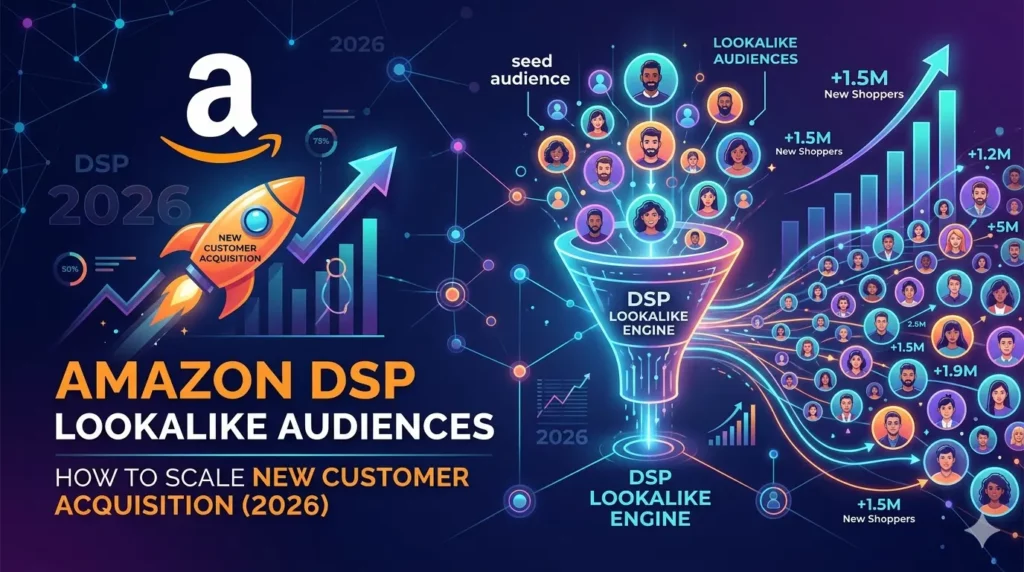
Amazon introduced similar audiences in DSP to expand from selected audience signals toward adjacent prospects. The quality of that expansion still depends on the input. A broad or low-value seed can create broad, low-value reach, while a high-intent seed gives the system a clearer customer pattern to extend.
- Choose a seed tied to the behavior you want more of, such as high-value purchasers or qualified category researchers.
- Exclude recent purchasers, existing retargeting pools, and other audiences that would blur prospecting results.
- Match creative to a new customer who may not know the brand yet.
- Test audience tiers, frequency, and incrementality before moving more budget into the tactic.
Availability and console labels can change, so confirm the current setup in Amazon DSP and review the official similar audiences announcement. Connect execution through Amazon DSP Management and the Amazon DSP and AMC Intelligence Playbook.
What Amazon DSP lookalike audiences actually do
Amazon DSP similar audiences and Amazon Marketing Cloud lookalikes are related ways to expand reach, but they are not the same control. A modeled audience identifies people with relevant similarities; it does not establish that those people will buy, have never encountered the brand, or will produce a particular return on ad spend.
The AMC lookalike launch announcement describes an advertiser-defined seed built from cross-source signals. Amazon models additional prospects from that seed for activation in DSP. By contrast, the DSP similar audiences beta announcement describes an opt-in expansion feature on eligible line items using custom audiences based on Amazon shopping interactions. It does not promise availability on every audience type.
Choose the workflow according to the question being tested. Expansion from an existing DSP targeting setup and expansion from a separately defined AMC customer cohort need not use the same inputs. Neither is automatically superior. Confirm availability in the account and market before designing the campaign.
Define a seed around the product and acquisition objective
A useful seed represents a behavior the business wants more of. That can be a purchase of a particular product group, a higher-spend customer cohort, or another eligible behavior supported by the available signals. The seed is a hypothesis about relevant prospects, not a certification of their future value.
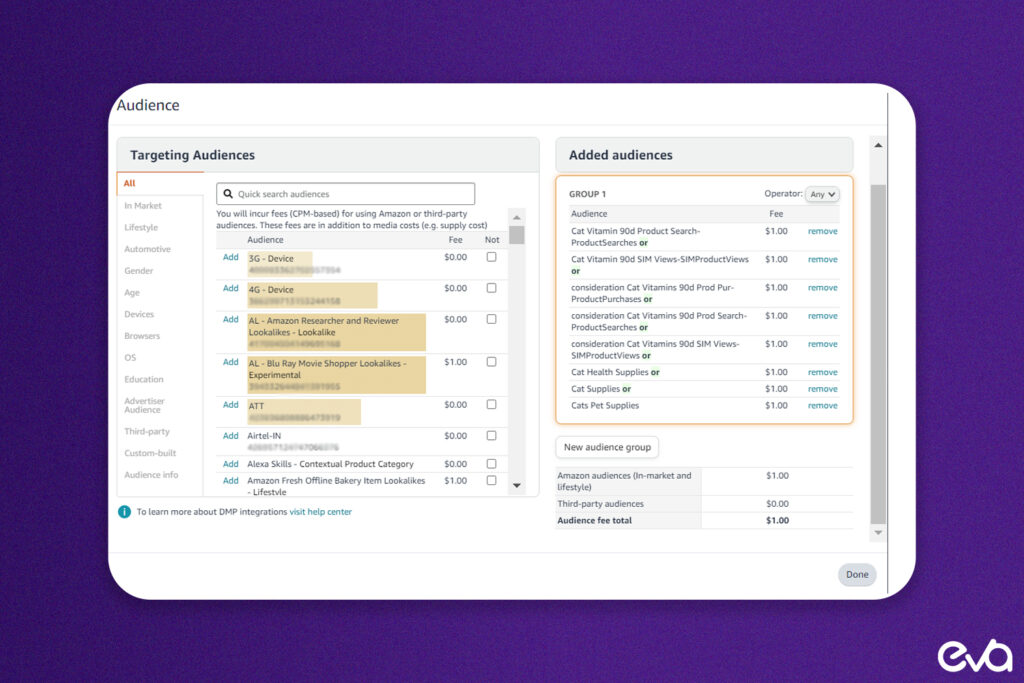
Hypothetical seed choices: A replenishment brand could test repeat purchasers, while a durable-goods brand could test purchasers of a starter kit. Requiring repeat purchases for an item normally bought once could discard relevant customers. A higher order value can also reflect a discounted bundle rather than stronger contribution, so compare the product mix with the commercial objective.
- Document the included ASINs and the reason they belong together.
- Choose a time range that represents normal availability, not only a promotion or stockout.
- Check that the needed events and fields are present in the account’s permitted datasets.
- Use advertiser-supplied data only through supported integrations with the required permissions.
- Keep the seed definition separate from the exclusions applied to the resulting campaign.
Do not assume that subscription status, a spending percentile, or being new to the brand proves lifetime profitability. Use those characteristics as testable selection criteria where they are available. Validate subsequent purchased-product mix and repeat behavior before attaching a lifetime-value claim.
Build and validate the AMC audience
Amazon introduced its no-code high-value audiences solution on May 29, 2024. The announcement describes analysis by past spending, with parameters including time frame, ASINs, and new-to-brand status. It supports creating lookalike or rule-based audiences from the selected group. It does not mean every custom sequence can be expressed through the same point-and-click controls.
- Confirm access: check the AMC account, available datasets, and intended advertising destination.
- Define the cohort: use supported no-code controls or a validated query for the required behavior.
- Validate creation: review the applicable requirements in Amazon’s audience-query guidance, including size and query constraints.
- Check readiness: confirm that audience generation succeeded and that the audience is available in the intended DSP or sponsored ads account.
- Record the configuration: retain the definition, date range, exclusions, selected reach setting, and campaign objective for comparison.
A submitted audience is not automatically ready for activation. Use its status and account diagnostics instead of planning around an unsupported fixed delivery time. If a cohort is too small, reconsider the hypothesis before expanding it; adding unrelated purchasers may meet a technical requirement while changing the meaning of the test.
Compare reach settings without assuming a ROAS hierarchy
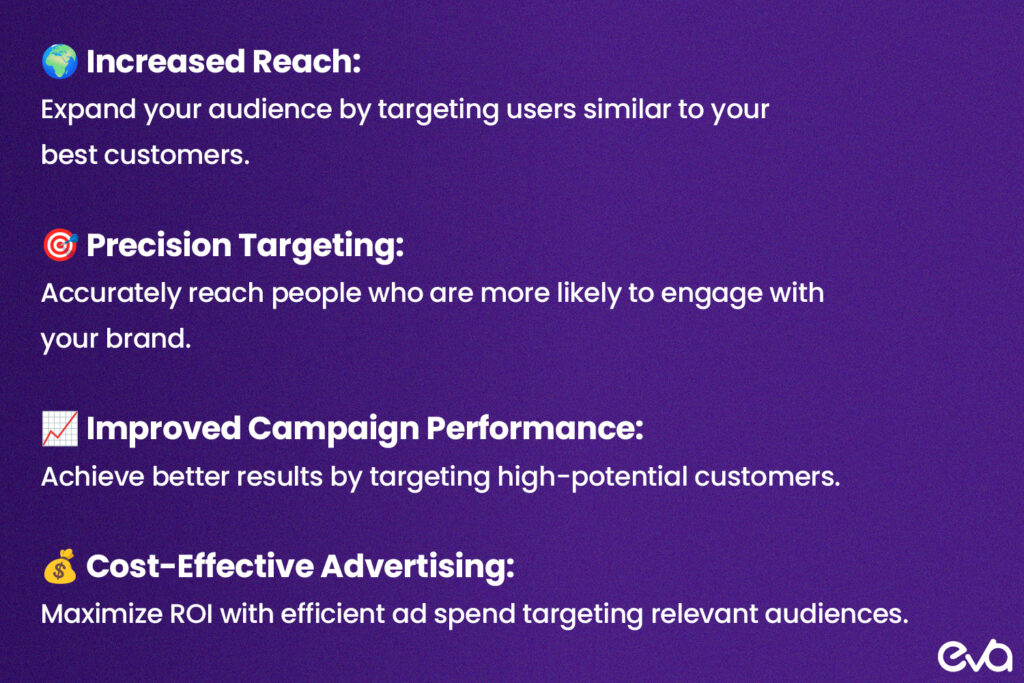
Use the similarity or reach settings actually offered in the current workflow. Do not infer a guaranteed conversion rate from a setting’s label. Greater modeled similarity and a smaller audience are not the same thing as greater incremental profit.
When comparing a narrower and a broader audience, determine whether their memberships overlap. For a non-overlapping test, exclude the narrower cohort from the broader test cell where supported, and keep a shared purchaser exclusion consistent. Excluding a broader set from a narrower subset could remove the very people the test was intended to reach. Check the resulting membership and delivery forecast before launch.
Keep creative, offer, supply choices, and reporting dates comparable. Separate campaign labels alone do not create a controlled experiment. If audience membership cannot be separated or measured adequately, describe the result as an operational comparison with limitations.
Match creative to the buying decision
Modeled prospects may be unfamiliar with the product, but lookalike membership does not prove a shopper has never seen the brand. For acquisition, explain what the product does and why it fits the intended use. Reserve reminder messaging for audiences whose observed behavior supports that message.
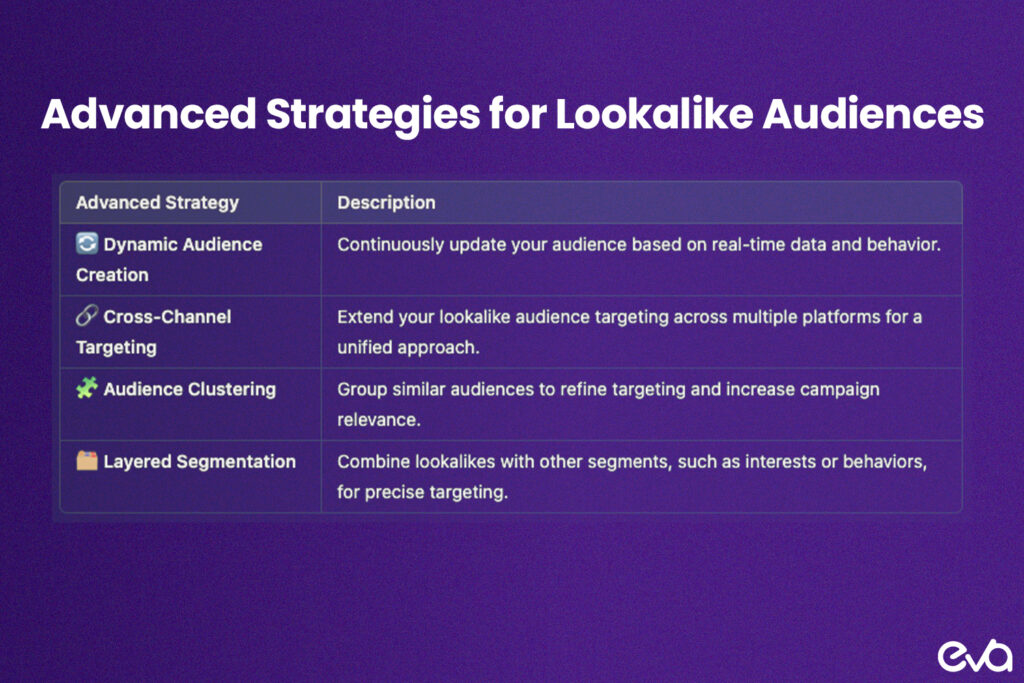
- Lead with a product benefit that can be demonstrated and substantiated.
- Use accurate compatibility, size, delivery, or warranty information when it affects the purchase.
- Use reviews, ratings, or comparisons only when the creative complies with the applicable policies and the claims can be verified.
- Match the destination to the decision: a detail page for a specific product or a Brand Store for assortment exploration.
Test a specific message against another defined message. Do not assume that a particular format, proof point, or image style wins across every category.
Measure acquisition without confusing attribution with causation
Start with the campaign objective and the amount the business can afford to spend acquiring an order. There is no universal lookalike ROAS, conversion-rate, new-to-brand-share, or detail-page-view-rate benchmark established by the sources cited here.
Amazon’s DSP new-to-brand guidance uses prior brand purchase history on Amazon to identify new-to-brand purchases. This is not a lifetime customer identity across every channel. Report the exact new-to-brand metric, attribution window, and promoted-versus-brand-halo scope being used.
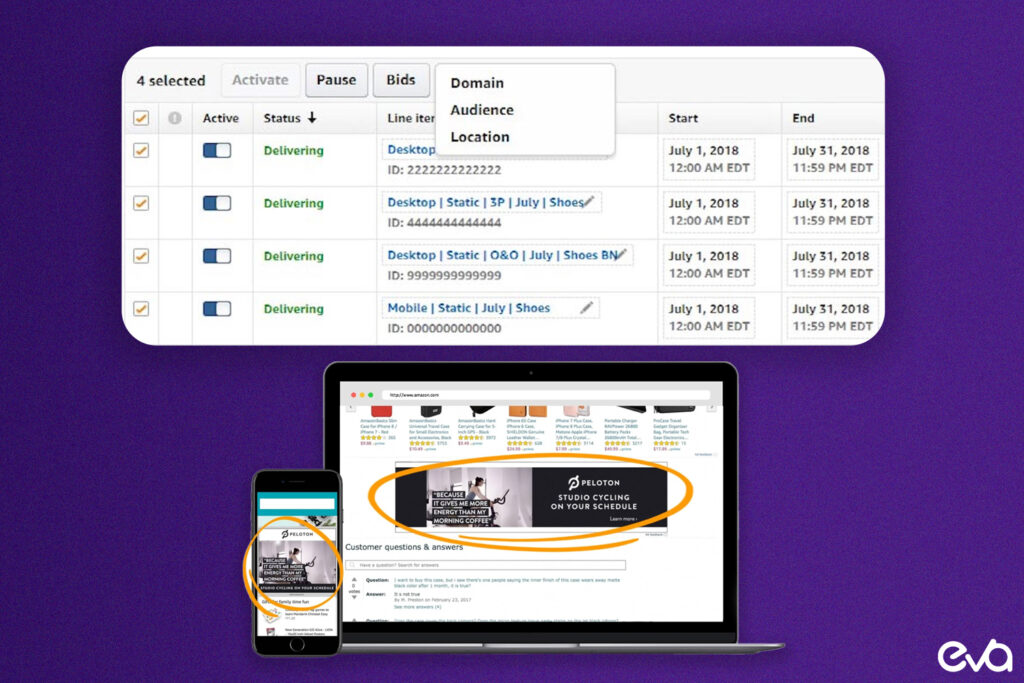
- Delivery: check reach, frequency, spend, and the eligible audience size.
- Acquisition: review new-to-brand purchases and cost per new-to-brand purchase with consistent definitions.
- Economics: reconcile the acquired product mix with contribution after media, discounts, and returns.
- Incrementality: use an appropriate controlled measurement design to assess additional purchases caused by advertising. Attributed sales or branded searches alone do not establish that effect.
Choose the observation period according to conversion lag, data volume, seasonality, and the planned comparison. There is no single learning-period promise for all lookalike campaigns. Operational failures, unavailable products, or breached spending limits warrant action even when a performance test has not matured.
Use AMC audiences beyond DSP when eligible
Amazon’s October 15, 2024 sponsored ads announcement supports rule-based and lookalike audiences for Sponsored Products and Sponsored Brands bid boosts and Sponsored Display targeting. This is separate from the earlier no-code high-value audience launch. Confirm the current product name and activation options in the account.
A sponsored ads audience bid boost changes a bid for a relevant audience; it does not automatically restrict the entire campaign to that audience. Account for other bid adjustments and the product’s economics before choosing a boost. A universal percentage increase is not justified by audience membership alone.
Evaluate each campaign’s contribution to the acquisition plan before adding channels. Do not sum separate platforms’ attributed sales and treat the result as deduplicated revenue. Similarly, a new seed made from campaign-acquired buyers is another hypothesis to test, not an automatically improved model.
When to scale a lookalike campaign
Increase spend only when the campaign is delivering to the intended audience, the purchased-product mix supports the commercial objective, and inventory can absorb additional demand. Keep a record of the evidence and the stop conditions. A higher reported ROAS caused by more existing-customer orders may not support an acquisition expansion.
For help coordinating the seed, creative, budget, and measurement plan, Get in touch for a free strategy session.
How should a brand choose an AMC lookalike seed?
Choose an AMC lookalike seed that represents the purchase behavior worth acquiring, then test whether the modeled audience delivers that behavior at an acceptable cost. Meeting an audience-generation threshold is a technical prerequisite, not evidence that the seed is commercially useful or that the resulting campaign will outperform another audience.
Amazon’s AMC lookalike announcement describes expansion from an advertiser-defined seed using cross-source signals. Its audience-query guidance lists 500 to 500,000 records for lookalikes and a 2,000-record minimum for rule-based audiences. These are distinct creation requirements, not universal performance benchmarks. Check the current workflow and generated audience status before assigning media budget.
Hypothetical decision example: a bundle seed or a single-item seed?
A kitchen-storage brand wants more buyers of its starter bundle. Its broad purchaser pool also includes customers who only bought a low-priced replacement lid. Using every purchaser would test a different acquisition hypothesis from using starter-bundle buyers. Select the relevant ASIN group and a period with representative availability, then inspect the eligible seed size. If it is too small, extending the period is a different choice from adding unrelated low-price products.
Record that choice before launch. Compare the bundle-based audience against a category-prospecting baseline with consistent creative, offer, reporting dates, and purchaser exclusions. Use separate budgets so remarketing cannot absorb the acquisition test. A lower cost per attributed purchase does not settle the decision if the acquired orders mostly contain replacement lids. Review the purchased-product mix, new-to-brand purchase cost, and contribution after returns before expanding spend. This example describes a test design, not an observed client result.
Connect seed definition to Eva’s AMC custom audience guide and separate acquisition from remarketing using the DSP audience segmentation guide. The Amazon DSP and AMC Intelligence Playbook supports the measurement plan; Amazon DSP management covers campaign execution.
Related: This guide is part of Eva’s Amazon DSP ads guide hub, which links Eva’s Amazon DSP guides in one place. For hands-on help, see Eva’s Amazon DSP management service, or book a call.
Frequently Asked Questions
Is an eligible seed guaranteed to perform?
No. Audience creation and commercial performance are separate questions. Check current technical requirements, then test the resulting audience against the product and acquisition objective.
Does every AMC audience require SQL?
No. Supported no-code solutions cover specific use cases. More customized logic may require a query or other supported tooling, and the available fields still constrain what can be built.
How soon can an audience be activated?
Activate it after successful generation and availability in the destination account. Do not treat a fixed number of hours as a service-level promise without current account-specific documentation.
Can advertiser customer data be used?
Eligible advertiser signals can contribute to AMC audiences through supported integrations. Confirm permissions, matching, available fields, and the selected workflow before planning the seed.
Should acquisition and remarketing be measured separately?
Yes. Distinct objectives, budgets, exclusions, and reporting make it easier to assess acquisition without allowing existing-customer demand to conceal its cost. They do not, by themselves, prove incrementality.