SHOPIFY SEARCH & AI OPTIMIZATION

Your Shopify Store Can Now Sell Inside ChatGPT, Gemini, and Perplexity
Most Brands Aren't Ready

AI-driven orders from Shopify stores grew 15x in 2025. AI-referred traffic converts 31% better than traditional search. Shopify’s Agentic Storefronts are already live — syndicating products to ChatGPT, Gemini, and Perplexity with native checkout. Eva optimises the SEO foundation, the AEO content structure, and the GEO brand authority that makes the whole system perform.

Layer 1 (86)
Partner Badges 03 1
Partner Badges 04
Partner Badges 05
Layer 1
Partner Badges 06
Partner Badges 07
Partner Badges 08
Partner Badges 09

THE PROBLEM

Most Shopify stores are optimised for a search engine that is losing share.

Traditional Google search volume dropped ~20% in 2025 as AI-powered interfaces absorbed demand. Gartner projects a further 25% decline as AI matures. The brands winning in 2026 are not the ones with the best keyword rankings — they are the ones whose product pages AI models can read, understand, and recommend with confidence.

THE THREE-LAYER SYSTEM

Three disciplines.
One connected visibility system.

Traditional SEO optimised for one thing: ranking on Google. In 2026, your Shopify store needs to be visible in three distinct places — traditional search results, AI-generated answer summaries, and the model-generated recommendations that increasingly shape early-stage purchase decisions. Each requires a different discipline. All three are interdependent.

THE PLATFORM ADVANTAGE

Shopify built the AI commerce infrastructure. Eva makes it perform.

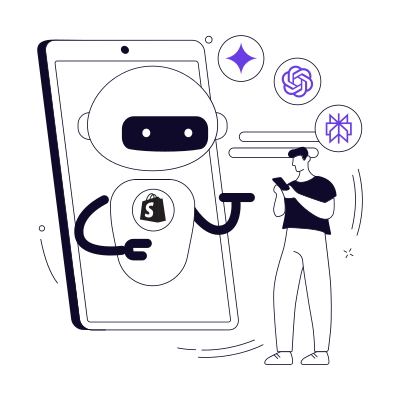
Shopify’s Agentic Storefronts — launched in late 2025 and now available for eligible merchants — automatically syndicate your product catalogue to AI platforms: ChatGPT , Perplexity , Microsoft Copilot Checkout, Google AI Mode, and Gemini. Shoppers can discover , compare, and purchase your products directly inside these AI interfaces — no redirect to your store required.

The infrastructure is live. The question is whether your products are winning the recommendations those platforms serve. That depends entirely on the quality of your product data, content structure, and brand authority — which is where Eva’s optimisation work determines the outcome.

Layer 2 (43)

What Agentic Storefronts Enable

ChatGPT, Perplexity, Gemini and Microsoft Copilot can recommend and sell your products natively — no link, no redirect. Direct purchase inside the AI conversation.

Product catalogue syndication is automatic for eligible merchants. Per-product visibility control available in the Shopify admin.

Native checkout supported on select platforms — the entire transaction stays inside the AI interface.

Layer 2 (44)

What Determines Whether You Win

Product data completeness — every dimension, material, use case, and specification structured for AI extraction.

Content citability — descriptions written in factual, declarative language AI models can confidently synthesise.

Brand authority — how widely and credibly your brand is referenced across publications, communities and reviews that AI models draw from.

WHAT EVA MANAGES

Five disciplines. One visibility system.

01.

SEO Foundation — T echnical & Keyword

Core Web Vitals, crawlability , canonical structure, site speed, and internal linking architecture — the technical foundation that feeds both traditional search and AI crawlers. Keyword strategy built by page type: collection pages targeted at category-level search intent, PDPs at product and comparison intent, blog content at educational and problem-aware queries. Every piece of technical health work benefits SEO ranking and AI discoverability simultaneously .

02.

Product Page Citability — AEO for PDPs

The most critical AEO lever for Shopify . Eva rewrites product
descriptions in factual, declarative language structured for AI
extraction — not marketing copy . Every dimension, material,
certification, use case, and compatibility detail is included explicitly. FAQ sections are added to PDPs addressing the most common shopper questions for that product. AI systems reward pages that read like a product database, not a brand pamphlet. This is the same discipline that makes Amazon listings win in Rufus — applied to Shopify’s external AI challenge.

03.

Schema Markup — Product, Review, FAQ, BreadcrumbList

Comprehensive JSON-LD schema implementation across every Shopify PDP template: Product schema with all required and recommended attributes, AggregateRating and Review schema connected to actual review data, FAQ schema on product pages and blog content, BreadcrumbList for navigation context. Schema is not a one-time setup — it requires maintenance as products, prices, and availability change. Eva monitors and updates schema across the catalogue continuously .

04.

GEO Authority Building & AI Crawler Configuration

Brand authority in trusted publications, review platforms, and
community channels (Reddit, YouTube) is the primary GEO lever that most brands have not started building. Eva coordinates editorial PR, review platform presence, and community strategy as a GEO programme — knowing that AI models weight citation frequency and source authority heavily . On the technical side, llms.txt is configured to direct AI crawlers to highest-value pages. Content is refreshed on a 30-day cycle for priority pages — AI Overviews favour URLs that are 25.7% fresher than traditional SERP results.

05.

Shopify Agentic Storefront Activation & Monitoring

Eva activates and manages Shopify’s Agentic Storefronts for eligible merchants — configuring product visibility across ChatGPT, Perplexity, Gemini, and Microsoft Copilot Checkout. Per-product visibility is managed based on margin, inventory availability, and competitive positioning. Performance is monitored across AI platforms to track which products are being recommended, with what frequency , and at what conversion rate — separate from traditional Google Analytics attribution.

THE COMMERCE EXPERTISE ADVANTAGE

The same discipline that wins
on Amazon Rufus wins in AI search

Writing product pages for AI citability is not a new discipline for Eva — it is the same intent-first, factual, structured approach that makes Amazon listings surface in Rufus recommendations. The core principle is identical: AI models reward content that reads like confident, specific product knowledge rather than marketing language.

The difference is the surface. Amazon Rufus reads your listing internally. ChatGPT and Perplexity read your Shopify store from the web. Eva applies the same optimisation framework to both — ensuring that wherever a shopper asks ‘what should I buy for [use case]?’ the answer includes your product.

Case Studies

View All Case Studies

Hear from the brands growing

Proven Results Across the Eva Growth System

Real outcomes from brands using Eva across Amazon, Shopify, and TikTok

Revenue Driven
Across Channels
$ 1 B+
Ad Spend Optimized
with Profit Focus
$ 0.3 B+
Avg. Profit Increase
in 6 Months
0 %
Reduction in
Operational Costs
0 %
Avg. Revenue Growth
in 6 Months
0 %

Based on aggregated performance across Eva-managed brands

Frequently Asked Questions

Is traditional SEO still relevant with AI search growing?

Yes — and it is the foundation GEO and AEO build on. The majority of Shopify traffic still comes from traditional Google search. Technical SEO health, keyword strategy, and content quality feed both traditional rankings and AI visibility simultaneously. A brand with poor SEO fundamentals will also perform poorly in AI search. Eva optimises all three layers because they are interdependent — improving one consistently improves the others.
Agentic Storefronts are Shopify’s native integration with AI shopping platforms — ChatGPT, Perplexity, Google AI Mode and Gemini, and Microsoft Copilot Checkout. They automatically syndicate your product catalogue to these platforms, enabling discovery and in some cases direct purchase without the shopper leaving the AI interface. They were launched in late 2025 and are available for eligible Shopify merchants. Eva manages activation, per-product visibility configuration, and ongoing performance monitoring across all connected platforms.
Product citability is the measure of how confidently an AI model can read, understand, and recommend your product page. AI answer engines are not looking for keywords — they are looking for factual, specific, structured information: exact dimensions, materials, certifications, use cases, and comparative attributes. A page that says ‘premium quality waterproof jacket’ is not citable. A page that says ‘rated IP67 waterproof, tested to 300mm rainfall per hour, made from recycled 300D ripstop nylon, designed for hiking above 2000m’ gives an AI model everything it needs to recommend your product confidently to a shopper asking a specific question. Eva rewrites product pages to meet this standard.
Traditional Google Analytics is insufficient for AI search measurement — many AI-referred sessions are attributed to ‘direct’ traffic rather than their actual source. Eva tracks AI-referred revenue and traffic as a distinct channel using UTM parameters and AI search referral monitoring. Share of voice in AI-generated answers is tracked by monitoring how frequently your brand and products appear in responses to target queries across ChatGPT, Perplexity, and Google AI Overviews. Shopify Agentic Storefront performance is monitored separately for recommendation frequency and conversion rate per platform.

AI-driven Shopify orders grew 15x in 2025.
Your products should be part of that.

Eva audits your current SEO foundation, product page citability,
schema completeness, and Agentic Storefront configuration — and
shows you exactly where AI search visibility is being lost.