Table of Contents
- Amazon Attribution: Why Cross-Channel Brands Get the Data Wrong
- How Amazon Attribution Works (And What It Misses)
- The Multi-Platform Attribution Problem
- What Platform-Siloed Attribution Costs in Practice
- What Cross-Channel Attribution Actually Requires
- The Halo Effect: Why Amazon Rank Is an Attribution Input
- Eva’s Cross-Channel View
Amazon Attribution: Why Cross-Channel Brands Get the Data Wrong
Attribution is not a reporting function. It is a capital allocation function.
The data your attribution system produces determines where you invest next — which channel gets more budget, which ad format scales, which audience to expand. Get attribution wrong and you are optimizing toward a false signal. The brands that scale efficiently are not the ones running the most ads. They are the ones with the clearest picture of what each dollar of ad spend is actually producing.
For brands running TikTok, Meta, and Amazon simultaneously, that picture is almost always wrong. Here is why — and what the difference looks like between platform-siloed attribution and a cross-channel system.
How Amazon Attribution Works (And What It Misses)
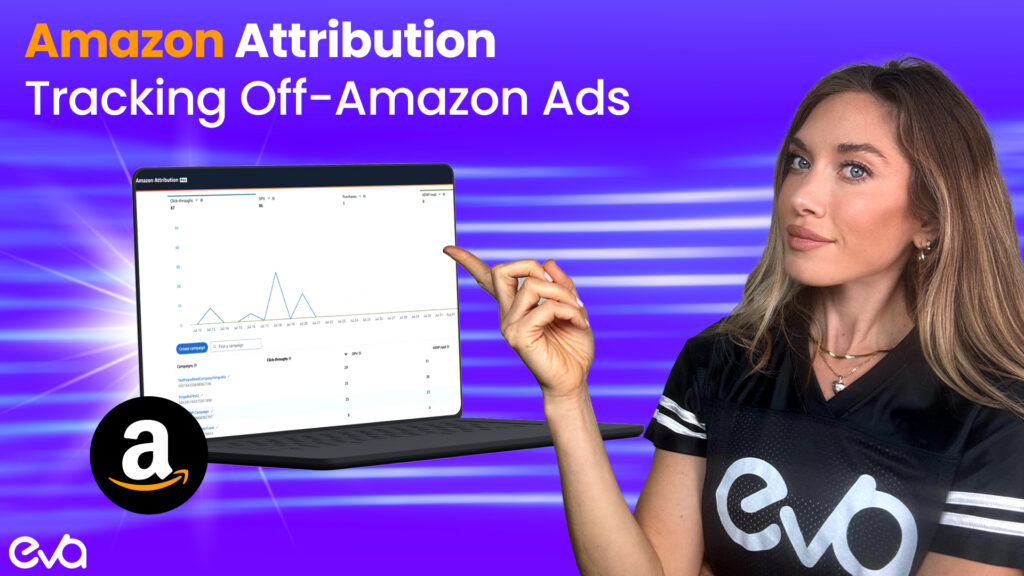
Quick answer: Amazon Attribution is Amazon's tool for tracking how off-Amazon marketing drives Amazon sales. You create tracking tags for external campaigns — a TikTok post, a Meta ad, an email — and measure how clicks from those sources convert on Amazon.
Amazon Attribution is Amazon’s tool for tracking how off-Amazon marketing drives Amazon sales. You create tracking tags for external campaigns — a TikTok post, a Meta ad, an email — and measure how clicks from those sources convert on Amazon.
It is genuinely useful. It answers a real question: is my external traffic driving Amazon sales? For brands just beginning to build off-Amazon demand generation, it is a meaningful step forward from no attribution at all.
But it has a measurement boundary that creates a systematic blind spot: it only measures the direct click-to-conversion path. A customer who sees your TikTok video, searches your brand name on Amazon three days later, and converts on an organic result does not appear in your Amazon Attribution data. The conversion is credited to organic, or to the last Sponsored Products click if there was one. The TikTok content that generated the intent gets no credit.
In categories where TikTok drives significant brand-search volume — and in 2026, that is most consumer product categories with visual appeal — this means TikTok is systematically undercredited in every brand’s attribution model. Budget decisions that rely on platform-reported ROAS will consistently underinvest in TikTok because the conversion path is longer and less direct than a click-through to an Amazon cart.
The Multi-Platform Attribution Problem
Quick answer: Layer in Meta and the problem compounds. Meta's ad platform measures conversions using its own pixel and its own attribution window. Amazon Attribution measures conversions using its own tags and its own window. TikTok Ads Manager measures using its own pixel.
Layer in Meta and the problem compounds.
Meta’s ad platform measures conversions using its own pixel and its own attribution window. Amazon Attribution measures conversions using its own tags and its own window. TikTok Ads Manager measures using its own pixel. Each platform’s reporting shows ROAS calculated from its own lens — and each lens overclaims the conversions it can see.
The result: add up the ROAS figures from your Meta dashboard, your TikTok Ads dashboard, and your Amazon Attribution tags, and the total implied revenue almost always exceeds your actual revenue. The platforms are each claiming credit for the same customer journeys from different vantage points.
A brand spending $50K per month across these three channels and relying on each platform’s own reporting will have a fundamentally inaccurate picture of where that spend is working. The usual outcome: Meta ROAS looks strong because the pixel tracks direct clicks to Shopify, TikTok ROAS looks weak because the path to conversion is less direct, and the budget allocation shifts toward Meta — which is the right answer for the metric, but potentially the wrong answer for the business.
What Platform-Siloed Attribution Costs in Practice
Quick answer: The cost of bad attribution is not visible in any single report. It shows up over time as structural underperformance in the channels that are actually driving value. Consider a brand where TikTok content is meaningfully driving Amazon brand-search volume — which is measurable independently via Amazon Brand Analytics.
The cost of bad attribution is not visible in any single report. It shows up over time as structural underperformance in the channels that are actually driving value.
Consider a brand where TikTok content is meaningfully driving Amazon brand-search volume — which is measurable independently via Amazon Brand Analytics. TikTok’s reported ROAS looks like $1.40. Meta’s reported ROAS looks like $3.20. The obvious budget decision is to cut TikTok and scale Meta.
But Amazon Brand Analytics shows that in the months where TikTok spend was higher, branded search queries were 34% higher. That branded search volume drove organic clicks that did not appear in Amazon Attribution. The actual blended impact of TikTok — direct conversions plus attributed brand search plus organic rank improvement from velocity — was running closer to $4.10 in economic value per dollar spent.
Without a system that connects these data sources, the brand cuts TikTok, Meta spend rises, CAC increases, and the Amazon organic rank that TikTok was supporting begins to soften. The revenue impact is diffuse enough that no one connects it back to the attribution error six months earlier.
What Cross-Channel Attribution Actually Requires
Quick answer: Solving this is not a tool problem — it is a data architecture problem. No single platform's native analytics will produce cross-channel attribution because each platform's incentive is to maximize its own reported contribution.
Solving this is not a tool problem — it is a data architecture problem. No single platform’s native analytics will produce cross-channel attribution because each platform’s incentive is to maximize its own reported contribution.
Cross-channel attribution requires connecting data from multiple sources into a single view that does not originate from any individual platform’s reporting:
- Amazon Brand Analytics — branded search volume over time, which correlates with off-Amazon demand generation
- Amazon Attribution tags — direct click-through measurement from specific off-Amazon campaigns
- Shopify order data — customer source and referral data for DTC conversions
- TikTok and Meta ad platform data — impression volume, frequency, and platform-reported conversion data as inputs, not as conclusions
- First-party customer data — post-purchase surveys asking how customers discovered the brand, email list growth correlated with content spikes
The goal is a blended picture where ad spend decisions are made based on an independent view of economic contribution, not on which platform’s dashboard happens to show the highest number this week.
The Halo Effect: Why Amazon Rank Is an Attribution Input
Quick answer: There is one attribution signal that most brands miss entirely: organic rank movement on Amazon as a downstream indicator of off-Amazon demand generation effectiveness. When TikTok content drives volume — even volume that does not click through via Amazon Attribution tags — that volume accelerates sales velocity on Amazon.
There is one attribution signal that most brands miss entirely: organic rank movement on Amazon as a downstream indicator of off-Amazon demand generation effectiveness.
When TikTok content drives volume — even volume that does not click through via Amazon Attribution tags — that volume accelerates sales velocity on Amazon. Amazon’s algorithm reads that velocity improvement as organic ranking signal. The ASIN moves up in search results. The higher organic position drives more discovery and more organic conversion at lower CAC.
This halo effect — off-Amazon content driving Amazon ranking improvement — is one of the highest-value outcomes a TikTok spend can produce, and it is invisible in every platform’s native attribution reporting. Measuring it requires correlating TikTok campaign periods with Amazon rank movement on target keywords, over a lag period of 2–4 weeks.
Brands that measure this halo effect consistently find that TikTok’s true contribution to Amazon profitability is significantly higher than direct attribution suggests. The economic case for TikTok investment looks completely different when ranking improvement is part of the measurement.
Eva’s Cross-Channel View
Quick answer: Eva manages Amazon, Shopify, and TikTok Shop as a single system for 9,000+ brands. The attribution picture that emerges from a connected system is structurally different from what any platform's native analytics can produce — because it includes ranking movement, blended CAC across channels, and inventory velocity as inputs alongside the standard conversion metrics.
Eva manages Amazon, Shopify, and TikTok Shop as a single system for 9,000+ brands. The attribution picture that emerges from a connected system is structurally different from what any platform’s native analytics can produce — because it includes ranking movement, blended CAC across channels, and inventory velocity as inputs alongside the standard conversion metrics.
The brands in Eva’s portfolio that have moved from platform-siloed attribution to a connected view consistently make different budget allocation decisions — and those decisions, made with accurate data rather than overclaimed platform reporting, compound over time into a meaningful competitive advantage.
Attribution is the input to every other investment decision. Getting it right is not a reporting upgrade. It is a growth architecture upgrade.
Ready to lower your ACoS and scale profitably?
Eva’s Amazon PPC management combines AI-driven bidding with hands-on strategy to maximize returns on every ad dollar. See how we’ve helped brands cut wasted spend and grow revenue.
Explore Eva’s Amazon PPC Service →