Table of Contents
- Amazon PPC Guide 2026: Quick Answer
- What Is Amazon PPC?
- Amazon PPC Ad Types in 2026
- The 2026 Amazon PPC Operating Model
- Campaign Architecture: the Foundation
- ACOS, ROAS, and TACoS: What Each Metric Tells You
- Keyword Strategy: Search Term Discipline Wins
- Bidding Strategy: Automation Needs Guardrails
- Budget Allocation: Where Spend Should Go
- Listing Quality Comes Before Scaling Spend
- When to Use DSP and AMC
- Amazon PPC Audit Checklist
- Common Amazon PPC Mistakes
- What Changed for Amazon PPC in 2026?
- How Eva Approaches Amazon PPC
- Amazon Ads Learning Hub
- Amazon PPC FAQ
Amazon PPC Guide 2026: Quick Answer
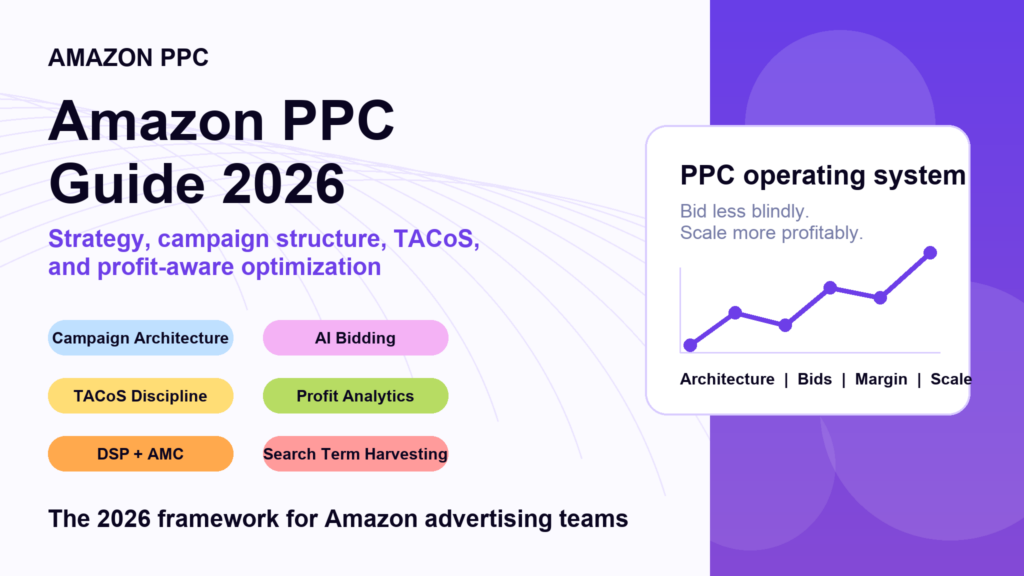
Quick answer: This Amazon PPC guide for 2026 explains how campaign structure, keyword and ASIN targeting, budget governance, search-term analysis, retail readiness, and profitability measurement work together. Advertising decisions should be evaluated beyond isolated bid or ROAS changes.
For managed execution, see Amazon PPC management services.
Related Eva guide: PPC can support query-level velocity, which matters for the Amazon badges guide framework.
Related Eva guide: For a deeper operating view on automation, pair this with the Amazon AI bidding strategies guide.
Related Eva guide: Once the PPC foundation is working, use the Amazon Brand+ advertising guide to evaluate upper-funnel expansion.
Related Eva guide: Use the Amazon advertising funnel guide to connect PPC structure to awareness, consideration, and loyalty.
Related Eva guide: For the next step beyond sponsored search structure, use our Amazon DSP vs PPC guide.
This guide explains how to build that system. It is written for brand operators, marketplace leaders, and ecommerce teams that need Amazon advertising to grow profitably, not just spend efficiently.
What Is Amazon PPC?
Amazon PPC, or pay-per-click advertising, is the sponsored advertising system inside Amazon Ads. Sellers and vendors bid to show ads across Amazon search results, product detail pages, brand placements, video placements, and display inventory. You pay when a shopper clicks the ad.
The familiar PPC metrics still matter: impressions, clicks, cost per click, click-through rate, conversion rate, ad sales, spend, ACOS, ROAS, and TACoS. But in 2026, those metrics are not enough by themselves. A campaign can show a healthy ACOS while quietly creating margin loss, stock pressure, poor keyword coverage, or dependency on paid traffic. The job is to connect ad performance to the actual economics of the account.
Amazon PPC Ad Types in 2026
| Ad type | Best use | What to watch |
|---|---|---|
| Sponsored Products | Keyword and ASIN-level demand capture for individual products. | Query quality, placement cost, conversion rate, SKU margin, and wasted spend. |
| Sponsored Brands | Brand visibility, storefront traffic, category authority, and multi-product storytelling. | Headline relevance, branded versus non-branded mix, landing page quality, and new-to-brand impact. |
| Sponsored Brands Video | High-intent search visibility with creative differentiation. | Creative fatigue, message clarity, product fit, and cost per qualified click. |
| Sponsored Display | Retargeting, competitor conquesting, audience expansion, and product detail page coverage. | Audience overlap, view-through interpretation, incrementality, and margin impact. |
| Amazon DSP | Upper-funnel and mid-funnel retail media across Amazon audiences and off-Amazon inventory. | Audience construction, frequency, attribution windows, AMC validation, and budget scale. |
A mature account does not treat these formats as isolated tactics. Sponsored Products often captures existing demand. Sponsored Brands and video shape brand consideration. Sponsored Display and DSP help with retention, category expansion, and audience strategy. The right mix depends on lifecycle stage, profit target, catalog depth, and whether the brand is trying to defend, launch, scale, or enter a new marketplace.
The 2026 Amazon PPC Operating Model
The biggest PPC mistake is trying to optimize every campaign with the same target. Launch campaigns, ranking campaigns, branded defense, competitor conquesting, retargeting, and profit harvesting have different jobs. They should not be judged with one blended ACOS target.
Use a clear operating model:
- Launch: prove search terms, collect conversion data, and support early ranking signals.
- Scale: increase profitable coverage on converting terms and ASINs.
- Defense: protect branded traffic, hero products, and high-margin catalog positions.
- Conquesting: test competitor and category demand where margin and conversion can support the cost.
- Harvesting: lower bids, reduce waste, and preserve sales volume where organic rank is already strong.
- Recovery: identify terms, products, or placements that need restructuring before budget is added.
This is where the 2026 approach differs from older PPC playbooks. Instead of asking “What ACOS should this campaign hit?” the better question is “What commercial job is this campaign supposed to perform, and what level of spend is justified by the outcome?”
Campaign Architecture: the Foundation
Good PPC architecture makes decisions easier. Poor architecture hides problems inside blended numbers. At minimum, your structure should separate brand, non-brand, competitor, category, retargeting, and product targeting. It should also separate exact match from broad discovery, isolate hero SKUs from secondary SKUs, and keep launch budgets away from mature profit campaigns.
A practical structure usually includes:
- Auto discovery campaigns for query mining, not uncontrolled spend.
- Manual exact campaigns for proven search terms with clear bid control.
- Phrase and broad campaigns for controlled exploration and new query discovery.
- Product targeting campaigns for competitor ASINs, complementary products, and defensive placements.
- Branded defense campaigns separated from non-branded growth campaigns.
- Margin-aware campaigns where bids reflect contribution margin, not only ad sales.
For a deeper operator framework, use the Amazon PPC Architecture Playbook 2026.
ACOS, ROAS, and TACoS: What Each Metric Tells You
ACOS shows ad spend as a percentage of ad-attributed sales. ROAS shows revenue per dollar of ad spend. TACoS shows ad spend as a percentage of total sales. All three are useful, but none should be used alone.
| Metric | Formula | Use it for | Risk |
|---|---|---|---|
| ACOS | Ad spend / ad sales | Campaign efficiency and bid control. | Can make growth campaigns look bad and branded campaigns look artificially strong. |
| ROAS | Ad sales / ad spend | Quick comparison of return across campaigns. | Can ignore margin, incrementality, and organic lift. |
| TACoS | Ad spend / total sales | Account-level dependence on paid traffic. | Can hide SKU-level waste or ranking problems. |
| Contribution margin after ads | Revenue minus COGS, fees, shipping, promotions, and ad spend | Profit-aware scaling decisions. | Requires clean cost and fee data. |
In 2026, serious brands should treat TACoS and contribution margin as operating metrics. If ACOS improves while total profit declines, the account is not improving. If TACoS rises while organic rank is flat, spend may be replacing demand rather than creating it. If TACoS falls while revenue grows, the account may be gaining real operating leverage.
For the profit side of the model, connect this guide with the Amazon Profitability Playbook 2026.
Keyword Strategy: Search Term Discipline Wins
Amazon PPC keyword strategy should be built around search terms, not just keywords. A keyword is what you bid on. A search term is what the shopper actually typed or selected. The search term report tells you where spend is working, where it is leaking, and which customer language should be reflected in your listing.
A strong workflow looks like this:
- Use auto, broad, and phrase campaigns to discover search terms.
- Promote converting terms into exact match campaigns.
- Add negatives where clicks do not convert or where intent is wrong.
- Separate branded, non-branded, competitor, and category terms.
- Review rank movement and listing relevance before increasing bids.
- Feed high-value search language back into titles, bullets, A+ content, and creative.
The goal is not to collect a large keyword list. The goal is to create a clean decision system for demand: which terms deserve budget, which terms need better listing relevance, and which terms should be excluded.
Bidding Strategy: Automation Needs Guardrails
AI bidding and automation can help, but they are not a substitute for strategy. Amazon’s bidding controls are powerful when the campaign has a clear job, clean search term history, enough conversion volume, and a realistic target. They are dangerous when used to compensate for poor structure, weak listings, or unclear margin thresholds.
Use these bidding principles:
- Bid higher only where the search term, SKU margin, and conversion rate justify it.
- Separate placement adjustments by campaign purpose.
- Do not let branded campaigns mask non-branded waste.
- Reduce bids before pausing terms that may still support organic rank or brand defense.
- Use dayparting only when the account has enough hourly performance data to support it.
- Review bids against inventory status, pricing changes, promotions, and Buy Box stability.
A bid is not just a media decision. It is a profit decision. That is why PPC management should connect to pricing, inventory, reimbursement, listing quality, and account health.
Budget Allocation: Where Spend Should Go
Budget allocation should follow the commercial role of each campaign. A brand trying to launch a new hero SKU will spend differently from a brand trying to protect margin on a mature catalog.
| Business goal | Budget priority | Primary metric |
|---|---|---|
| New product launch | Discovery, exact winners, Sponsored Brands Video, ranking support. | Search term quality, CVR, rank movement, early TACoS. |
| Profit recovery | Waste reduction, negative keywords, bid compression, SKU-level margin review. | Contribution margin after ads. |
| Market share growth | Non-branded exact, category terms, competitor ASINs, Sponsored Brands. | Total sales, share movement, TACoS trend. |
| Brand defense | Branded search, top ASIN protection, defensive product targeting. | Branded impression share and low-cost conversion capture. |
| Retention and cross-sell | Sponsored Display, DSP, remarketing audiences. | Repeat purchase, new-to-brand context, incrementality. |
Listing Quality Comes Before Scaling Spend
PPC cannot permanently fix a weak listing. If the title, image stack, price, reviews, delivery promise, A+ content, or variation structure is not competitive, higher bids usually create higher waste. Before scaling PPC, review the listing like a media buyer and a shopper:
- Does the main image win attention against competitors?
- Does the title match the search intent you are bidding on?
- Are reviews, rating, coupon, delivery date, and price competitive?
- Does the product detail page answer the objections behind the search?
- Does A+ content support the same positioning used in Sponsored Brands and video?
- Is the product in stock with a stable Buy Box?
If these are weak, fix the retail readiness first. Otherwise PPC becomes the most expensive way to discover that the product page cannot convert.
When to Use DSP and AMC
Sponsored ads are not the full Amazon media system. As spend grows, brands often need Amazon DSP and Amazon Marketing Cloud to understand audiences, incrementality, and full-funnel behavior. DSP can be useful when the brand has enough budget and catalog depth to justify audience strategy beyond search. AMC helps connect signals that are difficult to see inside basic campaign reporting.
Use DSP and AMC when you need to answer questions like:
- Which audiences are exposed but not converting?
- Are DSP campaigns creating incremental demand or just retargeting existing buyers?
- How do Sponsored Ads and DSP interact across the customer journey?
- Which campaigns support new-to-brand customers, repeat purchases, or category expansion?
- Where is frequency helping, and where is it becoming waste?
For that deeper layer, use the Amazon DSP and AMC Intelligence Playbook 2026.
Amazon PPC Audit Checklist
Use this checklist before increasing budget:
- Campaigns are separated by purpose: launch, scale, defense, conquesting, and harvesting.
- Branded and non-branded performance are not blended together.
- Auto campaigns are used for discovery, not uncontrolled budget consumption.
- Converting search terms are promoted into exact match.
- Negative keywords are reviewed weekly.
- Placement modifiers reflect campaign purpose and margin reality.
- ACOS, TACoS, and contribution margin are reviewed together.
- Low-margin SKUs do not receive the same bid logic as high-margin SKUs.
- Listings are retail-ready before spend is scaled.
- Inventory, pricing, Buy Box, and promotions are checked before bid changes.
- Sponsored Brands and video campaigns have clear landing page logic.
- DSP and retargeting are measured with audience and incrementality discipline.
Common Amazon PPC Mistakes
- Optimizing only for ACOS: ACOS can improve while profit and total sales decline.
- Mixing campaign purposes: Launch, defense, and profit campaigns should not share the same structure.
- Ignoring SKU economics: A bid that works for one SKU can lose money on another.
- Scaling before retail readiness: Weak images, reviews, price, and detail pages waste media dollars.
- Letting automation run without rules: Automation works best after the account logic is clean.
- Not connecting PPC to inventory: Ranking gains disappear when hero SKUs go out of stock.
- Failing to harvest: Mature terms should not always keep launch-level bids.
What Changed for Amazon PPC in 2026?
The direction is clear: more automation, more audience data, more retail media complexity, and less room for isolated campaign management. The brands that keep PPC separate from marketplace operations will struggle to explain why spend rises without durable growth.
In 2026, the strongest PPC teams are building systems around:
- Profit-aware bidding instead of only ACOS rules.
- Campaign architecture that maps to business objectives.
- AI-assisted optimization with human commercial guardrails.
- Search term harvesting connected to listing optimization.
- DSP and AMC for audience and incrementality insight.
- Integrated Amazon, Walmart, Shopify, and TikTok Shop growth planning.
How Eva Approaches Amazon PPC
Eva treats Amazon PPC as one part of a commerce growth system. Advertising decisions are connected to profit analytics, pricing, search visibility, listing quality, inventory status, and marketplace operations. That matters because the problem behind PPC underperformance is often not the bid alone. It may be a margin issue, a catalog issue, a retail-readiness issue, a ranking issue, or a channel strategy issue.
If your team needs hands-on execution, see Amazon PPC Management Services That Scale Profit. If you want the broader operating model, start with the Amazon PPC Architecture Playbook 2026.
Related Eva guide: Campaign structure becomes more effective when repeatable execution is automated safely. Review Eva's AI-powered PPC operating framework for the control model.
Related Eva guide: Brands that need help executing this framework can compare operating models with Eva's Amazon PPC expert vs agency scorecard before selecting a partner.
Amazon Ads Learning Hub
Use these guides to move from campaign setup to a coordinated Amazon advertising system. Each resource covers a different role in search capture, brand demand, audience growth, measurement, or managed execution.
- Amazon Sponsored Products
- Amazon Sponsored Brands
- Amazon Sponsored Display
- Amazon DSP
- Amazon Marketing Cloud
- Amazon PPC Management
Category-specific economics and claims controls matter in health and wellness. Eva’s Amazon PPC for supplements guide connects bids with contribution, inventory, listings, and search intent.
Amazon PPC FAQ
What Is a Good ACOS for Amazon PPC?
A good ACOS depends on margin, product lifecycle stage, and campaign purpose. A launch campaign may tolerate higher ACOS if it supports ranking and data collection. A mature profit campaign should be judged against contribution margin and TACoS, not ACOS alone.
Is TACoS More Important Than ACOS?
TACoS is often more useful for account-level health because it shows paid media dependence across total sales. ACOS is still useful for campaign-level control. The best operators use both, alongside contribution margin after ads.
How Often Should Amazon PPC Campaigns Be Optimized?
Search terms, wasted spend, and budget pacing should be reviewed weekly. Larger structural changes should follow enough data to avoid overreacting. High-spend accounts may need daily pacing checks, especially during launches, promotional periods, or inventory constraints.
Should I Use Automatic Campaigns?
Yes, but with a clear role. Automatic campaigns are useful for discovery and query mining. They should not become unmanaged catch-all campaigns. Winning search terms should be promoted into manual campaigns with better bid and budget control.
When Should a Brand Use Amazon DSP?
Amazon DSP makes sense when the brand has enough budget, catalog depth, and measurement discipline to move beyond search capture. It is most useful for audience strategy, retargeting, upper-funnel growth, and cross-channel retail media analysis.
If you want campaign execution managed by senior operators, Eva’s Amazon PPC agency guide explains what PPC management services should include beyond ACOS reporting.
Related Eva guide: Find out how an Amazon FBA agency manages logistics alongside paid media: Amazon FBA Agency | Eva.
Related Eva guide: Understand how marketplace management connects to your advertising strategy: Amazon Marketplace Management Beyond PPC.
Once PPC structure is healthy, AMC can help answer bigger questions about path to purchase, audiences, and frequency. See our Amazon Marketing Cloud guide.
Once Sponsored Ads are structured correctly, Performance+ can support broader full-funnel growth. Read our Amazon Performance+ guide.
Related Eva guide: Add brand and consideration campaigns with the Amazon Sponsored Brands guide while keeping product economics in view.
The Amazon PPC and DSP benchmark framework shows how campaign roles change the right ACOS, TACoS, and contribution guardrails.