Table of Contents
- Sponsored TV Is Now Part of Amazon Streaming TV
- Why TV Is Back on the Brand Agenda — and Why Amazon Is at the Center of It
- What Are Amazon Sponsored TV Ads?
- Where Your Ads Actually Show Up
- Ad Formats: What You Can Run
- Targeting: What Makes Amazon’s CTV Different
- Costs and Budgets: What to Actually Expect
- Creative Requirements and Production Tips
- How to Measure CTV Campaign Performance
- Where Sponsored TV Fits in Your Full Advertising Funnel
- What’s New in Amazon CTV Advertising for 2026
- Frequently Asked Questions
Sponsored TV Is Now Part of Amazon Streaming TV
Amazon Ads now presents Sponsored TV within its broader Streaming TV offering. Existing Sponsored TV campaigns remain accessible, while new campaigns are created through the Streaming TV option in Campaign Manager. This naming change matters because brands should plan the channel as full-funnel video, not as an isolated awareness experiment.
- Objective: define the audience behavior or business outcome the campaign must influence.
- Readiness: confirm product availability, detail-page conversion, pricing, and retail signals before adding reach.
- Creative: build for television attention while preserving a clear product and brand memory.
- Measurement: review reach, frequency, branded search, detail-page activity, new-to-brand behavior, and contribution impact together.
Confirm the latest product naming in the official Amazon Ads Sponsored TV update. For managed execution, compare Amazon DSP Management and use the Full-Funnel Commerce Playbook.
Why TV Is Back on the Brand Agenda — and Why Amazon Is at the Center of It
For a long time, TV advertising felt like something that only the biggest brands could afford. You needed a production budget, a media buy, and a way to reach a broad enough audience to justify the spend. Then came streaming, and the whole equation changed.
Today, the living room screen is more accessible than ever for brands of almost any size. And Amazon sits right at the center of that shift. Through Sponsored TV ads and Prime Video placements, brands can now run video ads on the biggest screen in the home, targeted to exactly the right audience, with Amazon’s purchase data doing the heavy lifting on who sees what.
I’ve been watching this space closely since Amazon started seriously investing in its streaming ad business, and the pace of development in 2026 has been significant. This article walks through exactly how it all works — the ad formats, the targeting, the costs, the creative requirements, and what brands are actually seeing in terms of results.
Prime Video now reaches over 315 million global ad-supported viewers — making it one of the three largest CTV ad platforms globally alongside YouTube and Disney.
What Are Amazon Sponsored TV Ads?
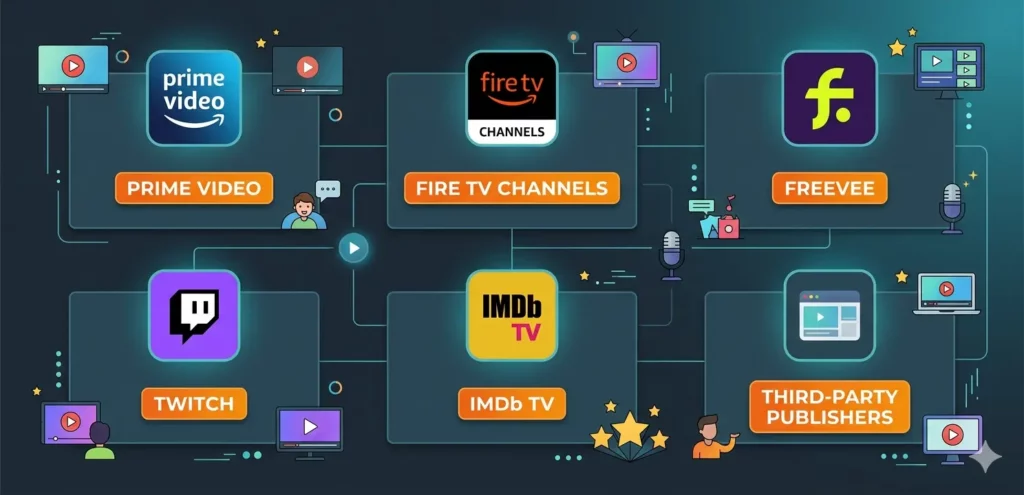
Amazon Sponsored TV is a self-serve streaming ad format that lets brands run non-skippable video ads across Amazon’s streaming inventory — including Prime Video, Freevee, Fire TV Channels, Twitch, and third-party publishers connected through Amazon’s network.
The key word here is self-serve. Unlike traditional TV buying or even Amazon’s managed DSP service, Sponsored TV has no minimum spend requirement. That makes it genuinely accessible to brands that would never have considered streaming TV advertising a few years ago.
It sits alongside Streaming TV ads via Amazon DSP — the more advanced, programmatic route that requires larger budgets and gives you more targeting and creative control. Think of Sponsored TV as the entry point: simpler setup, no minimum, and a streamlined workflow. DSP Streaming TV is the enterprise version with higher control and scale.
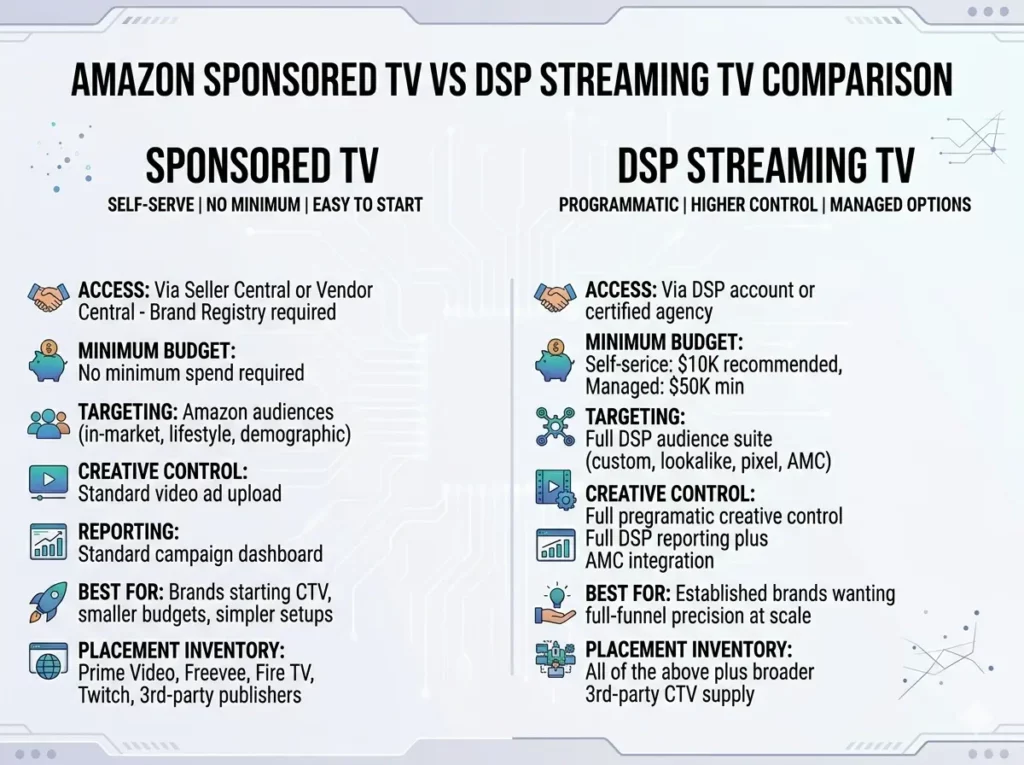
| Feature | Sponsored TV (Self-Serve) | Streaming TV via Amazon DSP |
| Access | Via Seller Central or Vendor Central — Brand Registry required | Via DSP account or certified agency |
| Minimum budget | No minimum spend required | Self-service: $10K recommended. Managed: $50K minimum |
| Targeting | Amazon audiences including in-market, lifestyle, and demographic | Full DSP audience suite — custom, lookalike, pixel, AMC segments |
| Creative control | Standard video ad upload | Full programmatic creative control |
| Reporting | Standard campaign dashboard | Full DSP reporting plus AMC integration |
| Best for | Brands starting with CTV, smaller budgets, simpler setups | Established brands wanting full-funnel precision at scale |
| Placement inventory | Prime Video, Freevee, Fire TV, Twitch, third-party publishers | All of the above plus broader third-party CTV supply |
Where Your Ads Actually Show Up
One of the things brands often get wrong about Amazon’s CTV offering is assuming it’s just Prime Video. The inventory is actually much broader than that. Here’s what’s covered.
Prime Video
This is the premium placement — pre-roll and mid-roll ads that appear during movies, TV series, live sports, and Amazon Originals. Ads here are non-skippable, run in a high-attention viewing environment, and sit alongside professionally produced content that viewers actively chose to watch. Since Amazon introduced ads to Prime Video in January 2024, the ad-supported tier has grown to reach the vast majority of Prime subscribers globally.
One of the most compelling updates from NewFronts 2026 (April 2026) is Amazon’s announcement of interactive video ad capabilities on Samsung TV Plus — launching in July 2026. This means brands will be able to show interactive calls-to-action directly on Samsung TV screens, letting viewers respond without leaving their content. That kind of shoppable TV experience was science fiction five years ago. (Source: Amazon Ads NewFronts 2026)
Freevee and Fire TV Channels
Amazon Freevee is the free, ad-supported streaming service within the Amazon ecosystem. Fire TV Channels are the free channels available on Fire TV devices. Both have growing viewership and tend to attract audiences who are engaged with free content — a slightly different demographic profile than paid Prime subscribers, but still backed by Amazon’s full data stack for targeting.
Twitch
Twitch is Amazon’s live streaming platform, primarily gaming-focused but with significant growth in food, music, fitness, and lifestyle content. Twitch audiences skew younger and tend to be highly engaged during streams. For brands in categories that overlap with that audience, Twitch placements can deliver strong attention metrics in ways that pre-recorded content can’t.
Third-Party Publishers via Amazon Publisher Direct
Beyond Amazon’s owned properties, Sponsored TV and DSP Streaming TV can also reach audiences on third-party streaming services and publishers connected through Amazon Publisher Direct. This extends reach significantly beyond the Amazon ecosystem.
At NewFronts 2026, Amazon announced a new Tubi Priority Access offering through Amazon DSP — giving advertisers preferred positioning on Tubi’s inventory, with Amazon able to match 85% of Tubi’s audience to Amazon shopping data. That match rate is described as one of the highest of any publisher in Amazon’s third-party CTV supply.
Ad Formats: What You Can Run
Amazon’s streaming ad inventory supports several formats, each suited to different brand goals and production budgets.
| Format | Where It Appears | Length | Skippable? | Best For |
| Pre-roll video | Before content starts on Prime Video, Freevee, Twitch | 15 or 30 seconds | No | Brand awareness, new product launches |
| Mid-roll video | During content breaks on Prime Video and Freevee | 15 or 30 seconds | No | Consideration campaigns during active viewing sessions |
| Interactive video ads | Prime Video — viewers get on-screen CTA (send to phone, sign up) | 15 or 30 seconds | No | Brands with local or action-focused goals, lead gen |
| Pause ads | Appears when viewer pauses Prime Video content | Static display format | N/A — viewer initiated | Brand recall, lower-funnel reminders |
| Branded slates | Opening or closing brand cards around content | Short static format | N/A | Brand visibility with lighter creative budget |
| Twitch video ads | Pre-roll or mid-stream on Twitch live content | 15 or 30 seconds | Some placements yes | Reaching gaming, lifestyle, and younger audiences |
Pause ads are worth calling out specifically because of a data point from BrightLine cited by eMarketer: pause ads deliver a 34% lift in unaided brand recall — higher than most standard display placements. They appear at a moment when the viewer has self-selected to stop and take a breath, making them more receptive to a brand message than during active content viewing.
Targeting: What Makes Amazon’s CTV Different
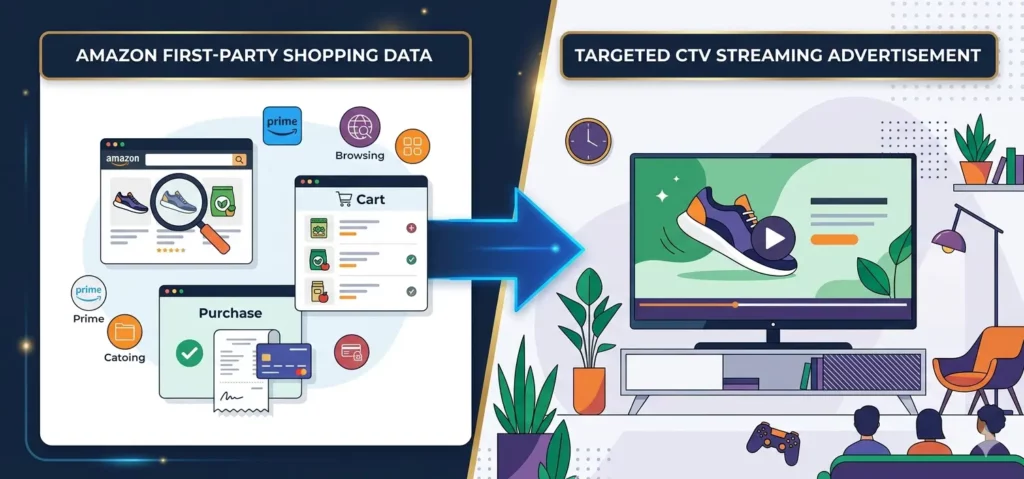
Most streaming TV platforms target based on content type, demographics, or third-party data segments. Amazon’s CTV targeting is different because it’s backed by first-party shopping behavior — and that difference is meaningful for brands that sell products.
When you run a Sponsored TV campaign, you can target audiences based on what they’ve actually bought, browsed, and searched for on Amazon. That means a beauty brand can run Prime Video ads specifically to households who have purchased skincare products in the past 90 days. A pet food brand can reach Prime Video viewers who are repeat buyers in the pet supplies category. That level of purchase-data targeting is not available anywhere else in streaming TV.
Available targeting options for Sponsored TV
- In-market audiences: People actively browsing your product category on Amazon in the past 30 days
- Lifestyle audiences: Long-term behavioral segments like fitness enthusiasts, home improvement shoppers, or health-conscious buyers
- Demographic targeting: Age, household income, gender, geographic location
- Life event targeting: New parents, recent movers, newly engaged, recent graduates
- Interest-based: Audiences classified by content interests drawn from Prime Video viewing behavior
- ASIN retargeting (via DSP): Reach shoppers who viewed your specific products on Amazon — powerful for reconnecting with warm prospects via the TV screen
The ASIN retargeting option is only available through the DSP route (not self-serve Sponsored TV), but it’s one of the most compelling use cases for brands that are already running DSP retargeting display campaigns. Adding a CTV touchpoint to a shopper who viewed your product page creates a two-screen presence that significantly strengthens recall and conversion likelihood.
Streaming TV campaigns added to existing Prime Video campaigns drove a 102% increase in branded search on Amazon — showing how CTV awareness directly fuels downstream search intent and organic discovery.
Costs and Budgets: What to Actually Expect
This is one of the most common questions brands ask before running their first CTV campaign, and the honest answer is that it varies more than most guides admit. Here’s a realistic breakdown.
| Route | Minimum Budget | Typical CPM Range | Campaign Length Recommendation |
| Sponsored TV (self-serve) | No minimum — practical minimum ~$5K for meaningful data | $15 to $30+ CPM depending on targeting precision and placement | Minimum 4 weeks to build frequency and measure recall |
| Streaming TV via DSP (self-serve) | $10,000 recommended minimum | $20 to $40+ CPM for premium placements | 6-8 weeks minimum for brand lift measurement |
| Streaming TV via DSP (managed service) | $50,000 minimum | $25 to $50+ CPM — includes Amazon team support | Quarterly campaigns with flight-based planning |
A few things to keep in mind about those numbers. CPM (cost per thousand impressions) is the pricing model for CTV — you pay per view, not per click. Streaming TV CPMs are higher than standard display because the inventory is premium and the ads are non-skippable. The trade-off is a much higher completion rate: viewers see your full ad, not a partial impression.
U.S. CTV ad spend reached $32.6 billion in 2025, growing at 15-16% year over year. As more advertisers enter the channel, inventory competition is increasing — which puts upward pressure on CPMs in popular categories and prime-time slots. Booking earlier in the year and using audience targeting precisely (rather than broad demographic buys) tends to produce better CPM efficiency.
Budget tip for smaller brands
If you’re testing Sponsored TV for the first time with a limited budget, start with a single tightly targeted audience segment rather than broad demographic reach. A $10K campaign concentrated on ‘in-market shoppers for your specific category’ will tell you much more than the same budget spread across all streaming inventory types.
Creative Requirements and Production Tips
The creative bar for CTV advertising is higher than display ads. Your video appears on a large screen, in a high-attention environment, next to professionally produced content. A product image with text overlay is not going to cut it.
The good news is that Amazon offers video creative production and editing services if you don’t have existing assets. The better news is that strong CTV creative doesn’t require a Hollywood budget — it requires clarity, a clear brand identity, and a single compelling message.
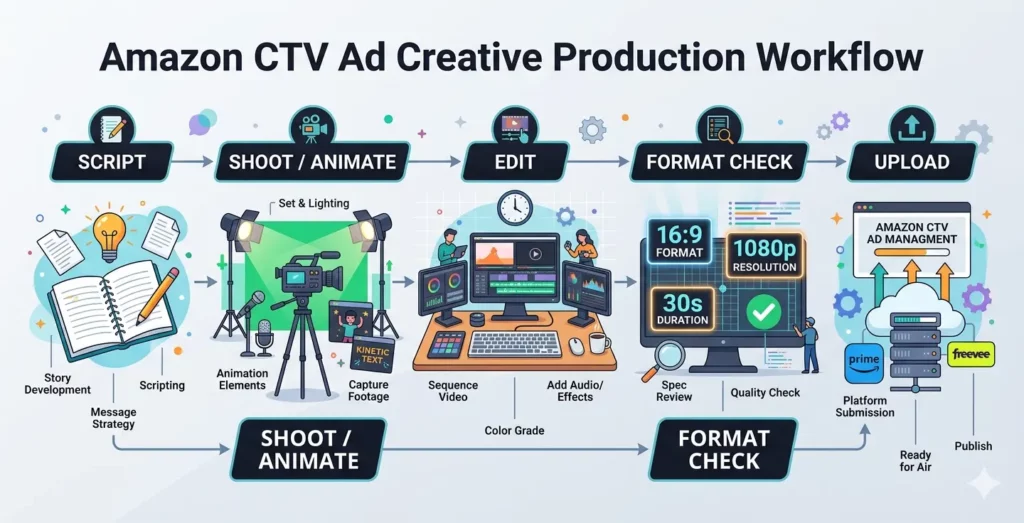
Technical specifications for Sponsored TV
- Video format: MP4 or MOV
- Resolution: 1920x1080px (1080p) recommended. 1280×720 minimum
- Aspect ratio: 16:9 (horizontal, full-screen TV format)
- Duration: 15 or 30 seconds. 30-second spots are standard for Prime Video; 15-second works better for Twitch and higher-frequency placements
- File size: 500MB maximum
- Audio: Stereo, 48kHz. Ads must include audio — silent CTV ads are not effective in this environment
- End card: Product detail page or Amazon Store URL as the landing destination
What makes CTV creative actually work
Brands that perform well on CTV almost always follow a similar pattern in how they structure their creative. It’s not complicated, but it requires discipline.
- Lead with the brand in the first 3 seconds. Viewers cannot skip these ads, but their attention still wanders. The brand and product should be unmistakably clear from the opening frame — not revealed at the end like a twist.
- Tell one story, not five. The temptation to pack a 30-second spot with multiple product features, testimonials, and offers is understandable but counterproductive. Pick one message, tell it well.
- Include a clear CTA in the final 5 seconds. ‘Find it on Amazon’, ‘Shop the collection’, ‘Available now on Amazon’ — give the viewer something to do even if they can’t click the TV screen directly.
- Design for sound on. Unlike social video where many viewers watch with audio off, CTV is almost always a sound-on environment. Write a script, use voiceover, and treat the audio as a core creative element.
- Match the visual quality of the content around it. Ads that feel amateurish next to a Prime Original series create a jarring experience. It doesn’t mean expensive — it means polished. Good lighting, clean editing, and professional audio go a long way.
Creative tip for Amazon brands
End your CTV spot with a clean product image on a white or dark background with your Amazon brand name and star rating clearly visible. Many viewers who see a CTV ad will search for the product directly on Amazon — make sure they know exactly what to search for.
How to Measure CTV Campaign Performance
Measuring CTV is different from measuring bottom-funnel campaigns, and brands that apply search ad logic to streaming TV results will almost always be disappointed. CTV operates at the top of the funnel — it builds awareness and intent, which then shows up in downstream metrics.
| Metric | What It Measures | What’s a Healthy Benchmark |
| Video Completion Rate (VCR) | Percentage of viewers who watch your ad to the end | 85-95% for non-skippable placements is typical |
| Branded Search Lift | Increase in Amazon searches for your brand name after campaign exposure | Measureable via AMC after 30 days of spend |
| New-to-Brand (NTB) Rate | Share of purchases from customers new to your brand in the past year | 50%+ for awareness-focused CTV campaigns |
| Detail Page View Rate (DPVR) | How often ad-exposed viewers visit your product listing | Baseline varies by category — track trend over time |
| Cost Per Completed View (CPCV) | Budget spent per ad viewed to completion | Varies by placement — compare across inventory types |
| Brand Lift Score | Survey-based measure of recall, favorability, purchase intent post-exposure | Available via Amazon Brand Lift studies for DSP campaigns |
For brands using Amazon DSP (not just self-serve Sponsored TV), Amazon Marketing Cloud (AMC) is the right tool for full measurement. AMC lets you run custom queries that show how CTV exposure influences downstream Sponsored Products clicks, detail page views, and purchases — the kind of cross-channel attribution that standard campaign dashboards can’t provide.
CTV + Sponsored Products campaigns measured together via AMC show meaningfully higher incremental sales than either channel in isolation — because the TV touchpoint builds the intent that search then captures.
Source: Amazon Ads — 5 Top Marketing Trends for 2026, April 2026
Where Sponsored TV Fits in Your Full Advertising Funnel
CTV advertising almost always works best as part of a layered strategy, not as a standalone channel. Here’s how it fits alongside the other Amazon ad types most brands are already running.
| Funnel Stage | Ad Type | CTV’s Role |
| Awareness | Sponsored TV, Brand+, Prime Video ads | Primary — CTV builds the brand impression that everything downstream depends on |
| Consideration | DSP display, Sponsored Brands, ASIN retargeting | CTV-exposed audiences are warmer leads for mid-funnel display campaigns |
| Conversion | Sponsored Products, cart abandoner retargeting, Performance+ | CTV rarely drives direct conversion — but shoppers who saw it convert at higher rates when they encounter lower-funnel ads |
| Measurement | AMC, Brand Lift studies | AMC shows how CTV exposure influenced search, DPVs, and purchases across the funnel |
The single most effective playbook we’ve seen with CTV and Amazon ads is this: run Sponsored TV or Prime Video ads to build awareness, then retarget the households that were exposed to the CTV ad with DSP display campaigns. The person who saw your 30-second video is far more likely to click a display retargeting ad than someone who has never encountered your brand.
Amazon’s own research supports this. Shoppers exposed to both video and display ad formats converted at 8 times the rate of those who saw only one format. That’s not an incremental improvement — it’s a fundamental difference in campaign effectiveness.
(Source: Amazon Ads Full-Funnel Guide, 2024)
What’s New in Amazon CTV Advertising for 2026
This space is moving faster than almost any other area of Amazon advertising agency. Here are the most significant developments as of mid-2026.
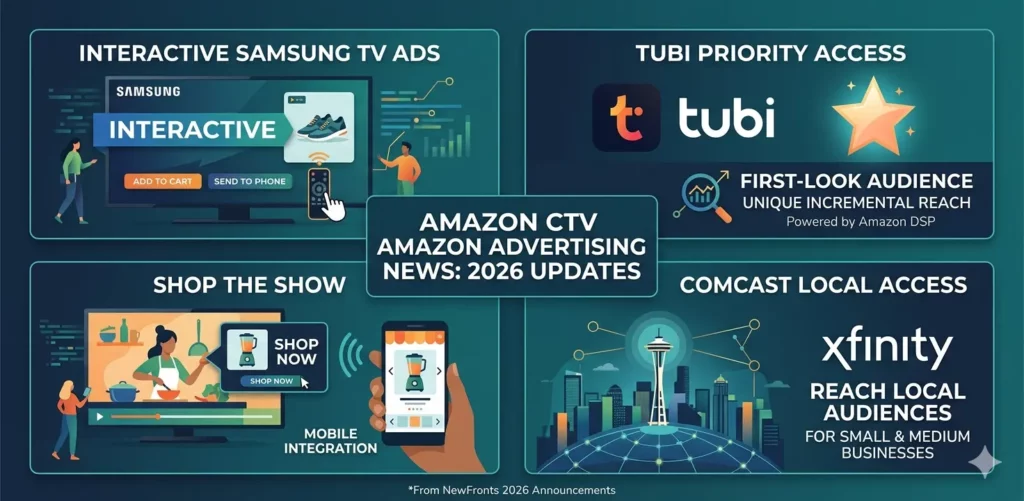
Interactive ads on Samsung TV Plus (launching July 2026)
Amazon announced at NewFronts 2026 a partnership with Samsung that brings remote-enabled interactive video ads to Samsung TV Plus. Viewers will be able to respond to on-screen CTAs directly from their remote — sign up, send to phone, or get more information — without interrupting their content. For brands with lead-gen or direct-response goals, this is a significant new capability.
(Source: Amazon Ads NewFronts 2026, April 2026)
Tubi Priority Access via Amazon DSP
Also announced at NewFronts 2026: Tubi Priority Access gives brands preferred positioning on Tubi’s free streaming inventory, with Amazon matching 85% of Tubi’s audience to Amazon shopping data. That match rate makes Tubi one of the most precisely targetable third-party CTV properties in Amazon’s network.
Shop the Show
Amazon’s Shop the Show feature allows Prime Video viewers to discover and buy products featured in shows, movies, and live sports without leaving their content. For brands whose products appear in or sponsor Prime Video content, this creates a direct shoppable bridge from the TV screen to the Amazon product listing.
Location-based interactive ads on Prime Video
In November 2025, Amazon launched location-targeted interactive ads on Prime Video. Brands can now show different CTAs to viewers based on where they’re watching — so an insurance company can prompt viewers in their coverage area to request a quote, while viewers outside that area see a general awareness message.
Full-Funnel Campaigns spanning CTV to conversion
Amazon’s new Full-Funnel Campaigns product (announced at unBoxed 2025, launching in 2026) uses AI to manage ad delivery across Sponsored Products, display, and Streaming TV in a single unified campaign — automatically shifting budget and format based on where the shopper is in the buying journey. CTV is now an integrated part of Amazon’s AI-managed full-funnel stack, not a separate channel bolted on the side.
Frequently Asked Questions
No. Amazon Sponsored TV is available to brands whether or not they sell on Amazon’s marketplace. However, sellers enrolled in Amazon Brand Registry get access through the sponsored ads workflow, which is the easiest route. Non-endemic brands (those not selling on Amazon) can access streaming TV inventory through Amazon DSP.
Sponsored TV has no minimum spend requirement — it’s one of the few Amazon ad formats without one. That said, in practice you’ll need enough budget to generate meaningful impressions. A daily budget of at least $200-500 is worth targeting for a test campaign, with a runtime of at least 4 weeks to build frequency and generate enough data to draw conclusions.
15 or 30 seconds are the standard options. For Prime Video and premium streaming placements, 30 seconds gives you more storytelling room and tends to perform better for brand recall. For Twitch and higher-frequency environments where viewers see more ads, 15-second spots can work well and reduce the risk of creative fatigue.
Yes, through Amazon DSP. You can build an audience of households exposed to your streaming TV ads and then serve display retargeting ads to those same users as they browse the web, use Amazon, or scroll through apps. This video-to-display sequence is one of the highest-performing creative strategies in the Amazon ad ecosystem.
Standard Sponsored TV reporting shows video completion rate, reach, and some downstream metrics. For a full picture of whether CTV exposure is influencing Amazon purchases, you need Amazon Marketing Cloud (AMC), which lets you run custom queries linking ad exposure to downstream Sponsored Products clicks, detail page views, and attributed sales. Without AMC, you’re only seeing part of the story.
Yes. Pre-roll and mid-roll video ads on Prime Video are non-skippable for viewers on the standard ad-supported tier. This is a significant difference from platforms like YouTube where skippable ads are common. Non-skippable placements deliver much higher video completion rates and more reliable brand exposure — but they also raise the creative bar, since the viewer will see your entire ad regardless of quality.
For Amazon sellers, the most effective landing destinations are either your product detail page (for a specific product campaign) or your Amazon Brand Store (for a broader brand awareness campaign). Sending TV ad traffic directly to your DTC website is possible but introduces friction — most viewers who want to act will search on Amazon anyway, so making your brand name and product name unmistakably clear in the ad is more important than the click-through destination.
Streaming TV and DSP planning increasingly connect to AI-assisted campaign systems. Our Amazon Performance+ guide explains where it fits.
Place streaming reach inside the full-funnel Amazon advertising benchmark for audience quality, frequency, new-to-brand, and contribution.