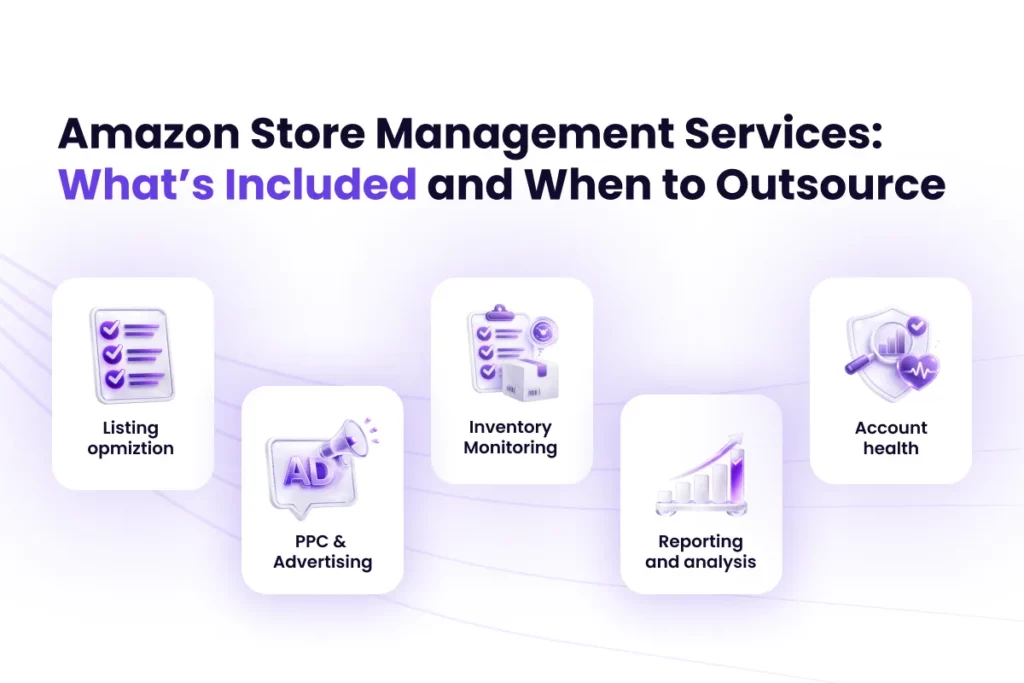
Amazon store management is the work that keeps an Amazon business healthy, profitable, and ready to scale. It is not just listing edits, PPC tweaks, or Seller Central troubleshooting. Real management connects advertising, ranking, content, pricing, inventory, account health, catalog quality, and reporting into one operating system.
Want it managed for you? Eva delivers Amazon store management services as part of full-service Amazon management. If you are comparing an Amazon store management agency, start there for scope, team, and onboarding.
That distinction matters in 2026 because Amazon is harder to manage casually. A brand can have strong products and still lose growth through weak catalog structure, poor ad efficiency, inventory gaps, pricing errors, delayed support tickets, account health issues, or content that does not convert.
Quick answer: what is Amazon store management?
Amazon store management is the ongoing operational and performance management of an Amazon seller or vendor account. It includes listings, catalog hygiene, advertising, inventory, account health, pricing, reporting, and growth planning. The best Amazon store management services do not treat those as separate tasks. They manage them as one system.
Related Eva service: Eva provides Full-Service Amazon Management across advertising, ranking, content, pricing, inventory, and operations.
Table of Contents
What Amazon store management includes
The exact scope depends on the brand, catalog, sales volume, and account complexity. But a serious Amazon store management partner should be able to own the main operating pillars that affect both sales and profit.
Catalog and listing management
Catalog work covers titles, bullets, descriptions, A+ content, backend keywords, parent-child variation structure, image sequence, category alignment, browse nodes, suppressed listings, and catalog hygiene. This is where many brands leak conversion before advertising ever has a chance to work.
Brands that want a faster diagnostic can use Eva’s Listing Optimizer to review listing quality, Alexa-style scoring, Cosmos scoring, and optimization opportunities.
Advertising and ranking management
Advertising is usually part of Amazon store management because PPC influences ranking, revenue, inventory velocity, and profitability. Strong management looks at Sponsored Products, Sponsored Brands, Sponsored Display, DSP, campaign structure, bid rules, placement, search term quality, negative targeting, budget pacing, and retail readiness.
This is also where technology matters. Eva’s Orbit for Amazon connects bids, ranking, inventory, and profit so advertising decisions are not made in isolation.
Inventory, pricing, and operational control
Amazon growth can break when inventory and pricing are not managed with the same discipline as ads. A store management team should monitor stock risk, replenishment timing, pricing pressure, stranded inventory, fulfillment issues, return patterns, and Buy Box risk.
This is why low-cost task support often fails. A freelancer can update a listing or adjust a bid. A management team has to understand how a decision in one area affects the entire account.
Account health, catalog issues, and Amazon support escalation
Some Amazon work is not strategic in the traditional sense. It is technical problem solving. Suppressions, policy warnings, variation problems, brand registry issues, stranded listings, reimbursement gaps, chargebacks, and support escalations can all block growth.
That is why Account Health and Catalog Management belongs inside the broader management conversation. Amazon support does not always solve seller problems quickly, so brands need a team that knows how to document, escalate, and keep pushing until the issue is resolved.
When should a brand outsource Amazon store management?
Outsourcing makes sense when Amazon has become too important to run as a side task. The warning signs are usually clear: ad spend is growing without profit clarity, listings are not maintained, inventory decisions lag, content is stale, catalog issues keep returning, and no single team owns the outcome.
Brands usually have three options:
- Freelancer support: useful for narrow tasks, but usually limited when the account needs strategic ownership.
- Internal team: strong when Amazon is already a major channel and the brand can hire specialists across ads, content, operations, and analytics.
- Full-service Amazon management: best when the brand needs one accountable team to manage performance, operations, and profit together.
How to choose an Amazon store management partner
A strong partner should be able to explain how they manage the whole account, not just one service line. Ask how they connect advertising to inventory, how they review contribution margin, how they improve listing conversion, how they handle catalog issues, and how they report decisions back to the brand.
- Do they own outcomes, or only complete tasks?
- Do they manage PPC, DSP, SEO, content, inventory, pricing, and operations together?
- Do they have senior operators reviewing the account, or is the work handed to junior task support?
- Do they use technology to connect ranking, inventory, bids, conversion, and profit?
- Do they know how to fight through Amazon support and catalog issues when the account gets stuck?
What results can Amazon store management improve?
Good management can improve visibility, conversion rate, ad efficiency, account health, listing quality, inventory control, customer experience, and contribution margin. The largest benefit is often coordination. The account stops being a set of disconnected tasks and becomes a managed growth channel.
For many brands, the difference is not whether Amazon has enough activity. The difference is whether the activity is coordinated around profitable growth.
Want one team to run the whole account? See Eva’s Amazon store management services for listings, advertising, inventory, pricing, account health, and reporting in one plan, or book a call.
FAQs about Amazon store management
Amazon store management is the ongoing work required to operate and grow an Amazon seller or vendor account. It usually includes listings, catalog quality, advertising, inventory, pricing, account health, and reporting.
Services often include catalog management, listing optimization, Amazon PPC, DSP support, SEO, A+ content, inventory planning, account health, issue escalation, reporting, and growth planning.
A freelancer can help with narrow tasks. A full-service agency is usually better when the brand needs ownership across ads, listings, inventory, pricing, account health, reporting, and profit.
Pricing depends on catalog size, channel complexity, advertising scope, and service depth. Serious full-service Amazon management usually requires a meaningful monthly retainer because it needs senior operators, technology, and cross-functional execution.
Final thoughts
Amazon store management is not about doing more random work inside Seller Central. It is about creating one operating system for the channel. The right team manages listings, ads, inventory, pricing, content, account health, and reporting together so the brand can grow with more control.
Eva’s Amazon Growth System gives brands full-service management across advertising, ranking, content, pricing, inventory, and operations under one accountable team.
Get My Growth Plan or explore Eva’s Full-Service Amazon Management.