Quick answer: To sell on TikTok Shop in 2026, a brand needs an approved Seller Center account, eligible products, clean listings, fulfillment and return operations, a content engine, creator affiliate coverage, and a paid media plan that turns attention into profitable orders. TikTok Shop is not just another marketplace upload. It is a commerce channel where content, creators, product pages, inventory, and advertising have to work together.
TikTok Shop changed the way shoppers discover products. On Amazon, shoppers usually arrive with intent. On TikTok, demand is often created before the shopper was planning to search. A creator demonstrates a product, a live host answers objections, a short video shows the use case, and the product can be bought inside the same experience.
That makes TikTok Shop powerful, but it also makes it operationally demanding. Brands that treat TikTok Shop as a simple listing channel usually struggle. Brands that treat it as a managed growth system can turn content into sales, sales into learning, and learning into a stronger omnichannel business.
This guide explains how to sell on TikTok Shop in 2026, what to set up first, where brands usually fail, and how to build a channel that supports Amazon, Shopify, and retail growth instead of becoming another disconnected storefront.
Table of Contents
- Who should sell on TikTok Shop?
- What you need before opening TikTok Shop
- Step 1: Create and verify your TikTok Shop Seller Center account
- Step 2: Connect Shopify or prepare your catalog feed
- Step 3: Choose products that can win in social commerce
- Step 4: Build TikTok Shop listings that convert
- Step 5: Set fulfillment, returns, and customer support before launch
- Step 6: Build a creator affiliate engine
- Step 7: Launch content, live selling, and paid amplification
- A 30/60/90 day TikTok Shop launch plan
- Common mistakes when selling on TikTok Shop
- How Eva helps brands sell on TikTok Shop
- FAQs about selling on TikTok Shop
Who should sell on TikTok Shop?
TikTok Shop is strongest for brands with products that can be explained visually, demonstrated quickly, or tied to a lifestyle, routine, problem, or community. Beauty, wellness, food, home, pet, fashion, fitness, accessories, and consumer goods often have a natural fit. The channel can also work for more technical products when the brand can explain the problem clearly and pair the product with the right creators.

The better question is not “Can this product be listed?” The better question is “Can this product create a reason to watch, click, and buy?” TikTok Shop rewards products with a visible use case, simple proof, strong offer, clear content angles, and enough margin to support creator commission, samples, discounts, and paid amplification.
What you need before opening TikTok Shop
Before setup, prepare the basics. This reduces approval delays and prevents the team from creating a shop that cannot operate cleanly once orders start coming in.
- Business information: legal entity, tax details, contact information, and identity verification documents.
- Product eligibility: category fit, compliance documents when needed, and products that follow TikTok Shop policies.
- Product assets: titles, product facts, images, dimensions, variation data, pricing, shipping weight, and inventory data.
- Operational plan: fulfillment method, return process, customer service owner, and escalation rules.
- Content plan: creator list, sample budget, content angles, launch calendar, and paid media plan.
If the brand also sells on Shopify, connect the shop setup to the Shopify operating plan early. TikTok Shop can create demand that should influence retention, email and SMS, landing pages, and product merchandising. For brands that want help managing the full channel, see Eva’s TikTok Shop Management service.
Step 1: Create and verify your TikTok Shop Seller Center account
Start in TikTok Shop Seller Center. Choose the correct market, enter business details, complete verification, add tax and payment information, and review the required policies for your product category. Do not rush this step. Incorrect entity data, wrong category choices, or missing compliance documents can create avoidable delays.
For brands, this is also the time to decide who owns the channel. TikTok Shop touches content, marketplace operations, customer support, logistics, ads, finance, and inventory. If ownership is unclear, the shop may launch but the day-to-day work will break across teams.
Step 2: Connect Shopify or prepare your catalog feed
If the brand runs Shopify, connect TikTok Shop to Shopify so product data, inventory, and order workflows can be managed more cleanly. The connection does not replace strategy. It simply reduces operational friction. Product information still needs to be written for TikTok Shop shoppers, not copied blindly from Shopify or Amazon.
For larger catalogs, do not upload everything at once. Start with a controlled product set. Choose SKUs with margin, inventory depth, simple creative angles, strong reviews or proof, and enough supply for creator sampling. A focused launch gives the team cleaner learning than a messy catalog dump.
Product selection is where many brands make the first mistake. They choose products based on inventory availability or internal priority, not TikTok behavior. A good TikTok Shop launch product usually has a clear hook, visible transformation, repeatable demonstration, strong offer, and a reason creators can talk about it without sounding scripted.
- Hero product: one product that can carry the main story.
- Bundle: a higher-AOV option that makes sense after the shopper understands the use case.
- Entry product: a lower-friction item that can convert new customers.
- Seasonal product: a product tied to a moment, trend, or giftable use case.
For more product-category planning, read Eva’s guide to TikTok Shop product categories that sell best.
Step 4: Build TikTok Shop listings that convert
A TikTok Shop listing has to do two jobs. It has to support discovery inside TikTok, and it has to convert shoppers who arrive from content. That means the listing should be clear, benefit-led, and operationally accurate.
- Title: use the product name, primary use case, and important attributes without keyword stuffing.
- Images: show the product clearly, then show size, texture, ingredients, package contents, use cases, and proof points.
- Description: answer what it is, who it is for, why it matters, how to use it, and what is included.
- Variations: make size, color, flavor, quantity, and bundle options easy to choose.
- Claims: keep claims compliant and support them with clear product facts.
The listing should match the content. If a creator sells the product around a specific problem, the product page should reinforce that same promise. If the video creates excitement but the listing is vague, conversion drops and paid traffic gets expensive. For listing-specific work, pair the TikTok Shop SEO guide with TikTok Shop Management so content, listings, creators, and paid traffic stay connected.
Step 5: Set fulfillment, returns, and customer support before launch
TikTok Shop growth can come in bursts. A product can move from a small test to a serious order spike quickly if content works. That is good only if the brand can fulfill cleanly. Late shipments, weak customer service, and messy returns hurt the account and slow future growth.
Decide how orders will be fulfilled, who monitors inventory, how returns are handled, and who responds to customer messages. TikTok Shop is a marketplace, so operating quality matters. Growth is not only content performance. It is also seller health, fulfillment reliability, product accuracy, and customer experience.
Useful related guides: TikTok Shop fulfillment and TikTok Shop returns and refunds.
Step 6: Build a creator affiliate engine
Creator affiliates are one of the biggest reasons TikTok Shop is different from a normal ecommerce store. The brand does not need every sale to come from its own account. Creators can explain, demonstrate, review, compare, and recommend products to audiences the brand does not already own.
But creator affiliate programs need management. Brands need product seeding, creator matching, commission strategy, content briefs, approval workflows, performance tracking, sample controls, and a way to turn winning creator content into paid amplification.
- Recruit creators by category, audience fit, content style, and trust level.
- Give creators product facts and angles, not a stiff script.
- Track creator-level sales, content quality, hook strength, and repeatability.
- Increase commission and sample access for creators who prove they can sell.
- Use winning content in Spark Ads when rights and setup allow it.
For more depth, read Eva’s guide to TikTok Shop affiliate marketing and the TikTok Shop influencer selection guide.
Step 7: Launch content, live selling, and paid amplification
TikTok Shop content should not be random posting. Build a weekly creative system. Test hooks, demos, objections, comparisons, unboxings, testimonials, founder stories, creator reviews, live shopping moments, and offer-led content. The goal is to learn what makes shoppers stop, trust, click, and buy.


Paid media should support proven content instead of forcing weak creative to scale. Spark Ads can amplify creator or brand content that already shows signal. Live shopping can answer objections and create urgency. Shop Ads can support product discovery and conversion. The channel works best when content, creators, and paid media share the same operating plan.
Useful related guides: TikTok Spark Ads, TikTok Shop Live Ads, and creating TikTok videos for shop sales.
A 30/60/90 day TikTok Shop launch plan
First 30 days: setup and controlled launch
Open and verify Seller Center, connect Shopify or catalog data, select launch products, build listings, prepare fulfillment, recruit the first creator group, seed samples, and publish initial brand content. The main goal is operational readiness and early signal.
Days 31 to 60: creator testing and conversion improvement
Measure creator performance, content hooks, listing conversion, product-page objections, fulfillment health, and return patterns. Improve listing images, offers, bundles, and creator briefs. Start paid amplification only on content that shows real engagement and sales potential.
Days 61 to 90: scale winners and connect channels
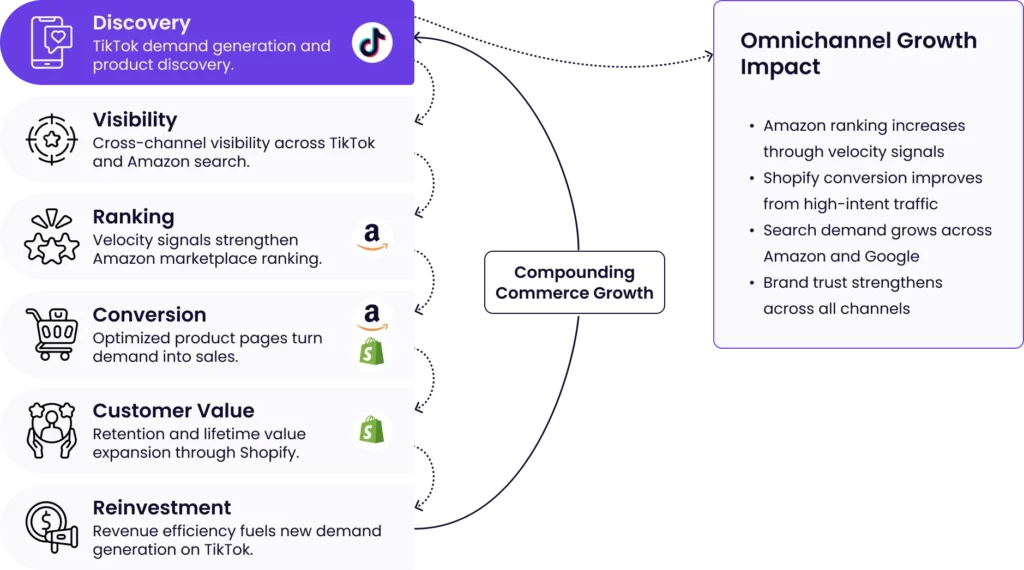
Scale top creators, expand winning SKUs, test live shopping, increase Spark Ads on proven content, and connect learnings back to Shopify and Amazon. TikTok Shop should not sit in a silo. Winning TikTok content can reveal product language, objections, bundles, hooks, and customer segments that improve the whole ecommerce system.
Common mistakes when selling on TikTok Shop
- Uploading the whole catalog: A focused launch usually learns faster than a giant unprioritized catalog.
- Copying Amazon content: TikTok Shop shoppers need social proof, use cases, and content alignment, not only marketplace keywords.
- Underfunding samples: Creator affiliate growth needs product access and relationship management.
- Ignoring fulfillment: Viral demand is dangerous when inventory and shipping are not ready.
- Judging content too early: Creative testing needs enough volume to separate weak hooks from weak products.
- Running paid ads without content signal: Paid amplification should scale what already shows promise.
How Eva helps brands sell on TikTok Shop
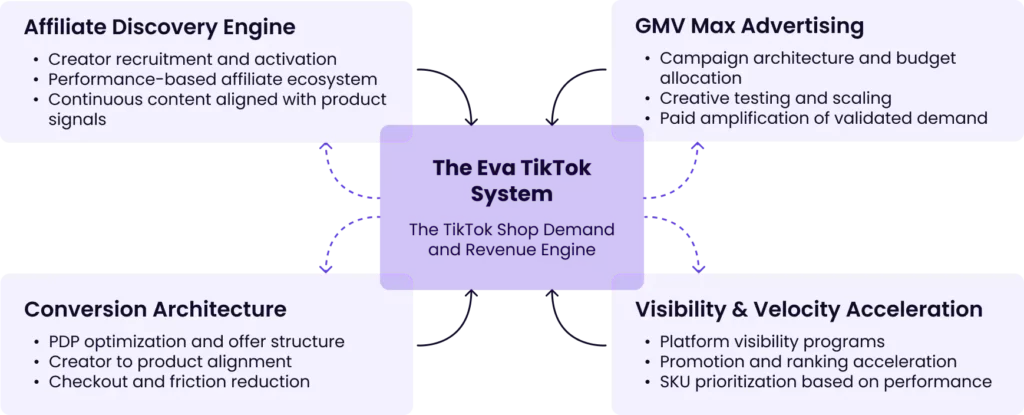
Eva manages TikTok Shop as part of a full-service commerce growth system. That means the work is not only posting videos or opening a shop. Eva helps brands connect shop setup, creator partnerships, content, paid ads, product pages, fulfillment signals, Shopify revenue, and Amazon demand capture.
The reason this matters is simple: TikTok can create demand fast, but demand only becomes profitable when the brand has the right product, offer, creative system, operations, and cross-channel strategy. Eva gives brands one team accountable for the growth system, not a disconnected creator program and ad account.
Related Eva resources: Explore TikTok Shop Management, Shopify Management, Meta Advertising, TikTok Shop Agency, TikTok Shop SEO, TikTok Spark Ads, and TikTok Shop Fulfillment.
FAQs about selling on TikTok Shop
How do I start selling on TikTok Shop?
Start by creating a TikTok Shop Seller Center account, verifying your business, adding tax and payment details, checking product eligibility, uploading product listings, setting fulfillment and returns, and building a content and creator plan.
Do I need Shopify to sell on TikTok Shop?
No. Shopify is not required, but brands that already use Shopify can connect it to TikTok Shop to simplify catalog and order workflows. The strategy still needs to be managed separately.
What products sell best on TikTok Shop?
Products that are visual, demonstrable, giftable, routine-driven, or problem-solving tend to fit TikTok Shop well. Beauty, wellness, food, home, pet, fashion, fitness, and accessories are common strong categories.
How much does it cost to sell on TikTok Shop?
Costs can include platform fees, fulfillment, returns, samples, creator commissions, discounts, content production, and advertising. The biggest planning mistake is only budgeting for listing setup and ignoring creator and content costs.
Can brands use creators to sell on TikTok Shop?
Yes. Creator affiliates are a major part of TikTok Shop growth. Brands should manage creator selection, product seeding, commission strategy, briefs, performance tracking, and paid amplification of winning content.
Is TikTok Shop worth it for established ecommerce brands?
Yes, when the brand has products that can be demonstrated, enough margin to support creators and paid media, reliable fulfillment, and a plan to connect TikTok demand with Shopify, Amazon, and the broader commerce P&L.
Sources and further reading
- TikTok Shop Academy for official seller education and policy guidance.
- TikTok Shop Seller Center for seller registration and shop management.
- TikTok for Business Shopify setup guide for Shopify connection context.
- Shopify TikTok Shopping guide for Shopify channel context.