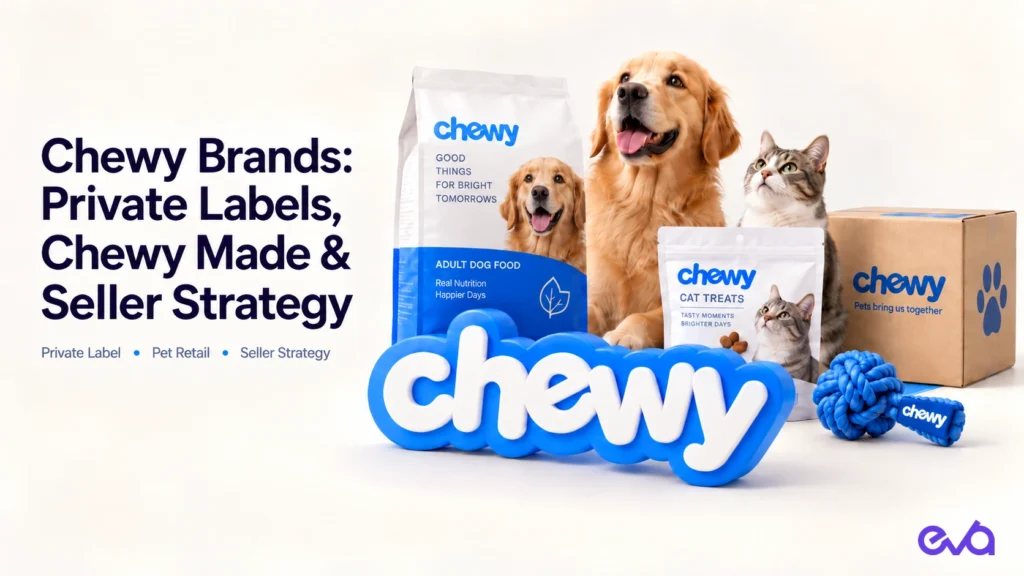
Chewy is best known as an online pet retailer, but its own-brand strategy is just as relevant to people who shop, source, or sell in pet. For shoppers, private-label products can be an accessible way to compare food, treats, toys, and everyday essentials. For brands, they are a visible reminder that marketplace competition is not limited to other third-party sellers.
This guide explains the Chewy brands shoppers may encounter, how Chewy Made fits into the picture, and what an ecommerce seller can learn from a retailer that owns both the digital shelf and a growing family of exclusive products. It is an educational guide, not a claim that every product or brand listed below is currently available in every category.
Table of Contents
- Quick answer: What are Chewy brands?
- What are Chewy’s private-label brands?
- What is Chewy Made?
- Why Chewy’s private brands matter to pet-product sellers
- How to evaluate Chewy private-label competition
- A seller strategy for competing alongside Chewy brands
- What a retail-ready product page should communicate
- Common mistakes to avoid
- Frequently asked questions
- The takeaway
- Need a connected marketplace growth plan?
Quick answer: What are Chewy brands?
“Chewy brands” usually refers to private-label and exclusive pet-product lines sold through Chewy. Chewy’s current consumer-facing umbrella is Chewy Made. On its Chewy Made brand page, Chewy says the collection includes products formerly sold under American Journey, Tiny Tiger, True Acre Foods, Bones & Chews, and Frisco, among others. Chewy also says these products are exclusive to Chewy.
For a seller, the important point is not simply the names. It is the operating model: a marketplace can use exclusive brands to create entry-price options, fill assortment gaps, build repeat-purchase habits, and control more of the customer experience. That makes rigorous category research essential before deciding where and how to compete.
What are Chewy’s private-label brands?
A private-label brand is owned or controlled by a retailer rather than an independent manufacturer selling through the retailer. The retailer typically determines the category opportunity, product positioning, price architecture, packaging direction, and route to market. The manufacturing model can differ from brand to brand, but the commercial relationship is what matters: the retailer has greater control over the offer and the shopping journey.
Historically, shoppers have recognized several Chewy-owned or exclusive names across food, treats, toys, bedding, and pet essentials. The most useful names to know when researching the category include:
- American Journey: a food-focused name that many shoppers may still recognize from Chewy’s catalog and past purchases.
- Tiny Tiger: a cat-focused brand name associated with food and treats.
- True Acre Foods: a dog-food and treat-oriented name.
- Bones & Chews: a name connected with dog treats and chews.
- Frisco: a widely recognized Chewy brand spanning pet supplies such as toys, beds, furniture, and accessories.
Chewy’s current messaging groups products formerly associated with those brands under Chewy Made. That does not mean a researcher should assume every legacy name has disappeared from every search result, product page, or customer vocabulary. It means a sound analysis should look at the live category, the actual product-detail page, and how Chewy presents the offer today.
What is Chewy Made?
Chewy Made is the retailer’s current umbrella for its own products. The brand page positions it as an exclusive collection created for pet parents and identifies multiple former private-brand names as part of the family. In practical terms, Chewy Made gives the retailer a clearer way to unite different category offers under one identity while retaining the breadth that shoppers expect from pet retail.
For consumers, that can simplify discovery: instead of learning a separate retailer-owned label in every aisle, a shopper can begin to recognize the Chewy Made signal. For ecommerce operators, it demonstrates a broader principle. Brand architecture is not merely a logo decision. It shapes how people browse, compare, remember, and return.
When assessing Chewy Made or any retailer-owned line, separate what is confirmed from what is inferred. Confirmed facts belong on the retailer’s current brand and product pages. Inferences—such as why a retailer may prioritize a price tier, a format, or an assortment gap—can guide competitive research, but they should not be presented as inside knowledge.
Why Chewy’s private brands matter to pet-product sellers
Private labels alter the competitive set in several important ways. First, they can compete across multiple price points, from impulse accessories to recurring food and treat purchases. Second, they can benefit from retail-native merchandising: category pages, on-site search, product recommendations, and promotional placements are all part of the same customer experience. Third, they can make a broad catalog feel easier to shop by giving customers a familiar, retailer-backed option.
That does not mean an independent brand cannot win. It means the brand needs a clear reason to be chosen. A strong reason can come from an ingredient story, a specific pet need, a product format, a design point of view, a premium experience, a community, or an operational advantage such as availability. The right answer depends on the category and the buyer—not on a generic “beat private label” playbook.
For sellers that also operate on Amazon or their own storefront, the lesson travels well. Marketplace performance and direct-to-consumer performance should inform each other. Search terms, reviews, product questions, creative tests, inventory signals, and margin constraints are connected. Eva’s Amazon marketplace management and Amazon SEO and AEO services are built around that kind of connected operating view.
How to evaluate Chewy private-label competition
Start with the category, not a single product. A single SKU can look like a direct competitor because it shares a keyword, while the actual buyer need is different. Create a research sheet that defines the shopper mission, the live alternatives, the value proposition, and the commercial constraints around each offer.
1. Shopper need and use case
Define the job the product performs. Is a pet parent choosing a daily food, a sensitive-stomach alternative, an enrichment toy, a travel accessory, or a treat for training? The more specifically a team defines the use case, the more useful its competitive comparison becomes. “Dog treats” is too broad; “soft training treats for small dogs with ingredient-conscious owners” is more actionable.
2. Price architecture
Compare price per unit, size, format, subscription or repeat-delivery availability, and visible promotions. Do not rely on a headline price alone. A lower sticker price can represent a smaller pack size, while a premium item may be more competitive on a per-serving basis. The goal is to understand the price ladder a shopper sees, including entry, core, and premium options.
3. Product promise
Read the title, the first images, feature bullets, ingredient or material callouts, and common questions. What is the offer promising in the first few seconds? Does it lead with convenience, nutrition, durability, breed size, life stage, flavor, or a lifestyle benefit? Map those messages before writing new copy. It helps uncover the claims that are table stakes and the areas where a differentiated brand can be more specific.
4. Creative and merchandising
On a marketplace, creative is part of conversion. Study image order, comparison charts, packaging readability, size references, video, and any store or brand-module experience. A product can be technically differentiated and still lose because the value is difficult to understand on a mobile screen. The best review is not “Which image looks nicest?” but “What question does each image answer for a first-time shopper?”
5. Review and trust signals
Reviews show recurring objections as well as proof points. Group them by theme: palatability, fit, durability, delivery condition, sizing, value, and repeat purchase. Avoid treating a few reviews as representative of an entire market. Look for patterns across enough products to identify whether the category has a persistent customer concern your product could solve.
6. Availability and operations
A brand’s promise is only as strong as the shopping experience around it. Track in-stock status, variants, lead times, bundle logic, and the consistency of the product-detail page. If a competitor is unavailable, that may create a short-term opening—but it is not a durable strategy. Build a plan that can support the demand you intend to create.
A seller strategy for competing alongside Chewy brands
The goal is not to copy a retailer-owned brand. It is to choose a position that is easy to understand and operationally viable.
First, build a category map. List the live products a shopper is most likely to compare, then identify the search phrases, price points, formats, and visible benefits around them. Include Chewy Made offerings where relevant, but also include established independent brands. This prevents the strategy from becoming overly focused on one retailer.
Second, choose one primary reason to buy. A new or growing product should answer a clear question: Why this product, for this pet, at this moment? A long list of broad benefits is less persuasive than one well-supported core promise with the details shoppers need to validate it.
Third, make the comparison easy. Use product titles, imagery, and description modules to clarify size, routine, material, ingredients, and expected outcomes where substantiated. The goal is not to make aggressive comparative claims. It is to remove the uncertainty that slows a purchase.
Fourth, protect margin before scaling demand. Estimate contribution margin by SKU and channel after platform fees, media spend, fulfillment, promotions, returns, and inventory carrying costs. A winning keyword or campaign is not automatically a winning business outcome if it repeatedly directs demand to an unprofitable product.
Fifth, connect advertising to retail readiness. Before increasing paid traffic, confirm that the landing page or detail page answers the query, the best variant is available, reviews and questions are monitored, and the creative gives customers enough context to decide. This is especially important in categories where shoppers need to understand a feeding routine, size, fit, or compatibility.
Sixth, use a test-and-learn cadence. Set a hypothesis, define a success metric, run the test long enough to produce usable evidence, and record the decision. Examples include testing an image order, a size guide, a benefit-led headline, a bundle, or a search-term grouping. Keep a decision log so the team does not repeat experiments or mistake a seasonal change for a creative win.
Seventh, plan the channel role. Amazon, a brand site, retail marketplaces, and repeat-purchase programs do not have to carry the same assortment or message. Decide what each channel is best at, then measure performance against that role. Eva’s marketplace expansion support can help teams align channel execution without turning every channel into an isolated project.
What a retail-ready product page should communicate
A customer should be able to understand the product without needing to search elsewhere. At minimum, a retail-ready page should make the category, use case, size or quantity, key product details, and next step clear. For food and treat categories, that can include life stage, dietary considerations, serving information, and ingredient transparency where appropriate. For toys and accessories, it may mean dimensions, material, pet-size guidance, care instructions, and an honest explanation of intended use.
Structure matters. Put the most decision-critical information near the top. Use images to prove what the written copy says. Answer predictable questions before they become support tickets or returns. Then keep monitoring post-purchase feedback, because customer language often reveals clearer wording than a team’s internal vocabulary.
This is where creative, content, media, and operations must work together. A paid campaign may reveal that shoppers misunderstand a size. A review may reveal that an image is ambiguous. An inventory issue may make the highest-converting variation unavailable. Connecting those inputs allows a brand to improve the system instead of treating each issue as a separate task.
Common mistakes to avoid
Mistake one: treating “private label” as a category by itself. Private-label products compete within real shopper missions and price ladders. Research the actual alternatives, not just the ownership model.
Mistake two: relying on outdated brand lists. Retailer brand architecture changes. Check the current retailer brand page and product-detail pages before publishing a list, buying ads, or briefing a creative team.
Mistake three: competing only on price. Price can matter, but it is difficult to defend without a cost advantage. A clearer product fit, stronger evidence, better creative, or more reliable availability can be a more sustainable reason to choose a brand.
Mistake four: launching traffic before the product page is ready. If the page cannot answer basic questions, spending more on media merely amplifies friction.
Mistake five: separating channel decisions from inventory and margin. A growth target that ignores stock health or contribution margin can create a larger operational problem.
Frequently asked questions
Are Chewy brands the same as Chewy Made?
Chewy Made is Chewy’s current umbrella for its own-brand products. Chewy’s brand page says it includes products formerly sold under names such as American Journey, Tiny Tiger, True Acre Foods, Bones & Chews, and Frisco. Because catalogs and customer language can change over time, use live product pages when researching a specific SKU.
Are Chewy Made products exclusive to Chewy?
Chewy states on its Chewy Made brand page that the products are exclusive to Chewy. Check the current page before relying on that fact in commercial materials, since retailer assortment and positioning can evolve.
Should a pet brand try to underprice Chewy private labels?
Not automatically. First determine what the shopper is comparing: price, formulation, convenience, size, durability, design, or a specific need. A brand that cannot profitably win on price should choose and prove a different reason to buy.
What should a seller monitor after launching in a competitive pet category?
Monitor search visibility, conversion rate, ad efficiency, contribution margin, stock levels, return reasons, review themes, product questions, and creative performance. The most useful dashboard connects these signals at the SKU level so a team can respond while the signal is still actionable.
The takeaway
Chewy’s private-label strategy is useful to study because it shows how retailer-owned brands can bring assortment, merchandising, and repeat-purchase behavior together. Chewy Made gives shoppers a current umbrella for exclusive products, while legacy names such as Frisco and American Journey may still be relevant to category research and customer searches.
For independent pet brands, the opportunity is to be more deliberate: know the shopper mission, identify the real alternative set, communicate a distinct value clearly, and connect demand generation to availability and margin. That discipline makes it easier to compete without relying on guesswork.