Table of Contents
- Quick answer: do you need an LLC to sell on Amazon?
- What happens if you sell on Amazon without an LLC
- LLC vs. sole proprietorship for Amazon sellers
- What an LLC actually protects you from
- Business setup checklist for Amazon sellers
- How to form an LLC for your Amazon business
- Common mistakes new Amazon sellers make with business structure
- How Eva helps with company formation and bookkeeping
- FAQ
- Sources and further reading
- Bottom line
Quick answer: do you need an LLC to sell on Amazon?
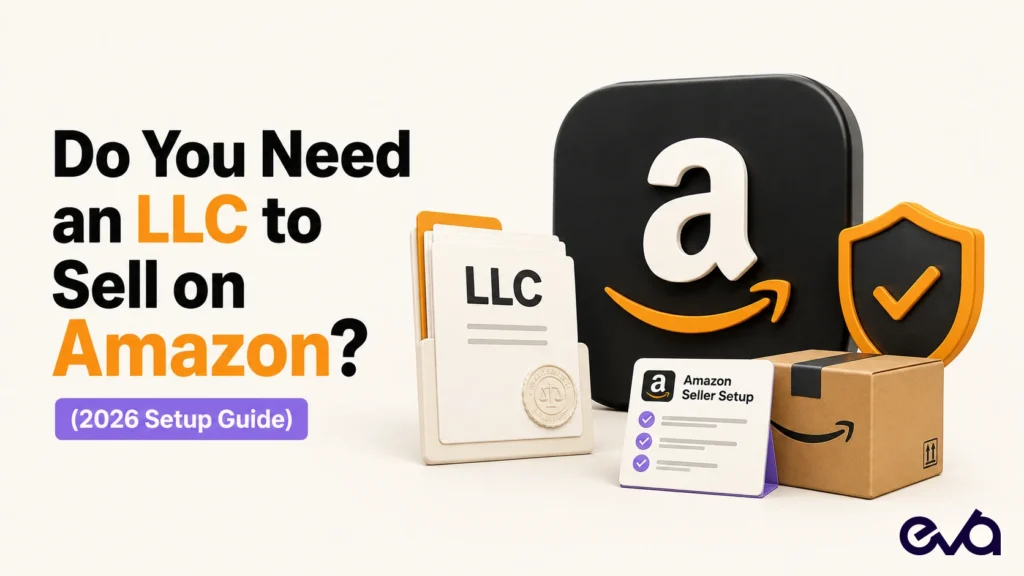
No. Amazon does not require an LLC to register as a seller — you can sign up as an individual using just your name and Social Security Number, and you are automatically treated as a sole proprietor. An LLC is not a legal requirement to sell on Amazon; it is a business decision about liability protection, taxes, and credibility that most sellers should revisit once they pass initial testing and start generating consistent revenue.
Related Eva resources: Company formation and bookkeeping and Amazon account management.
What happens if you sell on Amazon without an LLC
If you never file anything, you are not operating without a business structure — you are automatically a sole proprietor (or a general partnership if you have co-owners) the moment you make your first sale. No paperwork creates this status; it is the default under US law. The tradeoff is that a sole proprietorship creates no legal separation between you and the business: if a product causes injury, a customer sues over a defect, or the business takes on debt, your personal assets (bank accounts, car, home equity) are exposed alongside the business’s.
LLC vs. sole proprietorship for Amazon sellers
When a sole proprietorship is fine
- You are still validating a product or category and revenue is low.
- You are selling low-risk categories (books, low-liability accessories) rather than ingestible, wearable, or electrical products.
- You want to avoid state filing fees and annual report obligations before you know the business will continue.
When an LLC makes sense
- You sell products with real injury or defect exposure (supplements, electronics, children’s items, anything worn or ingested).
- Revenue has moved past the testing phase and the business has real assets, inventory, or cash to protect.
- You want to open a dedicated business bank account, apply for trade credit, or bring on a partner or investor.
- You plan to register the brand with Amazon Brand Registry or trademark the brand name, where a formal business entity simplifies the paperwork.
- You want the option to elect S-corp tax treatment later to reduce self-employment tax as profit grows.
What an LLC actually protects you from
An LLC (Limited Liability Company) creates a legal boundary between the owner’s personal assets and the business’s debts and legal liabilities, as long as the owner keeps business and personal finances separate (“commingling” funds is the most common way courts pierce this protection). For a physical-product Amazon seller, the realistic risks an LLC helps contain are product liability claims, supplier or freight contract disputes, and business debt if the company can’t pay a vendor or a loan. An LLC does not protect against Amazon account suspensions, intellectual property claims the seller caused, or personal guarantees the owner signs directly.
Business setup checklist for Amazon sellers
An LLC is usually one piece of a small setup checklist, not the only step. Most sellers who move past sole proprietorship end up handling all four of these:
| Item | What it does | Required to sell on Amazon? |
|---|---|---|
| LLC (or other entity) | Separates personal and business liability | No — optional |
| EIN (Employer Identification Number) | Free IRS tax ID; lets the business bank and file separately from your SSN | No, unless you register as a business (not individual) seller |
| Business license | General local/state permit to operate a business, independent of entity type | Not for Amazon itself; may be required by your city or state |
| Sales tax / seller’s permit | Registers you to collect and remit sales tax in states where required | Amazon collects marketplace-facilitator sales tax in most states automatically, but some sellers still need to register depending on nexus and product category |
How to form an LLC for your Amazon business
- Choose a state. For most small Amazon sellers, the home state where you actually live and operate is simpler and cheaper than “business-friendly” states like Delaware or Wyoming, because operating in a state other than where the LLC is formed usually requires registering as a foreign LLC there too — doubling the paperwork and fees.
- File Articles of Organization with your state’s Secretary of State, along with the filing fee (commonly $50–$500 depending on the state).
- Get an EIN from the IRS — this is free and can be done online in minutes; it lets you open a business bank account and file business taxes without using your personal SSN.
- Open a dedicated business bank account and route all Amazon payouts, supplier payments, and business expenses through it. Mixing personal and business funds is the main way LLC liability protection gets undone.
- Check state and local business license requirements and register for a sales tax permit if your state and product category require it.
- Update Seller Central with your legal business name, EIN, and business address under Account Info so Amazon’s tax and payout records match your new entity.
Common mistakes new Amazon sellers make with business structure
- Forming an LLC in a “popular” state instead of the home state, then having to register (and pay) as a foreign LLC in the state they actually operate from anyway.
- Mixing personal and business bank accounts after forming an LLC, which weakens or eliminates the liability protection the LLC was meant to provide.
- Waiting until after a liability event (a product complaint, a chargeback dispute, a supplier lawsuit) to form an LLC — an LLC formed after a problem already exists does not protect against that problem.
- Assuming Amazon requires an LLC and delaying launch to form one, when testing as an individual seller first is often the faster, lower-cost way to validate a product.
How Eva helps with company formation and bookkeeping
Eva’s Company Formation & Bookkeeping service handles entity setup, EIN registration, and ongoing bookkeeping for Amazon, Shopify, and TikTok Shop sellers as part of a full-service growth engagement — so the business structure decision gets made once, correctly, alongside the accounts, tax settings, and reporting that support it going forward.
FAQ
Is an LLC required to sell on Amazon FBA?
No. FBA has the same requirement as any other Amazon selling account: you can register as an individual seller with your SSN. FBA changes how inventory is stored and shipped, not the legal entity requirement to sign up.
Should I form an LLC before or after registering as an Amazon seller?
Most sellers register as an individual first to validate a product with minimal upfront cost, then form an LLC once sales are consistent and the liability or tax picture justifies it. If you already know you’re launching a higher-liability product (supplements, electronics, children’s items) at meaningful volume, forming the LLC first avoids re-papering contracts and accounts later.
Do I need a business license to sell on Amazon?
Amazon itself does not require a business license to open a seller account. Whether you need one depends on your city or state’s general business licensing rules, which apply regardless of whether you sell online, in a store, or on Amazon specifically.
What’s the real difference between an LLC and a sole proprietorship for an Amazon seller?
A sole proprietorship requires no paperwork and has no separation between you and the business — your personal assets are exposed to business liabilities. An LLC requires state filing and a modest fee, but creates a legal boundary that protects personal assets from most business debts and lawsuits, as long as business and personal finances stay separate.
Can I sell on Amazon without any business entity at all?
Yes. Selling as an individual without an LLC or corporation is legal and common, especially for sellers testing a product. You are automatically a sole proprietor by default; the tradeoff is personal liability exposure, not a compliance gap with Amazon.
Sources and further reading
- IRS: Single-Member Limited Liability Companies
- U.S. Small Business Administration: Choose a business structure
- IRS: Apply for an EIN online
- Amazon Seller Central: Create your seller account
Bottom line
An LLC is never required to sell on Amazon — you can register and sell as an individual from day one. It becomes worth the filing fee and paperwork once the product carries real liability risk, revenue has moved past the testing stage, or you need the banking, tax, or brand-registry benefits a formal entity provides. This is general information, not legal or tax advice; a specific entity choice should account for your state, product category, and financial situation.