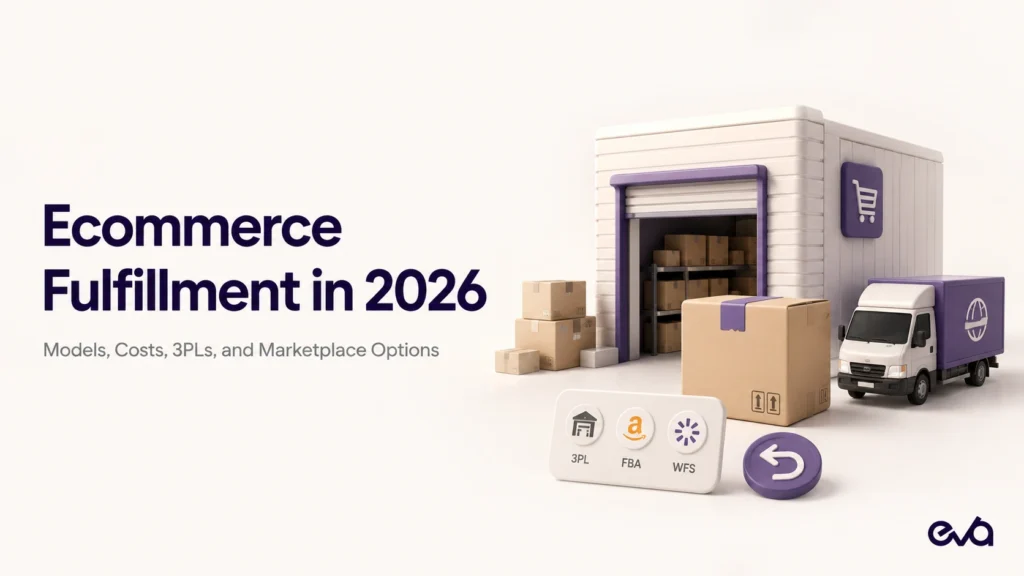
Ecommerce fulfillment covers the work between receiving inventory and completing a customer order: storage, picking, packing, shipping, tracking, returns, and reconciliation. Brands can operate in-house, use a third-party logistics provider, use marketplace programs such as FBA or WFS, or combine models. The right choice depends on order profile, service promise, product needs, geography, cost, and control.
This guide turns the search for ecommerce fulfillment into a business decision. It focuses on verifiable facts, operating tradeoffs, customer impact, and contribution margin. Platform features and policies change, so use the linked official sources and the live account as the final authority before implementation.
The recommended approach is deliberately cross-functional. A ecommerce fulfillment decision can affect acquisition, merchandising, inventory, payments, fulfillment, customer service, reporting, cash flow, and brand trust at the same time. Reading each section through only a marketing or technology lens can hide the operational cost. Use the article as a working checklist, then replace general assumptions with account-level data before taking action.
Table of Contents
- Quick decision framework
- Map the complete fulfillment workflow
- Compare the main operating models
- Build a true cost per order
- Define the service promise
- Evaluate 3PL partners
- Compare FBA and WFS deliberately
- Prevent inventory fragmentation
- Design returns and exception handling
- Plan implementation and migration
- Implementation roadmap for ecommerce fulfillment
- Metrics that keep the decision honest
- Common mistakes to avoid
- Fulfillment model profiles
- 3PL request-for-proposal scorecard
- Capacity and peak planning
- Fulfillment migration checklist
- Frequently asked questions
- Sources and further reading
- Design fulfillment around the channel portfolio
Quick decision framework
Before choosing a tool or changing a workflow, define the outcome, the owner, the available evidence, and the acceptable downside. For ecommerce fulfillment, a useful decision record states the current problem, baseline metrics, options considered, financial assumptions, risks, approval date, and review date. This prevents a popular tactic from becoming a permanent process without proof.
- Define the customer and commercial objective.
- Confirm current platform eligibility, policy, and pricing.
- Model total cost and contribution margin.
- Test with representative products, orders, and edge cases.
- Assign operational ownership and escalation paths.
- Measure the result against a documented baseline.
Map the complete fulfillment workflow
Document inbound appointments, receiving, quality checks, putaway, storage, inventory sync, order routing, picking, packing, labels, carrier handoff, tracking, delivery exceptions, returns, disposition, and financial reconciliation. A provider quote may cover only part of this chain.
The practical implication is that teams need evidence at the level where the decision is made. Use a representative product, order, market, and customer journey; document exceptions; and separate platform capability from what has actually been configured in the account.
For this part of the decision, turn this requirement into a short acceptance test. state the starting condition, the action a user or operator takes, the expected result, the data that proves it, and the person who approves the result. repeat the test for a normal case and at least two exceptions. this makes a broad requirement observable before budget or inventory is committed.
Compare the main operating models
In-house operations offer control but require facilities, labor, systems, and management. A 3PL converts much of that work into a service relationship. Marketplace fulfillment can strengthen marketplace delivery promises. Hybrid models can improve coverage but create inventory and data complexity.
From an operating perspective, assign a named owner, a review cadence, and an escalation threshold. The process should explain what happens when data is missing, a policy changes, demand exceeds the forecast, or a customer outcome conflicts with the original assumption.
For this part of the decision, interview the people who execute this work every day. their manual fixes, spreadsheets, support tickets, and workarounds often reveal costs that are absent from a vendor comparison. estimate the time spent per week, the error rate, and the downstream effect on customers and finance. a proposed improvement should remove a measured constraint rather than relocate it to another team.
Build a true cost per order
Include inbound freight, receiving, storage, pick fees, additional-item fees, packaging, postage, surcharges, account fees, integrations, returns, projects, minimums, and internal labor. Model product dimensions, zones, seasonality, and slow inventory rather than relying on one average order.
Financially, connect the choice to net revenue, variable cost, fixed cost, cash timing, and risk. A result can improve conversion or speed while still reducing contribution margin, so the scorecard must show both customer value and business value.
For this part of the decision, use a scenario model with conservative, expected, and upside cases. change volume, conversion, average order value, fees, labor, returns, and failure rates independently so the team can see which assumption drives the result. record the break-even point and the condition that would cause the plan to be paused. this is more useful than one precise-looking forecast.
Define the service promise
Set order cutoffs, handling time, delivery targets, tracking requirements, packaging standards, cancellation rules, and customer communication. Decide which promises are essential by channel and market. Faster shipping is valuable only when it is reliable and economically supported.
For measurement, capture a baseline before the change and keep the test window long enough to include refunds, returns, service contacts, and operational exceptions. Segment results by product, market, channel, and customer type when the blended average hides meaningful differences.
For this part of the decision, check the customer journey on mobile from first touch through post-purchase support. note every promise, field, delay, handoff, and source of uncertainty. then check whether internal systems can honor what the customer sees. the gap between presentation and execution is where many preventable cancellations, returns, complaints, and policy issues begin.
Evaluate 3PL partners
Request pricing files, service-level agreements, facility locations, carrier mix, systems documentation, references, security controls, business continuity, and escalation paths. Test how the provider handles peak periods, lot or serial tracking, bundles, kitting, regulated goods, and returns.
For governance, write the source of truth, access roles, approval steps, and rollback route. Keep screenshots or exports only where permitted, record decisions, and review the control after launch. Clear ownership matters most when several apps, partners, or channels share the workflow.
For this part of the decision, create a simple responsibility matrix for the workflow. one person should be accountable for the outcome even when marketing, operations, finance, technology, legal, and external partners contribute. define who can approve a change, who must be consulted, who receives an alert, and who performs rollback. ownership should remain clear during weekends and peak periods.
Compare FBA and WFS deliberately
Amazon FBA and Walmart Fulfillment Services are marketplace-specific programs with current eligibility, fee, inbound, storage, and policy terms. They can improve operational integration and delivery experience on their platforms, but should be compared with direct-to-consumer and multichannel needs.
For customer experience, make promises understandable before purchase and achievable after purchase. Accurate content, realistic delivery or service expectations, accessible policies, and responsive support reduce preventable contacts and protect long-term trust.
For this part of the decision, document the data lineage behind the decision. identify where each product, price, inventory, customer, order, and cost field originates; how often it updates; which transformations occur; and which report is authoritative. reconcile a sample to source records. decisions made from delayed or blended data should be labeled so confidence is not overstated.
Prevent inventory fragmentation
Define the system of record and set replenishment rules by node. Monitor available-to-promise inventory, stranded or suppressed units, reserved stock, weeks of cover, aging, and transfer lead time. More locations can improve speed while increasing working capital and stockout risk.
The practical implication is that teams need evidence at the level where the decision is made. Use a representative product, order, market, and customer journey; document exceptions; and separate platform capability from what has actually been configured in the account.
For this part of the decision, run a pre-mortem before launch. assume the initiative failed after ninety days and list the most plausible reasons: weak demand, bad economics, incomplete configuration, policy conflict, poor training, data latency, inventory shortage, or customer confusion. give each material risk an early-warning signal, an owner, and a response. this converts anxiety into an operating control.
Design returns and exception handling
Returns affect cost, inventory accuracy, customer trust, and product insight. Define authorization, labels, inspection, grading, refurbishment, restocking, disposal, fraud review, and refund timing. Track reasons at SKU level so content or product issues can be corrected.
From an operating perspective, assign a named owner, a review cadence, and an escalation threshold. The process should explain what happens when data is missing, a policy changes, demand exceeds the forecast, or a customer outcome conflicts with the original assumption.
For this part of the decision, set a review calendar before the work begins. daily monitoring may be appropriate during launch, followed by weekly operating reviews and monthly financial reviews. keep a decision log that records what changed and why. without this record, teams often repeat unsuccessful tests or credit the wrong action for a result that came from seasonality or a promotion.
Plan implementation and migration
Start with clean product dimensions, barcodes, inventory, packaging specifications, carrier rules, and integration tests. Run representative orders and returns before cutover. Establish daily reconciliation, escalation contacts, launch thresholds, and rollback options.
Financially, connect the choice to net revenue, variable cost, fixed cost, cash timing, and risk. A result can improve conversion or speed while still reducing contribution margin, so the scorecard must show both customer value and business value.
For this part of the decision, decide what evidence is strong enough to scale. one successful week may show technical feasibility but not durable demand, margin, or customer quality. require a minimum sample, stable operations, completed returns or dispute windows where relevant, and consistent results across important segments. scaling criteria should be agreed before enthusiasm changes the standard.
Implementation roadmap for ecommerce fulfillment
Use the first thirty days to validate facts and repair foundations. Inventory the current ecommerce fulfillment workflow, collect current platform terms, map systems and owners, benchmark performance, and identify the highest-risk gaps. Do not automate a process that the team cannot explain manually.
During days thirty-one through sixty, run a controlled pilot. Select a limited assortment, market, campaign, or order segment; define success and stop conditions; test normal and exceptional cases; and review the output with marketing, operations, finance, technology, and customer service. Record every assumption that materially affects the result.
During days sixty-one through ninety, decide whether to scale, repair, or stop. Standardize the successful workflow, train owners, create dashboards, document escalation and rollback, and schedule a policy and economics review. Expansion should follow demonstrated accuracy and profit, not activity alone.
Metrics that keep the decision honest
| Metric group | What to monitor | Why it matters |
|---|---|---|
| Demand | Qualified traffic, conversion, orders, average order value | Shows whether the offer earns customer action |
| Economics | Net revenue, variable cost, acquisition cost, contribution margin | Separates profitable growth from expensive volume |
| Operations | Cycle time, error rate, stock availability, exceptions | Tests whether the workflow can scale reliably |
| Customer | Cancellations, returns, contacts, satisfaction signals | Reveals problems hidden by initial sales |
| Risk | Policy incidents, fraud or disputes, access changes, data failures | Measures the downside of the operating model |
Common mistakes to avoid
Common mistakes include selecting ecommerce fulfillment tactics from headline price or popularity, relying on outdated screenshots, measuring gross sales without total cost, scaling before edge-case testing, allowing unclear data ownership, and failing to document a rollback path. Another mistake is copying a competitor workflow without knowing its assortment, margins, team, contracts, or customer mix.
A disciplined team treats every recommendation as a hypothesis. It verifies the current policy, tests the customer journey, reviews financial and operational consequences, and changes course when the evidence is weak. This approach is slower at the first meeting and much faster when the business scales.
Fulfillment model profiles
In-house fulfillment
In-house operations can provide direct control over labor, packaging, quality, and exception handling. The brand also owns facilities, hiring, scheduling, systems, carrier relationships, safety, continuity, and peak capacity. Model management time and unused capacity as well as pick-and-pack cost.
General-purpose 3PL
A third-party logistics provider can add warehouse expertise and geographic coverage. Compare receiving, storage, pick rules, packaging, carrier rates, returns, projects, minimums, integrations, reporting, and escalation. A low base pick fee does not prove a low total cost.
Amazon FBA
Fulfillment by Amazon can store inventory and handle picking, packing, delivery, customer service, and returns for eligible Amazon orders. Fees depend on product and service use and can include fulfillment, storage, aged inventory, returns processing, and other events. Use Amazon’s current Revenue Calculator and fee documentation.
Walmart Fulfillment Services
WFS is Walmart’s seller-facing fulfillment program. Evaluate current eligibility, inbound requirements, storage, fulfillment, returns, delivery coverage, and account-specific economics. Do not assume every Walmart network announcement changes seller access or terms.
Hybrid and multichannel fulfillment
A brand may combine marketplace programs, a DTC 3PL, stores, and internal facilities. This can improve coverage and resilience while fragmenting inventory and data. Define the order-routing logic, system of record, allocation rules, and reconciliation before adding nodes.
3PL request-for-proposal scorecard
| Area | Evidence | Failure question |
|---|---|---|
| Accuracy | Inventory and order error metrics | How are discrepancies investigated and credited? |
| Speed | Cutoffs and historical SLA attainment | What happens during peak volume? |
| Technology | API, webhooks, sandbox, status history | How are failed orders replayed? |
| Cost | Complete rate card and sample invoices | Which surcharges are not in the quote? |
| Continuity | Carrier and facility contingency plans | How is inventory moved after an outage? |
| Returns | Inspection and disposition workflow | When does sellable stock become available? |
Capacity and peak planning
Forecast ordinary demand, promotion lift, inbound lead time, labor, carrier collection, packaging, and customer-support volume together. Ask the warehouse to demonstrate how capacity is allocated when several clients peak at once. Define order-priority rules, overtime approval, cutoff changes, backlog reporting, and customer communication. After the peak, include returns, inventory reconciliation, invoice audit, and slow-stock exposure in the review; shipping the initial order is only part of the event cost. Review peak assumptions with the warehouse and carriers before inventory arrives.
Fulfillment migration checklist
Clean SKUs, barcodes, dimensions, weights, bundles, lot or serial requirements, packaging, and inventory before the first inbound. Integrate catalog, orders, tracking, cancellations, returns, and billing. Run test orders across zones, service levels, multi-item carts, split shipments, cancellations, failed addresses, and returns. Reconcile physical inventory and invoices daily during launch. Keep the previous route available until the new operation meets agreed thresholds.
Frequently asked questions
What does ecommerce fulfillment include?
It normally includes receiving, storage, inventory management, order processing, picking, packing, shipping, tracking, returns, and exception handling.
When should a brand use a 3PL?
A 3PL may fit when order volume, geography, service requirements, or operational focus make outsourced expertise more efficient than building internally.
Is FBA a 3PL?
FBA performs logistics services for Amazon sellers, but its program structure and marketplace integration differ from a general-purpose 3PL relationship.
How are fulfillment costs calculated?
Costs depend on receiving, storage, item count, dimensions, weight, zone, packaging, service level, returns, projects, and volume commitments.
What KPIs should be tracked?
Track receiving accuracy, inventory accuracy, order cycle time, on-time shipment, delivery performance, error rate, cost per order, returns, and aging.
Can one provider fulfill every channel?
Some can, but brands must test integrations, packaging, service levels, marketplace compliance, inventory ownership, and economics by channel.