Table of Contents
- Quick answer
- What ecommerce order management means
- The ecommerce order lifecycle
- Operating responsibilities at each handoff
- How to manage order exceptions
- Routing trade-offs in ecommerce order management
- Metrics that reveal order-flow problems
- How to test an order-management workflow
- Frequently asked questions
- Sources
- Build a more connected order operation
Quick answer
Ecommerce order management is the operating process that takes a customer order from checkout through payment review, inventory allocation, fulfillment, delivery, and, when necessary, a return, refund, or cancellation. A reliable workflow gives every team the same current order state, clear ownership, and rules for exceptions before the customer has to chase an answer. It does not depend on one universal routing rule or a single tool. It depends on accurate product, inventory, payment, and delivery information; defined handoffs; and tested decisions for the moments when the normal flow breaks.
What ecommerce order management means
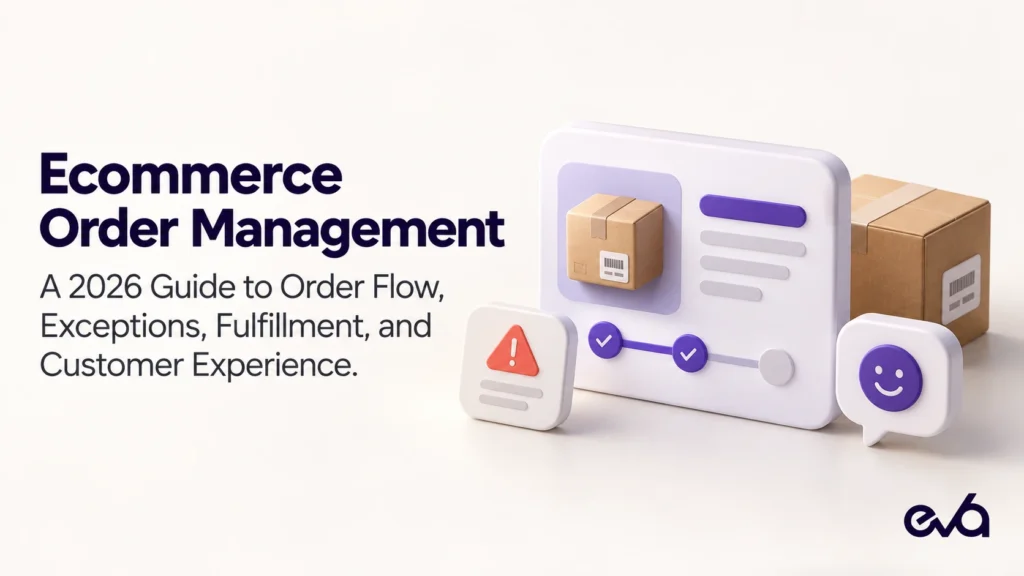
Ecommerce order management is the coordinated work of receiving an order, deciding whether and how it can be fulfilled, carrying it through shipment and delivery, and resolving any change that occurs along the way. It is an operating model, not simply a status screen. The model should make it clear what happened, what should happen next, who owns the next action, and what the customer should be told.
An ecommerce order management system is the category of technology that may store order data and help apply those rules. That category is useful to understand, but a system does not replace the decisions behind it. A team still needs to define its inventory source of truth, risk-review policy, routing priorities, cancellation authority, carrier escalation process, and return workflow. The technology should make those choices visible and repeatable rather than conceal them.
Order management overlaps with several related disciplines, but they are not interchangeable. Fulfillment is the physical work of picking, packing, handing off, and shipping an order. Inventory management is the work of knowing what stock exists, where it is held, and what is available to promise. Customer service handles questions and resolution communications. Order management connects those functions around the individual order and the rules that govern it.
That distinction matters when a customer asks why an item has not shipped. The answer may involve an inventory allocation failure, a payment hold, a warehouse queue, an address-validation issue, or a carrier delay. Treating every question as a customer-service ticket can mask the upstream owner. Treating every issue as a warehouse problem can miss the promise that was made at checkout.
The ecommerce order lifecycle
The order lifecycle begins when checkout records a customer commitment and ends only when the order is delivered, cancelled, refunded, or otherwise closed with an accurate record. The exact sequence differs by channel, product type, geography, and fulfillment network. Still, most ecommerce teams need a deliberate control point at each stage below.
1. Checkout and payment authorization
Checkout captures the products, quantities, price, tax, shipping choice, address, contact details, payment method, and customer-facing delivery expectation. The first control is data quality. A poorly structured address, unavailable shipping method, incorrect product attribute, or uncommunicated preorder date can create an exception before an order reaches operations.
Payment authorization confirms that the transaction can proceed under the brand’s payment and risk rules. Authorization is not always the same as release. A team may need a separate fraud-review decision for an order with risk signals, unusual order context, or a manual-review requirement. The important point is to avoid letting an unreleased order silently enter the warehouse queue.
2. Order creation and review
Order creation assigns a durable order record and establishes its state. The record should preserve the sales channel, line items, promotions, payment state, promised delivery context, inventory state, and any review flags. If a marketplace, storefront, payment provider, warehouse, or customer-service tool has a different version of the order, teams need a method to identify which field is authoritative.
At this stage, a useful operating question is: can this order be released as promised? If the answer is no, the order should enter a named exception state with an owner and a next-action deadline. A vague status such as “processing” can be acceptable for a customer-facing view, but it is not sufficient for an internal handoff.
3. Inventory allocation
Inventory allocation reserves or assigns stock for the order. The decision may consider on-hand inventory, available-to-promise inventory, safety stock, channel commitments, location, bundle components, and replenishment timing. Allocation should happen before a team promises an order can be sent from a particular location.
Allocation is where an oversell becomes visible. An oversell means the order contains inventory that cannot be fulfilled as the workflow currently expects. It may result from delayed inventory updates, competing channel demand, a bundle-component shortage, damaged stock, or a catalog mapping problem. The goal is not to hide that mismatch. It is to identify the available resolution paths early enough to communicate a real choice.
4. Order routing
Order routing chooses the location, warehouse, 3PL, store, or fulfillment service that should handle the order. It translates operating priorities into a fulfillment instruction. For example, a brand may prefer to minimize split shipments, use a particular location for a region, preserve scarce inventory, reduce distance, or protect a delivery promise.
Shopify describes order routing as the sequence of location rules used to decide where an order should be fulfilled. Its settings and availability can vary by plan, configuration, apps, and connected services, so teams should verify their own environment before relying on an example. The general lesson applies across commerce stacks: routing rules must express priorities in an order, because a workflow cannot optimize every trade-off at once.
5. Pick, pack, ship, and handoff
Fulfillment starts after a releasable order reaches the chosen location. The warehouse or 3PL picks the correct items, confirms quantity and condition, applies packaging rules, creates a shipment, and hands it to the carrier. A shipment event should include enough information for the customer and internal teams to understand the status: package-level tracking when available, carrier, service level, ship date, and any split-order relationship.
“Fulfilled” should not mean merely that a label exists. Teams should define whether the status means picked, packed, manifested, handed to carrier, or accepted by carrier. That definition affects customer messages and operational reporting. A label created without a carrier acceptance scan can require a different escalation than a package moving late in transit.
6. Delivery, returns, refunds, and closure
Delivery closes the forward shipment path, but not necessarily the order lifecycle. A delivery exception, missing package claim, return request, exchange, partial refund, cancellation, or chargeback can reopen the work. The order record should connect those events rather than leave each department with a separate story.
A return workflow determines how a customer receives instructions, how inventory is received or dispositioned, when a refund or replacement is authorized, and how the reason is recorded. A refund is a financial action; a return is a product and logistics action. They may occur together, but they should not be treated as the same state. For related channel-specific operating considerations, see Eva’s TikTok Shop fulfillment workflow.
Operating responsibilities at each handoff
Clear ownership prevents an exception from moving between teams without a decision. The table below is a starting operating map, not a mandate. Smaller teams may combine roles; larger teams may split them across more specialized owners. What matters is that every failure signal has an accountable next step.
| Area | Core question | Owner | Failure signal |
|---|---|---|---|
| Payment review | Can the order be released safely? | Payments / fraud | Avoidable cancellation or chargeback review backlog |
| Inventory allocation | Is stock available at the correct location? | Inventory / operations | Oversell, backorder, or split order |
| Routing | Which location should fulfill? | Operations / fulfillment | Unnecessary shipping cost or delivery delay |
| Fulfillment | Was the order picked, packed, and shipped correctly? | Warehouse / 3PL | Missing tracking or late dispatch |
| Customer communication | Does the customer know what changed? | CX / operations | “Where is my order?” contacts or avoidable refund requests |
The owner does not need to perform every action. The owner needs authority to make, escalate, or coordinate the decision. For example, a warehouse may discover a damaged item, but inventory operations may decide whether to substitute, split, source from another location, or cancel. Customer experience may send the message, but should not have to invent the operational answer.
Create an order-state vocabulary that is shared across sales channels, fulfillment partners, and support tools. “On hold,” “ready to fulfill,” “allocated,” “partially shipped,” “carrier exception,” “return received,” and “refund pending” can be useful only if each state has a documented meaning. A good vocabulary reduces manual interpretation and makes reports more comparable.
How to manage order exceptions
Order exceptions are events that require a choice outside the normal release-to-delivery path. They should be treated as designed workflows, not surprises. The most reliable approach is to define the trigger, required data, decision owner, customer message, resolution target, and reason code for every recurring exception.
| Exception | First decision | Data needed | Customer-facing action |
|---|---|---|---|
| Fraud review | Hold, release, or cancel | Payment/risk signals and order context | Set a clear review timeline |
| Oversell | Substitute, split, backorder, or refund | Inventory by location and replenishment timing | Explain available options before shipping |
| Split shipment | Ship separately or wait to consolidate | Inventory and delivery promise | Send tracking and package-level updates |
| Address issue | Correct before fulfillment or contact customer | Validation result and carrier constraints | Request confirmation quickly |
| Delayed shipment | Expedite, update, or cancel | Carrier, warehouse, and promised delivery data | Communicate the revised expectation |
Fraud review needs an explicit release policy. A team should understand which signals trigger review, who can release or cancel, how long review may take, and what happens if the customer contacts support first. Never let a fraud hold become an unowned queue. Review both false positives and unresolved cases: the first may cause avoidable cancellations, while the second may expose a risk decision that needs escalation.
Address issues are usually cheaper to solve before fulfillment than after carrier handoff. The workflow should distinguish a formatting issue that can be safely corrected under policy from a material change that requires customer confirmation. It should also record the time spent waiting for a response, because an order can move from “address review” to “late shipment” even when the original data issue was small.
Oversells require a customer-focused decision, not just an inventory adjustment. Possible actions include shipping the available items, offering a substitution, taking a backorder, cancelling the unavailable line, or refunding the order. The appropriate choice depends on the item relationship, delivery promise, legal and channel rules, and customer preference. A returns-management workflow can help connect post-purchase resolution choices to the broader order record.
Split shipments can protect delivery speed when different locations hold different line items, but they can also create more packages, more customer questions, and more cost. A team should decide when to split automatically, when to consolidate, and when a human must review the choice. The customer should receive package-level updates that do not imply all items are in one parcel.
Delayed fulfillment and damage need separate diagnostic paths. A late warehouse handoff can point to capacity, staffing, allocation, pick accuracy, or cut-off-time issues. A carrier delay occurs after handoff and may require different customer language and claims handling. A damaged item can be an inventory-quality issue, a packaging issue, or a transit issue. Reason codes should preserve those differences so leadership can act on patterns rather than a single “late order” total.
Routing trade-offs in ecommerce order management
Routing is the rule set that decides how an eligible order reaches a fulfillment location. The best routing order depends on the brand’s customer promise and network constraints. It is not automatically the nearest location, the lowest cost, the location with the most inventory, or the fastest carrier option.
A “minimize splits” rule may reduce package count and simplify communication, but it can delay an order if one location does not have every line item. A “ship from nearest” rule may improve distance but consume inventory needed for local demand. A “protect delivery promise” rule may select a more expensive location or service. A “preserve safety stock” rule may avoid stockouts but create a longer shipment. The team needs to choose the priority sequence and document the exceptions.
Start with four questions: What promise did the customer see? Which inventory is truly available to promise? Which locations can meet that promise? What incremental cost or operational risk does each choice create? A decision table can turn those questions into a repeatable policy without pretending the answer will always be identical.
When using platform routing features, confirm the current settings in the brand’s own store. Shopify’s order routing documentation and routing overview are useful examples of how location priorities and routing rules are described, but they are not a substitute for testing an individual configuration. Connected apps, inventory settings, markets, and fulfillment services can affect the actual outcome.
Review routing after a meaningful network change: a new warehouse, a new 3PL, a new sales channel, a carrier-service change, a major catalog expansion, or recurring split-order complaints. The review should compare intended decisions with actual orders. If the rule says “avoid splits” but many orders are still split, investigate inventory placement, line-item availability, fallback behavior, or an undocumented manual override.
Metrics that reveal order-flow problems
Order metrics should lead to a decision, not only a dashboard. Use completed periods, consistent definitions, and a clear denominator. Do not rely on a benchmark copied from another brand: product mix, average order value, geography, customer promise, channel rules, and fulfillment model all change what “good” looks like.
| Metric | Definition | Decision use |
|---|---|---|
| Order release time | Time from order creation to release for fulfillment | Finds review queues or approval bottlenecks |
| Allocation failure rate | Share of orders or lines that cannot be allocated as intended | Identifies inventory accuracy and placement issues |
| Split-shipment rate | Share of orders sent in more than one package | Tests routing and inventory trade-offs |
| On-time dispatch rate | Share of orders handed to carrier by the committed cut-off | Shows warehouse or process reliability |
| Carrier acceptance lag | Time from label creation to carrier acceptance event | Separates label activity from real handoff |
| Delivery exception rate | Share of shipments with a delivery problem | Guides carrier, address, and promise review |
| Cancellation rate by reason | Cancelled orders divided by orders, grouped by reason | Distinguishes demand, fraud, inventory, and operations causes |
| Return rate by reason | Returned units or orders, grouped by recorded reason | Reveals product, expectation, and fulfillment signals |
| Customer contact rate | Order-related contacts per order | Measures clarity of status and communication |
Pair the metric with the decision owner. For example, a rising split-shipment rate may be an inventory-placement question rather than a warehouse-performance score. A higher contact rate may signal missing tracking messages, but it can also reveal a delivery-promise mismatch. Drill into order state, channel, location, carrier, product family, and reason code before assigning a cause.
Use a small exception review each week. Select recurring or high-impact reason codes, examine representative orders from end to end, verify whether the recorded reason matches the evidence, and assign one corrective action. Keep the review focused enough that the actions can be tested. A large dashboard without a resolution loop can make the same issue look well-managed while it continues.
How to test an order-management workflow
Testing should simulate the conditions that create real handoffs, not only the happy path. A scenario-based QA checklist gives operations, customer experience, finance, and fulfillment a shared way to verify that states, messages, and records align. Use a safe testing environment where possible, and follow the brand’s rules for payment, customer data, carrier labels, and inventory movements.
- Create a normal in-stock order and confirm the order state, allocation, routing choice, shipment event, tracking information, and customer message are consistent.
- Create an order that requires payment or fraud review. Confirm it does not reach fulfillment before release, that the owner is visible, and that the customer-facing expectation is appropriate.
- Test an order with one unavailable line. Verify the approved choice among split shipment, substitution, backorder, cancellation, or refund, including the message and financial record.
- Test inventory held at more than one location. Confirm the routing priority produces the intended package count, delivery promise, and cost trade-off.
- Test an address-validation exception before fulfillment. Confirm the workflow captures the problem, requests confirmation when needed, and prevents an unsafe shipment.
- Test a cancellation before shipment and a return after delivery. Confirm inventory, payment, customer communication, and reason code behave as intended in each case.
- Test a delayed carrier handoff and a delivery exception. Confirm the team can distinguish warehouse status from carrier status and send an accurate update.
- Test a partial shipment and a partial refund. Confirm every system and customer message identifies which line items and packages are affected.
- Test a marketplace or external-channel order if relevant. Confirm channel requirements, acknowledgement rules, inventory synchronization, and customer-contact responsibilities are understood.
- Review reporting after each scenario. The exception should appear in the intended metric and not distort a separate category through duplicate or missing statuses.
Record the test date, scenario, expected result, actual result, owner, and follow-up. A failed test is useful evidence. It becomes a problem only when the workflow has no owner or the documented fix is not retested. Shopify’s order management and fulfillment documentation and fulfillment feature overview can help teams identify current platform-specific areas to verify; check the brand’s own plan and connected services before adopting a configuration.
Frequently asked questions
What is ecommerce order management?
Ecommerce order management is the process of controlling an order from checkout through payment review, inventory allocation, routing, fulfillment, delivery, and any return, refund, cancellation, or exception. It connects the teams and data needed to make each next action clear.
What is the difference between order management and fulfillment?
Order management coordinates the full order lifecycle and decision rules. Fulfillment is the operational execution of picking, packing, shipping, and handing a package to a carrier. Fulfillment is part of order management, but it does not cover payment holds, inventory allocation, customer communications, or returns by itself.
Why do ecommerce orders get split into multiple shipments?
An order may be split when different locations hold different items, one location cannot fulfill every line, a delivery promise requires faster partial shipment, or routing rules prioritize another trade-off. The customer should receive package-level tracking and a clear explanation when this happens.
How should a team handle an ecommerce oversell?
First verify inventory by location, replenishment timing, and the order promise. Then choose an approved resolution such as substitution, split shipment, backorder, cancellation, or refund. Communicate the available options before shipping whenever possible and record the reason so recurring inventory issues can be corrected.
Which order-management metrics matter most?
Start with the metrics that reveal a decision: release time, allocation failures, split shipments, on-time dispatch, carrier-acceptance lag, delivery exceptions, cancellation reasons, return reasons, and order-related customer contacts. Define them consistently and avoid applying someone else’s benchmark to a different operation.
Does every ecommerce business need the same order-routing rules?
No. Routing priorities depend on inventory placement, fulfillment locations, customer promise, carrier options, order composition, cost, and delivery goals. Teams should document their priority sequence, test it with realistic scenarios, and review actual outcomes after material changes.
Sources
- Shopify Help Center: Order routing
- Shopify Help Center: Understanding order routing
- Shopify Help Center: Order management and fulfillment
- Shopify Help Center: Fulfillment and shipping features
- Shopify Enterprise: Omnichannel order management
Build a more connected order operation
Order flow is only one part of a cross-channel operating model. If your team is connecting marketplace expansion, fulfillment, and customer experience across channels, explore Eva’s Marketplace Expansion service for a neutral conversation about operating priorities.