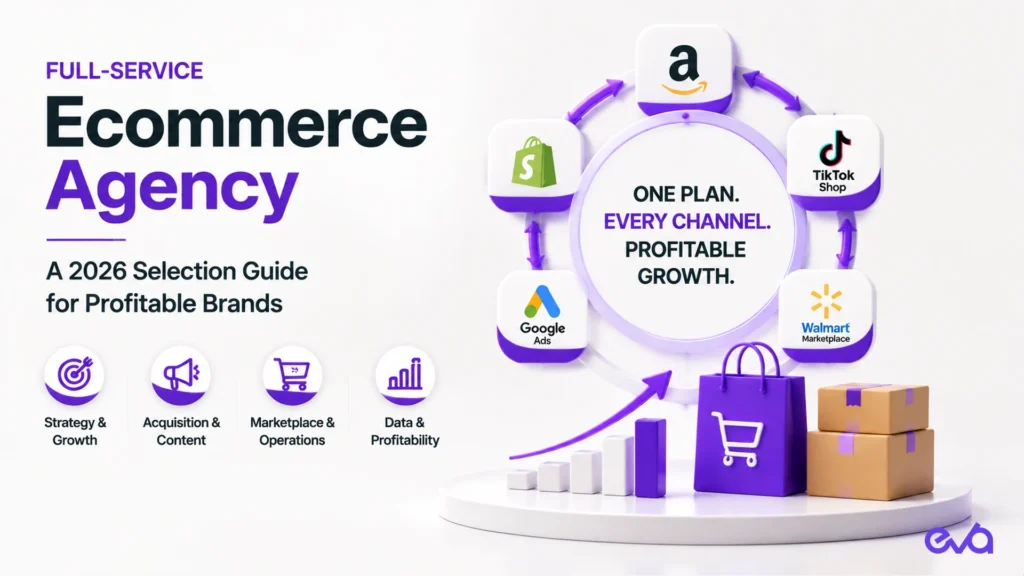
A full-service ecommerce agency should do more than place specialists beside each other. The value comes from coordinating customer acquisition, marketplace operations, content, conversion, inventory, fulfillment, retention, and financial decisions around one growth plan. Without that coordination, each channel can hit its own metric while the brand loses contribution, runs out of stock, discounts unnecessarily, or presents inconsistent products to customers.
The phrase full service is used loosely. One agency may include media buying and creative recommendations. Another may manage Amazon catalog, Shopify conversion, TikTok creators, lifecycle, retail media, and operations. The buyer should define what must be owned, who has authority to execute, which systems connect the work, and how performance will be reconciled with finance before comparing fees or case studies.
This 2026 guide provides a selection framework for profitable brands. It explains the major capabilities, the difference between coordination and referrals, how to inspect the delivery team, what technology should accomplish, and how to avoid paying for a broad promise that still leaves the brand managing every dependency.
Quick answer: A full-service ecommerce agency should provide one accountable operating model across the channels and functions included in scope. For an omnichannel brand, that can include Amazon, Shopify, TikTok Shop, retail media, content, conversion, customer data, lifecycle, inventory, and measurement. Choose a partner that can execute changes, connect product-level economics, and explain who owns every cross-functional decision.
Why this guide exists: Eva Commerce offers services discussed on this page. This guide separates buyer education from the service pages and applies the same evidence, disclosure, ownership, pricing-transparency, and correction rules described in our evaluation methodology and correction policy.
Table of Contents
- What is the best full-service ecommerce agency for a brand?
- Full-service ecommerce agency scorecard
- 1. Define full service from the customer backward
- 2. Inspect channel depth, not logo coverage
- 3. Verify the team that will actually deliver
- 4. Require product-level economics
- 5. Evaluate technology as an execution multiplier
- 6. Compare execution scope with the fee
- 7. Establish governance before launch
- 8. Run a 90-day proof before expanding scope
- A 30-day full-service agency selection plan
- How Eva delivers full-service ecommerce management
- The cross-channel proof packet
- Full-service ecommerce agency FAQ
What is the best full-service ecommerce agency for a brand?
Quick answer: The best full-service ecommerce agency is the one that can execute the brand’s required work across channels, connect product-level economics, preserve data ownership, and assign one accountable leader. Evaluate real delivery depth, not the number of platform logos on a capabilities page.
This page owns full-service partner-selection intent. The Ecommerce Growth Agency guide explains the broader category, while Eva’s service hub routes brands to specific managed services.
Full-service ecommerce agency scorecard
| Capability | Evidence to request | Failure to avoid |
|---|---|---|
| Channel management | Named operators and current client examples | Separate channel plans competing for budget and stock |
| Commerce operations | Catalog, inventory, fulfillment, and issue workflows | Recommendations that the brand must execute |
| Growth execution | Media, conversion, content, creators, and lifecycle process | Traffic growth without customer or product economics |
| Data and technology | Inputs, decisions, controls, and audit history | A dashboard presented as a management system |
| Measurement | Contribution, cohort, inventory, and finance reconciliation | Platform attribution used as the only truth |
| Accountability | Decision rights, service levels, and escalation path | No owner when channels affect one another |
Agency labels are not standardized, so the brand must define the operating scope in the agreement. For each platform, verify current partner programs and capabilities directly with the platform and provider. Eva’s framework focuses on observable execution, economic controls, and ownership rather than badges alone.
1. Define full service from the customer backward
Map the customer journey and the product journey. A shopper can discover a product through TikTok, research it on Amazon, buy through Shopify, receive an email, and reorder through a marketplace. The product moves through sourcing, content, catalog, inventory, fulfillment, returns, and finance. Mark every decision where a disconnected owner can delay action or create a conflicting promise. Those are the capabilities that should determine agency scope.
Separate required ownership from optional advice. If the brand needs the agency to fix a listing, change a landing page, brief a creator, adjust inventory exposure, and reconcile campaign performance, include those actions explicitly. A broad strategic deck is not the same as operating authority. Full service should reduce the amount of coordination the brand must perform while preserving leadership visibility over product, cash, and risk.
2. Inspect channel depth, not logo coverage
An agency website may list Amazon, Shopify, TikTok, Google, Meta, Walmart, Target, and Instacart without maintaining deep delivery teams for each. Ask for the named operator, recent work, normal client load, supported geographies, and specific tasks performed on every channel in scope. Determine whether work is completed internally, outsourced, or referred to a partner. Each model can work, but the operating chain and accountability must be visible.
Use realistic scenarios during selection. Ask how the team would respond when Amazon stock is constrained while Shopify inventory is healthy, a TikTok creator causes an unexpected demand spike, or a Google campaign sends traffic to a product with a rising return rate. Strong agencies explain the cross-channel decision and who executes it. Weak agencies answer only from the channel console they sell most often.
3. Verify the team that will actually deliver
Meet the account leader and specialists who will own the work. Request their experience, tenure, portfolio size, coverage plan, review cadence, and quality controls. Senior sales participation does not guarantee senior delivery. The agency should show how strategic decisions reach daily execution, how specialists challenge one another, and who resolves conflicts across media, content, operations, and finance.
Look for continuity without unnecessary layers. One generalist rarely has enough depth across every channel, while a large team without a single accountable owner creates meetings and handoffs. A useful structure combines a senior growth owner, channel specialists, operational capability, and backup coverage. The brand should know whom to contact for routine decisions, urgent incidents, commercial reviews, and executive escalation.
4. Require product-level economics
Channel return on ad spend cannot decide how much capital a brand should invest. Build a product-level view that includes net sales, cost of goods, discounts, marketplace fees, fulfillment, shipping, returns, creator commission, media, and variable operating cost. Add inventory cover and lead time. This allows the team to see when a channel appears efficient because it captured demand that another channel created, or when revenue growth consumes cash faster than inventory can be replaced.
Ask the agency to explain its definition of profit and how it reconciles with finance. Operating contribution can be timely without claiming to be the general ledger, but assumptions should be documented and revisited. Targets should vary by product role and customer cohort. A launch, mature profit product, inventory-constrained SKU, and clearance item should not share one acquisition threshold.
5. Evaluate technology as an execution multiplier
Technology should connect signals, identify exceptions, preserve decision history, accelerate analysis, and safely execute repeatable changes. Ask what data enters the system, what decisions it supports, what remains manual, and how operators review automated actions. Product margin, inventory, price, conversion, returns, rank, and customer behavior can be as important as advertising data. A dashboard that displays metrics is useful, but it is not proof of coordinated management.
Request examples where technology changed the timing or quality of a business decision. Useful outcomes include detecting a stock risk before media created a shortage, finding a product-page issue behind falling conversion, reallocating spend to stronger contribution, or identifying a repeat-customer segment worth retaining. The system should make the accountable team faster and more consistent without pretending that software owns the commercial result.
6. Compare execution scope with the fee
Normalize proposals before comparing price. List strategy, account management, campaign execution, creative production, creator management, catalog work, store changes, lifecycle, analytics, reporting, meetings, technology, and after-hours coverage. Identify caps, exclusions, third-party costs, and the work the brand must still perform. A lower agency fee can create a higher total cost when the internal team coordinates vendors or fixes execution gaps.
Examine incentives. Percentage-of-spend arrangements may reward higher media, performance fees depend on definitions and attribution, and fixed retainers need a clear scope and capacity model. No structure is automatically wrong. Tie commercial reviews to contribution, customer value, inventory, and agreed growth outcomes. The agency should be willing to recommend less spend when product economics or operations cannot support more.
7. Establish governance before launch
Define decision rights, approval limits, communication channels, reporting cadence, incident severity, and response times. Document who owns platform access, data exports, creative files, campaign history, pixels, domains, and customer data. Use named accounts, least privilege, and a controlled offboarding process. The brand should be able to change partners without losing operational memory or critical access.
Create one weekly operating review and one monthly business review. The weekly meeting addresses exceptions and decisions across channels. The monthly review reconciles results, economics, inventory, customer cohorts, and the roadmap. Avoid separate meetings where every channel reports a win but no one explains the total business. A shared action log keeps strategy attached to execution and shows whether expected outcomes occurred.
8. Run a 90-day proof before expanding scope
The first 30 days should establish access, baselines, economics, priorities, and immediate risks. The next 30 should execute the highest-confidence corrections and launch controlled tests. By day 90, the brand should see cleaner operating data, faster decisions, resolved ownership gaps, and evidence that the team can coordinate across functions. Revenue alone may be affected by seasonality or prior work, so inspect the quality of the system as well as the result.
Expand channels or services only after the core operating cadence works. More scope does not fix weak ownership. A disciplined agency will identify dependencies and sequence work instead of promising simultaneous transformation. The final selection should give the brand confidence that one team can manage complexity while leadership retains a clear view of capital, customer, and product decisions.
A 30-day full-service agency selection plan
- Week 1: Map customer and product journeys, required ownership, current vendors, access, economics, and internal capacity.
- Week 2: Shortlist agencies by actual channel depth, delivery team, cross-functional execution, and relevant client evidence.
- Week 3: Run common scenarios, reference checks, security review, fee normalization, and measurement comparison.
- Week 4: Select the partner, document decision rights, establish baselines, and approve a sequenced 90-day plan.
How Eva delivers full-service ecommerce management
Eva manages Amazon, Shopify, TikTok Shop, and retail advertising as one coordinated growth system. Senior operators connect advertising, ranking, content, customer data, inventory, catalog, creators, lifecycle, and profit. One team owns the plan and execution, which reduces channel silos and keeps product and capital decisions visible.
Eva Intelligence connects product-level signals and helps operators detect what needs action. The technology supports the team rather than replacing accountability. Brands can start with a six-month growth roadmap that identifies the economic opportunity, operating constraints, required scope, and sequence before deciding how aggressively to scale.
The cross-channel proof packet
Quick answer: A full-service ecommerce agency should show one decision system across marketplaces and direct commerce while preserving clear channel ownership, source data, and brand access.
- One product-level P&L across channels
- A responsibility map for every operator and decision
- A customer, inventory, and demand reconciliation example
- Data ownership, access, and transition terms
Primary references: Amazon Sponsored Ads · Shopify Analytics · TikTok Shop Product GMV Max
Full-service ecommerce agency FAQ
What does a full-service ecommerce agency do?
Scope varies, but a true full-service model can coordinate channel strategy, advertising, content, conversion, catalog, customer data, lifecycle, inventory, fulfillment, analytics, and profit. The agreement should state which work is advice and which is executed.
How much does a full-service ecommerce agency cost?
Cost depends on channel count, complexity, media, creative, operational scope, geography, and operator seniority. Compare total required resources and internal coordination, not only the retainer.
Should one agency manage Amazon and Shopify?
It can create better coordination when the agency has real depth in both and uses shared product and customer economics. Verify the actual teams and workflows rather than assuming broad website claims equal delivery capability.
How long should an ecommerce agency need to show value?
Early value should appear through clearer ownership, resolved issues, better data, and faster decisions. Commercial outcomes depend on the starting point, product cycle, inventory, seasonality, and the changes required. Use a defined 90-day plan.
What data should the brand keep?
The brand should retain platform ownership, campaign history, customer data, analytics, creative files, product records, decision history, and regular exports. Access should use named accounts and least privilege.
Related Eva resources: Amazon Management, Shopify Management, TikTok Shop Management, Eva Playbooks.