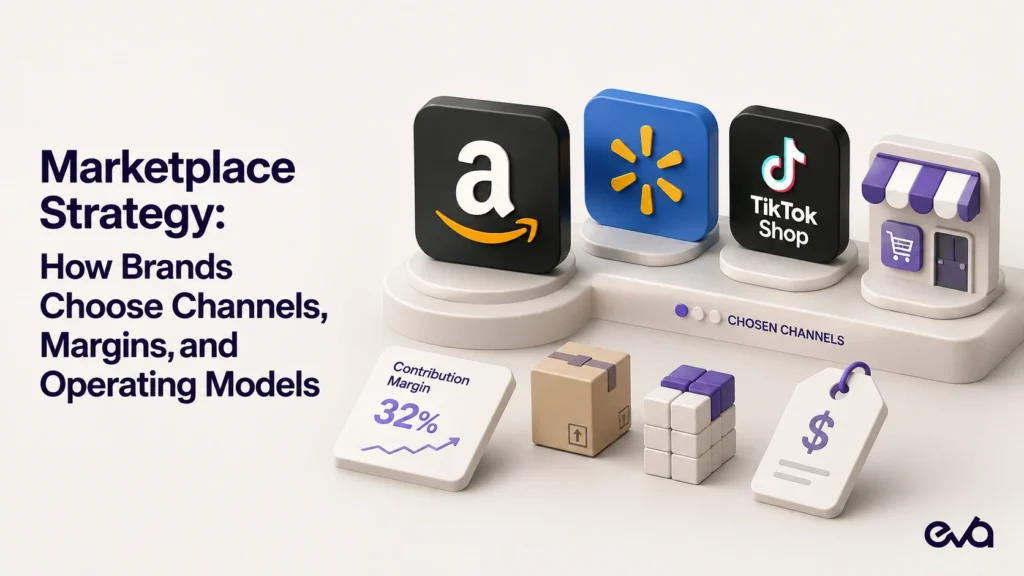
A marketplace strategy defines where a brand will sell, why each channel belongs in the portfolio, which products it will offer, how it will win discovery and conversion, and how operations will protect profit. It connects channel selection, assortment, price, content, inventory, fulfillment, advertising, data, governance, and financial measurement.
This guide turns the search for marketplace strategy into a business decision. It focuses on verifiable facts, operating tradeoffs, customer impact, and contribution margin. Platform features and policies change, so use the linked official sources and the live account as the final authority before implementation.
The recommended approach is deliberately cross-functional. A marketplace strategy decision can affect acquisition, merchandising, inventory, payments, fulfillment, customer service, reporting, cash flow, and brand trust at the same time. Reading each section through only a marketing or technology lens can hide the operational cost. Use the article as a working checklist, then replace general assumptions with account-level data before taking action.
Table of Contents
- Quick decision framework
- Define the commercial objective
- Score channel attractiveness
- Assign each channel a role
- Design assortment and pricing
- Build retail readiness
- Coordinate inventory and fulfillment
- Plan marketplace advertising
- Create governance and data ownership
- Review the portfolio quarterly
- Implementation roadmap for marketplace strategy
- Metrics that keep the decision honest
- Common mistakes to avoid
- Give every channel a specific role
- Marketplace portfolio scorecard
- Govern channel conflict deliberately
- Quarterly portfolio decisions
- Frequently asked questions
- Sources and further reading
- Turn marketplace strategy into execution
Quick decision framework
Before choosing a tool or changing a workflow, define the outcome, the owner, the available evidence, and the acceptable downside. For marketplace strategy, a useful decision record states the current problem, baseline metrics, options considered, financial assumptions, risks, approval date, and review date. This prevents a popular tactic from becoming a permanent process without proof.
- Define the customer and commercial objective.
- Confirm current platform eligibility, policy, and pricing.
- Model total cost and contribution margin.
- Test with representative products, orders, and edge cases.
- Assign operational ownership and escalation paths.
- Measure the result against a documented baseline.
Define the commercial objective
Decide whether the program is designed for revenue diversification, customer acquisition, geographic expansion, wholesale support, category defense, inventory productivity, or learning. One channel can serve several goals, but the primary objective determines the right assortment, investment, and measurement.
The practical implication is that teams need evidence at the level where the decision is made. Use a representative product, order, market, and customer journey; document exceptions; and separate platform capability from what has actually been configured in the account.
For this part of the decision, turn this requirement into a short acceptance test. state the starting condition, the action a user or operator takes, the expected result, the data that proves it, and the person who approves the result. repeat the test for a normal case and at least two exceptions. this makes a broad requirement observable before budget or inventory is committed.
Score channel attractiveness
Evaluate audience fit, category demand, competitive intensity, seller requirements, fees, advertising, fulfillment, data, international reach, brand control, and internal readiness. Use evidence and weights rather than choosing a marketplace because competitors appear there.
From an operating perspective, assign a named owner, a review cadence, and an escalation threshold. The process should explain what happens when data is missing, a policy changes, demand exceeds the forecast, or a customer outcome conflicts with the original assumption.
For this part of the decision, interview the people who execute this work every day. their manual fixes, spreadsheets, support tickets, and workarounds often reveal costs that are absent from a vendor comparison. estimate the time spent per week, the error rate, and the downstream effect on customers and finance. a proposed improvement should remove a measured constraint rather than relocate it to another team.
Assign each channel a role
A channel can be a scale engine, discovery surface, premium assortment, clearance route, regional test, or strategic defense. Explicit roles prevent teams from forcing identical prices, products, content, and targets onto fundamentally different environments.
Financially, connect the choice to net revenue, variable cost, fixed cost, cash timing, and risk. A result can improve conversion or speed while still reducing contribution margin, so the scorecard must show both customer value and business value.
For this part of the decision, use a scenario model with conservative, expected, and upside cases. change volume, conversion, average order value, fees, labor, returns, and failure rates independently so the team can see which assumption drives the result. record the break-even point and the condition that would cause the plan to be paused. this is more useful than one precise-looking forecast.
Design assortment and pricing
Choose hero products, channel exclusives, bundles, pack sizes, and excluded items based on demand and economics. Model price consistency, promotions, fees, fulfillment, advertising, returns, and wholesale relationships. Protect contribution margin and avoid avoidable channel conflict.
For measurement, capture a baseline before the change and keep the test window long enough to include refunds, returns, service contacts, and operational exceptions. Segment results by product, market, channel, and customer type when the blended average hides meaningful differences.
For this part of the decision, check the customer journey on mobile from first touch through post-purchase support. note every promise, field, delay, handoff, and source of uncertainty. then check whether internal systems can honor what the customer sees. the gap between presentation and execution is where many preventable cancellations, returns, complaints, and policy issues begin.
Build retail readiness
Accurate product data, compliant claims, images, reviews, availability, competitive offers, and reliable delivery must be in place before traffic is scaled. Readiness is continuous because catalog conflicts, stock, prices, and policies change.
For governance, write the source of truth, access roles, approval steps, and rollback route. Keep screenshots or exports only where permitted, record decisions, and review the control after launch. Clear ownership matters most when several apps, partners, or channels share the workflow.
For this part of the decision, create a simple responsibility matrix for the workflow. one person should be accountable for the outcome even when marketing, operations, finance, technology, legal, and external partners contribute. define who can approve a change, who must be consulted, who receives an alert, and who performs rollback. ownership should remain clear during weekends and peak periods.
Coordinate inventory and fulfillment
Forecast demand by channel while maintaining one view of working capital. Define allocation, replenishment, safety stock, lead times, fulfillment route, returns, and exception handling. Inventory should follow profitable demand without starving strategically important channels.
For customer experience, make promises understandable before purchase and achievable after purchase. Accurate content, realistic delivery or service expectations, accessible policies, and responsive support reduce preventable contacts and protect long-term trust.
For this part of the decision, document the data lineage behind the decision. identify where each product, price, inventory, customer, order, and cost field originates; how often it updates; which transformations occur; and which report is authoritative. reconcile a sample to source records. decisions made from delayed or blended data should be labeled so confidence is not overstated.
Plan marketplace advertising
Retail media should support the role of the channel and product. Separate branded defense, category acquisition, product targeting, remarketing, and experimentation. Connect spend to availability, conversion, margin, incrementality, and total sales rather than viewing platform ROAS alone.
The practical implication is that teams need evidence at the level where the decision is made. Use a representative product, order, market, and customer journey; document exceptions; and separate platform capability from what has actually been configured in the account.
For this part of the decision, run a pre-mortem before launch. assume the initiative failed after ninety days and list the most plausible reasons: weak demand, bad economics, incomplete configuration, policy conflict, poor training, data latency, inventory shortage, or customer confusion. give each material risk an early-warning signal, an owner, and a response. this converts anxiety into an operating control.
Create governance and data ownership
Assign decision rights for catalog, price, inventory, promotions, advertising, policy, customer service, and finance. Choose systems of record and reconciliation routines. Cross-functional governance prevents fast local decisions from creating company-wide errors.
From an operating perspective, assign a named owner, a review cadence, and an escalation threshold. The process should explain what happens when data is missing, a policy changes, demand exceeds the forecast, or a customer outcome conflicts with the original assumption.
For this part of the decision, set a review calendar before the work begins. daily monitoring may be appropriate during launch, followed by weekly operating reviews and monthly financial reviews. keep a decision log that records what changed and why. without this record, teams often repeat unsuccessful tests or credit the wrong action for a result that came from seasonality or a promotion.
Review the portfolio quarterly
Measure revenue, contribution margin, new customer indicators, organic and paid mix, in-stock rate, returns, operational effort, and strategic value. Expand, repair, reposition, or exit channels based on evidence. Strategy includes deciding what not to pursue.
Financially, connect the choice to net revenue, variable cost, fixed cost, cash timing, and risk. A result can improve conversion or speed while still reducing contribution margin, so the scorecard must show both customer value and business value.
For this part of the decision, decide what evidence is strong enough to scale. one successful week may show technical feasibility but not durable demand, margin, or customer quality. require a minimum sample, stable operations, completed returns or dispute windows where relevant, and consistent results across important segments. scaling criteria should be agreed before enthusiasm changes the standard.
Implementation roadmap for marketplace strategy
Use the first thirty days to validate facts and repair foundations. Inventory the current marketplace strategy workflow, collect current platform terms, map systems and owners, benchmark performance, and identify the highest-risk gaps. Do not automate a process that the team cannot explain manually.
During days thirty-one through sixty, run a controlled pilot. Select a limited assortment, market, campaign, or order segment; define success and stop conditions; test normal and exceptional cases; and review the output with marketing, operations, finance, technology, and customer service. Record every assumption that materially affects the result.
During days sixty-one through ninety, decide whether to scale, repair, or stop. Standardize the successful workflow, train owners, create dashboards, document escalation and rollback, and schedule a policy and economics review. Expansion should follow demonstrated accuracy and profit, not activity alone.
Metrics that keep the decision honest
| Metric group | What to monitor | Why it matters |
|---|---|---|
| Demand | Qualified traffic, conversion, orders, average order value | Shows whether the offer earns customer action |
| Economics | Net revenue, variable cost, acquisition cost, contribution margin | Separates profitable growth from expensive volume |
| Operations | Cycle time, error rate, stock availability, exceptions | Tests whether the workflow can scale reliably |
| Customer | Cancellations, returns, contacts, satisfaction signals | Reveals problems hidden by initial sales |
| Risk | Policy incidents, fraud or disputes, access changes, data failures | Measures the downside of the operating model |
Common mistakes to avoid
Common mistakes include selecting marketplace strategy tactics from headline price or popularity, relying on outdated screenshots, measuring gross sales without total cost, scaling before edge-case testing, allowing unclear data ownership, and failing to document a rollback path. Another mistake is copying a competitor workflow without knowing its assortment, margins, team, contracts, or customer mix.
A disciplined team treats every recommendation as a hypothesis. It verifies the current policy, tests the customer journey, reviews financial and operational consequences, and changes course when the evidence is weak. This approach is slower at the first meeting and much faster when the business scales.
Give every channel a specific role
Amazon
Amazon can provide broad product-search demand, mature advertising, fulfillment options, and intense offer competition. It often fits scale, category acquisition, branded defense, and customer-intent capture when catalog, inventory, compliance, and margin are ready.
Walmart Marketplace
Walmart can diversify marketplace demand and connect with Walmart’s retail ecosystem. Brands should evaluate category demand, assortment, price, item setup, fulfillment, seller performance, and Walmart Connect investment instead of treating it as a copy of Amazon.
TikTok Shop
TikTok Shop can combine entertainment, creators, affiliates, paid amplification, and checkout. It fits products that can be demonstrated and supported by workable commissions, inventory, content velocity, claims governance, and fast operations.
Etsy
Etsy is relevant for eligible creative goods and shoppers seeking the marketplace’s assortment. Product eligibility, listing economics, marketplace search, reviews, production workflow, advertising, and permitted customer communication shape the role.
eBay and specialist marketplaces
eBay and category-specific marketplaces may provide demand for particular products, conditions, geographies, or buyer communities. Evaluate the actual customer and economics rather than using platform size as a proxy for fit.
Owned ecommerce
A Shopify, BigCommerce, WooCommerce, or other owned storefront is not a marketplace, but it belongs in the same portfolio decision. It provides greater experience and data control while requiring the brand to generate demand. Channel strategy should connect, not confuse, these layers.
Marketplace portfolio scorecard
| Dimension | Question | Measure |
|---|---|---|
| Demand | Does the channel reach a relevant customer? | Qualified searches, category sales, conversion |
| Economics | Can the offer fund fees and growth? | Contribution margin after media and returns |
| Readiness | Can the brand meet the standard? | Catalog, stock, delivery, reviews, compliance |
| Control | Which decisions and data remain available? | Price, content, customer, reporting, integrations |
| Scale | Can operations absorb growth? | Error rate, cycle time, capacity, cash requirement |
Govern channel conflict deliberately
Document how pack size, product availability, advertised price, promotions, wholesale agreements, and customer expectations will work across the portfolio. Channel conflict is not solved by pretending every offer is identical. It is managed with clear roles, differentiated value where appropriate, lawful pricing policies, disciplined communication, and financial visibility. Review whether one channel’s promotion or inventory decision creates stockouts, price confusion, or retailer tension elsewhere before approving it.
Quarterly portfolio decisions
Classify each channel as expand, maintain, repair, test, or exit. Expansion requires profitable demand and stable execution. Maintenance protects a useful role without forcing growth. Repair has a deadline and a specific constraint. A test has a limited hypothesis and budget. Exit is appropriate when strategic value and economics remain weak after an agreed correction period. Recording these decisions prevents sunk cost and internal politics from becoming strategy.
Frequently asked questions
What is a marketplace strategy?
It is the plan that connects marketplace selection, channel roles, assortment, operations, marketing, data, and financial goals.
How many marketplaces should a brand use?
Use only the number the organization can operate well. Expansion should follow demand, economics, readiness, and capacity rather than a fixed count.
Should prices be the same everywhere?
Brands need a deliberate pricing policy that accounts for customer trust, channel costs, promotions, packs, agreements, and applicable laws.
How should marketplace profit be measured?
Start with net sales and subtract product cost, fees, fulfillment, advertising, returns, promotions, and allocated operating costs.
When should a brand leave a marketplace?
Consider exit or repositioning when economics, policy risk, demand, brand fit, or operating burden remain unattractive after a defined repair period.
Who should own marketplace strategy?
A clear accountable leader should coordinate commercial, operations, marketing, finance, technology, legal, and customer-service stakeholders.
Official marketplace resources: Amazon Sell, Walmart Marketplace, TikTok Shop Seller Center, and Etsy Fees & Payments Policy.
Sources and further reading
- marketplace expansion
- Walmart versus Amazon
- Amazon management
- TikTok Shop management