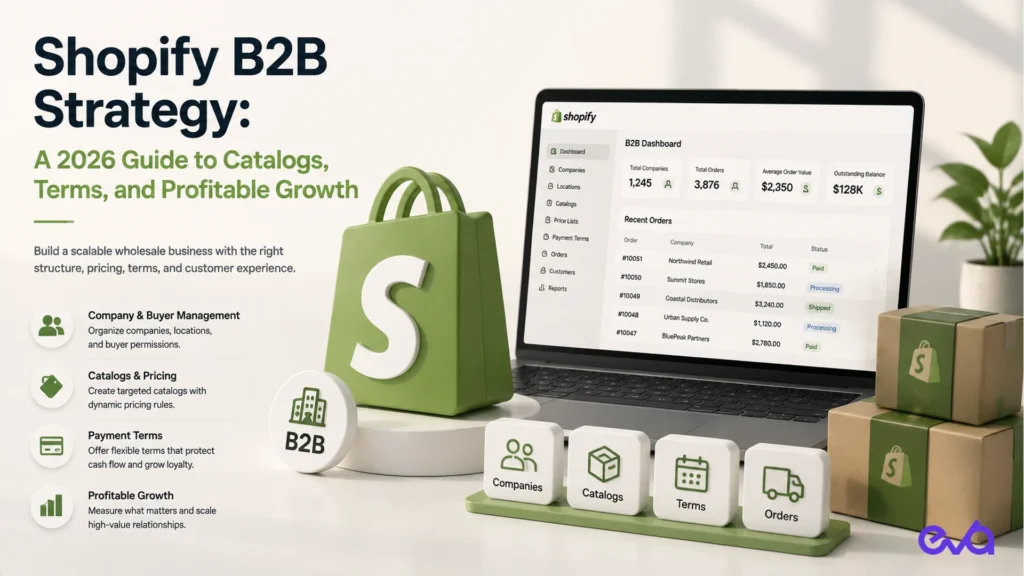
Shopify B2B gives eligible merchants tools to manage business customers, locations, catalogs, pricing, payment terms, checkout, and orders within Shopify. The technology can simplify wholesale operations, but profitable B2B growth still depends on commercial policy. A brand must decide whom it will serve, which assortment each buyer can access, how pricing works, what terms the business can finance, and how inventory and service will be protected.
Wholesale buyers expect consistency. They need reliable case packs, lead times, product data, order history, tax handling, payment options, and support. The brand needs margin, cash discipline, credit controls, channel policy, and a clean source of truth. If those rules are not established before configuration, the store can reproduce manual exceptions at a larger scale.
This 2026 guide connects Shopify configuration with the operating model behind it. It covers company and buyer structure, catalogs, price lists, payment terms, order controls, inventory, customer experience, data, and the scorecard brands should use to expand B2B without weakening direct-to-consumer or marketplace growth.
Quick answer: Define customer segments, company locations, buyer roles, assortment, price lists, quantity rules, payment terms, taxes, shipping, inventory allocation, and service levels before configuring Shopify B2B. Use catalogs and company-specific policies to reduce manual exceptions. Measure net contribution, payment behavior, reorder quality, inventory impact, and account growth rather than wholesale revenue alone.
Table of Contents
- Shopify B2B operating stack
- 1. Choose the B2B customer and channel role
- 2. Model companies, locations, and buyer permissions
- 3. Build catalogs around commercial policy
- 4. Set payment terms the cash cycle can support
- 5. Design ordering and fulfillment for wholesale reality
- 6. Create a buyer experience that reduces service cost
- 7. Connect acquisition, sales, and lifecycle
- 8. Measure B2B contribution and account quality
- A 30-day Shopify B2B launch plan
- How Eva supports Shopify B2B growth
- Shopify B2B FAQ
Shopify B2B operating stack
| Layer | Core decision | Control |
|---|---|---|
| Customer structure | Which companies, locations, and buyers can order | Verified roles and approval workflow |
| Catalog | Which products and prices each segment can access | Versioned assortment and price lists |
| Order policy | Minimums, increments, terms, tax, and shipping | Rules that protect margin and service |
| Inventory | What stock is available to each channel | Allocation, lead times, and backorder policy |
| Service | How buyers onboard, reorder, and resolve issues | Named ownership and response levels |
| Economics | Which accounts create durable contribution | Product, account, and cohort reporting |
Shopify documents B2B company profiles, customer locations, catalogs, pricing, payment terms, and related checkout controls for eligible plans. Confirm current availability and configuration in the official Shopify B2B documentation, including the pages for catalogs and payment terms.
1. Choose the B2B customer and channel role
Define the buyer segments the brand can serve well: independent retailers, regional chains, distributors, corporate buyers, hospitality, professional practices, or other groups. For each segment, document order size, assortment need, service expectation, credit risk, sales cycle, and expected reorder pattern. Do not open one wholesale experience to every applicant without qualification. Poor-fit accounts create support, payment, and inventory cost that revenue can hide.
Clarify how B2B relates to Shopify direct sales, Amazon, marketplaces, and existing distributors. Establish territory, pricing, promotion, exclusivity, and customer-conflict rules. A wholesale account should understand where it can sell the products and how the brand protects positioning. Internal teams also need a policy for channel conflicts so one urgent order does not create inconsistent exceptions.
2. Model companies, locations, and buyer permissions
Create company records that reflect the real commercial relationship. A company may have several locations with different shipping addresses, tax treatment, catalogs, payment terms, and buyers. Decide who can place orders, view pricing, approve purchases, and manage users. Verify business identity and buyer authority during onboarding. Named access reduces shared-logon risk and gives the service team a clearer order history.
Establish a lifecycle for account creation, approval, updates, inactivity, credit changes, and closure. Record the salesperson or account owner, segment, territory, agreed terms, tax evidence, and service level in controlled fields. Avoid placing essential policy only in notes. Structured records support automation, reporting, and consistent decisions when an employee or buyer changes.
3. Build catalogs around commercial policy
A B2B catalog combines product availability and pricing for a company or location. Design catalogs by meaningful commercial segment instead of creating a unique list for every customer unless the relationship truly requires it. Define base wholesale price, quantity breaks, case packs, minimums, increments, bundles, and exclusions. Keep effective dates and an approval process for price changes.
Connect assortment decisions with margin, inventory, compliance, packaging, and service. Some products may not be suitable for wholesale because they have low contribution, fragile shipping, high returns, constrained supply, or channel restrictions. Test how variants, bundles, subscriptions, and new products behave in the B2B experience. A clean catalog should reduce manual quotes without giving away uncontrolled exceptions.
4. Set payment terms the cash cycle can support
Payment terms are a financing decision. Define which customers can use due-on-fulfillment, net terms, deposits, cards, bank payments, or manual methods. Evaluate order size, payment history, credit evidence, concentration, inventory lead time, and the brand’s own supplier terms. Revenue from a large order can strain cash when the brand pays for inventory and fulfillment long before collecting from the buyer.
Create credit limits, overdue rules, dunning steps, holds, and approval thresholds. Reconcile Shopify order status with payment and finance records. The account team should see available credit and overdue exposure before encouraging another order. Review terms periodically and treat exceptions as explicit commercial approvals, not informal customer-service decisions.
5. Design ordering and fulfillment for wholesale reality
Test minimum quantities, case increments, shipping rates, tax, delivery addresses, purchase-order references, draft orders, partial fulfillment, backorders, cancellations, and returns. Make lead times and availability accurate. A buyer who cannot understand whether an item is ready, made to order, or backordered will create support work or lose confidence. Build confirmation and status communication around the buyer’s operational needs.
Wholesale packaging and fulfillment may differ from direct-to-consumer orders. Include case labels, inner packs, routing requirements, appointment delivery, carton limits, and damage controls where required. Price those services into the account economics. Coordinate inventory allocation so a large B2B order does not silently consume stock committed to marketplaces, subscriptions, or direct customers.
6. Create a buyer experience that reduces service cost
A useful B2B storefront helps an approved buyer find eligible products, understand pack size, see the correct price, reorder efficiently, access order history, and know whom to contact. Use clear product data, compatibility, merchandising, search, filters, and recommendations for the buying mission. Wholesale buyers may prioritize availability, dimensions, ingredients, certifications, shelf life, or case information differently from consumers.
Design onboarding and self-service around common questions, but keep human ownership for commercial and operational exceptions. Track support contacts by reason. Repeated questions can reveal unclear terms, product data, fulfillment status, or account setup. Improving the experience should lower service cost while strengthening reorder confidence, not simply move every interaction into an automated response.
7. Connect acquisition, sales, and lifecycle
B2B growth can come from sales outreach, trade events, referrals, search, paid media, retailer applications, and existing consumer relationships. Separate lead, applicant, approved account, first order, active account, at-risk account, and dormant account stages. Measure movement and quality through the funnel. An approved account without an economically sound order is not yet a successful acquisition.
Use lifecycle communication for onboarding, replenishment, new assortments, seasonal ordering, inventory arrival, and account reactivation. Respect buyer role and company policy. Coordinate automated messages with the account owner so the customer does not receive conflicting offers. Segment by commercial need and purchase cycle rather than sending consumer promotions to wholesale buyers.
8. Measure B2B contribution and account quality
Report net sales, product margin, discount, fulfillment, freight subsidy, service cost, payment cost, bad debt, return, and acquisition expense by company, location, product, and cohort. Add days to pay, reorder interval, inventory impact, concentration, and credit utilization. A large customer can be valuable while still creating risk that requires different terms or inventory planning.
Review exceptions weekly and the account portfolio monthly. Identify overdue balances, falling order frequency, margin erosion, low-fill orders, repeated service issues, and product concentration. Pair the quantitative view with account-owner context. The objective is predictable, profitable relationships that the operation can serve, not the largest possible gross wholesale number.
A 30-day Shopify B2B launch plan
- Week 1: Define buyer segments, channel policy, qualification, economics, account roles, and required data.
- Week 2: Configure companies, locations, catalogs, prices, quantity rules, terms, taxes, and approval controls.
- Week 3: Test complete order, payment, fulfillment, return, support, and finance scenarios with representative buyers.
- Week 4: Onboard a controlled customer group, monitor exceptions, and launch account-level contribution reporting.
How Eva supports Shopify B2B growth
Eva manages Shopify growth across advertising, conversion, merchandising, customer data, lifecycle, inventory, and operations. For B2B programs, the same coordinated model helps brands connect customer acquisition with catalog rules, account economics, stock, service, and cash instead of treating the wholesale storefront as an isolated build.
Eva Intelligence helps operators connect product and customer signals, while experienced teams own the commercial decisions and execution. The goal is a B2B channel that can scale without creating uncontrolled discounts, manual exceptions, or inventory conflict with the rest of the brand.
Shopify B2B FAQ
What is Shopify B2B?
Shopify B2B is a set of wholesale capabilities for eligible Shopify merchants, including companies, locations, catalogs, pricing, payment terms, and B2B checkout controls. Current plan and feature availability should be confirmed with Shopify.
Can Shopify B2B and DTC use the same store?
Shopify supports blended B2B and direct experiences in suitable configurations. The brand should test theme behavior, pricing, products, apps, customer access, analytics, tax, and operations before choosing the architecture.
How should wholesale pricing be set?
Start with product and account economics, required retailer margin, service cost, freight, payment terms, channel positioning, and volume. Use controlled price lists and approval for exceptions.
Should every B2B customer receive net terms?
No. Terms should reflect credit evidence, order history, concentration, cash capacity, and risk. New accounts can begin with immediate payment or deposits and earn different terms through performance.
How is Shopify B2B profitability measured?
Measure net contribution after product cost, discount, fulfillment, freight, service, payment, returns, bad debt, and acquisition. Add payment timing, reorder quality, inventory impact, and account concentration.
Related Eva resources: Shopify Management, Shopify Profitability Guide, Shopify Merchandising Strategy, Eva Playbooks.