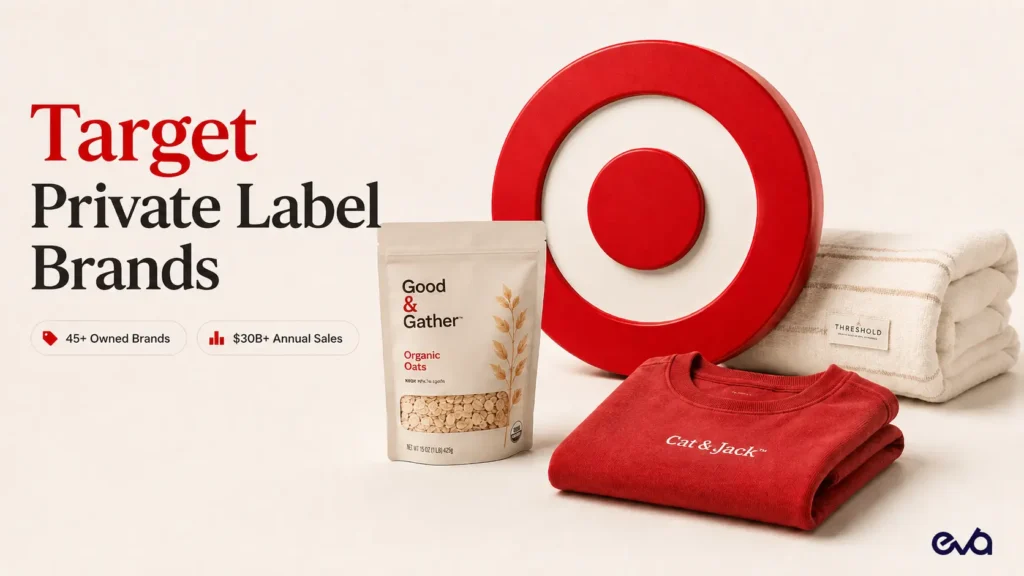
Target brands include Good & Gather, up&up, Threshold, Cat & Jack, All in Motion, Market Pantry, Casaluna, Favorite Day, Goodfellow & Co, Universal Thread, Hearth & Hand with Magnolia, dealworthy, and more than 30 others. Most are Target private label or exclusive house brands built to compete on price, design, and category control across grocery, apparel, home, baby, beauty, and general merchandise.
Quick answer
Target says it has more than 40 owned brands, and several of them, including Good & Gather, Cat & Jack, Threshold, and All in Motion, have each passed $1 billion in annual sales. Combined, Target’s owned brands bring in more than $30 billion a year, about one-third of Target’s annual sales, making private label one of the largest single drivers of Target’s retail business.
If you sell consumer products, Target’s private label portfolio is more than a list of store brands. It is a map of how Target thinks about category control. The retailer uses owned brands to cover grocery, apparel, home, baby, beauty, pets, electronics, and seasonal demand with products shoppers already associate with Target’s design-forward, slightly-elevated positioning.
For third-party brands, that matters because Target Plus and Target’s Roundel advertising platform are not just a new sales channel. You are entering a retail environment where Target’s own brands can be the design benchmark, the price anchor, or the default shopper expectation in your category, and where Target shoppers specifically expect better design and merchandising than at a pure discount retailer.
Table of Contents
- Target private label brands: use the list as a market signal
- List of Target Private Label Brands
- What Are Target Brands?
- Is Good & Gather a Target Brand?
- Target Private Label vs National Brands
- What This Means Before Selling on Target Plus
- How to Compete Against Target’s Private Label Brands
- Target Brand Signals to Review Before Launch
- Target private-label brand map by category
- Frequently Asked Questions
- Want to know if Target is ready for your brand?
Target private label brands: use the list as a market signal
A brand list is a starting point for category research. Compare product differentiation, price architecture, customer expectations, and the channel work required to compete.
For teams that need coordinated execution, see marketplace expansion services.
List of Target Private Label Brands
This is a practical seller-facing list, not a legal ownership database. Target adds, retires, and repositions owned brands regularly, so treat this as a research starting point and verify current assortment on Target.com before making a sourcing or pricing decision.
| Target brand | Primary category | What brands should learn from it |
|---|---|---|
| Good & Gather (2019) | Grocery, 2,500+ products | Target’s flagship $1B+ brand. Competes on trust and everyday value in food, but with cleaner packaging and fewer artificial ingredients than most private label. |
| up&up (2009, relaunched 2024) | Household essentials, health, personal care | The true value anchor across nearly every category. National and marketplace brands need a clear reason above this price floor. |
| Threshold (2012) | Home styling and furnishings | $1B+ brand. Shows Target can compete on design taste, not just price, in home goods. |
| Cat & Jack (2016) | Children’s apparel | $1B+ brand. Durability guarantees and size-inclusive fit drove category dominance over national kids’ brands. |
| All in Motion (2020) | Active lifestyle, family activewear | $1B+ brand. Proves private label can win in performance apparel, traditionally a national-brand stronghold. |
| Market Pantry (2001) | Pantry staples | Legacy value brand now sitting below Good & Gather, a two-tier grocery strategy sellers should map separately. |
| Casaluna (2020) | Bedding and bath | Premium-tier home brand; shows Target segments home goods by quality tier, not one flat private label. |
| Favorite Day (2021) | Snacks, bakery, treats | Built for impulse and discovery, not just replenishment. Packaging and novelty matter as much as price. |
| Goodfellow & Co (2017) | Menswear and grooming | Comparison shopping is intense; fit content, fabric detail, and styling photography carry the category. |
| A New Day / AVA & VIV (2015–2017) | Women’s apparel, extended sizes | Size range and fit guidance are the deciding factor more often than price for apparel shoppers. |
| dealworthy (2024) | Low-price essentials, multi-category | Target’s newest and most aggressive value play, a direct signal that price competition is intensifying, not easing. |
| Hearth & Hand with Magnolia (2017) | Home and lifestyle | Celebrity/creator partnership brand that shows Target uses exclusivity and story, not just price, to drive category share. |
| Kindfull (2021) | Cat and dog food | A relatively new category entry; still an open lane for differentiated pet brands to compete on formulation. |
What Are Target Brands?
Target brands are product lines sold under brand names Target owns, controls, or manages as exclusive retail brands. Shoppers often call all of them “Target brands,” but the operating model varies. Some, like Good & Gather and Threshold, are true private label lines designed and sourced by or for Target. Others are exclusive partnership brands, like Hearth & Hand with Magnolia, built with an outside creator or company but sold only at Target.
The common thread is that Target can use these brands to shape assortment, price perception, packaging, and category margin without sharing that control with a national manufacturer. That is why a seller or advertiser should treat Target’s owned brands as strategic competitors, not just background shelf noise.
Is Good & Gather a Target Brand?
Yes. Good & Gather, launched in 2019, is Target’s flagship grocery private label brand and one of several Target owned brands that have passed $1 billion in annual sales, alongside Cat & Jack, Threshold, and All in Motion. It spans more than 2,500 products, from fresh produce to snacks to frozen meals, and sits above the legacy Market Pantry brand in Target’s two-tier grocery pricing structure.
Good & Gather also illustrates how Target’s private label strategy differs from a pure discount approach: the brand markets itself on ingredient quality and no artificial flavors or sweeteners, not just low price, competing with national and organic brands rather than only undercutting them.
Target Private Label vs National Brands
National brands usually win through brand equity, innovation, specialized claims, wider media support, and long-standing shopper loyalty. Target private label brands usually win through design credibility, price-value trust, exclusivity, and tight merchandising. Shoppers associate the Target owned-brand shelf with “better taste for the price” more than any other mass retailer.
The best marketplace strategy accepts that reality. A third-party brand does not need to out-design Threshold or out-price up&up. It needs to choose where it can credibly beat the private label offer: a more specific use case, stronger technical claims, better reviews, a differentiated bundle, or a premium tier Target hasn’t built yet.
What This Means Before Selling on Target Plus
Before applying to Target Plus (Target’s invite-only third-party marketplace) or investing in Roundel advertising, brands should map their products against Target’s private label presence. A product that sits next to Good & Gather, Threshold, or Cat & Jack needs a sharper launch model than a product in a category where Target still relies mainly on national brands.
Price architecture
Model the private label anchor, national brand price range, Target Plus fees, and ad budget before deciding whether the category can be profitable.
Design and content proof
Target shoppers respond to photography and styling quality as much as spec sheets. Listings need to look like they belong next to Threshold and Casaluna.
Operational readiness
Shipping speed, inventory reliability, reviews, and return handling can undercut a well-designed listing if the operating system isn’t ready.
How to Compete Against Target’s Private Label Brands
Competing with Target private label brands starts with choosing the right battle. If a product is close to an up&up or Market Pantry item and the only difference is a higher price, the listing will need exceptional proof to convert. If the product solves a more specific customer problem, offers stronger design, better materials, or gives shoppers a clear reason to trade up from Good & Gather or Threshold, Target Plus can still be a strong channel.
The first move is to separate the catalog into three groups: direct value competitors that need disciplined pricing, differentiated products that can justify a premium through design, formulation, or bundling, and SKUs that shouldn’t launch yet because fees, shipping costs, or ad spend requirements make the economics too thin next to a $1B+ house brand.
Next, build the listing around comparison clarity the way Target’s own brands do. Target shoppers expect strong lifestyle photography, clear material and size detail, and a design point of view, not just a spec table. The trade-up reason should be obvious: better materials, a more specific use case, a stronger warranty, or a more complete bundle than the private label alternative sitting next to it.
Finally, treat Roundel the same way Amazon or Walmart Connect advertisers treat retail media: as an amplifier of readiness, not a substitute for it. Paid placement can get a new product in front of Target shoppers quickly, but it will expose weak photography, thin reviews, or pricing that can’t compete with the private label anchor just as quickly. The better sequence is content and pricing readiness first, controlled Roundel spend second, and scale only after the data shows which products and price points can win.
Target Brand Signals to Review Before Launch
Before applying to Target Plus, review Target’s search results for your core products and write down the private-label pressure in each category. A simple scorecard can prevent expensive mistakes.
- Private label visibility: Which Target owned brands appear on page one for the target search terms?
- Price gap: How far above or below the Target house brand does the national-brand set sit?
- Design gap: Are top listings winning with stronger lifestyle photography, styling, or packaging than yours?
- Review gap: Can the new listing compete with the review count and rating profile shoppers already see?
- Fulfillment gap: Are top competitors using faster shipping, better availability, or store pickup options?
- Margin gap: Can the SKU absorb Target Plus fees, promotions, and Roundel spend while staying profitable next to a $1B+ house brand?
Eva can help brands evaluate Target readiness through Target advertising and Roundel management, and connect execution to broader marketplace expansion strategy across Amazon, Walmart, and Shopify.
Target private-label brand map by category
Use this table as a merchandising map, not a static master list. Target can add, retire, reposition, or expand brands, so validate the current assortment on Target.com before making pricing or category decisions.
| Category signal | Examples shoppers may encounter | What marketplace sellers should review |
|---|---|---|
| Grocery and household essentials | Good & Gather, Market Pantry, Favorite Day, up&up | Price-per-unit, ingredient claims, packaging design, and two-tier pricing position |
| Home and décor | Threshold, Casaluna, Brightroom, Room Essentials | Design language, material clarity, lifestyle imagery, and quality-tier positioning |
| Apparel and kids | Cat & Jack, A New Day, Goodfellow & Co, Universal Thread | Size architecture, fit content, fabric detail, and durability guarantees |
| Active and swim | All in Motion, Shade & Shore | Performance claims, fit, and comparison content against national activewear brands |
| Baby and kids home | Cloud Island, Pillowfort | Safety and material trust signals, and nursery styling consistency |
| Pets | Boots & Barkley, Kindfull | Formulation transparency and a newer, less saturated competitive lane |
How to use the brand map
- Identify the Target-owned or exclusive brands occupying the first page for the target query.
- Compare price, pack size, review count, photography quality, and promotional treatment.
- Choose a defendable position: premium design, specialty use case, superior materials, or stronger content.
- Recheck the category quarterly and record additions, removals, and changes in shelf placement.
Frequently Asked Questions
What brands does Target own?
Target says it has more than 40 owned brands, including Good & Gather, Cat & Jack, Threshold, All in Motion, up&up, and Market Pantry, spanning apparel, home, food, baby, beauty, and pets.
How many private label brands does Target have?
Target says it has more than 40 only-at-Target owned brands. Several of them, including Good & Gather, Cat & Jack, Threshold, and All in Motion, have each passed $1 billion in annual sales.
What is Target’s biggest private label brand?
Good & Gather is Target’s flagship private brand by product count, with more than 2,500 grocery items. It is one of several Target owned brands, alongside Cat & Jack, Threshold, and All in Motion, that have each passed $1 billion in annual sales.
Does Target own any clothing brands?
Yes. Target’s owned apparel brands include Cat & Jack (kids), A New Day and AVA & VIV (women’s), Goodfellow & Co (men’s), Wild Fable (young adult), Universal Thread (denim), and All in Motion (activewear).
Is up&up a Target brand?
Yes. up&up, originally launched in 2009 and relaunched in 2024, is Target’s core value private label brand, covering everyday essentials across health, household, and personal care categories.
Can third-party brands sell next to Target private labels?
Yes, through Target Plus, Target’s invite-only third-party marketplace. Brands need a clear design or value proposition, strong product photography, competitive pricing, and enough differentiation to compete against Target’s house brands and national brands already on the shelf.
How much revenue do Target’s private label brands generate?
Target says its owned brands generate more than $30 billion a year, about one-third of its annual sales. Several individual brands, including Good & Gather, Cat & Jack, Threshold, and All in Motion, have each passed $1 billion.
Sources and context: Target Brands (corporate.target.com); Target’s athletic-wear line becomes its 10th billion-dollar store label (Fortune, 2021); Private-label brands at Target and other grocers losing stigma (Star Tribune); Eva Target Plus and Roundel operating playbook.
Want to know if Target is ready for your brand?
Eva can benchmark your catalog against Target’s private label brands, model Target Plus and Roundel economics, and build a launch plan across content, pricing, and marketplace operations.