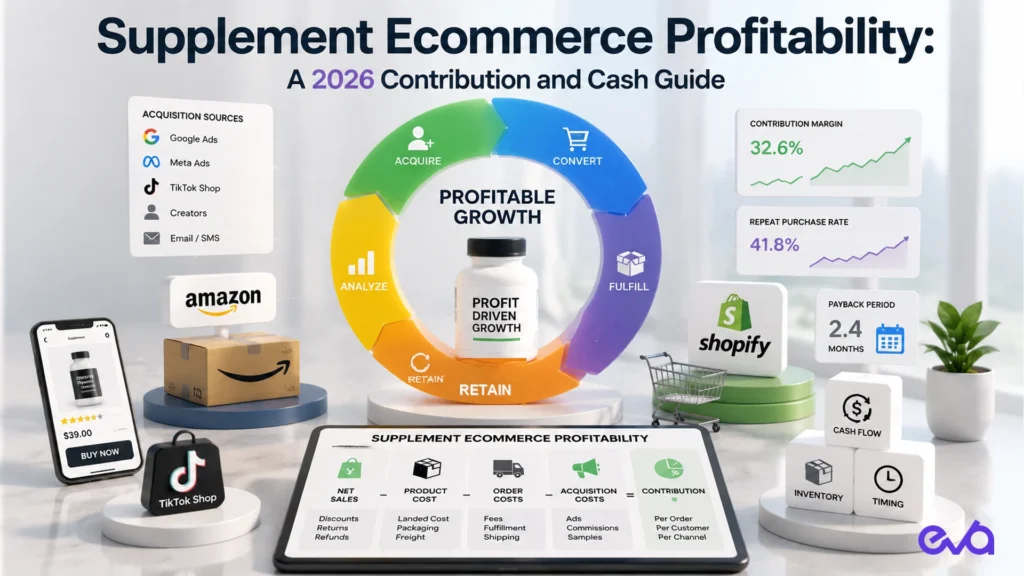
Supplement ecommerce profitability is the contribution and cash a brand creates after the full cost of acquiring, fulfilling, serving, and retaining customers. Gross margin on a bottle is only the beginning. Channel fees, discounts, fulfillment, shipping, returns, samples, creator commissions, advertising, subscription incentives, inventory, and working-capital timing can change the result.
The category often has repeat-purchase potential, which can justify acquisition investment. That potential should be earned through mature cohort evidence. A forecast built from optimistic revenue LTV can hide weak first-order economics, early subscription churn, and cash tied up in long production cycles.
This guide creates one operating language across Amazon, Shopify, TikTok Shop, Google, Meta, creators, inventory, and finance. The examples are formulas, not category benchmarks.
Quick answer
Calculate supplement ecommerce profitability from net sales after discounts and returns, then subtract product and landed cost, channel and payment fees, fulfillment, shipping subsidy, storage, creator commissions, samples, advertising, variable creative, service, and retention cost. Review contribution by SKU, pack, channel, offer, and cohort, then add inventory and cash timing before deciding how fast to scale.
Table of Contents
- In this guide
- Supplement profitability stack
- Current primary sources
- 1. Define net sales consistently
- 2. Build trustworthy product and landed cost
- 3. Calculate order contribution by channel
- 4. Measure acquisition contribution
- 5. Build customer contribution and payback
- 6. Connect inventory and working capital
- 7. Analyze returns, churn, and leakage
- 8. Run one weekly capital-allocation meeting
- A four-week supplement profitability build
- How Eva manages supplement growth around profit
- Supplement ecommerce profitability FAQ
In this guide
- 1. Define net sales consistently
- 2. Build trustworthy product and landed cost
- 3. Calculate order contribution by channel
- 4. Measure acquisition contribution
- 5. Build customer contribution and payback
- 6. Connect inventory and working capital
- 7. Analyze returns, churn, and leakage
- 8. Run one weekly capital-allocation meeting
Supplement profitability stack
| Level | Calculation | Decision |
|---|---|---|
| Net sales | Gross product sales minus discounts, returns, and allowances | Is demand economically real? |
| Product contribution | Net sales minus product and landed cost | Which SKU and pack deserve attention? |
| Order contribution | Product contribution minus channel, payment, fulfillment, shipping, and service | Which offer and channel work? |
| Acquisition contribution | Order contribution minus media, commission, samples, and variable creative | Which source deserves the next dollar? |
| Customer contribution | Cumulative contribution across repeat orders and retention costs | What CAC and payback are supportable? |
| Cash contribution | Contribution adjusted for inventory and settlement timing | How quickly can the brand safely grow? |
Current primary sources
Shopify profit reports: Shopify explains gross profit and margin reporting from net sales and cost-per-item data, including limitations of static cost data.
Amazon Sponsored Products budget guidance: Amazon explains daily budgets and recommends that advertising budgets remain sustainable for the business and aligned with campaign goals.
Shopify customer segmentation: Shopify explains customer segmentation that can support cohort and lifecycle analysis.
1. Define net sales consistently
Operator answer
Use completed-order net product sales after discounts, returns, refunds, and allowances, with taxes and shipping handled consistently.
Document whether the operating view uses order, shipment, completion, or settlement date. Separate product revenue, discount, refund, return, tax, duty, shipping revenue, gift card, cancellation, and adjustment. The daily view can support decisions while finance retains the final accounting treatment.
Connect each adjustment to the original order, SKU, channel, customer, campaign, and cohort where possible. A product can appear profitable before its return or refund window matures. Use completed-order or lag-adjusted views for channels with meaningful cancellation or return timing.
2. Build trustworthy product and landed cost
Operator answer
Version cost by SKU, pack, batch or effective period, and include material inbound and packaging components.
Start with product purchase or manufacturing cost and add freight, duty, inspection, packaging, kitting, preparation, and other landed components that affect the decision. Maintain effective dates instead of overwriting history. Allocate bundle cost to every component.
Record samples, replacements, reships, gifts, damaged units, and expired or disposed inventory even when customer revenue is zero. Use finance-approved cost treatment for formal reporting. The operating model should be accurate enough to compare products and offers without pretending to replace inventory accounting.
3. Calculate order contribution by channel
Operator answer
Subtract the variable costs required to complete and serve an order, then compare equivalent products across channels.
For Shopify, include payment, fraud, pick and pack, packaging, shipping subsidy, apps or service costs that vary, and returns. For Amazon, include marketplace, fulfillment, storage, inbound, preparation, returns, and reimbursement leakage. For TikTok Shop, include platform fees, commissions, discounts, fulfillment, and returns.
Segment by product, pack, market, shipping service, discount, creator, purchase option, and new or returning customer. A larger bundle can improve gross dollars while increasing shipping and slowing repeat. A marketplace order can have lower direct customer data value but more demand capture.
4. Measure acquisition contribution
Operator answer
Subtract media, affiliate or creator commission, samples, variable creative, and acquisition service cost from the order contribution created.
Keep platform ROAS and ACOS, but do not use them as profit. Reconcile attributed sales with completed orders and customer identity where available. Separate brand capture, retargeting, and repeat customers from incremental new-customer acquisition.
For creators, include free product, shipping, commission, production support, paid amplification, and returned orders. For content with cross-channel effects, triangulate brand search, direct traffic, Amazon and Shopify movement, surveys, codes, and controlled tests. Label uncertainty rather than assigning every sale to a convenient source.
5. Build customer contribution and payback
Operator answer
Follow cumulative contribution through actual repeat orders and subscription cycles, then measure how long it takes to recover acquisition cost.
Create cohorts by first-order month, product, pack, channel, campaign or creator, offer, market, and subscription status. Track net sales, product cost, fulfillment, returns, refunds, retention incentive, service, and contribution through consistent windows. Compare mature cohorts before forecasting young ones.
Payback targets should reflect available capital, inventory lead time, demand seasonality, repeat interval, margin, and risk. A longer payback can be rational with stable evidence and sufficient cash. It should not be created by assuming every new subscriber remains active for an arbitrary number of months.
6. Connect inventory and working capital
Operator answer
A profitable unit can still create a cash crisis when production minimums, deposits, lead time, safety stock, and channel settlement absorb capital.
Model purchase-order deposit, balance, production, release, freight, receiving, channel transfer, sale, settlement, return, and reorder timing. Add component minimums and packaging inventory. Forecast by SKU and scenario, not only total revenue.
Use contribution velocity, which combines contribution per unit, realistic demand, and inventory commitment. A slightly lower-margin product that turns reliably can generate more usable cash than a high-margin SKU with a large MOQ and slow sell-through. Coordinate media and promotions with stock and replenishment confidence.
7. Analyze returns, churn, and leakage
Operator answer
Treat every adjustment as evidence about product, promise, fulfillment, service, or channel operation.
Connect return or refund reason with SKU, pack, listing or PDP, creator or campaign, fulfillment, and cohort. Separate damage, wrong item, delivery, expectation, price, duplicate subscription, and product-related service issues. Use qualified escalation for product-safety or adverse-event information.
Track subscription pause, skip, cancel, failed payment, refund, and support cost. Track marketplace storage, removals, chargebacks, missing inventory, and reimbursement recovery. The fastest profit gain often comes from fixing leakage before buying more traffic.
8. Run one weekly capital-allocation meeting
Operator answer
Use the operating model to decide where the next dollar and next unit of inventory should go.
Review net sales, order contribution, acquisition contribution, cohort payback, returns, subscription behavior, inventory cover, purchase orders, cash, and material platform issues. Focus on changes that can alter a decision. Name the owner and expected effect.
Preserve a log for price, pack, discount, media, creator commission, listing, PDP, lifecycle, fulfillment, and inventory changes. Reconcile monthly with finance and update costs. The goal is a trustworthy decision system, not a perfect dashboard that arrives after the opportunity has passed.
A four-week supplement profitability build
- Week 1: Define net sales, contribution levels, new-customer rules, cohort windows, payback, and cost ownership.
- Week 2: Join orders, products, discounts, fees, fulfillment, returns, ads, creators, subscriptions, and inventory.
- Week 3: Trace representative orders and cohorts, reconcile with finance, and document assumptions and gaps.
- Week 4: Launch the weekly capital meeting, record decisions, and measure the realized effect on contribution and cash.
How Eva manages supplement growth around profit
Eva connects advertising, ranking, content, product pages, creators, retention, inventory, and channel operations to product and customer economics. This prevents one channel from claiming a win that another team has to fund.
Eva Intelligence helps senior operators identify where capital should move and what product or operational issue must be fixed first. The purpose is not a generic dashboard. It is accountable execution across Amazon, Shopify, TikTok Shop, Google, Meta, and retail media.
Supplement ecommerce profitability FAQ
What is a good supplement profit margin?
There is no universal margin. Product, channel, fulfillment, acquisition, returns, repeat behavior, inventory, and overhead differ. Use the brand’s required contribution, cash needs, and risk.
Should supplement brands accept a first-order loss?
Only as an explicit investment supported by mature cohort evidence, cash, inventory, and a time-bound rule. Do not justify structural loss with an unproven revenue LTV.
How should creator cost be calculated?
Include payment or commission, free product, sample shipping, production support, amplification, discounts, returns, and service. Connect the cost to completed-order and cohort contribution.
How should Amazon and Shopify profitability be compared?
Use a shared contribution framework while retaining channel-specific fees, fulfillment, acquisition, customer data, returns, and inventory. Compare the same product and time basis.
How often should profitability be reviewed?
Review operational contribution weekly when spend and inventory move quickly, and reconcile with finance monthly. Update scenarios when costs, purchase orders, lead times, or demand change materially.
Related Eva resources: Supplement Ecommerce Agency, Unified Performance View, Blended CAC and Contribution Margin Playbook, Shopify Supplement Brand Growth, Amazon PPC for Supplements.
Important scope note
This guide covers ecommerce operations, not medical or legal advice. Platform policies change, and brands remain responsible for product safety, substantiation, labeling, claims, and qualified review.
Related Eva resource: For marketplace growth support that keeps operational and compliance considerations in view, explore Eva’s supplement ecommerce growth team.