Supplement marketplace compliance is the operating discipline that keeps product data, documentation, labels, claims, listings, ads, creators, fulfillment, and platform responses aligned. It is not a one-time certificate or a disclaimer pasted onto a page. Each channel has its own product and advertising rules, and the complete customer message can extend across packaging, images, testimonials, video, product pages, and checkout.
Brands often split this work among product, legal, marketplace, paid media, creators, agencies, and customer service. Without a shared source of truth, one team can publish language another team already rejected, a creator can repeat an unsupported customer statement, or a product update can leave old marketplace content live.
This guide presents a cross-channel operating model. It does not provide individualized legal, medical, laboratory, manufacturing, or certification advice.
Quick answer
Build supplement marketplace compliance around one versioned product file, an approved claims library, current primary-source policy monitoring, qualified review, channel release checklists, creator disclosure controls, and an incident log. The brand retains responsibility for the product and evidence, while ecommerce operators ensure approved information is used consistently and platform workflows are managed on time.
Table of Contents
- In this guide
- Cross-channel supplement control matrix
- Current primary sources
- 1. Separate product responsibility from platform operations
- 2. Create one versioned product file
- 3. Build an approved claims library
- 4. Maintain current platform matrices
- 5. Control creators, affiliates, and testimonials
- 6. Build a release gate for every channel
- 7. Operate incidents and appeals consistently
- 8. Audit the entire customer message
- A 30-day cross-channel compliance operating setup
- How Eva supports supplement marketplace operations
- Supplement marketplace compliance FAQ
In this guide
- 1. Separate product responsibility from platform operations
- 2. Create one versioned product file
- 3. Build an approved claims library
- 4. Maintain current platform matrices
- 5. Control creators, affiliates, and testimonials
- 6. Build a release gate for every channel
- 7. Operate incidents and appeals consistently
- 8. Audit the entire customer message
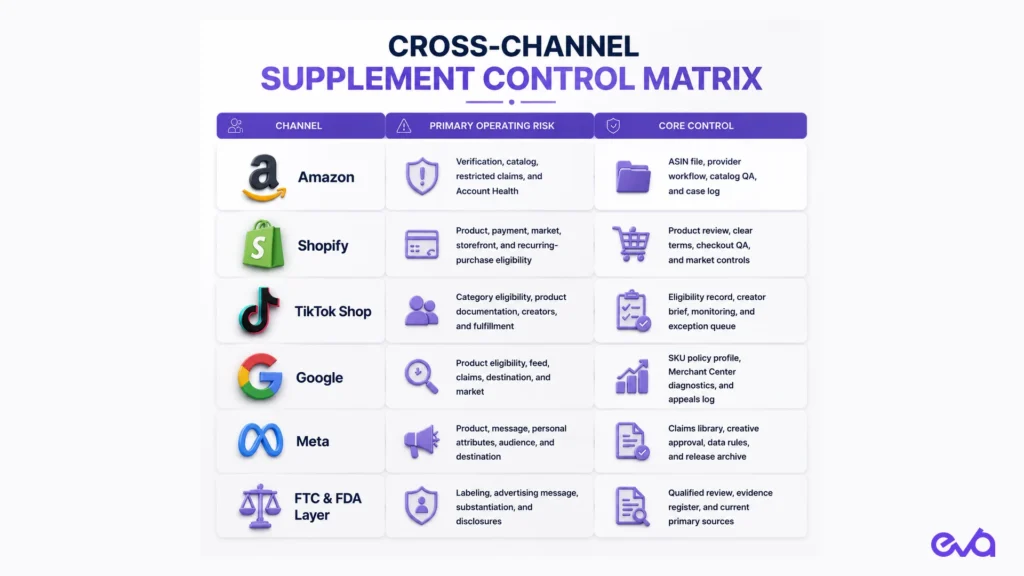
Cross-channel supplement control matrix
| Channel | Primary operating risk | Core control |
|---|---|---|
| Amazon | Verification, catalog, restricted claims, and Account Health | ASIN file, provider workflow, catalog QA, and case log |
| Shopify | Product, payment, market, storefront, and recurring-purchase eligibility | Product review, clear terms, checkout QA, and market controls |
| TikTok Shop | Category eligibility, product documentation, creators, and fulfillment | Eligibility record, creator brief, monitoring, and exception queue |
| Product eligibility, feed, claims, destination, and market | SKU policy profile, Merchant Center diagnostics, and appeals log | |
| Meta | Product, message, personal attributes, audience, and destination | Claims library, creative approval, data rules, and release archive |
| FTC and FDA layer | Labeling, advertising message, substantiation, and disclosures | Qualified review, evidence register, and current primary sources |
Current primary sources
FDA Dietary Supplements Guidance and Regulatory Information: FDA organizes guidance and regulatory information for labeling, claims, manufacturing practice, ingredients, adverse events, and other supplement topics.
FTC Health Products Compliance Guidance: FTC staff explains truthful advertising, adequate support, implied messages, testimonials, and disclosures.
Amazon dietary supplement policy announcement: Amazon explains its dietary supplement verification workflow and seller action path.
TikTok Shop Dietary Supplements Requirements: TikTok Shop publishes current category eligibility, documentation, and restricted-product requirements.
1. Separate product responsibility from platform operations
Operator answer
The brand and qualified reviewers own the product, substantiation, label, and legal judgments. Ecommerce operators own accurate execution and timely platform workflows.
Write a responsibility matrix for product identity, formulation version, manufacturing records, testing and verification, label, claims, creative, listings, ads, creators, data, fulfillment, cases, and incident escalation. Name a person, not only a department. Define who can approve and who can publish.
An agency should not present itself as the manufacturer, laboratory, certifier, regulator, or legal decision-maker. It can organize evidence, manage catalog and account processes, apply approved language, monitor channels, and coordinate corrective action. That separation protects clarity and prevents an operator from making a judgment outside its role.
2. Create one versioned product file
Operator answer
Every channel should draw from the same current product identity, label, evidence, and approval records.
Store the SKU, identifiers, product name, form, count, ingredients and facts as applicable, directions, warnings, package images, manufacturer, facility, testing or verification records, label version, claims approvals, and effective dates. Connect marketplace and advertising IDs. Preserve prior versions.
Use a change-control record for formula, ingredient, label, pack, count, claim, manufacturer, facility, or market changes. Identify every affected listing, feed, Store, ad, creator brief, email, page, and support script. Close the change only when the live surfaces and inventory transition have been checked.
3. Build an approved claims library
Operator answer
The library should state what may be said, where, for which product, with what evidence and qualification, and when it must be reviewed again.
Include exact approved wording, supporting source, product, audience, channel, visual guidance, required qualification, reviewer, approval date, and re-review date. Add examples of disallowed or escalation language. Writers and creators need operational guidance, not a folder of technical documents they cannot interpret.
Review express and implied messages. The FTC guidance emphasizes the net impression. Images, testimonials, sequence, demonstrations, body focus, comparisons, and disclosures can affect meaning. A disclaimer does not neutralize a message that remains misleading.
4. Maintain current platform matrices
Operator answer
Track official source, last reviewed date, affected products and markets, owner, operational control, and next review date for each channel rule.
Platform requirements change. Maintain direct links to Amazon, TikTok Shop, Shopify, Google, Meta, Walmart, Target, Instacart, FDA, and FTC sources relevant to the business. Do not rely on a search snippet or an agency blog as the authority for a release decision.
When a policy changes, identify affected products, content, ads, creators, markets, and deadlines. Record the decision and evidence. A policy matrix should generate work, not become a static spreadsheet nobody owns.
5. Control creators, affiliates, and testimonials
Operator answer
Material connections should be disclosed clearly, and partners should use the same reviewed product and claims guidance as the brand.
Provide a brief with product facts, approved talking points, demonstrations, prohibited implications, disclosure instructions, audience and market, review process, and escalation contact. The FTC states that free products and other benefits can create a material connection that should be disclosed.
Monitor live content and paid amplification. Preserve the post, disclosure, approval, edits, and corrective actions. A genuine customer experience can still communicate an unsupported message if the brand features or amplifies it. Do not coach creators to frame a scripted outcome as spontaneous personal experience.
6. Build a release gate for every channel
Operator answer
No listing, feed, page, ad, email, or creator campaign should publish without product, message, destination, market, and operational checks.
The release record should name the SKU, asset, channel, market, product version, claims version, destination, reviewer, publisher, inventory status, and approval timestamp. Test mobile rendering, links, product selection, price, availability, subscription terms, shipping, and support.
Automate deterministic checks such as broken links, missing fields, image sizes, identifiers, price and availability mismatches, and prohibited phrase flags. Human review remains necessary for meaning, context, evidence, and product-specific judgment. Automation should expose risk, not declare legal approval.
7. Operate incidents and appeals consistently
Operator answer
Use one record for every platform notice or material customer issue, with the exact cause, evidence, action, owner, deadline, and prevention step.
Classify the event: product, verification, catalog, claim, ad, creator, account, feed, payment, fulfillment, customer safety, or another category. Preserve the original notice and affected asset. Do not make several undocumented edits while trying to discover what worked.
Respond through the official channel with the material requested. When an appeal is appropriate, make it concise and evidence-led. Platforms control their decisions. After resolution, update the product file, release checklist, training, and monitoring so the same failure is less likely to repeat.
8. Audit the entire customer message
Operator answer
Review packaging, listing, images, Store, ads, creators, reviews used in marketing, emails, landing pages, checkout, and support together.
A customer does not experience the organization chart. They see a sequence of messages. Compare the sequence for consistency, qualifications, product identity, purchase terms, and evidence. Check what a reasonable customer could understand, not only whether each sentence passed a separate checklist.
Run a quarterly cross-channel audit and an event-driven review after product, policy, market, or claims changes. Sample real customer journeys from ad or creator through purchase and post-purchase. Record findings, owners, due dates, and verification evidence.
A 30-day cross-channel compliance operating setup
- Week 1: Assign responsibilities and inventory products, versions, channels, markets, sources, and current issues.
- Week 2: Build product files, claims library, platform matrix, creator brief, and release checklists.
- Week 3: Audit live listings, feeds, ads, pages, creators, checkout, and customer-service messages.
- Week 4: Close priority gaps, test the incident workflow, and establish monthly policy and quarterly journey reviews.
How Eva supports supplement marketplace operations
Eva coordinates ecommerce execution across Amazon, Shopify, TikTok Shop, Google, Meta, and retail media. Operators can apply approved product information, manage catalog and advertising workflows, monitor platform events, and connect operational issues with inventory and profit.
Eva does not manufacture, test, certify, medically approve, or legally approve supplements. The brand and its qualified product, laboratory, regulatory, and legal partners retain those responsibilities.
Supplement marketplace compliance FAQ
Is one compliance checklist enough for every marketplace?
No. Use one product and evidence foundation, then apply current channel, product, market, listing, advertising, creator, payment, and fulfillment requirements.
Can an agency approve supplement claims?
An agency can apply a brand’s approved claims library and manage release workflows. Product-specific substantiation and legal judgments belong with the brand and qualified reviewers.
Does a disclaimer make a claim acceptable?
Not by itself. Review the complete express and implied message. A disclosure should be clear and cannot repair a message that remains unsupported or misleading.
How often should platform policies be checked?
Monitor material notices continuously, review high-risk sources on a scheduled cadence, and recheck before launches, new markets, product changes, or major campaigns.
What should happen after a listing or ad restriction?
Preserve the notice and asset, identify the exact issue, use the official response path, document every action, and update preventive controls after resolution.
Related Eva resources: Supplement Ecommerce Agency, Brand Protection and Compliance, Full-Funnel Commerce Playbook, Amazon Supplement Listing Requirements, TikTok Shop Supplements.
Important scope note
This guide covers ecommerce operations, not medical or legal advice. Platform policies change, and brands remain responsible for product safety, substantiation, labeling, claims, and qualified review.
Related Eva resource: For hands-on support, explore Eva’s supplement ecommerce growth team.
Related Eva resource: For marketplace growth support that keeps operational and compliance considerations in view, explore Eva’s supplement ecommerce growth team.
Related Eva resource: For marketplace growth support that keeps operational and compliance considerations in view, explore Eva’s supplement ecommerce growth team.