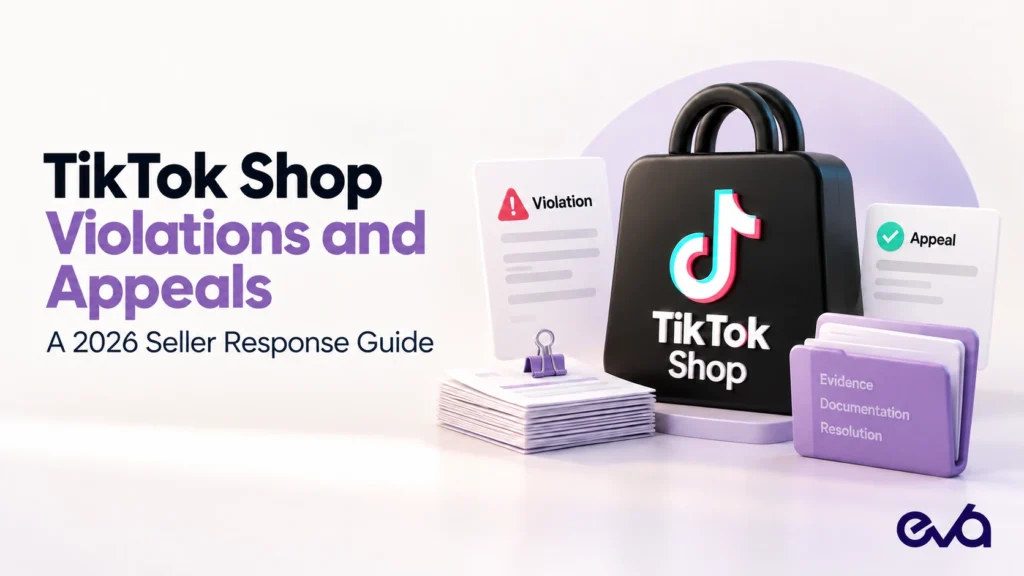
Quick answer: When a TikTok Shop violation appears, open the ticket in Seller Center, identify the exact policy and enforcement, preserve the original evidence, and check whether Correction or Appeal is available. TikTok's current US guidance generally gives sellers 30 calendar days for a first appeal and 15 calendar days after a rejection for a second appeal, although some pre-enforcement cases can have much shorter windows. Follow the deadline shown on the actual ticket.
The fastest response is not always the safest response. A seller who immediately rewrites a listing, deletes creator content, or sends a generic appeal can remove context that would have supported the case. The better approach is a controlled incident workflow: contain risk, preserve facts, classify the root cause, choose the correct route, and prevent the same failure from appearing elsewhere in the catalog.
This guide is written for ecommerce leaders deciding how to handle TikTok Shop violations inside a real operating system. It separates platform facts from recommendations, connects channel metrics with customer and financial outcomes, and gives every action an owner, evidence requirement, and review point for enforcement response. Platform interfaces and policies can change; verify the current source pages and the live account before making a policy-sensitive or irreversible change for enforcement response.
Table of Contents
- Decision framework
- Read the violation ticket before changing anything
- Distinguish correction, appeal, and remediation
- Build an evidence package that answers the actual allegation
- Write a concise appeal, not a defensive essay
- Watch the clock and the account-health thresholds
- Audit connected accounts, listings, and creator assets
- Separate intellectual property cases from general policy cases
- Turn every violation into a prevention control
- How to prioritize the work
- 30/60/90-day implementation roadmap
- Measurement scorecard
- Weekly operating review
- Common mistakes
- Frequently asked questions
- Related Eva resources
- Sources and further reading
- Protect shop health while you scale
Decision framework
Use the following framework to classify the situation before choosing a tactic. The objective is to protect the customer, preserve evidence, and direct effort toward the decision that changes the outcome for enforcement response. A clear classification also prevents several teams from making conflicting edits while the platform, catalog, campaign, or case is still being reviewed for enforcement response.
| Situation | Interpretation | Recommended next step |
|---|---|---|
| Correction offered | Fix before enforcement when the product can comply | Complete the exact ticket requirements before its timer expires |
| Factual or system error | Appeal with evidence | Explain the error and attach product-specific proof |
| Actual policy breach | Remediate and prevent recurrence | Do not misrepresent the facts in an appeal |
| Account-wide pattern | Escalate operational review | Audit connected listings, creators, and accounts |
Read the violation ticket before changing anything
The ticket is the source of truth for the affected object, policy reference, enforcement action, deadline, and available options. Confirm whether it concerns a product, listing attribute, order, fulfillment event, customer service metric, creator asset, intellectual property right, or account-level behavior.
What to inspect: Capture the ticket ID, timestamps, listing and content versions, account notifications, and the team members who touched the affected workflow.
What to do: Freeze nonessential edits until the incident owner understands which evidence must be preserved and whether similar SKUs are exposed.
Distinguish correction, appeal, and remediation
Correction is appropriate when TikTok offers a chance to fix an issue before enforcement and the underlying product can meet the policy. Appeal is appropriate when the enforcement is factually wrong or evidence shows compliance. Remediation addresses a real violation and the operating failure that caused it.
What to inspect: Check the buttons and countdown shown in the ticket rather than assuming every case follows the same path.
What to do: Write the decision in one sentence: what happened, which route applies, what evidence supports it, and who owns the deadline.
Build an evidence package that answers the actual allegation
A strong package is specific. Depending on the case, useful evidence may include invoices, authorization letters, trademark records, product photos, packaging, ingredient labels, certifications, tracking, warehouse scans, customer messages, or screenshots that show the original configuration.
What to inspect: Verify that names, dates, addresses, SKUs, order IDs, and issuing organizations match. Unrelated evidence makes the reviewer work harder and can weaken credibility.
What to do: Use a short chronology and label every attachment so the reviewer can connect the claim, the fact, and the proof.
Write a concise appeal, not a defensive essay
An appeal should state what decision is disputed, why it is incorrect, which policy condition is satisfied, and where the supporting proof appears. Emotional language, blame, repeated submissions, and unsupported claims do not replace evidence.
What to inspect: Use original documents and explain any apparent mismatch before the reviewer has to infer it.
What to do: End with a precise request: remove the violation, restore the listing or privilege, and update the account record if the evidence is accepted.
Watch the clock and the account-health thresholds
TikTok Shop's current US guidance describes deadline-based options and account-health milestones. The live violation ticket remains the authority because some corrections or pre-enforcement appeals can have shorter windows than the general process.
What to inspect: Create alerts for every open ticket, first appeal, second appeal, document request, and enforcement start time.
What to do: Review Account Health daily during an incident and communicate business impact to advertising, creator, inventory, and customer-service owners.
Audit connected accounts, listings, and creator assets
A violation rarely exists in isolation when templates, product data, or creator briefs are reused. TikTok Shop may also take corresponding action against connected accounts in certain circumstances. The incident response should therefore search for the same root cause across the system.
What to inspect: Query matching claims, images, product types, suppliers, certificates, and creators. Include inactive listings that could be reactivated later.
What to do: Fix the shared source—feed rule, content brief, supplier document, or approval workflow—rather than editing only the ticketed listing.
Separate intellectual property cases from general policy cases
IP enforcement usually requires proof of ownership, authorization, or legitimate sourcing. TikTok's US guidance lists different documents depending on whether the appellant owns the right, has permission from the owner, or obtained authentic products through an authorized chain.
What to inspect: Confirm who owns the trademark, copyright, design, or other right and whether the documents cover the exact product, territory, seller, and time period.
What to do: Involve qualified counsel when ownership, licensing, fair use, or infringement is disputed; an operations team should not invent a legal position.
Turn every violation into a prevention control
After the ticket closes, perform a root-cause review. Common failures include outdated policy assumptions, poor supplier evidence, uncontrolled claims, creator improvisation, catalog templates, late shipping, weak customer-service routing, or access rights that allow unreviewed changes.
What to inspect: Measure time to detection, time to containment, appeal outcome, lost selling days, affected GMV, and repeat rate by cause.
What to do: Add the preventive control to onboarding, product launch, creator approval, inventory planning, and the weekly shop-health review.
How to prioritize the work
Prioritize TikTok Shop violations actions by business impact, urgency, confidence, and reversibility. A problem that can remove selling privileges, block an entire catalog, consume a filing deadline, or create customer harm should move ahead of a cosmetic improvement for enforcement response. Within the same risk level, start where the team has strong evidence and can verify the result quickly for enforcement response.
Estimate impact with a range rather than a single precise number for enforcement response. Use affected products, recent net sales, contribution margin, advertising dependency, inventory exposure, customer contacts, and staff time for enforcement response. Label assumptions and avoid turning platform-reported gross value into profit for enforcement response. When the evidence is weak, run a smaller diagnostic or pilot before making a broad change for enforcement response.
Reversibility matters because feeds, campaigns, listings, policies, and automated systems interact for enforcement response. Keep a targeted backup of settings or content, record the reason for the change, define the expected signal, and state the rollback condition for enforcement response. The team should be able to explain what changed and why when performance moves several days later for enforcement response.
30/60/90-day implementation roadmap
Days 1–30: establish the facts and protect the downside
Create an incident register, preserve every open ticket, and assign one owner for deadlines and evidence. Capture a baseline before changing the workflow for enforcement response. Document data sources, current owners, open risks, policy references, and the customer or financial outcome the work should improve for enforcement response. Resolve urgent deadlines first, but keep emergency actions inside the same evidence and approval process for enforcement response.
Days 31–60: test the operating change
Audit the highest-risk listings, creators, suppliers, and shared templates; repair the source of repeat violations. Use a representative product, campaign, case, or market and include normal transactions plus exceptions for enforcement response. Review the pilot with marketing, operations, finance, catalog, and customer-service owners where relevant for enforcement response. A technical pass is incomplete when the customer experience or contribution economics deteriorate for enforcement response.
Days 61–90: scale, repair, or stop
Add daily alerts during incidents and a weekly prevention review tied to catalog, content, fulfillment, and customer service. Standardize what worked, train backup owners, and add monitoring before expanding the scope for enforcement response. If the result does not meet the agreed threshold, repair the constraint or stop the change for enforcement response. Do not turn a pilot into permanent process simply because the team invested time in it for enforcement response.
Measurement scorecard
A scorecard should combine leading indicators that reveal process quality with lagging indicators that show customer and financial outcomes for enforcement response. Review absolute values, rates, and affected volume together for enforcement response. A low failure rate can still be material on a large catalog, while a dramatic percentage change on a handful of orders may not justify a broad intervention for enforcement response.
| Metric | Decision it supports | Review cadence |
|---|---|---|
| Open violations by deadline | Shows whether the underlying risk or opportunity is moving | Weekly |
| Account Health Rating | Connects execution quality with the commercial result | Weekly and monthly |
| Appeal acceptance rate | Reveals concentration hidden by the blended average | Weekly by segment |
| Time to containment | Provides an early warning before customer impact expands | Daily during incidents |
| Repeat violations by root cause | Tests whether the new control remains durable | Monthly with quarterly audit |
Weekly operating review
Put TikTok Shop violations on a short weekly agenda until the process is stable. Review new exceptions, overdue actions, material metric changes, affected products or campaigns, upcoming inventory or policy events, and decisions that require another team for enforcement response. Assign one accountable owner to every action even when several specialists contribute for enforcement response.
Keep the meeting decision-focused for enforcement response. The record should state what changed, what evidence supports the conclusion, what happens next, and when the team will review the result for enforcement response. Separate confirmed facts, reasonable inferences, and open questions for enforcement response. This prevents a platform notification or one unusual day from becoming an unsupported strategy change for enforcement response.
Once the workflow is reliable, reduce meeting time but keep automated monitoring and a monthly control review for enforcement response. A healthy process should surface exceptions without forcing people to rebuild the same spreadsheet every week for enforcement response. Automation can collect and reconcile evidence; qualified owners should still approve policy, customer, and financially material decisions for enforcement response.
Common mistakes
- Optimizing one dashboard in isolation. In enforcement response, channel metrics can improve while contribution, inventory, customer experience, or another marketplace declines.
- Using outdated policy or interface screenshots. For enforcement response, verify the current market, account, and official guidance before acting.
- Changing several variables at once. Uncontrolled edits make a enforcement response result difficult to interpret and reverse.
- Scaling before the workflow handles exceptions. Test the refunds, returns, stockouts, rejections, and ownership handoffs relevant to enforcement response before increasing volume.
- Reporting gross activity as business value. Connect enforcement response results with net revenue, variable cost, contribution, and risk.
- Leaving no decision record. Record the owner, evidence, approval, expected signal, and review date for material enforcement response changes.
The common pattern is a gap between platform activity and business ownership for enforcement response. The remedy is not more reporting for enforcement response. It is a smaller set of decision-ready metrics, a reliable source of truth, explicit rights to act, and a feedback loop that repairs the shared process instead of repeatedly treating its symptoms for enforcement response.
Frequently asked questions
Where can sellers see TikTok Shop violations?
TikTok directs US sellers to Seller Center and the Account Health or Shop Health violation records area; the exact navigation can change, so follow the current ticket and help guidance.
How long do sellers have to appeal?
Current US guidance generally states 30 calendar days for a first appeal and 15 days after a rejected first appeal for a second, but some cases show shorter ticket-specific windows.
How many appeals are allowed?
TikTok's US guidance generally allows up to two appeals for an eligible case. The option displayed in the live ticket controls.
Should a seller delete the listing before appealing?
Not automatically. Preserve the original evidence and read the ticket first; deleting or editing can remove context needed to diagnose the case.
What makes an appeal stronger?
A concise explanation, original product-specific evidence, consistent identifiers, and a direct connection between the policy condition and the proof make review easier.
What happens after both appeals are denied?
Available escalation depends on the account and case. Follow current TikTok support guidance, preserve the record, and correct any operational exposure elsewhere.
Related Eva resources
Sources and further reading
- TikTok Shop US Violation & Appeal Guide
- TikTok Shop US: How to Appeal a Violation
- TikTok Shop US: IP Appeal Requirements
Platform policies, features, thresholds, interfaces, and timelines can change. The cited first-party sources and the live account should be treated as the final authority at the time of action for enforcement response.
Protect shop health while you scale
Eva manages TikTok Shop as a connected operating system across catalog, creators, ads, inventory, fulfillment, and customer experience. Explore TikTok Shop Management to reduce repeat failures and keep growth accountable.