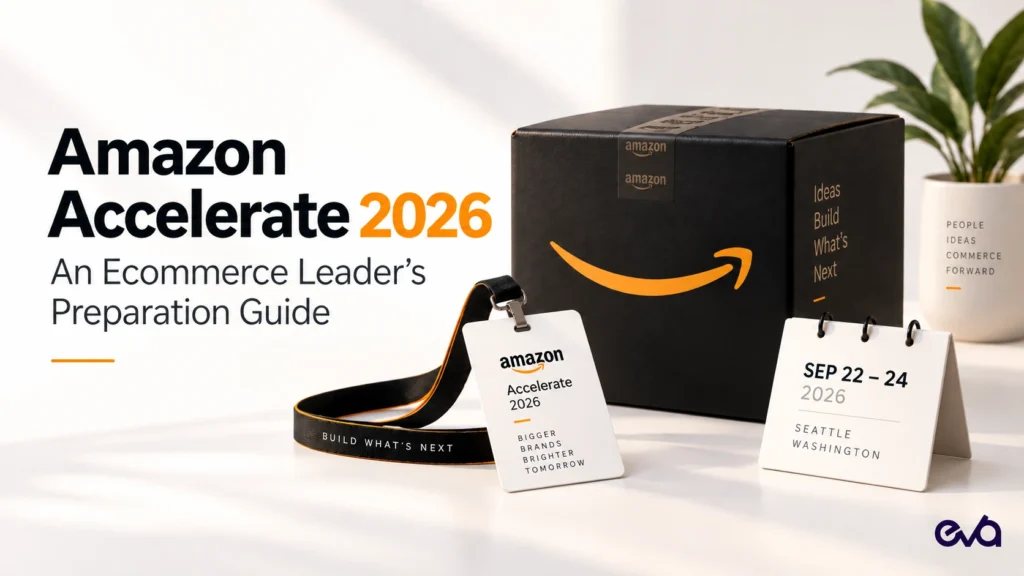
Amazon Accelerate 2026 is a useful moment to turn scattered marketplace questions into an operating plan. The annual seller conference takes place September 22–24 at the Seattle Convention Center. Amazon has announced sessions, expert support, partner conversations, and product experiences designed for sellers at different stages. For an ecommerce leader, the value is not simply attending more presentations. It is arriving with the right account questions, validating assumptions with the right people, and converting what is learned into accountable work after the event.
This guide explains how to prepare for Amazon Accelerate 2026, how to decide which discussions matter for your business, and how to translate the event into actions across catalog, advertising, operations, inventory, and profitability. It is written for brands that sell on Amazon as part of a broader ecommerce system, not as an isolated channel.
Table of Contents
- What is Amazon Accelerate 2026?
- Why an event plan matters for ecommerce teams
- Prepare a one-page account brief before Amazon Accelerate
- Choose sessions and meetings by decision, not novelty
- Account health and catalog questions to bring
- Advertising and demand questions to bring
- Operations, inventory, and fulfillment are part of the growth plan
- How to assess AI announcements without chasing features
- Evaluate Partner Connect conversations carefully
- Turn the event into a 30-day ecommerce action plan
- Frequently asked questions
- Official resources
- Amazon Accelerate 2026: turn event learning into action
What is Amazon Accelerate 2026?
Amazon Accelerate is Amazon’s annual seller conference. Amazon lists the 2026 event for September 22–24 in Seattle and describes a program of expert-led sessions, one-to-one support, networking, and partner discovery. Its published event information also highlights expanded breakout tracks, Seller Café appointments, Partner Connect, and hands-on product experiences. The exact agenda, availability, and registration terms can change, so attendees should use Amazon’s current official event page as the source of truth.
That distinction matters. An event agenda is not a roadmap for every seller. A brand with an unstable catalog needs different help from one that is preparing a product launch. A mature advertiser with poor contribution-margin visibility should not spend its most valuable conversations chasing a generic growth tactic. The best outcome is a small number of decisions with clear owners, evidence, and next steps.
Why an event plan matters for ecommerce teams
Marketplace work is interconnected. A listing update can influence discoverability and conversion. An advertising change can accelerate demand beyond the capacity of available inventory. A promotion can raise sales while weakening net margin. A new tool can be useful, but only when the team knows which decision it will improve and what source data it needs.
Without preparation, an event can create a long list of interesting ideas and no operating change. With preparation, it becomes a concentrated research sprint. The team can bring current performance, identify the constraints that matter most, ask more precise questions, and decide what requires a test rather than an immediate rollout.
Eva recommends organizing the event around one business objective: profitable, durable growth. That means considering demand, conversion, margin, inventory, customer experience, and operating risk together. It also means separating an Amazon-provided capability from a capability that is already configured, usable, and appropriate for a particular account.
Prepare a one-page account brief before Amazon Accelerate
Before booking sessions or meetings, build a concise account brief. It should be specific enough to guide a conversation but short enough that a subject-matter expert can understand the context quickly. Do not include credentials, customer data, or sensitive commercial details in an event handout. Bring aggregate facts and keep source exports secure.
- Business objective: Define the outcome for the next quarter, such as restoring profitability on a hero ASIN, preparing a product launch, improving catalog health, or reducing fulfillment risk.
- Baseline: Record the relevant recent trend in sales, units, conversion, ad spend, return rate, inventory coverage, and contribution margin. A number without a period or product scope is rarely useful.
- Constraint: State the one or two issues most likely to prevent the objective, such as suppressed listings, low organic visibility, unstable Buy Box, poor search-term relevance, unavailable inventory, or unclear reporting.
- Decision needed: Write the decision that needs evidence. For example: which catalog remediation should happen first, whether a new advertising format fits the launch, or whether a fulfillment workflow can support planned demand.
- Question owner: Assign a person who can make the post-event decision and a person who will execute it.
This brief keeps every interaction tied to a real operating need. It also creates a useful record when several people attend different sessions and return with overlapping notes.
Choose sessions and meetings by decision, not novelty
Start with the account’s highest-cost uncertainty. If account health threatens sales continuity, prioritize that before browsing broad trend sessions. If a new product has a launch date but weak retail readiness, prioritize catalog, inventory, advertising, and measurement questions together. If the business needs to decide whether to expand into a new marketplace, focus on the operating requirements rather than only the projected demand.
A practical priority order is:
- Issues that can block sales, visibility, or fulfillment now.
- Decisions connected to a committed launch, seasonal event, or inventory deadline.
- Opportunities that could improve profitable growth when the underlying account is stable.
- Longer-term capability research, including tools and workflow design.
For each selected session, write one question you cannot answer from public documentation. For each meeting, prepare a short example, the evidence you have already checked, and the decision that will follow. Asking “How can we grow?” usually produces a generic answer. Asking “Which reports should we compare to determine whether a variation-level search-term change is hurting conversion?” creates a more useful discussion.
Account health and catalog questions to bring
Catalog and account problems can make every other investment less effective. If a title, variation relationship, compliance attribute, image, or product-detail-page issue limits visibility or conversion, more advertising may simply buy traffic into a weak experience. Start with the customer-facing detail page and the operating controls behind it.
Useful questions include:
- Which account-health signals should be reviewed first for this product category and business model?
- What evidence is required when a listing or attribute is disputed, and which team should maintain it?
- How should a brand distinguish a content-quality issue from a catalog-data, policy, or technical issue?
- Which changes can safely be tested on one ASIN or variation before a broader rollout?
- How should the team document decisions so a later account-health review has the necessary context?
For a broader foundation, Eva’s Amazon marketplace management service connects catalog, advertising, operations, and reporting instead of treating a listing as a standalone copywriting exercise. The goal is a detail page that reflects accurate product information, commercial priorities, and the shopper’s decision process.
Advertising and demand questions to bring
Advertising discussions should begin with the role the spend is meant to play. Is it defending branded demand, discovering search terms, accelerating a launch, improving rank for a profitable query cluster, or supporting sell-through? Each job needs a different success measure. Attributed sales alone cannot explain whether a campaign is increasing total profitable demand or merely shifting it between ads and organic placements.
Bring a product-level view of spend, sales, conversion, search terms, organic position where available, stock coverage, price, promotions, and margin assumptions. Then ask how Amazon’s current tools can help answer a narrowly framed question. Examples: What is the right way to separate new-query discovery from defensive spend? Which report helps assess whether an ad change preceded a change in branded demand? What controls should be in place before increasing spend on an ASIN with limited inventory?
Teams should also make clear what they will not infer. A short-term rise in revenue does not prove a tactic is profitable. A fall in attributed return does not prove a campaign is useless if it supports a product launch, branded search, or another measurable strategic job. Evaluation needs a declared hypothesis, a test window, and a stop condition.
Operations, inventory, and fulfillment are part of the growth plan
Amazon Accelerate can surface new demand ideas, but demand is only valuable when the brand can fulfill it accurately and profitably. Before the event, identify days of inventory by key ASIN, inbound timing, capacity constraints, variation risk, return patterns, and the operational consequences of a promotional or advertising lift.
Use event conversations to clarify process rather than assume a universal answer. A seller may need guidance on FBA workflow, inventory placement, reimbursement controls, returns, or operational data. The important follow-up is to assign the evidence owner and establish the threshold for action. For example, an advertising team should know when inventory coverage requires a spend reduction; an operations team should know when a campaign calendar changes demand expectations.
This is also where ecommerce management becomes cross-functional. Finance should be able to see the contribution-margin implications. Customer-service and operations teams should understand the promise made by a listing or promotion. A launch can succeed in a dashboard while creating avoidable delays, cancellations, or stockouts that weaken the customer experience.
How to assess AI announcements without chasing features
Amazon has promoted interactive AI experiences as part of its 2026 event information. New capabilities deserve attention, but a feature announcement is not automatically an implementation decision. Ask what task the tool changes, which inputs it relies on, how output quality will be reviewed, what account permissions are involved, and how the team will measure whether it improves speed, accuracy, conversion, or profitability.
AI can assist research, content preparation, workflow triage, and analysis. It should not be used to invent product specifications, compliance claims, customer proof, performance results, or policy interpretations. Keep a human owner for factual validation and for any change that affects a public listing, account status, customer expectation, or paid-media budget.
Evaluate Partner Connect conversations carefully
Partner discovery can be valuable when a brand has a defined gap: creative capacity, advertising expertise, catalog operations, reporting, logistics, international expansion, or another capability that the internal team cannot sustainably own. It is less valuable when it becomes a search for a generic shortcut.
Use a consistent evaluation checklist: What exact outcome will this partner own? What data, approvals, and access are required? How will success be measured? What is excluded? Who owns the relationship internally? What happens if the work does not meet quality or compliance expectations? A partner’s claims should be verified through appropriate references, documentation, and a scoped operating plan rather than accepted as proof.
Turn the event into a 30-day ecommerce action plan
The week after Amazon Accelerate is where the value is won or lost. Within two business days, consolidate notes into a decision log. Each item should include the question, the source, the proposed action, assumptions, owner, required approval, expected measure, and review date. Do not turn every note into a project. Select the few items with the clearest connection to the account objective.
During the first 30 days, use three stages. First, validate: confirm documentation, policy, account eligibility, data availability, and dependencies. Second, test: make the smallest controlled change that can answer the question. Third, standardize or stop: scale the practice only after the evidence supports it, or document why it should not continue.
For content and advertising changes, preserve before-state evidence and measure a completed period after the change. For operational changes, include error rates, customer impact, and margin—not just speed. For cross-channel work, compare Amazon outcomes with the relevant Shopify, TikTok Shop, or other marketplace signals so one dashboard does not become the whole decision.
Amazon Accelerate is most useful when it improves the quality of those decisions. The conference can introduce people, products, and ideas. A disciplined ecommerce team converts the useful ones into a clear operating rhythm: evidence, owner, test, measurement, and learning.
Frequently asked questions
When is Amazon Accelerate 2026?
Amazon’s official event page lists Amazon Accelerate 2026 for September 22–24 in Seattle. Confirm the current agenda, registration status, and attendance details directly with Amazon before making travel or budget decisions.
Who should attend Amazon Accelerate?
Attendance is most valuable for people who own an Amazon business decision or can translate event learning into action. This may include marketplace leaders, catalog and account-health owners, advertising leads, operations leaders, and ecommerce executives.
How should a brand prepare for an Amazon seller conference?
Prepare a one-page account brief with the objective, baseline, constraints, decision needed, and owner. Choose sessions and meetings around those decisions, not around the broadest or newest topic.
Should ecommerce teams implement every tool announced at an event?
No. Validate eligibility, documentation, inputs, risks, and the specific decision the tool improves. Start with a controlled test and define the measure of success before a broad rollout.
What should happen after Amazon Accelerate?
Consolidate notes into a decision log, validate the few highest-priority ideas, run small controlled tests, and measure the business result before standardizing a new process.