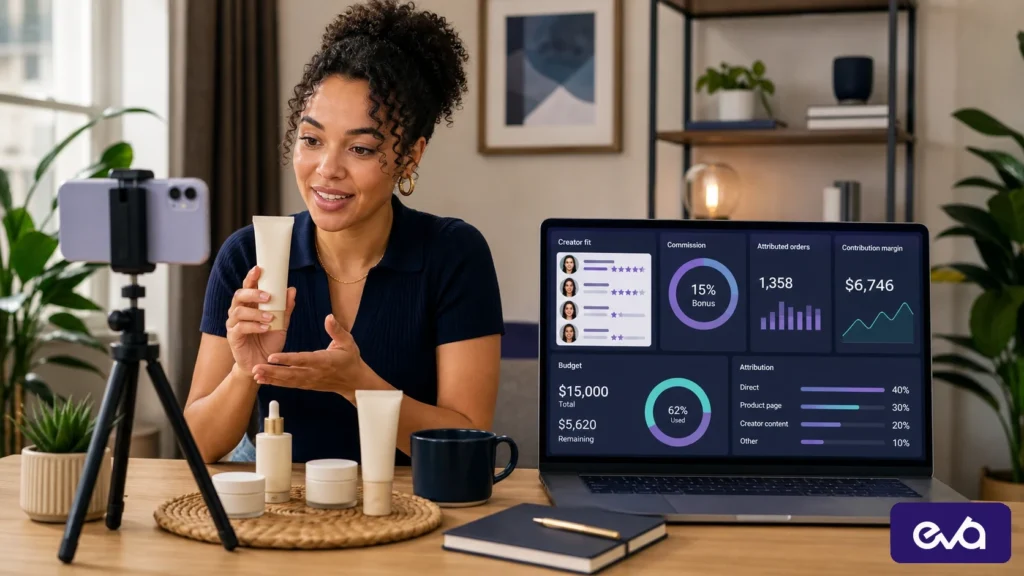
Amazon Creator Connections helps brands work with Amazon creators by offering bonus commissions on qualifying sales. A brand selects eligible products, defines a campaign period, sets a commission and budget, and gives creators a reason to publish content that can send shoppers to Amazon.
The opportunity is straightforward; profitable execution is not. A campaign can generate content and sales while still losing money after commission, discounts, product cost, returns, advertising, and operating time. The right goal is not maximum creator activity. It is a repeatable set of creator-product matches that produces useful content and contribution profit.
Table of Contents
- Quick answer: how does Amazon Creator Connections work?
- Start with products that can support creator economics
- Select creators by fit, not follower count
- Design commissions as a controlled test
- Give creators useful freedom with clear guardrails
- Understand attribution before judging performance
- A practical campaign operating rhythm
- When to reject or pause a campaign
- How Eva approaches Creator Connections
- FAQ
- Sources
Quick answer: how does Amazon Creator Connections work?
Brands create campaigns for eligible products, set the campaign dates, bonus commission, and maximum budget, and make the opportunity available to eligible Amazon creators. Creators choose campaigns and publish qualifying content. Amazon reports campaign activity and attributes eligible sales according to the program’s current rules. Always verify eligibility, attribution, billing, and marketplace rules in the live Amazon Ads interface before committing budget.
Start with products that can support creator economics
Do not begin with a creator list. Begin with a product-level profit model. A good candidate has enough gross margin, reliable inventory, a clear demonstration or story, competitive reviews, a conversion-ready detail page, and a commission ceiling the brand can afford.
Use this contribution model for each completed order:
Contribution = net selling price − product cost − Amazon fees − fulfillment and shipping − creator commission − discounts − expected returns − variable operating cost
Treat the result as a decision tool, not a universal accounting definition. Finance should approve the inputs. If the product is unprofitable before the creator commission, a larger creator program will scale the problem.
Select creators by fit, not follower count
Score creators using factors that relate to the product and buying decision:
- Category relevance and audience fit
- Ability to demonstrate the product clearly
- Trust, content quality, and consistency
- Evidence of commerce intent rather than reach alone
- Brand safety and claims discipline
- Prior performance with comparable products, when available
A smaller creator who answers the shopper’s real objections can outperform a larger creator whose audience is only loosely related.
Design commissions as a controlled test
The bonus commission should reflect product margin, expected conversion, content value, campaign maturity, and competitive demand for creator attention. Avoid applying one rate to every SKU.
Begin with a bounded test: a defined product set, fixed dates, maximum budget, approved claims, and a review point. Increase commission or budget only when completed-order economics and content quality justify the change. Pause campaigns when inventory is thin, returns rise, the detail page underperforms, or the campaign exceeds its approved contribution threshold.
Give creators useful freedom with clear guardrails
A strong brief explains the customer problem, product use case, differentiators, demonstration points, approved proof, prohibited claims, disclosure requirements, and the desired next action. It should not force every creator into the same script.
For regulated or sensitive categories, the brand must approve claim language before content goes live. Never ask creators to invent personal outcomes, testimonials, comparisons, or performance promises.
Understand attribution before judging performance
Amazon’s current Creator Connections help documentation describes a 24-hour purchase window after a shopper clicks a creator link. Program rules can change, and aggregate reporting does not answer every incrementality question. Review the live documentation and reporting interface for the active marketplace.
Separate four questions:
1. Did the creator generate attributed orders?
2. Were those orders profitable after all variable costs?
3. Did the content create reusable learning or assets?
4. Did the campaign create incremental demand rather than claim demand that would have occurred anyway?
Attributed revenue is a reporting signal, not proof of incrementality.
A practical campaign operating rhythm
Before launch, verify eligibility, user permissions, product economics, inventory, detail-page readiness, claims, commission ceiling, budget, and measurement ownership. During the campaign, monitor creator participation, content quality, clicks, attributed orders, returns, inventory, and remaining budget. At the review point, expand only the creator-product combinations that meet the agreed quality and contribution thresholds.
When to reject or pause a campaign
Reject or pause the campaign when the product cannot absorb commission, the listing is not conversion-ready, inventory cannot support demand, claims cannot be controlled, the creator audience is a weak match, or reporting cannot distinguish completed profitable orders from gross activity.
How Eva approaches Creator Connections
Eva treats creator activity as one part of the Amazon growth system. Product selection, detail-page quality, advertising, inventory, pricing, and contribution margin should inform which campaigns deserve more capital. Creator content should generate learning that improves the product page and broader media plan, not disappear after one attribution report.
Get My Growth Plan to connect creator campaigns with Amazon content, advertising, inventory, and profit decisions.
FAQ
What is Amazon Creator Connections?
It is an Amazon marketplace service that lets eligible brands offer bonus commissions to eligible Amazon creators for qualifying sales generated by creator content.
How should a brand choose a commission?
Model the maximum affordable commission at SKU level after product cost, Amazon fees, fulfillment, discounts, returns, and other variable costs. Then use a bounded test rather than a permanent universal rate.
How should brands measure success?
Track content quality, qualified traffic, completed attributed orders, returns, contribution after variable costs, creator-product repeatability, and the value of reusable content or learning.
Sources
- Amazon Ads Help: Understand Amazon Creator Connections
- Amazon Seller Central and Ads Console: current campaign eligibility, billing, attribution, and reporting terms