An Amazon DSP campaign plan should do more than activate programmatic inventory. A useful plan connects audience strategy, creative, media controls, measurement, retail readiness, and business constraints into one operating plan. That is especially important when an ecommerce team is using Amazon DSP to create demand beyond the search results page, where a last-click return alone rarely explains the value of the work.
This guide explains how to create an Amazon DSP campaign plan, define the operating model, and set the questions that need answers before committing media budget. It is designed for brand and marketplace leaders—not for logistics businesses using “DSP” to refer to Amazon’s delivery-service program.
Table of Contents
- Quick answer: What is Amazon DSP campaign planning?
- What an Amazon DSP campaign plan should cover
- When is an Amazon DSP campaign ready to run?
- The operating model behind a serious campaign plan
- How to evaluate an Amazon DSP campaign plan
- Measurement: beyond a single return number
- A practical first 30-day DSP campaign brief
- Frequently asked questions
- Build an Amazon DSP program around profitable growth
Quick answer: What is Amazon DSP campaign planning?
Amazon DSP campaign planning is the process of defining, activating, managing, and measuring campaigns through Amazon’s demand-side platform. Amazon DSP lets advertisers programmatically reach audiences on Amazon and across third-party destinations. Amazon says on its Amazon DSP product page that it is available to brand advertisers, campaign teams, and tool providers, including advertisers that do not sell products in the Amazon store.
A sound plan decides whether DSP is appropriate for the objective, translates a commercial question into audience and creative tests, defines campaign controls, and makes the results usable for the wider ecommerce business. It does not replace the brand’s product knowledge, margin ownership, inventory planning, or approval process. It connects those inputs to media decisions.
What an Amazon DSP campaign plan should cover
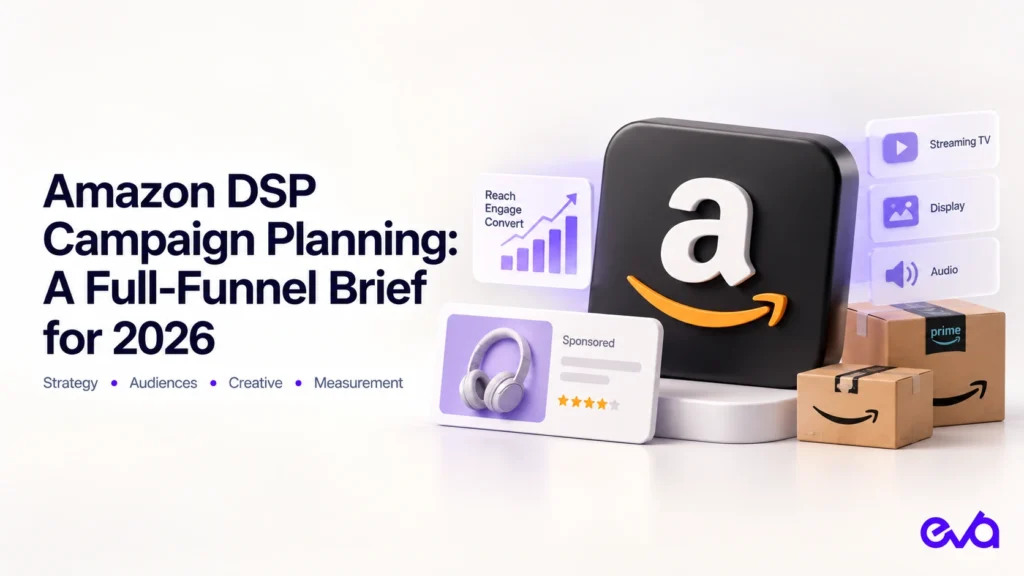
Amazon DSP is programmatic advertising technology, not a single ad format. Amazon describes it as a way to buy ads that reach new and existing audiences across Amazon and third-party destinations. Available formats can include display, online video, Streaming TV, audio, and other inventory, subject to market and account availability. That breadth creates an execution challenge: a campaign can be technically live while still lacking a clear business job.
A capable campaign plan begins with the business question. Is the goal to introduce a new audience to the brand, support a product launch, re-engage shoppers who showed relevant behavior, protect a seasonal demand window, or learn which audience and message deserve more investment? Each job requires different audience design, creative, budget pacing, frequency controls, and success measures.
The next job is audience planning. Amazon describes three broad audience categories: Amazon audiences informed by buying, browsing, and streaming signals; advertiser audiences built from approved inputs such as remarketing or product relevance; and third-party audiences. A campaign plan should explain which type is being used, why it relates to the hypothesis, what exclusions are in place, and how the audience will be evaluated. “More targeting” is not a strategy if the team cannot explain the shopper or the desired action.
Creative is equally important. The campaign plan should make sure the message fits the placement and the decision stage. Awareness creative can introduce a brand or problem; consideration creative may need to clarify a product category, proof point, or use case; retargeting creative should not simply repeat the first exposure. Strong partners build a learning plan around the creative rather than treating assets as interchangeable files.
Finally, campaign operations matter. This includes account structure, line-item setup, pacing, bids, frequency, inventory quality controls, brand-suitability settings where applicable, reporting, and documented change history. Good operational hygiene makes the account easier to diagnose. It also prevents a team from confusing a delivery problem, an audience problem, a creative problem, and a landing-page problem.
When is an Amazon DSP campaign ready to run?
An campaign team may be a good fit when a brand has a meaningful media question but lacks in-house programmatic depth, time for disciplined testing, or a connected measurement process. It can also be useful when several teams touch Amazon advertising but no one owns the full customer journey from audience exposure through retail conversion, repeat behavior, margin, and inventory.
It is not automatically the right next step for every advertiser. A business with an unstable product detail page, unclear unit economics, inconsistent inventory, or no approved creative process may need to solve those constraints first. DSP can amplify demand, but it cannot repair a confusing offer or make unavailable products available. A credible plan should be willing to say that a readiness task comes before a media increase.
Amazon offers self-service and managed-service routes. Its own materials state that managed service is intended for advertisers seeking consultative resources or with limited programmatic experience, and that budget minimums can apply. A third-party partner discussion should therefore include access route, ownership, scope, fees, budget assumptions, and the brand’s ability to see its own data. Do not assume a single commercial model applies to every account.
The operating model behind a serious campaign plan
1. A written objective and hypothesis
Every campaign should start with a sentence that can be tested. For example: reach a defined prospective audience with a specific product message, then evaluate whether the exposure improves a declared downstream signal compared with the available baseline. The exact measure will vary, but the causal question should be clear before budget is activated.
2. Retail readiness before scale
Before a team increases reach, it should review the destination. For an Amazon product detail page, this can include title clarity, image sequence, variation selection, price context, availability, reviews, and the information a first-time shopper needs. For an external site, it can include landing-page relevance, page speed, product availability, and conversion instrumentation. The destination does not need to be perfect; it needs to be ready enough that the test can answer the intended question.
3. A transparent test map
A test map identifies the audience, creative, placement, budget range, timing, exclusions, owner, success signal, and decision rule. It also records what will not be concluded. For example, an attributed sale can be useful evidence, but it is not by itself proof of incrementality or lifetime value. A partner that explains these limits gives the brand a more reliable basis for decision-making.
4. Clear control and approval rights
The brand should understand who owns the advertiser account, who can access reports, who approves creative and budget changes, and how account history will remain available if the relationship ends. This is not an administrative detail. It is how a team preserves learning, governance, and the ability to audit spend.
How to evaluate an Amazon DSP campaign plan
Start with questions that reveal operating quality rather than presentation quality.
- How do you decide whether DSP should be used? Look for a response tied to objective, audience, retail readiness, economics, and measurement—not a blanket recommendation.
- What will you own, and what remains with our team? Scope should distinguish media buying from creative production, landing-page work, product-detail-page work, data engineering, and business approvals.
- How will you structure learning in the first 90 days? A good answer has a sequence of hypotheses, not an undefined promise to “optimize.”
- What data will we see and how often? Request a view of the recurring report and the decision log, not only a polished monthly summary.
- How do you handle inventory and margin constraints? The answer should show how media choices change when hero products are low in stock or no longer meet profitability thresholds.
- How do you treat creative testing? Ask how the operating team prevents message, audience, and placement changes from being blended into one untraceable result.
- What happens when the result is inconclusive? A capable team can name the next diagnostic step instead of reframing every result as success.
References and case studies can be useful, but do not treat them as a substitute for a clear operating plan. Verify the relevance of the category, the time period, the scope of the work, and what the outcome actually measured. Ask what conditions made the work successful and whether those conditions exist in your business.
Measurement: beyond a single return number
Amazon DSP reporting can include reach, frequency, viewability, detail-page-view rate, new-to-brand metrics, and other campaign measures depending on eligibility and setup. Amazon also offers Amazon Marketing Cloud for eligible custom analytics using pseudonymized signals and approved inputs. Those tools can improve visibility, but they do not remove the need for a measurement plan.
A useful dashboard separates delivery, engagement, retail, and business signals. Delivery includes spend, impressions, reach, frequency, and pacing. Engagement can include video completion or click behavior where relevant. Retail signals may include detail-page views, add-to-cart activity, conversion, and product-level availability. Business signals include contribution margin, returns, stock coverage, and the commercial role of the SKU. The best interpretation asks whether these signals move together in a way that supports the original hypothesis.
Do not force every campaign to prove itself through the same window or metric. A retargeting test may have a shorter decision cycle than an upper-funnel video initiative. A launch campaign may be measured against retail readiness, audience learning, and demand creation as well as attributable orders. Define the hierarchy before the campaign begins, then document the decision that follows.
Reporting should also make tradeoffs visible. If frequency rises while incremental reach slows, the next question is whether the message is becoming repetitive or whether a smaller, more qualified audience is appropriate. If a campaign produces product-detail-page views but conversion stalls, investigate price, availability, page clarity, competing offers, and the fit between the audience promise and the destination. If sales rise while contribution margin falls, do not call the campaign a win without explaining the economics. A campaign team earns trust by surfacing these tensions early and recommending the next evidence-based action.
A practical first 30-day DSP campaign brief
Give the internal team enough context to diagnose the opportunity without sending unneeded confidential information. A concise brief should include the business objective, the products or categories in scope, available inventory, key commercial constraints, current media activity, approved creative assets, target audiences or known customer questions, and the decision the leadership team needs to make.
In the first 30 days, the output should be more than a launch. Ask for an account and access review, a retail-readiness review, a measurement map, an audience and creative hypothesis document, a test calendar, and an approval workflow. These artifacts create shared language before spend expands. They also make it easier to tell whether later changes are based on evidence or preference.
Amazon DSP works best as part of an advertising system, not as a separate line in a spreadsheet. The campaign plan should coordinate with sponsored ads, organic retail content, brand-store or landing-page owners, inventory planning, and finance. Eva’s Amazon advertising funnel guide and Amazon Marketing Cloud guide provide useful supporting context for that connected approach.
Frequently asked questions
Can brands that do not sell on Amazon use Amazon DSP?
Amazon says Amazon DSP is available to advertisers that sell in the Amazon store and advertisers that do not. Eligibility, formats, destinations, and access options can vary, so confirm the current setup with Amazon Ads or Amazon Ads or a qualified partner.
Is Amazon DSP campaign planning the same as PPC planning?
No. There can be meaningful overlap, but DSP is programmatic media buying across Amazon and third-party inventory, while PPC work is often centered on search and sponsored-ad formats. A strong operating team explains how the two roles work together rather than treating them as interchangeable.
What should a brand own in a DSP campaign?
The brand should retain visibility into account access, reporting, approvals, business objectives, product facts, inventory and margin constraints, and the decisions made with campaign results. The exact technical ownership model should be agreed in writing.
How long does it take to know whether DSP is working?
There is no universal answer. The appropriate evaluation period depends on the objective, audience size, format, purchase cycle, available budget, creative change, and measurement method. Agree on the review windows and decision criteria before launch.