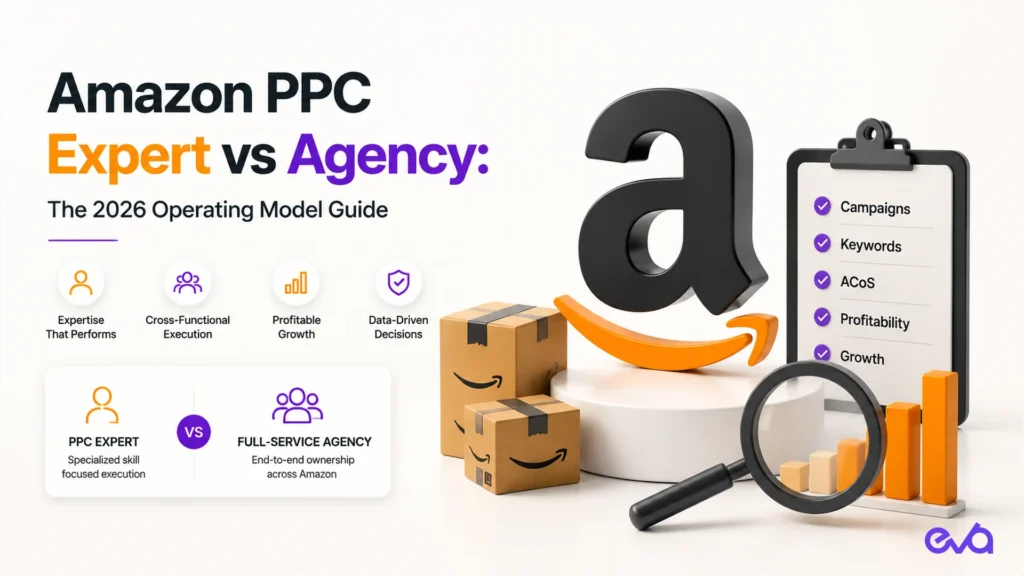
An Amazon PPC expert can improve campaign structure and bidding, but advertising performance is rarely an advertising-only problem. Conversion changes with price, coupon, reviews, content, availability, delivery promise, competitor offers, and organic rank. A specialist who cannot change or coordinate those conditions may diagnose the issue correctly and still be unable to improve the business outcome.
Brands typically choose among an individual expert, a freelancer, an agency, an in-house team, or software. The titles are less important than the operating model. Who owns the growth number? Which decisions are included? How quickly can the team act? What happens when advertising conflicts with inventory or margin? Can the partner fix catalog and content issues, or only send recommendations to another team?
This guide provides a practical scorecard for deciding which model fits the brand in 2026. It also explains why low fees can be misleading, how technology should support operators, and what evidence to request before giving a partner control of meaningful advertising capital.
Quick answer: Hire an individual Amazon PPC expert when the brand has strong internal ownership and needs a defined specialist capability. Hire a full-service agency when advertising must be coordinated with content, ranking, pricing, inventory, catalog, and finance. Use software to accelerate repeatable analysis and execution, but keep an accountable operator responsible for objectives, exceptions, and profit.
Table of Contents
- Amazon PPC operating-model comparison
- 1. Define the business outcome before comparing providers
- 2. Separate console skill from commercial ownership
- 3. Test the depth behind the account lead
- 4. Understand what the fee actually buys
- 5. Evaluate technology by the decisions it improves
- 6. Inspect cross-functional execution
- 7. Build measurement around contribution and portfolio role
- 8. Run a structured selection process
- A 30-day Amazon PPC partner selection plan
- How Eva combines operators with advertising technology
- Amazon PPC expert and agency FAQ
Amazon PPC operating-model comparison
| Model | Best fit | Primary limitation |
|---|---|---|
| Freelancer or expert | Focused account with strong internal leadership | Capacity and cross-functional execution |
| PPC agency | Brands needing media depth and reliable coverage | Scope may stop at the advertising console |
| Full-service Amazon agency | Brands needing one team across the Amazon operation | Requires deeper access and a larger investment |
| In-house team | Brands with scale, leadership, and recruiting capacity | Hiring depth, continuity, and specialist coverage |
| Software | Teams with operators who need faster detection and execution | No independent business accountability |
Amazon describes Sponsored Products as cost-per-click ads that promote individual listings and appear in shopping results and product pages. That auction is only one layer of the brand’s operating system. Review the current format in the official Amazon Sponsored Products overview before evaluating a partner’s claims.
1. Define the business outcome before comparing providers
Begin with the products and economics, not a target advertising cost of sale. Identify whether the brand needs a launch, organic rank growth, profitable scale, defense, inventory reduction, cash protection, or portfolio cleanup. Define contribution margin, stock cover, price authority, promotion limits, and the expected role of each SKU. A partner cannot choose the right bid strategy when the business has not chosen the job advertising must perform.
Write the decision rights. Specify who can change budgets, bids, targeting, price, coupon, content, inventory allocation, and campaign status. Establish response times for stockouts, listing suppression, conversion drops, and competitor moves. A narrow specialist can succeed when the internal team owns the other decisions. The same specialist will struggle when every recommendation waits across several disconnected owners.
2. Separate console skill from commercial ownership
Console skill includes campaign structure, search-term harvesting, negative targeting, placement adjustment, budget pacing, match-type control, product targeting, bulk operations, and reporting. These capabilities matter, but they do not prove that the operator can allocate capital across a product portfolio. Ask how the person responds when efficiency, rank, cash, inventory, and market share point in different directions.
Commercial ownership means the operator can explain why a product deserves investment, what must be fixed outside advertising, and when growth should slow. Review real decision records, not only polished case studies. A useful example identifies the starting economics, constraint, action, tradeoff, and realized result. Percentage growth without spend, margin, inventory, and timing context does not demonstrate a repeatable operating system.
3. Test the depth behind the account lead
Many agencies sell with senior leaders and deliver through a different team. Ask who performs search-term analysis, writes strategy, executes changes, covers absences, reviews quality, and joins business reviews. Meet the actual account owner. Request their portfolio size, tenure, escalation path, and specialist support. A reasonable client load depends on complexity, automation, and scope, but the agency should be able to explain it clearly.
Freelancers can provide strong expertise and direct access, yet one person creates continuity risk. In-house teams offer proximity but often need several specialists to cover PPC, DSP, content, catalog, analytics, and operations. A mature agency should provide named accountability plus backup. The objective is not the largest team. It is enough qualified capacity to detect, decide, execute, and verify without the brand managing the agency minute by minute.
4. Understand what the fee actually buys
Compare fees against included work, operator seniority, account load, technology, meeting cadence, creative support, catalog work, and performance responsibility. A low monthly fee may fund only bid adjustments and a report. The brand then supplies strategy, content, troubleshooting, inventory decisions, and coordination. That can be appropriate for a capable internal team, but it should not be described as full-service management.
For a meaningful Amazon operation, credible full-service management commonly starts around several thousand dollars per month because it requires senior attention across multiple disciplines. Percentage-of-spend pricing can create an incentive to increase media, so pair it with contribution and business targets. Fixed fees can encourage efficiency but need scope controls. The correct comparison is total cost to achieve the operating outcome, including the brand’s internal management time and the cost of slow decisions.
5. Evaluate technology by the decisions it improves
Software should reduce repetitive analysis, detect exceptions, apply tested rules, preserve history, and help operators act faster. Ask which inputs the system uses beyond ad-console data. Product margin, price, inventory, conversion, organic rank, promotion, and portfolio role can materially change the correct action. A tool that optimizes only toward a platform metric may make efficient campaign decisions that weaken the broader business.
Require explainability and human override. The team should be able to show why a material action occurred, which boundary applied, and how the outcome was verified. Automated bid count is not a business result. Useful measures include faster response, fewer wasted queries, stronger budget allocation, controlled stock exposure, improved contribution, and less analyst time spent on routine work. Technology should multiply an accountable team, not hide the absence of one.
6. Inspect cross-functional execution
Give the candidate a scenario: conversion falls on a hero ASIN while spend and click volume remain stable. A PPC-only response may lower bids. A complete response checks price, coupon, featured offer, reviews, images, title, variation, availability, delivery promise, suppression, competitor changes, and traffic mix before deciding. Ask who performs each check and who can implement the fix.
Repeat the exercise for an impending stockout, excess inventory, a new product launch, and a margin change. Strong partners connect the advertising action to the product and operational response. Weak partners return a list for the brand to coordinate. Recommendations have value, but a brand seeking full-service management should know whether it is buying advice or execution before signing the agreement.
7. Build measurement around contribution and portfolio role
Use advertising cost of sale, total advertising cost of sale, conversion, placement, search-term performance, new-to-brand measures, and organic rank where relevant. Then connect those metrics with product contribution, inventory cover, return behavior, price, and cash. A launch product and a mature profit product should not have identical targets. The scorecard should make product roles visible so one blended account number cannot hide poor allocation.
Agree on attribution limits. Platform-reported sales, retail sales, and finance revenue answer different questions. Reconcile rather than forcing them to match. Review decisions weekly and business outcomes monthly. The partner should document material actions and expected effects, then revisit whether the result occurred. That learning loop is more valuable than a presentation that explains performance only after the month is over.
8. Run a structured selection process
Shortlist providers based on scope and operating fit. Give each the same data sample and scenario. Ask for diagnosis, priorities, first 30 days, required access, assumptions, risks, and measures. Speak with references whose catalog size, spend, category, and internal team resemble yours. Review contract length, data ownership, transition support, termination, conflicts, confidentiality, and the ability to export campaign history.
Choose the clearest ownership model, not the most aggressive forecast. A credible partner will identify what cannot be known before access, challenge unrealistic targets, and explain where the brand must participate. The best fit gives the company enough depth to execute while keeping leaders close to capital and product decisions. That is how an expert, agency, software platform, or internal team becomes part of a real growth system.
A 30-day Amazon PPC partner selection plan
- Week 1: Define product roles, economics, scope, decision rights, data access, and internal ownership.
- Week 2: Screen providers for actual operators, portfolio load, technology, coverage, and commercial depth.
- Week 3: Run a common account scenario, reference checks, security review, and contract comparison.
- Week 4: Select the model, document baselines, agree on the first 90 days, and design transition controls.
How Eva combines operators with advertising technology
Eva combines senior Amazon operators with Eva Intelligence. Advertising decisions are connected with organic rank, content, price, catalog, inventory, and product profit. This allows the team to act on the cause of a performance change rather than optimizing bids around a broken retail offer. One accountable team manages the operating priorities and execution.
Brands can use Eva for full-service Amazon management or focused Amazon PPC support. The right scope depends on the internal team and the work that must be owned. Eva’s six-month growth roadmap is designed to make that operating model, economic opportunity, and sequence clear before capital moves.
Amazon PPC expert and agency FAQ
How much does an Amazon PPC expert cost?
Fees vary by experience, account complexity, scope, and time commitment. Compare the work and decision ownership included, not only the monthly price. Low-cost support may be appropriate when the brand supplies strategy and cross-functional execution.
Is an Amazon PPC agency better than software?
They solve different needs. Software accelerates detection and repeatable execution. An agency supplies people who set objectives, manage exceptions, coordinate functions, and remain accountable for outcomes. Many brands need both.
What should an Amazon PPC agency manage?
At minimum, targeting, bids, budgets, placements, search terms, campaign structure, testing, and reporting. A full-service agency should also coordinate content, catalog, price, inventory, ranking, and profit decisions.
Should Amazon PPC fees be based on ad spend?
A percentage can align fees with workload but may reward higher spend. Fixed fees can support efficiency but require clear scope. In either model, use contribution and business outcomes alongside advertising metrics.
When should a brand hire in-house?
In-house can work when the brand has enough scale to recruit, lead, and retain the required specialists and can provide coverage during turnover or absence. External depth can still support training, tools, or specialized work.
Related Eva resources: Amazon PPC Management, Amazon Management, Amazon PPC Guide, Eva Playbooks.