Looking to hire an Amazon PPC agency?
Amazon PPC management is the ongoing operation of Sponsored Products, Sponsored Brands, and Sponsored Display with bid, budget, search-term, and profitability control. This guide explains how the work is done, what it costs, and which KPIs matter. If you want a team to run it for you, Eva’s Amazon PPC agency page covers our PPC management services, the activation roadmap, and a free advertising audit.
Table of Contents
- Amazon PPC management: how the work is done
- Amazon PPC Management Process: Why Most Ad Spend Does Not Scale Profitably
- What Are Amazon PPC Management Services?
- What’s Included in Amazon PPC Management?
- AI PPC management: where automation helps and where it fails
- How Eva Approaches Amazon PPC Differently
- Why Businesses Use Amazon PPC Agencies
- How to Choose the Right Amazon PPC Service
- Pricing: What Do Amazon PPC Management Services Cost?
- Related Amazon growth services
- What Amazon PPC management services should deliver in the first 90 days
- How to evaluate an Amazon PPC agency: evidence, weekly reporting, and proof
- Frequently Asked Questions
Amazon PPC management: how the work is done
Quick answer: Amazon PPC management is the ongoing control of Sponsored Products, Sponsored Brands, and Sponsored Display campaigns. A useful management service connects campaign structure, search terms, bids, budgets, placements, product readiness, inventory, and product economics. It should explain where spend moved, why it moved, and whether the change improved the business rather than reporting ACoS alone.
| Management area | Operator decision | Evidence to review |
|---|---|---|
| Campaign architecture | Separate discovery, branded defense, category, competitor, and product-targeting jobs | Search-term flow and campaign role |
| Bid and budget control | Fund useful demand without protecting waste | ACoS, TACoS, contribution, and budget utilization |
| Retail readiness | Do not force spend into products constrained by content, price, offer, or inventory | Conversion, Featured Offer eligibility, stock, and detail-page quality |
| Measurement | Separate attributed sales from incremental business impact | Total sales, organic movement, margin, and repeatable learning |
Service ownership: This article explains the management model. Brands ready to hire an operator should review Eva’s Amazon PPC management agency service. For the operating controls behind it, see the Orbit methodology and the Amazon PPC Architecture Playbook.
Primary reference: Amazon Ads describes Sponsored Products as cost-per-click ads with keyword or product targeting, advertiser-controlled budgets, and reporting for ongoing optimization in its Sponsored Products best-practices guide.
Amazon PPC Management Process: Why Most Ad Spend Does Not Scale Profitably
Most Amazon sellers do not have an ad spend problem. They have an efficiency problem.
Traffic is already there. Budget is already being deployed. But margins stay flat, ACoS creeps up, and scaling starts to feel like pouring more money into a system that is not built to convert spend into profit.
Across accounts at different spend levels, the same pattern appears. Growth slows not because demand disappears, but because campaign structure, bid logic, and profitability targets fall out of alignment.
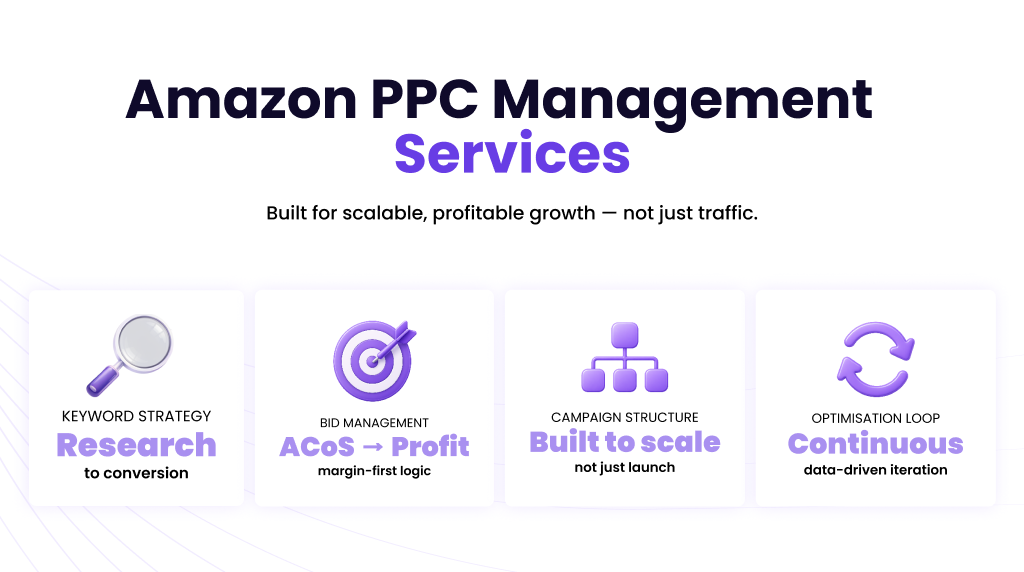
Amazon PPC management services fix the leak. The right service does not just run your ads; it builds a system that connects keyword targeting, bid logic, campaign structure, and profitability goals into one continuous optimization loop.
This guide explains the Amazon PPC management process, cost drivers, reporting, and KPIs. Brands seeking direct execution can review Eva’s Amazon PPC management agency service.
What Are Amazon PPC Management Services?
|
Quick answer: Amazon PPC management services are professional services that plan, build, operate, and optimize your Amazon advertising campaigns on an ongoing basis. This includes Sponsored Products, Sponsored Brands, and Sponsored Display ads, with the goal of driving profitable sales, not just volume. |
Amazon’s advertising platform has grown into one of the most complex and competitive ad ecosystems in retail. Sellers can now run Sponsored Products (keyword-targeted ads appearing in search results), Sponsored Brands (banner ads featuring your brand logo and product range), and Sponsored Display (audience-retargeting ads on and off Amazon). Each has its own bidding mechanics, targeting logic, and performance levers.
“Management” is the critical word. Running ads is easy. Managing them, structuring campaigns to isolate performance signals, adjusting bids based on profitability data, pruning wasted spend, and scaling what works requires expertise, time, and the right tooling.
A professional PPC management service takes full ownership of that process. You get strategy, execution, and reporting without becoming an Amazon Ads expert yourself.
What’s Included in Amazon PPC Management?
The best PPC management services operate as a system, not a checklist. Here is what that system looks like in practice.
1. Keyword research and targeting strategy
An effective keyword strategy goes beyond pulling a list from Helium 10. It involves segmenting keywords by intent (discovery vs. conversion), match type (broad, phrase, exact), and funnel stage. High-volume head terms go into separate campaigns from long-tail converters, so bids and budgets can be managed independently.
2. Campaign architecture
Campaign structure determines what you can control and measure. A well-built account isolates your best-performing ASINs, separates auto and manual campaigns, and creates distinct campaigns for brand defense, competitor conquesting, and category exploration. Sloppy structure means you cannot diagnose what is working, you can only watch spend go out the door.
3. Bid optimization
Bids need to change constantly based on conversion data, inventory levels, competitor activity, and profitability targets. Manual bid management at scale is unsustainable. Professional services use rules-based automation, AI-assisted bidding, and human review to keep bids calibrated against your actual ACoS and TACoS targets.
4. Negative keyword management
Unchecked search term reports generate wasted spend fast. Every week, irrelevant or non-converting search terms should be identified and negated at the campaign or ad group level. This is one of the highest-ROI activities in PPC management and one of the most commonly neglected.
5. Reporting and optimization cycles
Good reporting is not a weekly slide deck with impressions and clicks. It is a performance loop: review what happened, diagnose why, adjust the campaigns, and measure the result. Metrics that matter are ACoS (advertising cost of sale), TACoS (total advertising cost of sale, including organic revenue), ROAS, and contribution margin after ad spend.
AI PPC management: where automation helps and where it fails
Quick answer: AI PPC management is useful when it harvests search terms, flags wasted spend, and proposes bid or budget moves faster than a human can. It fails when it optimizes ACoS in isolation, ignores inventory and listing readiness, or treats every ASIN with the same bid logic.
Buyers searching for AI PPC management usually want three things: less manual bid work, clearer waste control, and a system that still respects margin. Automation can handle rules, anomaly alerts, and bulk negatives. A management team still has to decide which products deserve aggression, which need defense, and when paid spend should pause because content, price, or stock cannot convert.
Eva uses AI-assisted controls inside a profit and ranking context, not as a set-and-forget black box. For the managed service model, see Amazon PPC management services. For how AI supports operators day to day, see AI-Powered PPC: Boosting Manager Efficiency and AI PPC Management: 5 Tips to Improve Results.
How Eva Approaches Amazon PPC Differently
Most Amazon PPC providers manage campaigns as an isolated advertising function. Eva does not.
Advertising decisions are made within a broader growth system, where bid strategy, budget allocation, ranking momentum, and contribution margin need to stay aligned. This shifts PPC from a channel-level activity to a business-level decision system.
Data-first decision making
Eva’s Advertising Intelligence platform connects ad performance with inventory levels, profitability signals, and organic ranking movement. Bids are not set in isolation. They reflect what each ASIN can afford to spend based on margin, rank trajectory, and stock position.
This is where many accounts lose efficiency. Products running low on inventory are often pushed too aggressively, while products with strong ranking potential are managed too conservatively. The issue is not a lack of data. It is poor decision alignment.
ACoS vs TACoS vs profit, measuring what matters
ACoS is useful, but it is not enough to run the business. Eva treats ACoS as a diagnostic metric, while budget decisions are guided by TACoS trends and contribution margin. A campaign with a 30% ACoS looks expensive in isolation. But if that spend is driving organic ranking improvements that generate organic sales at zero ad cost, the TACoS might be highly efficient at 12%. Reporting only ACoS misses this entirely.
|
Metric |
What it measures |
When to use it |
|
ACoS |
Ad spend ÷ ad revenue |
Campaign-level efficiency |
|
TACoS |
Ad spend ÷ total revenue (ad + organic) |
Overall account health |
|
ROAS |
Revenue ÷ ad spend |
Absolute return on investment |
|
Contribution margin |
Revenue minus COGS, fees, and ad spend |
True profitability per unit |
Continuous optimization loops
This is not set-and-forget campaign management. It is a continuously adjusted system tied to real business performance.
Eva runs structured review cycles, with daily bid and budget adjustments, weekly search term analysis and performance reviews, and monthly strategic recalibration based on ranking data, profitability signals, and business goals.
Eva does not manage PPC in isolation. Advertising decisions are made within a broader growth system that includes SEO and AI optimization, creative and A+ content, and account health. This ensures PPC stays aligned with what is happening across the entire listing, not just inside the ads dashboard.
Ready to turn Amazon PPC signals into profitable growth?
Review the managed PPC service model or start with a free advertising audit to identify wasted spend, campaign structure gaps, and scaling opportunities.
Why Businesses Use Amazon PPC Agencies
Amazon advertising is not getting simpler. New ad types, new targeting options, and increasingly sophisticated competition have made it one of the hardest platforms to manage in-house at scale. Here is what typically drives sellers to hire an agency.
Complexity compounds quickly
A single seller with 20 ASINs across three categories can easily have 200+ active campaigns, thousands of keywords, and hundreds of daily bid decisions. Managing that manually while also running operations, sourcing inventory, and handling customer issues is not feasible. Mistakes over-bidding on low-margin products, missing a wasted spend surge, and ignoring a competitor conquest campaign compound fast.
Most brands do not need more ad spend first. They need a clearer view of where efficiency is already breaking across campaign structure, bid logic, and profitability alignment.
This is where Eva typically starts, isolating wasted spend, identifying scaling constraints, and mapping where performance is being limited before recommending changes
The cost of inefficiency is high
Poorly managed campaigns routinely waste 20–40% of ad spend on irrelevant traffic or over-bid keywords. At a $50,000/month ad budget, that is $10,000–$20,000 in monthly losses. Most professional management services pay for themselves through waste reduction alone, before accounting for growth.
Scaling requires a system
You cannot scale chaos. Brands that try to grow ad spend without a structured campaign architecture typically see ACoS rise linearly with spend, the opposite of what should happen. A well-built system lets you increase budget efficiently, with each dollar generating more return as data accumulates and optimization matures.
How to Choose the Right Amazon PPC Service
The agency market is crowded with generalist providers. Here is how to evaluate them properly.
Questions to ask before hiring
- How do you structure campaigns, and can you show me an example account structure?
- What metrics do you report on, and how often?
- Do you optimize for ACoS, TACoS, or contribution margin, and why?
- How do you handle bid changes: manual, rules-based, or AI-assisted?
- What does your onboarding process look like, and how long before campaigns are live?
- Who will manage my account day-to-day, and what is their experience level?
Red flags to watch for
- Guaranteed ACoS or ranking targets Amazon’s algorithm is not contractually controllable.
- Vague reporting (“we optimized your campaigns this month”) with no specific data.
- Account access restrictions: You should always own and have full visibility into your ad account.
- No discussion of campaign structure before onboarding structure is a strategy.
- Flat management fee with no incentive tied to performance outcomes.
Agency vs in-house: a practical comparison
|
In-house |
Amazon PPC agency |
|
|
Cost |
Salary + tools + training |
Management fee (predictable) |
|
Expertise |
Depends on hire quality |
Specialist team with platform depth |
|
Scalability |
Limited by headcount |
Scales with ad spend |
|
Speed to optimize |
Slower ramp-up |
Faster with existing frameworks |
|
Business context |
Highly embedded in ops |
Depends on communication |
|
Best for |
Large brands with 50+ SKUs and a budget for a dedicated hire |
Growing brands that need expertise without the overhead |
Pricing: What Do Amazon PPC Management Services Cost?
Pricing transparency is rare in this space. Here is an honest breakdown of how agencies structure fees and what drives cost differences.
Common pricing models
|
Model |
How it works |
Typical range |
Best for |
|
% of ad spend |
Agency fee = % of monthly ad budget |
8–15% of spend |
Brands spending $10k+/mo |
|
Flat monthly retainer |
Fixed fee regardless of spend |
$1,500–$5,000/mo |
Smaller budgets need a predictable cost |
|
Flat + performance |
Base fee plus bonus on results (revenue or ROAS targets) |
Base $1,000+ plus % of growth |
Growth-stage brands |
|
Full-service platform (Eva) |
Integrated management across PPC, SEO, ops, and creative |
Custom (based on scope) |
Scaling brands want one system |
What drives cost differences
- Number of ASINs and campaigns under management
- Monthly ad spend (percentage-based fees scale with budget)
- Scope of work: PPC only vs PPC plus SEO, creative, and catalog management
- Reporting depth and frequency
- Level of strategic involvement (execution-only vs growth partner)
As a rule, the cheapest option is rarely the best ROI. An agency charging $800/month to manage $30,000 in ad spend is likely using templated automation with minimal human oversight. The managed ad spend at risk dwarfs the management fee by a wide margin.
What you get in a serious management engagement
| Included in a serious management engagement | Why it matters |
|---|---|
| Campaign architecture and match-type isolation | Makes waste and winners measurable |
| Search-term harvesting and negatives | Stops irrelevant spend from compounding |
| Bid and budget control tied to inventory and margin | Prevents paying for unconvertible demand |
| Reporting on ACoS, TACoS, and contribution | Connects ads to business outcomes |
| Coordination with listing and SEO inputs | Paid clicks need retail readiness |
Full scope, roadmap, and commercial terms live on the Amazon PPC management services page.
Related Amazon growth services
Ready to Scale Your Amazon Advertising Profitably?
Amazon PPC is not a set-and-forget channel. It is a live system that rewards consistent, data-driven management and punishes neglect. The sellers who win in the long term are not necessarily the ones spending the most; they are the ones spending the most efficiently.
Eva’s Amazon PPC management service connects advertising performance to organic ranking, listing quality, inventory health, and overall profitability. One team, one system, full accountability.
What Amazon PPC management services should deliver in the first 90 days
Quick answer: The first 90 days should create control, remove obvious waste, protect priority products, improve the campaign and search-term structure, and establish a repeatable profit-led operating cadence.
The exact pace depends on account history, data quality, catalog size, seasonality, inventory, and existing campaign structure. The service should still make its sequence and decision rights clear before it begins.
| Period | Primary work | Expected evidence |
|---|---|---|
| Days 1-30 | Audit economics, tracking, portfolio priorities, campaign structure, search terms and constraints | Baseline, risk list, quick controls and a documented operating plan |
| Days 31-60 | Rebuild or refine structure, targeting, budgets, negatives, placements and product priorities | Cleaner control, stronger query quality and fewer avoidable leaks |
| Days 61-90 | Scale proven demand, connect paid and organic signals, improve creative inputs and allocate capital | Decisions tied to revenue quality, rank, inventory and contribution profit |
A credible provider should explain what it will stop, protect, test, and scale. It should also show how the plan changes when inventory, price, ranking, or margin changes.
Related Eva guide: The right management model depends on internal ownership and cross-functional scope. Use Eva's Amazon PPC partner selection guide to compare an expert, agency, in-house team, and software.
How to evaluate an Amazon PPC agency: evidence, weekly reporting, and proof
Quick answer: Judge an Amazon PPC agency on evidence, not screenshots of improving ACOS. Ask who operates the account, what is included, how performance is defined, how pricing works, and who owns the data. Then check that weekly reporting connects ad spend to profit, ranking, catalog readiness, and inventory.
| Selection question | Evidence to request |
|---|---|
| Who operates the account? | Named team, roles, seniority, account load, and escalation coverage |
| What is included? | Campaign types, search-term work, creative input, listing feedback, reporting, and exclusions |
| How is performance judged? | Definitions for ACOS, TACoS, contribution, rank, inventory risk, and incrementality |
| How does pricing work? | Retainer, spend fee, minimums, setup, software, creative, and work left to the brand |
| Who owns the data? | Account access, campaign history, exports, documentation, and offboarding terms |
What an Amazon PPC agency’s weekly report should show
- Revenue quality: ad sales, total sales, TACoS, ACOS, contribution margin, discounts, and product-level profitability.
- Ranking impact: keyword movement, organic lift, indexation issues, conversion rate, and whether paid spend is creating durable search visibility.
- Budget control: wasted spend, budget caps, bid changes, campaign structure, negative keywords, and where budget should move next.
- Catalog readiness: listing quality, image gaps, review issues, A+ content, Buy Box pressure, and conversion blockers.
- Inventory risk: stockout pressure, overstock, launch inventory, and whether spend should be accelerated or slowed.
- Next actions: which campaigns, ASINs, keywords, and listings need the next operator decision.
The Amazon PPC proof packet to ask for before hiring
Ask for the operating artifacts that show how the agency turns search data into controlled product decisions:
- Campaign and portfolio architecture for one sample catalog
- Search-term promotion and negation rules
- Placement, budget, and bid change history
- Product-level margin, inventory, rank, and conversion context
To have Eva run this for your account, see Amazon PPC agency services or book a call.
Frequently Asked Questions
What does an Amazon PPC management service include?
A full-service Amazon PPC management engagement typically includes keyword research, campaign architecture and setup, ongoing bid optimization, negative keyword management, search term analysis, A/B testing of ad creative and targeting, and regular performance reporting. More comprehensive providers also connect PPC performance to organic ranking and listing optimization.
How much do Amazon PPC agencies charge?
Most agencies charge between 8% and 15% of monthly ad spend, or a flat retainer ranging from $1,500 to $5,000 per month. Full-service growth platforms with a broader scope, covering SEO, creative, and operations in addition to PPC, are typically priced on a custom basis, depending on catalog size and monthly revenue.
Is Amazon PPC management worth it?
For most brands spending more than $5,000 per month on ads, yes. Poorly managed campaigns typically waste 20–40% of ad budget on low-quality traffic and over-bid terms. Professional management usually recovers that waste while also improving conversion efficiency, so the service frequently pays for itself before revenue growth is counted.
How long does it take to see results?
Initial improvements in efficiency reduced wasted spend, and better keyword targeting are typically visible within 2–4 weeks of proper campaign restructuring. Measurable revenue growth and ranking improvements generally take 60–90 days as campaigns accumulate conversion data and bidding algorithms calibrate. Brands with weaker listing quality may need concurrent improvements to their listings to see the full impact.
What is a good ACoS or TACoS on Amazon?
ACoS benchmarks vary significantly by category and margin. A 20–30% ACoS is often cited as a general target, but this is misleading without knowing your profit margin. The more useful measure is TACoS’s total ad spend divided by total revenue, including organic. For mature brands with strong organic velocity, a TACoS of 8–15% is typically healthy. For brands in active launch or ranking-growth mode, a higher TACoS is often acceptable and intentional.
What is the difference between an Amazon PPC management guide and Amazon PPC management services?
This article explains the operating model, costs, and KPIs. Amazon PPC management services are the paid engagement where Eva owns campaign execution, optimization, and reporting. Start here to learn the framework, and use the service page when you are ready to hire.
Should Amazon PPC be managed with Amazon SEO and Amazon DSP?
Often yes for scaling brands. PPC creates and defends demand, Amazon SEO and AEO improve conversion and organic share, and Amazon DSP extends reach with AMC audiences. Eva can run them together under full-service Amazon management when one owner is better than three vendors.
For more on amazon account management services: what they include & how to choose, see: Amazon Account Management Services: What They Include & How to Choose.
P.S.
Eva helps ecommerce brands connect Amazon PPC, listing quality, inventory signals, and profitability into one coordinated growth system. If your team is evaluating how to scale Amazon advertising with stronger commercial discipline, the next step is a focused growth review.
Related Eva service: Brands that need hands-on execution can explore Amazon PPC.