Most Amazon sellers are stuck in the same loop: they hire an agency to manage their PPC campaigns, see some initial traction, then hit a plateau. Revenue stops growing. Profit margins shrink. The ads that worked last quarter underperform this quarter. And nobody can explain why.
What are Amazon marketplace management services? Amazon marketplace management services cover the coordinated work of running an Amazon account: advertising, listing content and Amazon SEO, A+ Content and images, catalog and inventory health, pricing, account health and compliance, reviews, and reporting tied to profit. The difference from PPC-only management is scope. The provider is accountable for how those pieces work together, not only for ad metrics.
Table of Contents
- 2026 operator note: marketplace management is not task management
- Technical Support vs Strategic Amazon Management
- The PPC Trap: Why Paid Ads Alone Do Not Drive Long-Term Growth
- PPC-Only Approach vs. Amazon Marketplace Management
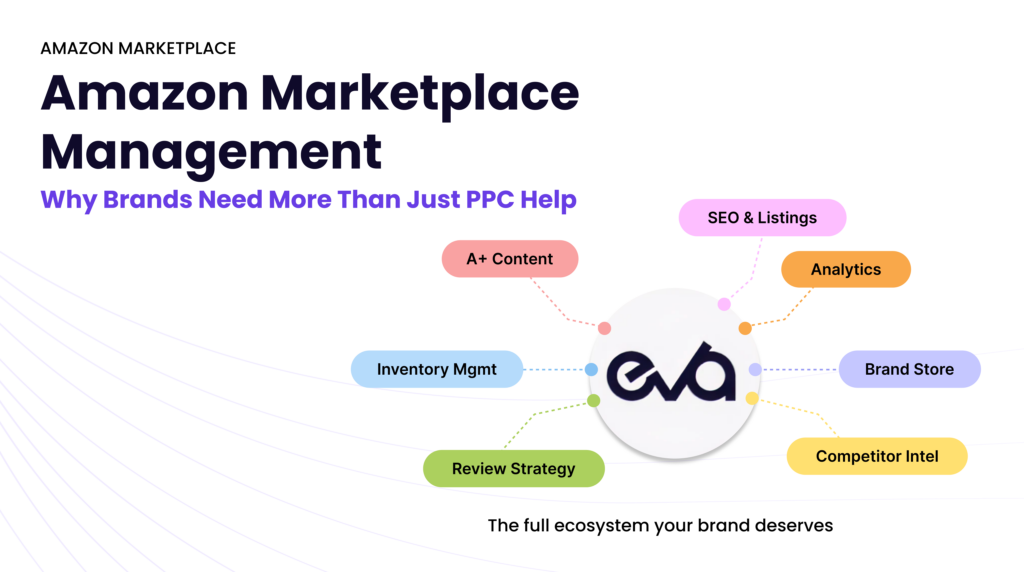
- What Amazon Marketplace Management Actually Requires
- Amazon marketplace management services: quick answers
- Why Amazon Marketplace Management Requires a Systems Approach
- Final Thought
- FAQ
2026 operator note: marketplace management is not task management
A strong Amazon management partner should connect advertising, search ranking, catalog quality, account health, inventory, pricing, and margin. If those pieces are managed separately, the seller may get more activity without a better business outcome.
Related Eva resources: Amazon Management, Amazon PPC Management, Orbit.
The problem is not the PPC. It is the belief that PPC alone can drive sustainable growth on Amazon.
Technical Support vs Strategic Amazon Management
Many sellers purchase premium Amazon support because default Seller Support is limited and technical issues can stay unresolved for too long. That support layer can be useful for escalations, but it is not the same as full marketplace management.
Strategic Amazon management means your team owns growth decisions across product priorities, catalog quality, inventory risk, advertising efficiency, conversion drivers, creative quality, and profit. It also means having operators who can escalate hard with Amazon and advocate for your business when platform-side errors hurt revenue.
For a deeper breakdown, read Amazon Account Management Services: SAS vs Full-Service Management and Eva’s full-service Amazon management model.
Amazon is not just a paid advertising channel. It is a marketplace with its own economy, ranking system, operational rules, and customer behavior patterns. Winning on Amazon means much more than optimizing bids and keywords.
Eva operator note
Before trying to improve performance, step back and look at how your growth actually behaves.
If results depend heavily on continuous ad spend or shift quickly with small campaign changes, that usually points to a structural issue rather than a tactical one.
The PPC Trap: Why Paid Ads Alone Do Not Drive Long-Term Growth
Quick answer: Here is what happens when you rely solely on PPC for Amazon growth: This is why so many brands plateau. The ads are being optimized, but the system behind them is not.
Here is what happens when you rely solely on PPC for Amazon growth:
- You are fighting a losing battle on visibility. Your ads might rank well today, but they depend on continuous spend. The moment you pull back, visibility drops. At the same time, competitors that have built strong organic positioning continue to sell without that same dependency, which slowly widens the gap.
- You are ignoring the foundation. Every listing has its own baseline performance, search visibility, conversion rate, inventory velocity, and review strength. When those are strong, advertising becomes more efficient. When they are weak, advertising becomes more expensive because it is compensating for problems that should have been fixed at the listing level.
- You are flying blind on profitability. Most PPC optimization is done around ACOS, but ACOS does not reflect real profit. If margin, inventory costs, and returns are not considered, it is easy to scale revenue while quietly reducing profitability.
- You are missing ranking velocity. Amazon responds to consistent sales performance. When sales are driven in a structured way, organic ranking improves over time, which reduces reliance on paid traffic. If PPC is the only driver, that momentum never fully builds, and growth stays tied to spend.
This is why so many brands plateau. The ads are being optimized, but the system behind them is not.
PPC-Only Approach vs. Amazon Marketplace Management
| Area | PPC-Only Approach | Amazon Marketplace Management |
|---|---|---|
| Visibility | Driven by ad spend; drops when budgets are reduced | Built through organic ranking and sustained sales velocity |
| Conversion | Dependent on traffic volume; weak listings increase costs | Strengthened through optimized listings and clear positioning |
| Profitability | Measured mainly through ACOS | Measured through full unit economics and margin structure |
| Growth | Linear and spend-dependent | Compounding through ranking, conversion, and retention |
| Risk | High dependency on paid traffic | Diversified across multiple performance drivers |
| Stability | Fluctuates with campaign performance | Stabilized through system-wide alignment |
What Amazon Marketplace Management Actually Requires
Quick answer: What Amazon Marketplace Management Actually Requires is important for Amazon Marketplace Management: Why Brands Need More Than Just PPC Help because it shapes how Amazon teams make decisions, prioritize work, and measure whether marketplace activity is producing profitable growth. Real Amazon growth is not about any single tactic. It is about how multiple parts of the business work together, because each one directly affects the others.
Real Amazon growth is not about any single tactic. It is about how multiple parts of the business work together, because each one directly affects the others.
1. Demand Generation: Advertising Plus Strategy
Quick answer: Yes, PPC matters. But it is not just about the campaigns. It is about using advertising to support how the product performs inside the marketplace. Effective Amazon advertising should accomplish three things: This is where many accounts start to break: ads are active, but they are not aligned with how the product is supposed to win in its category.
Yes, PPC matters. But it is not just about the campaigns. It is about using advertising to support how the product performs inside the marketplace.
Effective Amazon advertising should accomplish three things:
- Drive profitability. Campaigns need to be built around real business outcomes, not just volume. That means understanding margins, cost structure, and how each campaign contributes to actual profit.
- Generate market intelligence. Advertising data shows how customers behave, what they search for, what they click, and what they buy. Used correctly, it informs decisions beyond PPC, including pricing, positioning, and messaging.
- Build ranking velocity. Campaigns should be structured to push sales through the keywords that matter most, because that strengthens organic ranking over time.
This is where many accounts start to break: ads are active, but they are not aligned with how the product is supposed to win in its category.
2. Listing and Content Optimization: SEO, A+ Content, and Images
Quick answer: Your listing is your storefront, and it plays a much bigger role than many brands realize. Weak titles that do not reflect real search intent, bullet points that do not address actual customer concerns, A+ content that looks polished but does not help decision-making, and images that fail to show real value are common issues that quietly reduce performance.
Your listing is your storefront, and it plays a much bigger role than many brands realize.
Weak titles that do not reflect real search intent, bullet points that do not address actual customer concerns, A+ content that looks polished but does not help decision-making, and images that fail to show real value are common issues that quietly reduce performance.
When the listing is weak, everything downstream becomes harder. Conversion drops, the cost of traffic increases, organic ranking slows, and advertising efficiency declines because the system behind the ads is not strong enough to support them.
Real Amazon marketplace management includes:
- SEO optimization. Structuring listings around high-intent keywords so they can rank and convert at the same time.
- Conversion-focused design. Building A+ content and visuals around how customers evaluate products, including the objections and information gaps that shape purchase decisions.
- Competitive positioning. Understanding how other products in the category are presented and ensuring your product has a clear, defensible position.
This is where efficiency comes from. A listing that converts well reduces the need for aggressive ad spend and makes growth more stable over time.
3. Catalog and Operational Health: Inventory, Pricing, and Compliance
Quick answer: The operational side of Amazon is less visible, but it directly affects performance. Amazon reacts to consistency. If inventory runs out, ranking drops. If pricing is unstable, conversion becomes unpredictable. If account issues arise, visibility can be affected regardless of demand.
The operational side of Amazon is less visible, but it directly affects performance.
Amazon reacts to consistency. If inventory runs out, ranking drops. If pricing is unstable, conversion becomes unpredictable. If account issues arise, visibility can be affected regardless of demand.
Marketplace management needs to account for:
- Inventory forecasting and management. Keeping products available without overstocking in a way that hurts margins.
- Dynamic pricing strategy. Adjusting pricing based on demand, competition, and profitability instead of reacting without a clear strategy.
- Account health and compliance. Monitoring risks and resolving issues before they impact performance.
When this layer is not managed properly, growth becomes fragile because performance depends on conditions that are not fully controlled.
4. Customer Value and Retention: Repeat Purchase, Reviews, and Brand Building
Quick answer: The most profitable Amazon brands are not built on one-time transactions. They are built on repeat behavior and trust. Marketplace management includes: When this layer is strong, growth becomes more efficient because each new customer contributes more value over time.
The most profitable Amazon brands are not built on one-time transactions. They are built on repeat behavior and trust.
Marketplace management includes:
- Review and social proof strategy. Building credibility consistently so conversion improves over time.
- Repeat purchase mechanics. Creating reasons for customers to return, increasing lifetime value without increasing acquisition costs.
- Brand development. Moving beyond individual product performance and building recognition inside the marketplace.
When this layer is strong, growth becomes more efficient because each new customer contributes more value over time.
Amazon marketplace management services: quick answers
What is included in Amazon marketplace management services?
Scope varies by provider, but a full service usually includes advertising strategy and campaign management, keyword research and listing optimization, A+ Content and images, catalog fixes and listing errors, inventory and FBA restock planning, pricing and Buy Box monitoring, account health and policy cases, review and brand protection work, and reporting on sales, ad spend, TACoS, and margin. Compare what is written into the contract, not only the sales deck.
Should you use an agency or manage Amazon in-house?
In-house works when you already have people with Amazon advertising, catalog, and operations experience and enough volume to keep them busy. An agency fits when you need several specialties at once, want senior experience without hiring each role, or are expanding to other channels. Many brands use a hybrid: an internal owner who sets goals and approves budgets, plus a partner that runs daily execution.
How do you choose an Amazon marketplace management provider?
Ask who will actually work on your account and what experience they have, what is included versus billed separately, how results are reported (TACoS and contribution margin, not only ACoS), how account health issues are escalated, which data and account access you keep if you leave, and what the contract term and notice period are. Ask for references from brands in a similar category and size.
Why Amazon Marketplace Management Requires a Systems Approach
All of these components are connected.
Advertising influences listing performance. Listing conversion affects advertising efficiency. Inventory stability supports ranking. Customer behavior feeds back into both conversion and long-term value.
When one part is weak, it limits everything else.
This is why managing only one layer, like PPC, does not lead to sustained growth. Even if that layer performs well, the rest of the system can still hold the business back.
Real marketplace management aligns everything in one direction, so improvements in one area support progress in another instead of working against it.
If your Amazon growth has started to slow down or feels inconsistent, it is usually not a campaign issue; it is structural. This is typically where a deeper account review starts to uncover what is actually limiting performance and where the real opportunities are.
Looking for a partner to run this? See Eva’s Amazon marketplace management services for how we cover advertising, listings, catalog, inventory, and account health in one plan, or book a call with our team.
Final Thought
If growth feels inconsistent, the issue is rarely effort. In most cases, the campaigns are running, the listings are being updated, and operations are being managed. But the way these elements interact is misaligned, which is why performance depends on constant adjustments instead of building on itself over time.
Amazon marketplace management is not about doing more or adding new tactics on top of what already exists. It is about structuring the system so that advertising, listing performance, operational consistency, and customer behavior support each other.
When that structure is in place, growth stops depending on continuous intervention and becomes more stable because it is no longer driven by isolated actions, but by a system that reinforces itself as it scales.
Related Eva guide: Build the operating foundation with the Amazon seller account setup guide before delegating marketplace execution.
Related Eva guide: Brands considering books or other media should first confirm how to sell digital products on Amazon through a currently supported Amazon program.
FAQ
What is Amazon marketplace management?
Amazon marketplace management is the coordinated management of advertising, listings, SEO, A+ content, inventory, pricing, account health, reviews, and profitability so the account grows as one connected system.
Why is PPC alone not enough for Amazon growth?
PPC can create visibility, but it cannot fix weak listings, poor conversion, margin leakage, inventory issues, or low organic ranking on its own. Without those foundations, ad spend becomes more expensive and growth stays dependent on continuous budget.
How does marketplace management improve profitability?
Marketplace management improves profitability by connecting campaign decisions to margins, inventory availability, conversion rate, pricing strategy, and SKU-level performance instead of optimizing only for ACOS or traffic volume.
When should a brand move beyond PPC management?
A brand should move beyond PPC management when growth depends too heavily on ad spend, performance changes quickly with small campaign adjustments, organic ranking is weak, or revenue growth is not translating into stable profit.