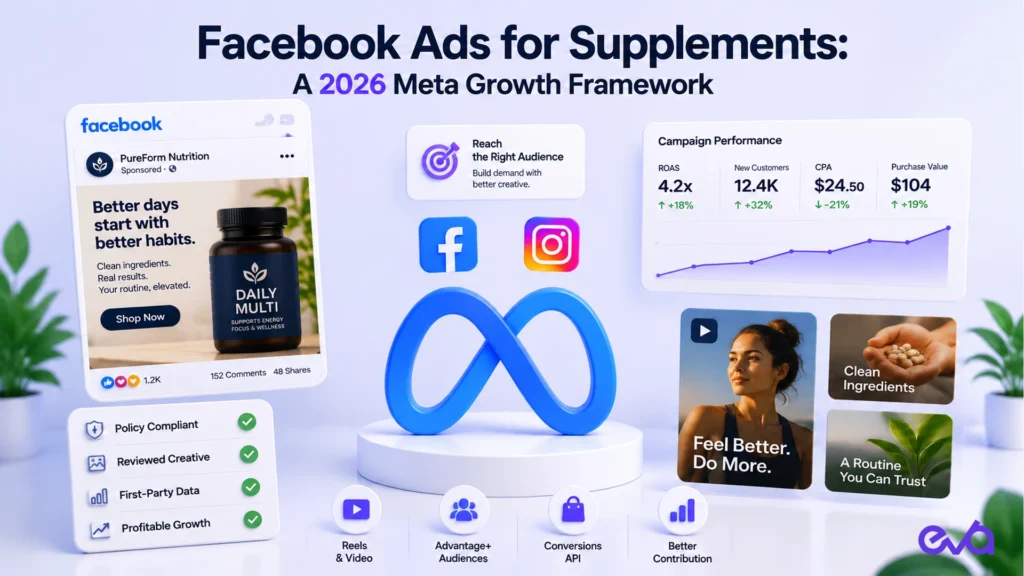
Facebook and Instagram can help supplement brands create demand, communicate product differentiation, and reconnect with interested customers. The same formats can also create risk when a creative implies knowledge about a person, presents an unsupported health message, relies on an unclear testimonial, or sends traffic to a landing page that changes the meaning of the ad.
Meta advertising should be managed as a commerce system. Creative, audience, product page, offer, event data, inventory, and customer economics all affect the result. Platform return on ad spend is not enough. A campaign can report attributed revenue while discounts, product cost, fulfillment, returns, creative production, and weak repeat behavior make the customer unprofitable.
This guide focuses on responsible ecommerce execution for supplement brands. It does not approve products or claims and does not replace current Meta policy review or qualified professional advice.
Quick answer
Run Facebook ads for supplements by creating a reviewed claims library, using product and routine creative that does not infer a personal condition, connecting Shopify events through reliable first-party data and Conversions API, matching each ad to a consistent landing page, testing one meaningful variable at a time, and optimizing toward new-customer contribution and payback.
Table of Contents
- Supplement brand advertising: turn research into a decision
- Supplement brands running Facebook and Instagram ads (checked October 2026)
- In this guide
- Meta advertising control system
- Current primary sources
- 1. Confirm product and destination readiness
- 2. Build a claims and creative library
- 3. Avoid sensitive personal inference
- 4. Create a deliberate testing system
- 5. Connect Shopify and Conversions API correctly
- 6. Align campaign structure with the buying journey
- 7. Optimize for contribution and payback
- 8. Operate policy and account exceptions
- A four-week Meta advertising reset
- How Eva manages Meta advertising for supplement brands
- Facebook ads for supplements FAQ
Supplement brand advertising: turn research into a decision
Use public advertising examples as research input, not proof of a brand result. Compare offer, product category, creative pattern, compliance risk, and the decision the team needs to make next.
For teams that need coordinated execution, see Meta advertising services.
Supplement brands running Facebook and Instagram ads (checked October 2026)
These 11 supplement brands had active ads in the public Meta Ad Library when we checked on October 11, 2026 (United States, all ad types, active ads only). Each brand had active ads running under its own Facebook Page, and some of those are creator or partner ads, which the notes point out. The notes describe only what is visible in the ads: formats, offers and message angles.
- AG1 by Athletic Greens: Image and video ads for AG1 Next Gen and AG1 Pro. Visible angles: a daily nutrition routine, clinical-study framing with disclaimer footnotes in the copy, a 25% discount for military and first responders verified through ID.me, and free-gift bundles such as travel packs and a shaker. Search AG1 by Athletic Greens in the Meta Ad Library (example ad: Library ID 1603630744310905).
- Seed: Image and video ads for the DS-01 Daily Synbiotic. Visible angles: strain count and capsule delivery technology, positioning against other probiotics, and creator videos that share a personal discount code. Search Seed in the Meta Ad Library (example ad: Library ID 4482210852097204).
- Momentous: Image and video ads for creatine and other performance products. Visible angles: third-party testing and purity messaging, creatine education aimed at women, an expert partnership with Dr. Stacy Sims, and retail ads announcing Momentous at select Target stores with a receipt-based gift card offer. Search Momentous in the Meta Ad Library (example ad: Library ID 2138463833731729).
- Thorne: Image ads built around routine and discipline that feature basketball player Cade Cunningham, plus separate ads inviting health practitioners to join its practitioner program. Search Thorne in the Meta Ad Library (example ad: Library ID 2173914909866842).
- Transparent Labs: Image and video ads for protein, pre-workout and creatine products. Visible angles: ingredient transparency and “no fillers” messaging, product-specific explainers, and a subscribe-and-save offer of 10% off with free shipping. Search Transparent Labs in the Meta Ad Library (example ad: Library ID 1858347108655695).
- Grüns: Image and video ads for superfood gummy packs, including a separate Grüns Kids line. Visible angles: fiber education, a first-order price offer, percentage-off sales with free gifts for new subscribers, and seasonal flavor returns. Search Grüns in the Meta Ad Library (example ad: Library ID 1671052451271776).
- Goli: Mostly video ads for gummy supplements. Visible angles: a Zero Sugar bundle, limited-time sales with free shipping, money-back guarantee messaging, and partner ads that share discount codes. Search Goli in the Meta Ad Library (example ad: Library ID 967732149704896).
- Create Wellness: Image ads for creatine gummies. Visible angles: candy and soda-inspired flavors, limited flavor drops and bundles, subscribe-and-save pricing, and NSF Certified for Sport and purity messaging. Search Create Wellness in the Meta Ad Library (example ad: Library ID 2264041867747585).
- Cymbiotika: Image and video ads across many products, including sea moss, beauty peptides and liposomal vitamins. Visible angles: daily ritual and consistency, a starter pack of best sellers, customer-quote testimonials, and subscribe-and-save discounts. Search Cymbiotika in the Meta Ad Library (example ad: Library ID 1367449558692467).
- Nutrafol: A large set of image and video ads for hair growth supplements. Visible angles: life-stage messaging such as menopause and women over 45, clinical-testing framing, product bundles, and subscribe-and-save discounts. Search Nutrafol in the Meta Ad Library (example ad: Library ID 1730021461611111).
- Garden of Life: Creator partnership video ads labeled #GOLPartner and #ad, in which creators describe their own probiotic routine, with comment prompts and the standard FDA statement disclaimer. Search Garden of Life in the Meta Ad Library (example ad: Library ID 1602772847894641).
Note on this list: Ad activity changes every day. Brands start, pause and replace ads often, so open the Ad Library links to see what is running now. This list was checked in October 2026. It does not show ad spend, reach or results for any brand, and it is not an endorsement of any product or claim.
Patterns visible across these ads
- Subscription offers: Transparent Labs, Create Wellness, Cymbiotika, Nutrafol and Grüns all promote subscribe-and-save or new-subscriber pricing.
- Creator, expert and athlete voices: Seed, Goli and Garden of Life run creator or partner ads, Momentous features a named expert, and Thorne features an athlete.
- Retail and channel news: Momentous uses ads to announce its Target availability and a store purchase offer, not only online orders.
- Visible disclaimers: several brands, including AG1 and Garden of Life, include footnotes or the FDA statement disclaimer in the ad copy.
How to check a supplement brand in the Meta Ad Library
- Open facebook.com/ads/library and choose the country you sell in.
- Set the category to All ads and search the brand name or its Facebook Page.
- Filter to active ads, then note the “Started running on” date, the number of versions, and the platforms shown.
- Open the landing page from each ad and compare it with the ad’s message, offer and disclaimers.
- Save screenshots with the date, because the ad may be gone the next time you look.
Use these examples as research inputs for your own claims library and testing plan, as described in the sections below. For hands-on help, see Meta advertising services.
In this guide
- Supplement brands running Facebook ads (Oct 2026)
- 1. Confirm product and destination readiness
- 2. Build a claims and creative library
- 3. Avoid sensitive personal inference
- 4. Create a deliberate testing system
- 5. Connect Shopify and Conversions API correctly
- 6. Align campaign structure with the buying journey
- 7. Optimize for contribution and payback
- 8. Operate policy and account exceptions
Meta advertising control system
| Layer | Operating question | Release control |
|---|---|---|
| Product | Is the product eligible and accurately represented? | Product file and qualified review |
| Message | What express and implied message will the audience receive? | Claims library and creative approval |
| Audience | Is targeting appropriate and non-sensitive? | Audience rules and privacy review |
| Landing page | Does the destination continue the same promise? | PDP and checkout QA |
| Measurement | Are browser, server, order, and customer signals reliable? | Event and identity governance |
| Economics | Does acquired demand create contribution and pay back? | Cohort model and spend guardrails |
Current primary sources
Meta Advertising Standards: Meta publishes the current advertising standards that govern ad content, targeting, restricted goods, health and wellness, and landing destinations.
FTC Health Products Compliance Guidance: FTC staff explains substantiation, implied messages, testimonials, and clear disclosures for health-related marketing.
FTC Disclosures 101 for Social Media Influencers: FTC staff explains when material connections should be disclosed and how to make the disclosure hard to miss.
1. Confirm product and destination readiness
Operator answer
Do not launch until the product, ad account, landing page, payment path, and geographic market can support the proposed promotion.
Check current Meta standards and the rules that apply to the product and market. Review the product name, packaging, ingredients and facts as applicable, approved positioning, testimonials, claims evidence, and landing page. Confirm the product can be purchased, fulfilled, and supported in the targeted location.
Test the destination on mobile. Verify page speed, product selection, price, purchase option, subscription terms, checkout, shipping, returns, privacy, and customer support. Meta reviews can consider the destination, and customers judge the entire journey. A compliant-looking ad does not repair a contradictory landing page.
2. Build a claims and creative library
Operator answer
Every material message should have an owner, approved wording, applicable product, supporting source, review date, and visual guidance.
List the facts and reviewed positioning the team can use, the qualifications that must remain nearby, and the wording or implications that require escalation. Include image and demonstration rules. Creative can imply an outcome through expression, body focus, before-and-after framing, symbols, testimonials, or the sequence of scenes even when the caption appears cautious.
Archive the final asset with its copy, landing page, reviewer, approval date, and intended market. When an editor changes a hook, crop, testimonial, overlay, or call to action, recheck the net impression. An old approval should not be treated as a blanket license for every variation.
3. Avoid sensitive personal inference
Operator answer
Speak about the product and routine without stating or implying that the advertiser knows a person has a health condition or sensitive attribute.
Review direct address, audience labels, copy, and visuals for personal-attribute implications. A message can describe a product category or a general routine without telling the viewer what is wrong with them. Avoid creative that isolates a body area or presents a personal diagnosis-like conclusion.
Audience strategy should use lawful, appropriate commerce and engagement signals. Do not build segments from sensitive health assumptions. Document data source, consent, purpose, retention, and activation. The media team should know which customer fields may and may not be used.
4. Create a deliberate testing system
Operator answer
Test customer problem framing, product education, demonstration, proof format, offer, and landing experience in controlled families.
Begin with a creative matrix that names the audience stage, product, message, evidence, format, creator, hook, and landing page. Change one meaningful factor where practical. Produce enough variation to learn without flooding delivery with underpowered assets. Label every asset consistently so performance can be connected to the actual concept.
Use clear decision thresholds for spend, impressions, clicks, conversion, completed orders, and contribution. A high click-through rate can indicate curiosity or an overpromising hook. Review downstream conversion, returns, support, and repeat behavior before declaring a winning message.
5. Connect Shopify and Conversions API correctly
Operator answer
Define events, identifiers, consent, deduplication, product IDs, and purchase value before using server-side signals to optimize.
Map view, product, cart, checkout, purchase, refund, and subscription events to the same product and order identifiers used in Shopify. Deduplicate browser and server events. Exclude taxes or shipping from value only if the definition is documented and used consistently. Preserve currency and market.
Event volume is not data quality. Validate representative customer journeys, compare Meta events with Shopify orders, review event match and duplicate patterns, and monitor changes after theme, app, checkout, consent, or subscription releases. Do not send fields the brand should not use for advertising.
6. Align campaign structure with the buying journey
Operator answer
Use campaign roles for prospecting, education, product consideration, retargeting, and retention without allowing overlap to hide the decision.
Keep the structure simple enough for signal and operational control. Separate markets, products, offers, or objectives only when the team needs a different budget, creative, landing page, or economic rule. Excessive fragmentation can produce sparse learning and constant manual intervention.
Retargeting can capture customers created by other channels. Report it separately from broader acquisition and use holdouts or incrementality tests when available. Coordinate email, SMS, Google, creators, and Meta so several channels do not claim the same order without a business-level reconciliation.
7. Optimize for contribution and payback
Operator answer
Judge Meta acquisition by new-customer contribution, cohort payback, and incremental demand, not platform revenue alone.
Subtract discounts, product cost, payment, fulfillment, shipping subsidy, returns, variable creative, media, and service cost from new-customer net sales. Follow customers through repeat orders and subscription cycles. Compare cohort quality by concept, source, product, offer, and market.
Set spend rules from marginal contribution, inventory, cash, and evidence. A campaign can tolerate a longer payback when repeat behavior is mature and capital is available. Do not credit an unproven lifetime-value forecast to a young cohort simply to justify more spend.
8. Operate policy and account exceptions
Operator answer
Maintain a release record and one issue log for rejections, restrictions, product changes, landing-page changes, and account warnings.
When an ad is rejected, identify the specific asset, copy, destination, product, policy category, and account history. Review the complete message before editing a single word. Preserve the original and revised versions. Appeal only when the team can explain why the asset and destination meet the current rule.
Monitor product, policy, and account changes. Re-review evergreen ads after a label, product, landing page, or platform policy change. A creative that ran previously is not automatically suitable forever. Use incident findings to update the claims library and future briefs.
A four-week Meta advertising reset
- Week 1: Audit products, policies, claims, destinations, events, cohorts, creative, and contribution.
- Week 2: Fix the claims library, landing pages, event quality, asset naming, and campaign roles.
- Week 3: Launch a controlled creative matrix with clear thresholds and product-level economics.
- Week 4: Review contribution, cohort quality, policy events, and creative evidence, then move capital deliberately.
How Eva manages Meta advertising for supplement brands
Eva connects Meta creative, media, Shopify customer data, Conversions API, product pages, lifecycle, inventory, and contribution. Senior operators can see whether a message creates profitable new customers or only attractive platform reporting.
Eva supports commerce strategy and execution. Product substantiation, product safety, claims approval, privacy, and legal review remain with the brand and its qualified reviewers.
Facebook ads for supplements FAQ
Can supplement brands advertise on Facebook and Instagram?
Some eligible supplement products can be advertised, subject to current Meta standards, product, message, audience, market, account, and landing-page requirements. Check the current policy for the exact promotion.
What supplement creative tends to work?
Useful creative often clarifies the real product, routine, format, customer decision, and brand evidence. Performance depends on product, audience, offer, market, and execution. Every concept still needs claims and policy review.
Should brands use testimonials?
Testimonials should be genuine, appropriately disclosed, representative or qualified where required, and limited to messages the advertiser can support directly. Review the current FTC and platform requirements.
Is Conversions API enough to fix attribution?
No. It can improve event delivery, but attribution still requires event governance, order reconciliation, customer cohorts, incrementality evidence, and documented limitations.
What should replace ROAS as the main decision metric?
Use new-customer contribution and payback alongside platform reporting, conversion, inventory, and incrementality. No single metric explains the entire customer journey.
Related Eva resources: Supplement Ecommerce Agency, Meta Advertising, Cross-Channel Signal Architecture Playbook, Shopify Supplement Brand Growth, Supplement Marketplace Compliance.
Important scope note
This guide covers ecommerce operations, not medical or legal advice. Platform policies change, and brands remain responsible for product safety, substantiation, labeling, claims, and qualified review.
Related Eva resource: For hands-on support, explore Eva’s supplement ecommerce growth team.
Related Eva resource: For marketplace growth support that keeps operational and compliance considerations in view, explore Eva’s supplement ecommerce growth team.