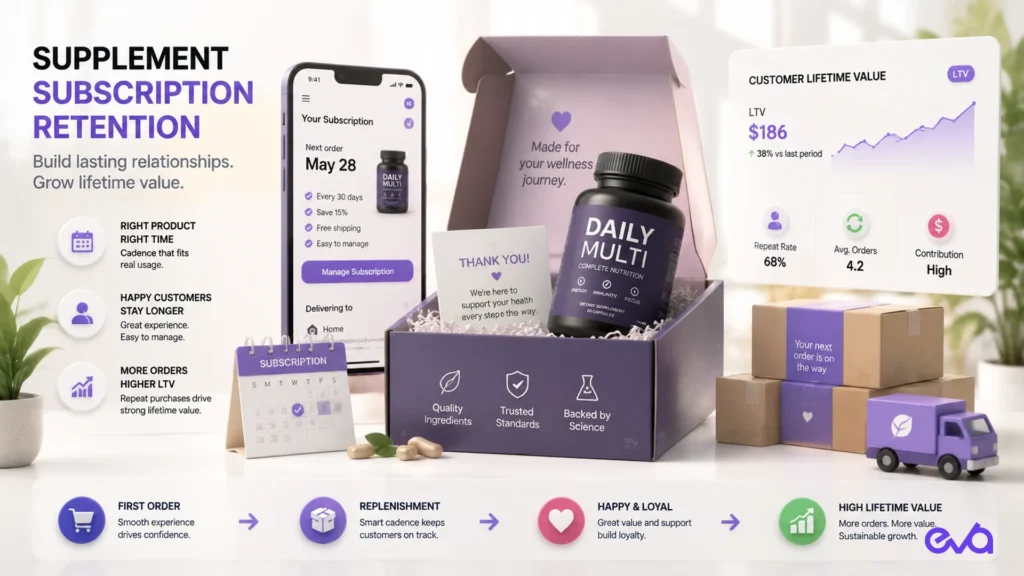
Supplement subscription retention is the ability to keep a useful customer relationship through transparent enrollment, an appropriate replenishment cadence, a reliable product and delivery experience, and easy account control. Retention is not the percentage of customers who failed to find the cancel button. A durable program earns the next order.
Many brands start with a standard discount and monthly cadence. The offer may lift first-order conversion while creating oversupply, early cancellation, high support cost, and weak contribution. The better approach measures product use patterns, time to second order, pauses, skips, cancellation reasons, failed payments, refunds, and cohort economics by product and acquisition source.
This guide shows how to design and operate a supplement subscription program without relying on dark patterns or an unsupported lifetime-value forecast.
Quick answer
Improve supplement subscription retention by making terms clear, matching cadence to observed replenishment behavior, delivering useful onboarding and education, offering easy skip and pause controls, recovering failed payments respectfully, and fixing product or service causes behind cancellation. Measure cumulative contribution and payback by cohort, not active subscribers alone.
Table of Contents
- In this guide
- Subscription retention operating model
- Current primary sources
- 1. Define the subscription promise
- 2. Set cadence from behavior
- 3. Build onboarding for confidence and control
- 4. Design ethical skip, pause, and save flows
- 5. Recover failed payments respectfully
- 6. Measure cohort contribution and payback
- 7. Use cancellation evidence to improve acquisition
- 8. Run a weekly retention review
- A four-week subscription retention reset
- How Eva manages supplement subscription retention
- Supplement subscription retention FAQ
In this guide
- 1. Define the subscription promise
- 2. Set cadence from behavior
- 3. Build onboarding for confidence and control
- 4. Design ethical skip, pause, and save flows
- 5. Recover failed payments respectfully
- 6. Measure cohort contribution and payback
- 7. Use cancellation evidence to improve acquisition
- 8. Run a weekly retention review
Subscription retention operating model
| Moment | Customer need | Brand measure |
|---|---|---|
| Enrollment | Understand price, frequency, benefits, and control | Opt-in conversion and early cancellation |
| Onboarding | Know what arrives and how to manage the plan | First-cycle support and engagement |
| Replenishment | Receive the right quantity at the right time | Skip, pause, shipment, and surplus signals |
| Service | Resolve delivery, billing, or product questions | Resolution time, refunds, and save quality |
| Renewal | Choose whether the next order still fits | Renewal rate and contribution |
| Win-back | Return for a relevant reason | Reactivation contribution and future retention |
Current primary sources
Shopify subscriptions setup: Shopify explains subscription setup, product purchase options, policy requirements, and customer subscription management.
Shopify customer segmentation: Shopify explains how segments can be built from customer and order attributes.
FTC negative option rule resources: FTC provides current rule and compliance resources for negative-option programs. Brands should obtain qualified review for their program.
1. Define the subscription promise
Operator answer
The customer should understand what will arrive, how often, what it costs, when billing occurs, and how to change or end the plan before enrolling.
Write the purchase option in plain language next to the selection and checkout. Show the discount, recurring price, frequency, next-step timing, shipping treatment, and account controls. Avoid placing essential terms only in a policy link. Test mobile checkout because compressed interfaces can hide context unintentionally.
Decide what subscription actually adds beyond a discount. Useful benefits can include convenience, flexible cadence, early access, appropriate bundles, education, or service. The value must be operationally sustainable. A deep permanent discount can create acquisition volume while weakening every future order.
2. Set cadence from behavior
Operator answer
Use product pack, expected use according to approved instructions, and observed reorder timing to offer a small number of sensible cadence choices.
Analyze time from first to second order and between later orders by product, pack, cohort, source, and purchase option. Look at the distribution, not only the average. A wide distribution suggests that customers need flexibility. Compare order timing with skip, pause, cancel, and support reasons.
Start with evidence and keep the customer in control. Do not infer a personal condition or give individualized use advice. Cadence options should reflect product configuration and approved product information. Make it simple to move a delivery earlier or later before excess inventory becomes a cancellation.
3. Build onboarding for confidence and control
Operator answer
The first messages should confirm the order, explain the plan, show account controls, set delivery expectations, and provide reviewed product information.
Send a clear confirmation with product, quantity, price, frequency, next billing date, shipping, and account-management path. Follow with practical education that matches approved messaging. Avoid overwhelming the customer with daily promotional email before the first product arrives.
Coordinate delivery and onboarding. A delayed package makes timed education feel disconnected. Trigger messages from fulfillment events where possible and give customer service access to the same subscription status. Track support contacts during the first cycle because they often reveal unclear terms or product-page gaps.
4. Design ethical skip, pause, and save flows
Operator answer
Save flows should solve the stated customer problem, not create friction or hide the requested action.
Collect a concise cancellation reason and offer a relevant option such as skip, pause, cadence change, product change, or support only when it addresses that reason. Keep cancellation available and clear. Measure whether a saved subscriber remains satisfied and profitable through later cycles, not only whether the cancellation click was avoided.
Use reason data to fix upstream causes. Too much product points to cadence or pack. Price can point to value, discount design, or financial fit. Delivery and damage point to operations. Product expectations can point to acquisition and PDP messaging. A save offer should not substitute for correcting the system.
5. Recover failed payments respectfully
Operator answer
Use a limited sequence, clear account instructions, and suppression after resolution or cancellation.
Track failure reason where available, retry timing, message delivery, update success, involuntary churn, and support contacts. Avoid repeated messages after a payment is fixed. Keep links secure and direct customers to the account area rather than requesting sensitive information in email or SMS.
Separate involuntary churn from customer cancellation in reporting. A rising failure rate can reflect card lifecycle, processor issues, acquisition quality, or customer finances. Evaluate recovery by retained contribution after retries, discounts, and service cost.
6. Measure cohort contribution and payback
Operator answer
Subscription LTV should be cumulative contribution after variable costs, not projected recurring revenue.
For each cohort, track net sales, discounts, product cost, fulfillment, shipping, payment fees, returns, refunds, support, incentives, acquisition, and retention cost. Show cumulative contribution by completed cycle. Compare mature cohorts before extending a long forecast from new customers.
Segment by first product, pack, cadence, source, offer, market, and new versus existing customer. A channel that produces many subscribers can still underperform when early churn and discount are high. Use payback targets that reflect cash, inventory, and risk.
7. Use cancellation evidence to improve acquisition
Operator answer
Feed subscription outcomes back into ads, landing pages, offers, product pages, and merchandising.
Join acquisition source and creative with subscription lifecycle. Identify messages that create strong enrollment but weak second-cycle retention. Review whether the ad overemphasized discount, simplified the product, or attracted customers who did not fit the offer. Adjust creative and targeting before adding another save incentive.
Compare the lifetime pattern of one-time and subscription customers. Some valuable customers prefer to repurchase manually. Give them a good replenishment path. The objective is not the highest subscription share. It is a larger base of satisfied, profitable repeat customers.
8. Run a weekly retention review
Operator answer
Review a small set of cohort, service, delivery, payment, and inventory exceptions, then assign fixes to the team that owns the cause.
Monitor renewal, skip, pause, cancel, failed payment, refund, ticket reasons, delivery, stock, and contribution. Separate expected seasonality from structural change. Review both counts and rates so a small cohort does not create an exaggerated story.
Preserve a change log for cadence, pricing, benefits, emails, SMS, account UX, fulfillment, and offers. Allow enough time and volume for a fair read. Reconcile subscription data with Shopify, the subscription app, payment, support, fulfillment, and finance.
A four-week subscription retention reset
- Week 1: Audit terms, cadence, customer controls, lifecycle, service reasons, cohorts, and economics.
- Week 2: Fix enrollment clarity, confirmation, account management, skip, pause, cancellation, and failed-payment paths.
- Week 3: Rebuild replenishment timing and segments from observed behavior, then address the top cancellation cause.
- Week 4: Launch a contribution-led retention scorecard and one controlled test with a documented decision rule.
How Eva manages supplement subscription retention
Eva connects subscription, email, SMS, customer data, paid acquisition, product pages, merchandising, inventory, and contribution. The team can see when an acquisition message creates short-lived enrollment and can correct the offer or journey instead of treating churn as an isolated lifecycle problem.
Eva Intelligence helps operators identify customer and product exceptions, while experienced teams own the strategy and execution. The goal is a transparent replenishment relationship that customers choose to continue.
Supplement subscription retention FAQ
What is a good supplement subscription retention rate?
There is no universal rate. Product, pack, cadence, price, acquisition source, cohort age, and measurement method differ. Compare completed-cycle retention and cumulative contribution with the brand’s own targets.
Should subscribers receive a discount?
A discount can support the value exchange, but model its effect on every cycle and on acquisition behavior. Convenience, flexibility, service, and relevant benefits can also create value.
How many cadence options should a brand offer?
Offer a small number grounded in product configuration and observed reorder behavior. Too many choices can create confusion, while one rigid cadence can create surplus and churn.
Should cancellation be difficult?
No. Make account controls clear and obtain qualified review for recurring-billing requirements. Save flows should solve the customer’s stated problem without obstructing the requested action.
How should subscription LTV be calculated?
Use cumulative contribution through completed cycles after product, fulfillment, shipping, payment, discounts, returns, acquisition, retention, and service costs. State the cohort age and assumptions.
Related Eva resources: Supplement Ecommerce Agency, Shopify Management, Shopify Retention and LTV Playbook, Shopify Supplement Brand Growth, Supplement Ecommerce Profitability.
Important scope note
This guide covers ecommerce operations, not medical or legal advice. Platform policies change, and brands remain responsible for product safety, substantiation, labeling, claims, and qualified review.
Related Eva resource: For marketplace growth support that keeps operational and compliance considerations in view, explore Eva’s supplement ecommerce growth team.