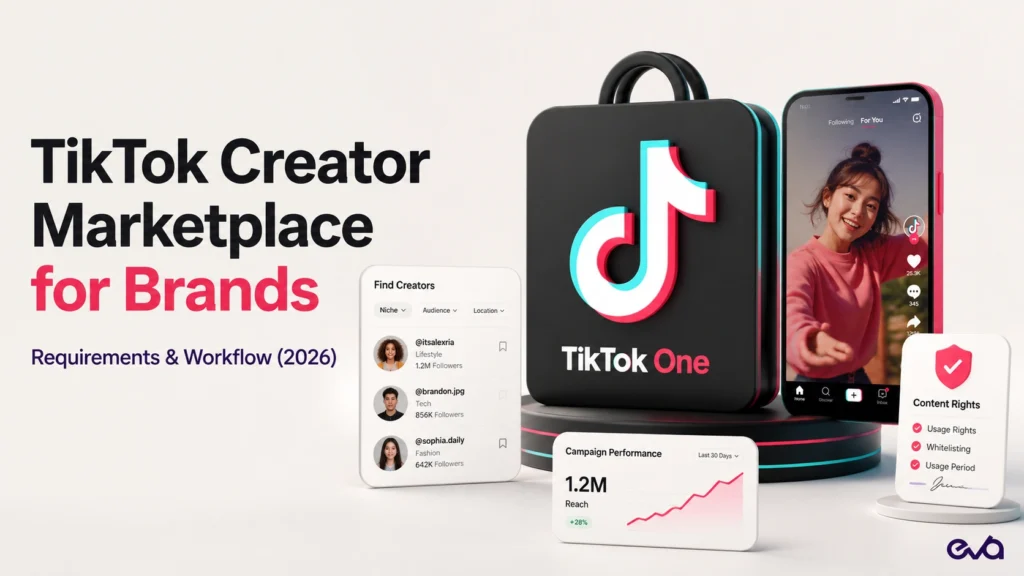
TikTok Creator Marketplace is now part of TikTok One. Brands searching for the former marketplace can use TikTok One to build a brand profile, discover creators, launch collaboration projects, manage creative deliverables, and prepare approved content for organic publishing or paid amplification. The name changed, but the operating question is the same: how can a brand turn creator fit into repeatable, measurable content?
This guide explains the current workflow for brands. It focuses on platform access, project structure, creator evaluation, content rights, and performance controls—not on choosing an influencer by follower count alone. For a deeper creator-fit framework, read how to choose the right TikTok Shop influencer.
Table of Contents
- What happened to TikTok Creator Marketplace?
- TikTok One vs TikTok Shop affiliate marketing
- Brand requirements before creating a project
- How to find creators without overvaluing follower count
- Build a brief creators can execute
- Clarify content rights and ad authorization
- Measure the project as a creative system
- A practical launch checklist
- Official TikTok resources
- How to choose the right TikTok One project type
- Creator evaluation scorecard for brands
- Budgeting a creator campaign
- Create a compliant claims library
- Design the review and revision workflow
- From creator content to paid-media testing
- Thirty-day operating cadence
- Frequently asked questions
- Build a managed TikTok Shop growth system
What happened to TikTok Creator Marketplace?
TikTok moved new creator-brand projects from TikTok Creator Marketplace into TikTok One. TikTok’s official creator documentation says that creators using the earlier Creator Marketplace and Creative Challenge experience had to transition to TikTok One for new brand projects after March 10, 2025. For marketers, this means older tutorials may show menus and eligibility language that no longer match the current interface.
TikTok One combines several collaboration routes. A brand may run a creator marketing project, source creator content at scale, or work with creative partners. Availability, requirements, payment options, and project features can vary by region and account, so the live account interface and TikTok’s current documentation should remain the final source of truth.
TikTok One vs TikTok Shop affiliate marketing
| Route | Primary purpose | Typical commercial model | Best fit |
|---|---|---|---|
| TikTok One creator marketing | Commission custom creator content | Project fee or platform-supported arrangement | Brands that need a brief, deliverables, review, and usage rights |
| TikTok Shop affiliate | Drive product sales through creator promotion | Commission on attributed sales | Products with strong economics, inventory, and creator-ready offers |
| Direct creator outreach | Build a negotiated partnership outside discovery tools | Negotiated fee, commission, gifting, or hybrid | Brands with an established creator pipeline and contract process |
These routes can complement one another. A brand may commission content through TikTok One, authorize suitable assets for advertising, and operate a separate TikTok Shop affiliate program. The important control is to document which arrangement grants which rights and which outcome it is expected to produce.
Brand requirements before creating a project
Start with account readiness. TikTok’s current guidance requires a brand profile before creating a project and says a valid brand website is needed to save that profile. TikTok also states that a business must be verified to create certain TikTok One projects. Complete verification early rather than discovering the requirement during a launch window.
- Use an accurate brand name, description, industry, website, logo, and social links.
- Confirm who owns project approval, creator communication, payments, and legal review.
- Define the target market and ensure the selected solution is available in that region.
- Prepare product claims, prohibited claims, mandatory disclosures, and visual guardrails.
- Decide whether content will be organic only, used as an ad, or licensed for additional channels.
How to find creators without overvaluing follower count
TikTok One lets advertisers filter creator profiles using criteria such as creator location, audience location, follower count, median views, engagement rate, and audience demographics. A useful shortlist balances four dimensions:
- Audience fit: Does the creator reach the country, age group, and customer context the brand serves?
- Content fit: Can the creator explain or demonstrate the product in a native style?
- Performance consistency: Are median views and recent engagement stable, or is the profile dependent on one outlier?
- Operational reliability: Does the creator submit on time, respond clearly, and handle revisions professionally?
Follower count is a discovery signal, not a forecast. Compare recent organic and sponsored videos, audience geography, view distribution, comment quality, and the creator’s ability to deliver the required format.
Build a brief creators can execute
A strong creator brief gives direction without forcing every creator into the same script. It should define the business objective, product truth, audience problem, mandatory elements, prohibited claims, deliverables, aspect ratio, length, deadline, revision process, disclosure rules, and usage rights.
Separate non-negotiables from creative freedom. The creator should know what must be accurate while retaining room to choose the hook, pacing, setting, and storytelling approach that fits their audience. If every line is prescribed, the output may look like a conventional ad instead of creator-led content.
Before approval, document where the asset can appear, how long the brand can use it, whether editing is allowed, whether paid media is included, and whether creator identity can be used outside TikTok. TikTok requires branded-content disclosure for posts that promote a brand, product, or service. The platform setting does not replace a clear commercial agreement or applicable legal review.
Measure the project as a creative system
Use metrics that match the job of the asset. Reach-focused content may be judged by qualified views, watch behavior, and audience fit. Consideration content may be judged by product-page visits, comments, saves, or branded search lift. Conversion content may be judged by attributed orders, cost per acquisition, contribution margin, and new-customer quality.
Do not treat creator selection as the final optimization. Tag each asset by hook, creator profile, product angle, proof type, format, and call to action. The resulting pattern library can inform the next brief and the paid-media test plan. For the broader commerce workflow, see Eva’s guide to TikTok Shop affiliate marketing.
A practical launch checklist
- Verify the business and complete the brand profile.
- Choose the collaboration route based on the required output.
- Set one primary objective and a small set of supporting metrics.
- Shortlist creators using audience, content, performance, and reliability signals.
- Write a clear brief and define approval ownership.
- Confirm disclosures, claims, content rights, and ad authorization.
- Track asset-level results and feed learnings into the next project.
Official TikTok resources
- About TikTok One for creators
- Set up a TikTok One brand profile
- Find creators in TikTok One
- TikTok One policies
How to choose the right TikTok One project type
Begin with the output the business actually needs. If the goal is a small number of bespoke creator partnerships, a creator marketing project can support direct invitations or applications and a defined set of deliverables. If the bottleneck is creative volume for testing, a content-at-scale route may be more suitable. If the brand needs specialist production support, a creative partner may be the better operational choice. The platform route should follow the brief, not the other way around.
Write a one-sentence project decision before setup: “We need a specific number of creator-led videos for a defined audience and use case, with agreed paid-media rights, by a particular date.” This forces the team to agree on the output, audience, rights, and timing. Without that decision, brands often invite too many creators, request incompatible deliverables, or discover that the content cannot be used in the intended campaign.
Creator evaluation scorecard for brands
A scorecard makes selection more consistent across team members. Use a small number of weighted criteria and preserve the evidence behind each rating. The purpose is not to reduce creativity to a formula; it is to prevent a visually impressive profile or one viral post from overriding audience and operational fit.
| Dimension | What to review | Warning signs |
|---|---|---|
| Audience relevance | Country, language, age range, interests, and customer context | Large audience with weak overlap to the target market |
| Content capability | Hooks, demonstrations, storytelling, editing, and product explanation | Every sponsored video uses the same generic format |
| Performance pattern | Median views, engagement quality, consistency, and recent trend | Decision depends on one extreme outlier |
| Brand safety | Recent posts, tone, claims, disclosures, and category conflicts | Undisclosed promotions or risky product claims |
| Reliability | Response quality, submission history, revisions, and deadlines | Unclear communication or repeated late delivery |
| Commercial fit | Fee, rights, expected output, and likely reuse value | Price evaluated without deliverables or license scope |
Use the same scorecard for invited creators and applicants. Leave a short written reason for approval or rejection. Those notes become valuable when the team reviews which creator characteristics actually correlated with useful content.
Budgeting a creator campaign
The creator fee is only one part of the budget. Include product samples, shipping, platform or partner costs, production support, music or asset licensing where applicable, legal review, internal labor, revisions, paid amplification, and measurement. If content will become advertising creative, reserve budget for media testing rather than spending the entire amount on production.
Evaluate cost per usable asset as well as cost per creator. One creator may deliver several distinct hooks, while another may produce a single asset with narrow usage rights. A lower fee is not necessarily more efficient if the content needs extensive revisions or cannot be amplified. Conversely, a high-performing organic creator may not automatically produce the best direct-response ad. The brief and evaluation method should reflect the intended job.
Create a compliant claims library
Creators need accurate product information in language they can understand and use. Prepare a claims library that separates approved facts, required qualifiers, prohibited statements, and claims that need legal or regulatory review. Include the source for important specifications so the team can resolve questions quickly.
Do not encourage creators to present personal experience they did not have or results the brand cannot substantiate. Review on-screen text, captions, spoken claims, product demonstrations, and links—not only the main script. Disclosure requirements should be explicit in the brief and checked again before posting. If the asset will run as an ad, confirm that it also meets the applicable advertising policies.
Design the review and revision workflow
Too many reviewers can slow a project and produce contradictory feedback. Assign one owner to consolidate comments from brand, performance, product, and legal stakeholders. Define how many revision rounds are included and distinguish factual corrections from subjective preferences.
- Review the first submission for factual accuracy, mandatory elements, disclosure, and technical specifications.
- Check whether the opening communicates the audience problem or product use case quickly.
- Consolidate feedback into one prioritized response with timestamps where helpful.
- Approve the final asset and record the approved version, caption, rights, and authorization period.
- Store the asset with creator, concept, hook, product, market, and usage-right tags.
A revision should protect accuracy and campaign purpose without removing the creator’s natural voice. If the same misunderstanding appears across several creators, improve the brief rather than treating every submission as an isolated failure.
From creator content to paid-media testing
Plan multiple testable variables. One asset may lead with a customer problem, another with a product demonstration, and another with a comparison or routine. Keep enough consistency in the offer and landing experience to understand what the creative changed. Avoid changing the audience, bid strategy, offer, landing page, and creative simultaneously if the goal is to learn which message works.
For each asset, record the creator, hook, first visual, proof type, length, call to action, organic performance, authorization status, and paid results. Compare early attention metrics with downstream outcomes. A video that earns a strong view rate may still attract the wrong audience, while a lower-volume asset may generate more qualified product visits or purchases.
Thirty-day operating cadence
In week one, define the objective, economics, audience, claims, and content gaps. In week two, source and evaluate creators, confirm rights, and finalize the brief. In week three, manage submissions and approvals while preparing the product page and media plan. In week four, launch controlled tests, document results, and decide which concepts to iterate, scale, or retire.
The cycle should produce two outputs: usable content and better creative knowledge. Preserve unsuccessful tests as structured learning rather than deleting them from the record. Over time, the brand can identify which creator profiles, messages, and formats fit particular products and funnel stages.
Frequently asked questions
Is TikTok Creator Marketplace still available?
New creator-brand project activity moved to TikTok One. Older articles may still use the Creator Marketplace name, which remains a common search term, but brands should follow the current TikTok One interface and official documentation.
How many followers does a creator need?
Requirements can vary by region and opportunity. Brands should not use a universal follower threshold as their primary quality filter. Audience relevance, median views, content quality, reliability, and project-specific eligibility provide a stronger decision framework.
Can TikTok One content be used in ads?
Some workflows support ad authorization and Spark Ads, but rights and authorization must be confirmed for the specific project and creator. Document the permitted channels, duration, editing rights, and final approved asset.
Build a managed TikTok Shop growth system
Creator content works best when the offer, product detail page, affiliate economics, inventory, paid amplification, and reporting operate together. Explore Eva’s TikTok Shop management service to connect creator activity with marketplace operations and profitable growth.