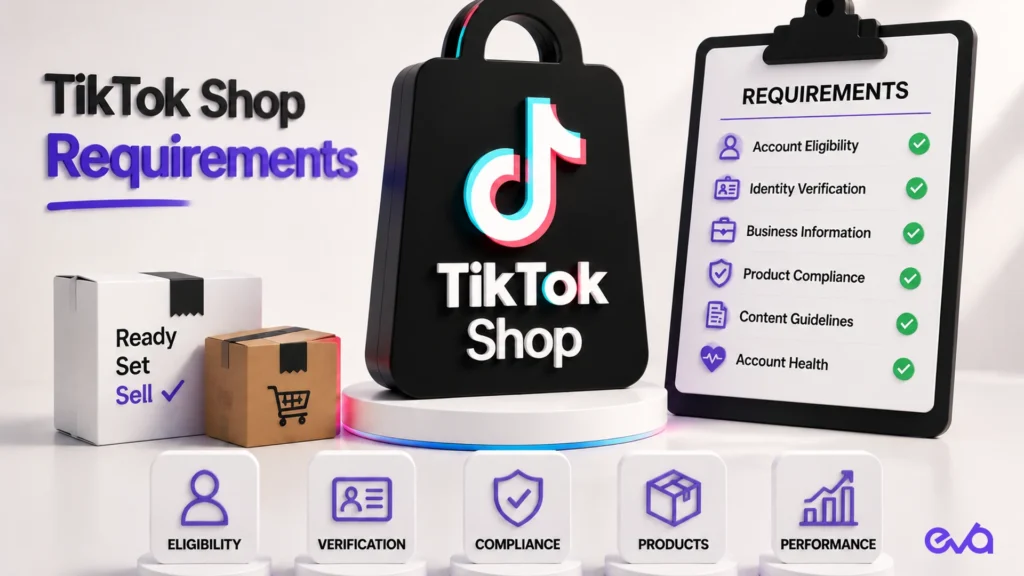
TikTok Shop eligibility is not one universal threshold. Sellers, creators, affiliates, agencies, and product categories follow different requirements that can vary by country, account type, age, identity, business registration, follower level, account standing, and current platform policy. The application screen in the relevant TikTok Shop account is the final source for that account.
Approval is only the first gate. A brand also needs eligible products, accurate listings, compliant content, creator and sample controls, inventory, fulfillment, returns, customer service, and a profit model. Launching before these elements are ready can create cancellations, violations, refund cost, or creator demand that the operation cannot serve.
This 2026 guide explains how US brands and creators should approach eligibility, verification, product readiness, affiliate samples, account health, and launch sequencing. Policies change, so use this article as an operating framework and confirm every current threshold and document requirement in TikTok Shop Academy and Seller Center.
Quick answer: Verify the current US requirements for the exact seller or creator account, complete identity or business checks, connect eligible account roles, and confirm that products comply with category and content policies. Before activating creators or ads, prepare listings, inventory, samples, fulfillment, returns, service, and account-health ownership. Passing enrollment does not mean the operation is launch ready.
Table of Contents
- TikTok Shop eligibility and launch stack
- 1. Identify the exact account and market path
- 2. Prepare identity and business verification
- 3. Confirm product and category eligibility
- 4. Separate creator eligibility from brand fit
- 5. Build a controlled sample program
- 6. Prove fulfillment and service readiness
- 7. Protect account health from the first order
- 8. Launch against completed-order contribution
- A 30-day TikTok Shop readiness plan
- How Eva manages TikTok Shop readiness and growth
- TikTok Shop eligibility FAQ
TikTok Shop eligibility and launch stack
| Gate | What to verify | Operating risk |
|---|---|---|
| Identity | Age, location, person or business, and matching records | Verification rejection or account mismatch |
| Account role | Seller, creator, affiliate, agency, and permissions | Wrong access or unsupported activity |
| Product | Category, claims, documentation, and listing accuracy | Suppression, return, or violation |
| Content | Disclosure, claims, product match, and rights | Enforcement or customer confusion |
| Operations | Inventory, samples, fulfillment, returns, and service | Cancellation and account-health damage |
| Economics | Fees, commission, media, samples, returns, and contribution | GMV growth without profit |
TikTok Shop publishes current seller, creator, affiliate, sample, and policy guidance through TikTok Shop Academy. Requirements can change and differ by account. Confirm the live rules in the official TikTok Shop Academy onboarding guidance and the relevant Seller Center workflow before acting.
1. Identify the exact account and market path
Define whether the applicant is a business seller, individual seller, official brand account, marketing account, creator, affiliate creator, or agency partner. Confirm the operating country and the entity that will receive sales, hold inventory, issue tax records, and serve customers. Requirements and available features differ. Do not assume a threshold from another country or account type applies to the US path.
Map ownership before connecting accounts. Use current business information, named users, secure credentials, and role-based access. Record who controls Seller Center, the TikTok account, payments, affiliate settings, content, customer service, and advertising. Avoid building the operation around one employee or agency login. The brand should retain recovery paths and platform ownership if a relationship ends.
2. Prepare identity and business verification
Use legal names, addresses, tax information, registration records, bank details, and identity documents that are current and consistent. Differences in abbreviations, old addresses, ownership, or image quality can delay verification. Submit only through official account workflows and store a secure record of what was provided, when, and under which case or application.
For brands using distributors, agencies, or multiple entities, document authorization and commercial roles before enrollment. The selling entity, intellectual-property owner, fulfillment operator, and advertising payer may differ, but the relationships should be explainable. Resolve contradictions before launch rather than discovering them during an appeal or payment review.
3. Confirm product and category eligibility
Review prohibited, restricted, invitation-only, and documentation-required categories. Confirm claims, ingredients, safety, certifications, age restrictions, packaging, labeling, and shipping rules for every product. A category appearing in the listing interface does not remove the seller’s responsibility to meet policy and legal requirements. Preserve supplier, testing, compliance, and authenticity evidence.
Create accurate product titles, images, descriptions, variations, dimensions, ingredients, included components, and use instructions. Content and creator claims should match the product customers receive. Misalignment creates refunds and policy exposure. Test listings from a customer perspective before inviting creators or funding demand. A compliant but confusing page is still not launch ready.
4. Separate creator eligibility from brand fit
A creator who meets the platform’s current eligibility threshold is not automatically qualified for the brand. Evaluate audience and product relevance, content quality, claim discipline, prior commerce behavior, completed content, sales quality, refund patterns, and communication. Smaller creators can be valuable when their audience and product understanding are strong. Follower count alone is a weak selection method.
Define permitted claims, required disclosures, usage guidance, prohibited language, product facts, content rights, approval needs, and escalation. Give creators enough freedom to communicate naturally while protecting accuracy. Monitor live content and customer questions. A creator program becomes scalable when qualification, briefing, sample decisions, and performance review follow consistent rules.
5. Build a controlled sample program
Free and refundable samples can accelerate creator participation, but every unit has product cost, fulfillment cost, opportunity cost, and inventory risk. Define eligibility using product fit, creator evidence, content completion, sales quality, and stock. Use auto-approval carefully. A broad rule can send inventory to creators who never publish or whose audience cannot convert.
Track request, approval, shipment, delivery, content due date, content URL, completed content, orders, cancellations, returns, commission, and contribution. Follow current platform rules for sample types and obligations. Do not pressure creators to make unsupported claims or guarantee positive content. The objective is credible product education and profitable customer acquisition, not maximum sample volume.
6. Prove fulfillment and service readiness
Validate inventory accuracy, handling time, carrier workflow, tracking, delivery promise, packaging, cancellation, return routing, refund authority, and customer-service coverage. Run test orders through the complete process. Creator content can produce demand in bursts, so model a base case and a sudden spike. Protect a reserve and decide when to reduce affiliate or advertising exposure.
Assign owners for late shipment, lost parcel, wrong item, damage, product question, cancellation, return, and escalation. Create evidence retention for tracking, photographs, messages, and resolution. Customer-service patterns should flow back to listing, content, creator briefing, packaging, and product teams. Repeating the same refund without correcting the cause weakens account health and economics.
7. Protect account health from the first order
Monitor policy notifications, listing status, cancellation, fulfillment, tracking, returns, customer messages, content claims, creator activity, and payment issues. Define incident severity and response time. Preserve the source evidence needed for an appeal before a problem occurs. A clear record is easier to assemble during normal operations than during an urgent enforcement event.
When a violation appears, identify the exact policy, affected object, root cause, immediate correction, preventive control, and evidence. Avoid submitting repeated generic appeals. Correct connected listings, content, creator briefs, or fulfillment processes when the issue is systemic. Account health is the result of the complete operating system, not a support task owned by one person after enforcement.
8. Launch against completed-order contribution
Build the unit economics before scale: net selling price, discount, platform fees, creator commission, affiliate incentives, advertising, product cost, sample cost, fulfillment, shipping, cancellation, return, and service. Use completed orders and return-adjusted contribution, not gross merchandise value alone. Different products and creators can require different commission and scale thresholds.
Start with a controlled product group, qualified creators, proven stock, and measured content. Review customer questions, listing conversion, creator completion, orders, cancellations, returns, contribution, and account signals each week. Expand only when the operation can repeat the result. Eligibility opens the door; disciplined execution determines whether TikTok Shop becomes a durable channel.
A 30-day TikTok Shop readiness plan
- Week 1: Confirm the account path, current requirements, entity, identity, roles, product categories, and policy evidence.
- Week 2: Build accurate listings, unit economics, creator rules, sample controls, and inventory scenarios.
- Week 3: Test orders, fulfillment, tracking, returns, service, content, permissions, and account-health response.
- Week 4: Launch a controlled product and creator group, review completed-order contribution, and expand only after proof.
How Eva manages TikTok Shop readiness and growth
Eva manages TikTok Shop across creators, content, affiliate, advertising, listings, inventory, fulfillment, returns, account health, and profit. One operating team connects the customer promise with the units and service the brand can actually deliver. That reduces the gap between platform eligibility and commercial readiness.
Eva Intelligence helps operators connect creator, product, customer, and economic signals. Specialists still own qualification, content judgment, incident response, and the decision to scale. Brands can use a six-month TikTok roadmap to sequence setup, creator activity, media, and operations around profitable completed orders.
Supplement brands should also review category documentation, listing, creator, fulfillment, and contribution requirements in Eva’s TikTok Shop supplements guide.
TikTok Shop eligibility FAQ
How many followers are needed for TikTok Shop?
The current requirement depends on market, account type, creator path, age, and account standing. Check the live TikTok Shop Academy and account enrollment screen because thresholds can change.
Can a business sell on TikTok Shop without creators?
A seller can operate its store and content under the capabilities available to its account. Creators and affiliates are a growth path, not a substitute for product, listing, fulfillment, and service readiness.
Are all products allowed on TikTok Shop?
No. TikTok Shop has prohibited, restricted, and documentation-dependent categories and product policies. Sellers must also follow applicable laws, claims, labeling, safety, and shipping requirements.
What is a refundable TikTok Shop sample?
Refundable sample programs allow eligible arrangements where a creator may recover the sample cost after meeting current platform conditions. Exact rules change, so confirm them in the current Academy guidance.
Does TikTok Shop approval mean the brand is ready to launch?
No. Launch readiness also requires eligible products, accurate content, inventory, fulfillment, returns, service, creator controls, account-health ownership, and workable unit economics.
Related Eva resources: TikTok Shop Management, How to Sell on TikTok Shop, TikTok Shop Account Health, Eva Playbooks.