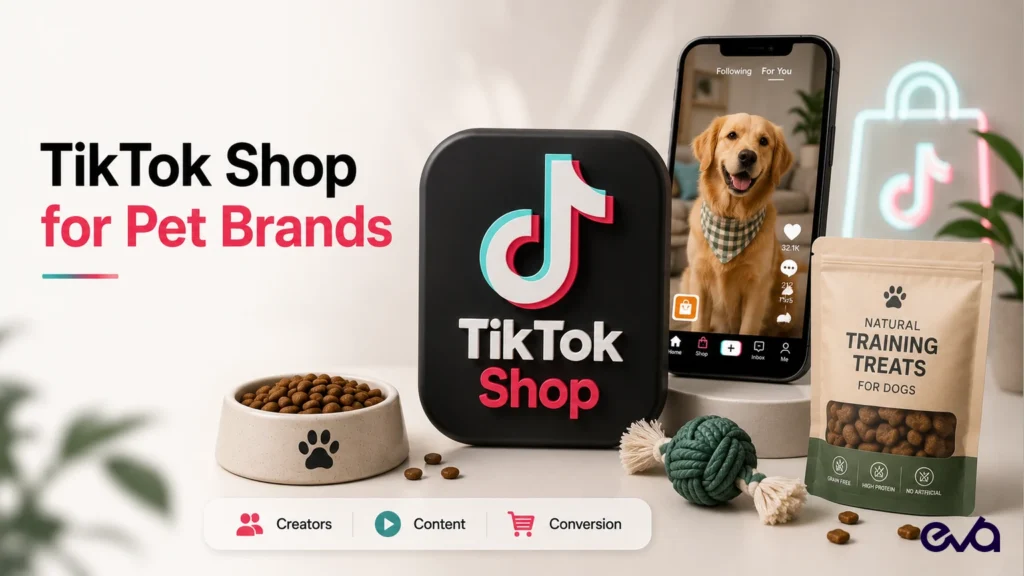
TikTok Shop for pet brands can be powerful because pet owners do not only shop by feature. They respond to real use, emotion, habit, humor, safety, and trust. A short video of a dog actually using a product can answer questions faster than a polished product description.
The channel also creates risk. Pet brands still need margin discipline, claim control, inventory readiness, and a clean customer experience. The brands that win on TikTok Shop usually treat creators as a learning system, not just a distribution list.
Table of Contents
- How TikTok influences pet owners
- Choose creators by pet fit, not follower count
- Build briefs around real pet-owner problems
- Model samples, commissions, and fulfillment before scaling
- Protect claims and customer expectations
- Turn winning TikTok content into a channel system
- Turn pet-owner trust into the creative brief
- Choose creators by pet fit and audience behavior
- Build TikTok Shop around fulfillment and customer experience
- Measure creator commerce beyond first orders
- Final takeaway
How TikTok influences pet owners
Pet content travels well because it is visual and relatable. Owners watch feeding routines, grooming demos, enrichment ideas, training clips, cleanup hacks, travel tips, and health-support stories. That creates a natural path from content to commerce when the product solves a visible problem.
The strongest TikTok Shop pet content usually shows the problem first. A messy feeding area, a bored dog, a picky cat, a shedding issue, a travel problem, or a refill moment gives the shopper context. The product then appears as a practical answer, not a forced ad.
Choose creators by pet fit, not follower count
Follower count is a weak filter by itself. Pet brands should look at pet type, pet age, household context, comment quality, disclosure habits, camera style, and whether the creator can explain a product without sounding scripted.
| Creator signal | Why it matters | What to check |
|---|---|---|
| Pet match | The audience recognizes the use case | Dog, cat, puppy, senior pet, multi-pet home |
| Trust | Pet owners are cautious about safety | Comments, tone, product history |
| Demo quality | Visual proof reduces friction | Before/after, routine, usage clarity |
| Claims discipline | Unsupported health claims create risk | Brief compliance and approval flow |
Build briefs around real pet-owner problems
A good brief gives creators enough direction to protect the brand while leaving room for a believable voice. The brief should include the product job, ideal customer, key objections, safe claim language, required disclosures, offer details, and examples of useful proof moments.
For pet products, avoid asking every creator to say the same line. One creator may show a feeding routine. Another may show a travel use case. Another may explain why a subscription helped them avoid last-minute store runs. The range of angles gives the brand better learning.
Model samples, commissions, and fulfillment before scaling
Samples cost money, and TikTok Shop can create fast demand when a video works. Before increasing creator volume, model product cost, sample shipping, commission, discount, platform fees, fulfillment, returns, customer support, and available inventory.
This is especially important for bulky, perishable, regulated, or education-heavy pet products. A product can look popular while still losing money if the brand has not calculated contribution correctly. The pet ecommerce profitability guide gives a simple framework for this.
Protect claims and customer expectations
Pet wellness, supplements, calming products, digestion support, skin and coat products, and training claims need careful handling. TikTok videos move quickly, but the brand still needs a review process for unsupported promises, medical language, misleading before-and-after claims, and unclear disclosures.
Claims discipline is not about making content boring. It is about making content safe enough to scale. A creator can still show a useful routine, a real customer problem, and a clear reason to buy without overpromising.
Turn winning TikTok content into a channel system
Winning hooks should not stay trapped in TikTok Shop. They can inform Shopify PDP copy, Amazon listing bullets, paid social creative, email education, bundles, and FAQ content. If many creators mention the same objection, that objection probably belongs on the product page.
For brands also selling on marketplaces, connect TikTok learnings to Amazon and Shopify pages. Eva’s Amazon Creator Connections guide shows a parallel approach to creator economics and attribution.
Final takeaway
TikTok Shop can help pet brands create demand, but the channel works best when creator selection, claims, inventory, margin, and lifecycle are managed together. The opportunity is not just one viral pet video. It is a repeatable learning system for how pet owners decide what to trust.