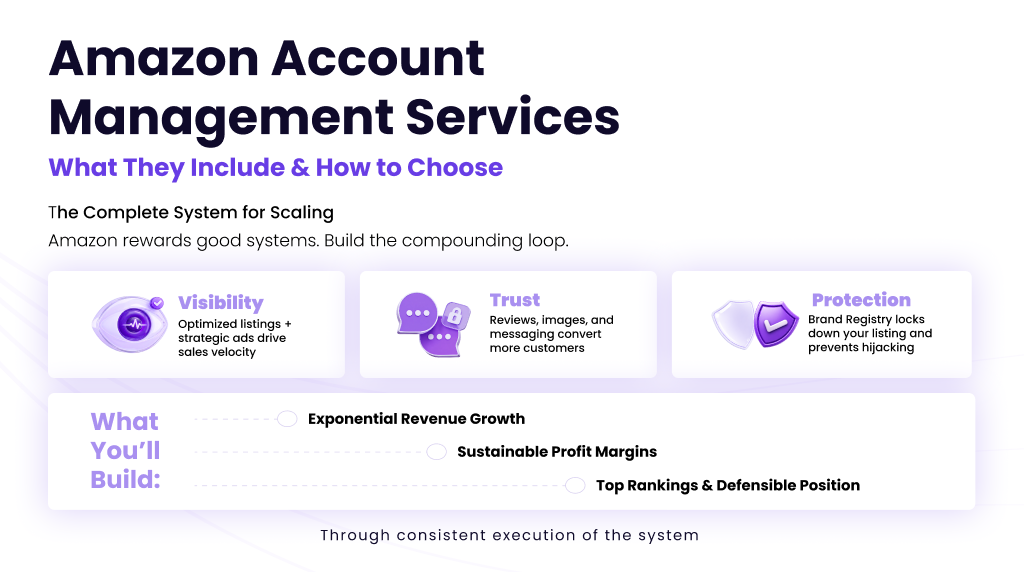
Amazon account management services exist because most sellers eventually discover the same problem: Amazon is too important to manage as a collection of tickets, listing edits, and ad tweaks. The real channel is a system. Search visibility affects ad efficiency. Inventory affects rank. Catalog issues affect conversion. Pricing affects Buy Box stability. Account-health friction slows everything down.
Related Eva guide: Account management should connect catalog, reviews, pricing, inventory, and badge readiness, which this Amazon badges guide covers.
Related Eva guide: A serious Amazon account management partner should understand Amazon AI bidding strategies, not only manual campaign changes.
Related Eva guide: Amazon account management should connect Brand+ to PPC, DSP, and retail readiness; see the Amazon Brand+ advertising guide.
Related Eva guide: A strong account-management partner should connect advertising to the full Amazon advertising funnel.
Related Eva guide: Advertising scope is a major part of account management, and this Amazon DSP vs PPC guide explains how the channels should work together.
That is why the phrase “Amazon account management” needs a clearer definition. Amazon Strategic Account Services, often called Amazon SAS, can give eligible sellers a point of contact inside Amazon. Freelancers or VAs can help with narrow Seller Central tasks. But neither model is automatically the same as full-service Amazon management.
The real service is holistic ownership: building the Amazon strategy around the market, products, margin structure, catalog quality, advertising, inventory, and operational constraints, then executing the different pillars with the right people and tools. Anything less may still be useful, but it should not be confused with a white-glove Amazon growth partner.
Table of Contents
- Quick answer: what should Amazon account management actually own?
- What Are Amazon Account Management Services?
- Amazon SAS Is Not the Same as Full-Service Account Management
- What Does an Amazon Account Manager Do?
- Types of Amazon Account Management Services
- How Much Do Amazon Account Management Services Cost?
- Benefits of Hiring an Amazon Account Management Service
- What should a real Amazon account management team review every week?
- What should an Amazon account management weekly report show?
- What complete Amazon account management should own
- How to Choose the Right Amazon Account Management Service
- When Do You Actually Need One?
- FAQ About Amazon Account Management Services
- Conclusion
- Ready to Put Your Amazon Account Under Proper Management?
Quick answer: what should Amazon account management actually own?
Amazon account management should own the operating system behind the channel: advertising, ranking, catalog quality, content, pricing, inventory, account health, issue escalation, reporting, and profit. Amazon SAS can help with Amazon-side guidance and escalation. A freelancer can help with tasks. Full-service Amazon management is different because one team is accountable for the commercial outcome.
The strongest model connects Full-Service Amazon Management, Amazon PPC Management, Amazon Listing Optimization, and the Amazon Profitability Playbook into one roadmap. That is the difference between clearing tickets and managing Amazon as a profit system.
What Are Amazon Account Management Services?
Amazon account management services are ongoing support services designed to help sellers run their Amazon business more effectively. They are broader than account setup, broader than storefront design, and broader than hiring someone to make a few edits to listings. The core idea is simple: instead of managing Seller Central in fragments, you put structured ownership around the parts of the business that affect visibility, conversion, operations, and account stability.
These services can come from three main sources. First, Amazon offers Strategic Account Services, a premium program for eligible sellers that includes a designated customer success manager, operational guidance, strategic planning, and access to specialists. Second, agencies provide outsourced account management across listings, ads, operations, and reporting. Third, freelancers or virtual assistants offer more narrow support, often focused on specific tasks such as listings, PPC, or case management.
The goal is not just to “keep the account live.” It is to keep it healthy, better organized, and easier to scale. Good account management should improve how the channel is run, not just how busy it looks.
Amazon SAS Is Not the Same as Full-Service Account Management
Amazon Strategic Account Services can be valuable, but sellers should understand what it is buying. Amazon describes SAS as personalized support through a designated customer success manager, operational guidance, strategic planning, and access to subject-matter specialists. Amazon also says pricing is customized and the program is currently at capacity.
That makes SAS closer to premium Amazon-side access than a complete outsourced growth team. In practice, many sellers buy SAS because normal Seller Support is limited, slow, or inconsistent, and they need a paid path for technical issue resolution and escalation. This is a support reliability purchase, not a full strategic growth engine.
SAS is not designed to be your holistic operator. It is not primarily focused on improving profit structure, creative quality, catalog conversion systems, or multi-channel growth planning. Optimization in this model often skews toward operational support and advertising execution continuity, not full business ownership across margin, inventory risk, catalog architecture, and brand-level growth priorities.
It also does not replace a team that can represent your business in hard moments, challenge poor platform decisions, and keep pressure on unresolved issues. Serious Amazon account management includes escalation muscle: your team should be able to fight for root-cause resolution with Amazon when the platform is wrong and your revenue is at risk.
This distinction matters because many sellers look at SAS after years of frustration with normal Seller Support. Reddit and Seller Central discussions repeatedly describe the same theme: sellers want a real person, better escalation, and relief from support loops. That pain is real. But solving support friction is not the same as managing the business.
- Amazon’s SAS page describes operational guidance, strategic planning, specialist access, customized pricing, and current capacity limits.
- A Reddit SAS discussion frames the value largely around access and peace of mind when Seller Support is unreliable.
- Another SAS thread discusses SAS as a paid path to escalation, with sellers debating whether the economics make sense.
- Amazon’s own seller forum shows sellers weighing SAS as a support and guidance layer, not a guaranteed growth engine.
So the right question is not “SAS or agency?” The better question is: do you need Amazon-side access for problems Amazon should normally solve, or do you need a senior operating team to run the channel as a profit system?
What Does an Amazon Account Manager Do?
An Amazon account manager sits at the intersection of operations and growth. The exact scope depends on the provider, but the role usually covers day-to-day execution plus ongoing strategic oversight.
Typical responsibilities include:
- optimizing product listings and catalog structure
- managing PPC campaigns and budgets
- monitoring inventory and stock risk
- tracking account health and policy issues
- coordinating fulfillment-related problems
- handling reviews, feedback, and customer-facing issues
- reporting on performance and recommending next actions
That general shape is consistent across Amazon’s own SAS positioning, agency service pages, and live account-manager role descriptions, which emphasize business planning, operational standards, fulfillment, traffic, conversion, and growth support.
Daily vs Strategic Responsibilities
The easiest way to understand the role is to split it into two layers.
Daily responsibilities usually include catalog updates, case management, ad checks, stock monitoring, suppression issues, review monitoring, and Seller Central housekeeping. This is the work that keeps the account from slipping. Many low-cost providers position account management around listing handling, inventory checks, buyer-seller messages, and day-to-day Seller Central operations. That is useful admin work, but it is not the same as senior ownership of the Amazon growth system.
Strategic responsibilities include prioritizing which products need greater visibility, deciding where ad spend should go, identifying operational bottlenecks, planning for peak events, improving conversion drivers, and aligning Amazon execution with broader business goals. Amazon’s SAS program frames this explicitly as strategic planning supported by operational guidance and specialist access. Amazon’s own Strategic Account Manager job descriptions also emphasize joint business plans, growth opportunities, fulfillment, traffic, and conversion drivers.
That difference matters. A cheap task-runner may keep the lights on. A strong Amazon seller account manager should also help the business make better decisions.
Types of Amazon Account Management Services
Not all account management support is built the same way. The smartest way to compare options is by looking at ownership, depth, and fit.
| Option | Best for | What you usually get | What it is not |
|---|---|---|---|
| Amazon SAS | Eligible sellers who need Amazon-side technical support reliability and escalation | Customer success manager, operational guidance, planning support, specialist access, and help navigating Amazon programs | A complete outsourced team that owns strategy, profit architecture, inventory planning, catalog conversion, creative quality, and execution |
| Freelancer / VA | Narrow tasks or admin support | Case handling, flat-file updates, listing edits, keyword cleanup, basic reporting, and Seller Central housekeeping | Senior strategy, deep market planning, accountability, or full-channel ownership |
| AI-assisted task support | Repeatable work with clear inputs | Drafting listing copy, organizing keywords, summarizing reports, QA checklists, support-case drafts, and routine analysis | Judgment, market strategy, cross-functional prioritization, or accountability for profit |
| Full-service Amazon management | Brands that need the channel run as a growth and profit system | Product and market strategy, advertising, inventory planning, catalog management, SEO, listing optimization, issue escalation, reporting, and profit-focused execution | A cheap admin layer or a one-person task desk |
Simple rule: if the service is mostly helping you navigate Amazon support and clear technical blockers, it is a support service. If the service is building strategy and owning outcomes across the full operating system, it is management.
This is where many providers blur the category. A freelancer managing many accounts can be useful for repetitive work, but much of that layer is now increasingly replaceable or accelerated by AI. A cheap service can help with tasks; it rarely has the senior attention, data stack, or operating cadence to build a durable Amazon strategy.
Full-service Amazon management is different. It should start with the market and the product portfolio, then connect advertising, inventory, pricing, catalog quality, content, ranking, and account health into one execution plan. The manager is not just “checking Seller Central.” The team is deciding which products deserve capital, which listings need conversion work, which ad budgets are defendable, and which operational constraints are blocking profit.
That is the level where Eva positions Amazon account management: senior operators supported by Advertising Intelligence, catalog and listing workflows, SEO/AEO, PPC, DSP, inventory signals, and performance reporting. The work is not only to solve Amazon’s support problems. It is to make the Amazon channel easier to run and harder for competitors to take.
How Much Do Amazon Account Management Services Cost?
Pricing is one of the biggest gaps in the SERP because many providers compare unlike services. A support desk, a VA, Amazon SAS, and a full-service Amazon management team are not the same product.
In practice, there are four common pricing models:
- task-based or hourly freelancer support
- monthly admin or support retainers
- Amazon SAS or Amazon-side paid support programs
- full-service management retainers, sometimes with media or performance components
At the low end, sellers can buy task work cheaply. That can make sense for isolated needs: upload this flat file, draft this support case, check these suppressed ASINs, or clean up this keyword list. But low-cost support is usually priced that way because the scope is narrow, the labor is junior or outsourced, or the work is increasingly AI-assisted.
Amazon SAS should be thought of separately from cheap task support and separately from full strategic management. SAS is often purchased to close the Amazon-support gap when sellers need dependable escalation and technical issue handling. That can be worth paying for, but it should not be mistaken for full-channel profit management.
For real Amazon account management, a serious service should generally start around $3,000 per month and move up based on catalog size, ad spend, marketplace complexity, inventory risk, and reporting expectations. Below that level, sellers should assume they are buying limited execution, admin help, or outsourced task coverage unless the provider can clearly prove otherwise.
That does not mean expensive automatically means good. It means sellers should ask what the provider owns. Do they build product-level strategy? Do they manage PPC and DSP with profit targets? Do they monitor inventory and catalog signals? Do they know when an issue is an Amazon escalation problem versus an operational problem? Do they have tools to connect advertising, ranking, content, catalog health, and margin?
The real takeaway is this: compare providers by scope and accountability, not headline price. Amazon SAS may help you get better Amazon-side guidance. A freelancer may help with tasks. A full-service Amazon agency should own the operating system that drives profit.
Benefits of Hiring an Amazon Account Management Service
The obvious benefit is time savings, but that is not the whole story. The bigger benefit is operational control.
A good Amazon account management service can reduce the fragmentation that hurts seller performance. Listings are updated more consistently. Ad decisions are reviewed with more discipline. Inventory is monitored more proactively. Account problems are less likely to sit unnoticed. That creates a more stable foundation for growth.
There is also a specialization benefit. Amazon is not one job. It is catalog work, ad work, compliance work, operational work, and performance analysis, all layered together. Amazon’s SAS program reflects this by combining tactical advice, strategic planning, and subject-matter specialists across areas such as supply chain, brand protection, and discovery.
For many brands, hiring help is not about handing off responsibility. It is about bringing in a team that can own the details more rigorously than an already-stretched internal team can.
What should a real Amazon account management team review every week?
A good weekly account management review should not be a generic performance summary. It should show which decisions were made, which blockers were removed, and where the next dollar or operator hour should go.
- Revenue and profit: revenue, contribution margin, TACoS, ad spend, organic rank movement, and product-level profitability.
- Advertising control: Sponsored Ads, DSP, budget pacing, search term waste, ranking support, and where automation needs human guardrails.
- Catalog and content: suppressed listings, variation issues, title and image gaps, A+ content, brand store updates, and conversion blockers.
- Inventory and operations: stockout risk, sell-through, replenishment timing, stranded inventory, FBA issues, and fulfillment constraints.
- Account health and escalation: open cases, policy issues, listing errors, reimbursements, Buy Box risk, and where Amazon needs to be challenged.
- Ranking and discovery: priority keyword movement, badge opportunities, review velocity, search query performance, and AI search readiness.
- Next actions: what to scale, what to fix, what to stop, and which product should receive capital next.
This is why account management has to connect to Amazon Marketplace Management, what an Amazon agency actually does, Amazon listing optimization services, the Amazon PPC Architecture Playbook, and the Amazon Ranking Acceleration Playbook. The weekly meeting should create operating decisions, not just reporting.
What should an Amazon account management weekly report show?
A weekly report should connect Amazon support issues to growth decisions. It should show account health, catalog blockers, stranded inventory, suppressed listings, case progress, Buy Box pressure, pricing risk, advertising impact, inventory exposure, and the next decision for each owner.
What complete Amazon account management should own
Quick answer: Full-service Amazon account management should coordinate strategy, catalog, content, advertising, ranking, pricing, inventory, account health, operations, and profit. Technical issue resolution is useful, but it is not a growth strategy by itself.
Services such as Amazon SAS and technical support providers can help brands navigate cases, catalog problems, and limited Seller Support. That solves a real operational need. It does not automatically include market strategy, product economics, creative, media, inventory planning, or accountability for profitable growth. Define whether the brand is buying issue resolution, advertising management, or complete account ownership.
Freelancers and low-cost providers can manage routine tasks across many accounts, and software can now automate much of repetitive monitoring and execution. The differentiator is senior judgment and coordinated action when pricing, rank, conversion, stock, cash, and competition conflict. Ask who builds the plan, who executes outside the ad console, and how many accounts the actual operator carries.
Serious full-service management commonly starts around $3,000 per month and rises with complexity, spend, catalog size, creative, and operational scope. Offers far below that level may be narrow, highly outsourced, or automated. That can be suitable if expectations are explicit. Compare total cost, internal coordination, operator access, technology, and realized contribution rather than the retainer alone.
2026 operator checklist
- Strategy and product-level economics
- Named senior operator and execution depth
- Catalog, creative, advertising, and inventory scope
- Technology, contribution, and clear pricing
Related Eva resources: Amazon Management, Amazon PPC, Eva Playbooks.
Eva Intelligence helps operators see where support work is affecting revenue and profit. A case backlog is not just administration if it blocks a listing, damages conversion, delays inventory, or prevents advertising from scaling a profitable product.
How to Choose the Right Amazon Account Management Service
The wrong provider usually sounds polished before they sound specific. The right provider can explain what they do in concrete terms.
Use this checklist before hiring:
- Scope: What do they actually own each month? Listings only, or also PPC, inventory, account health, and reporting?
- Reporting: What do they report on, how often, and what decisions come out of that reporting?
- Communication: Who is the point of contact? How often do you meet? What happens when something breaks?
- Experience: Do they understand your category, catalog complexity, and operating model?
- Tools and process: How do they manage workflows, approvals, and issue escalation?
- Boundaries: What is explicitly not included?
This is where comparison matters most. Amazon SAS is strongest when you qualify for it and want Amazon-led guidance. An agency makes sense when you need broad outsourced execution. A freelancer makes sense when you need lower-cost help for defined tasks. Amazon-side programs, agencies, and freelancers all use similar language, but the scope is very different. The useful comparison is not brand name versus brand name; it is whether the provider owns a narrow support lane or the full operating system behind Amazon profit.
Warning signs are usually easy to spot. Be cautious if a provider cannot define deliverables, cannot explain their reporting logic, or promises growth in language that sounds impressive but says nothing. “We do everything” is not a scope document.
When Do You Actually Need One?
You probably need outside help when Amazon has become too important to run casually, but your internal structure has not caught up.
That usually happens in a few scenarios:
- Your team is juggling Amazon on top of other roles
- Ad spend has become too complex to manage lightly
- Listings and catalog health keep slipping
- Inventory mistakes are affecting sales momentum
- Account health issues are handled reactively
- The business is plateauing, and no one owns the full picture
You may not need a full-service provider if your needs are still narrow. If you only need help rewriting listings or cleaning up a few cases, a freelancer or short-term specialist may be enough. Full account management becomes more sensible when the problem is not a single task but the operating system around the account.
Related Eva guide: Brands opening a new account should follow the Amazon seller account guide and retain primary ownership.
FAQ About Amazon Account Management Services
What are Amazon account management services?
Amazon account management services help sellers run and grow their Amazon business. They usually cover some mix of listings, PPC, inventory, account health, operations, and reporting.
How much do Amazon account managers cost?
Costs vary by model. Freelancer or AI-assisted task support can be cheap because the scope is narrow. A serious full-service Amazon management partner should generally start around $3,000 per month and increase with catalog complexity, ad spend, marketplaces, and operational scope. Amazon SAS uses customized pricing and is a different category because it is Amazon-side guidance rather than outsourced channel ownership.
Does Amazon provide account managers?
Yes, but not as a standard feature for every seller. Amazon offers Strategic Account Services for eligible sellers, with a designated customer success manager, operational guidance, specialist access, and customized pricing. Most sellers use SAS as a paid technical support and escalation layer because default Seller Support is limited. It is helpful for platform-side issues, but it is not the same as a full-service team managing strategy, advertising, inventory, catalog, content, profit, and execution.
What does an Amazon account manager do daily?
Daily work can include catalog updates, case handling, ad checks, inventory monitoring, suppression fixes, and account-health follow-up. Strategic work builds on that through planning, optimization, and growth decisions.
Is hiring an Amazon agency worth it?
It can be, if the agency owns the full system rather than only completing tasks. The value is highest when listings, PPC, inventory, catalog health, ranking, creative quality, and margin are connected, and no one internally has the time, tools, or operator depth to manage those decisions together. The right team should also be able to escalate aggressively with Amazon and protect your business when platform-side issues threaten revenue.
Related comparison: If you are comparing Amazon support vendors, read Eva vs My Amazon Guy and the full Amazon agency alternatives hub to see how education/support-led models differ from full-service Amazon management.
Related free tools: Start with the Eva ecommerce tools hub to run listing, advertising, and recovery checks before turning the findings into a full Amazon growth roadmap.
Conclusion
The best Amazon account management services do more than “help with Amazon.” They create structure around a channel, which becomes expensive when it is managed inconsistently. That means clear ownership, better reporting, tighter execution, and fewer surprises across listings, ads, inventory, and account health.
Amazon SAS can absolutely have value when you need dependable technical support and escalation because Amazon’s default support experience is limited. But SAS is not a substitute for strategic management. Strategic management means market-aware planning, product-level prioritization, integrated advertising and inventory decisions, catalog and creative quality control, and profit accountability.
For businesses evaluating providers, the right question is not who offers the most tasks. It is who will own outcomes, run the full operating system, and advocate for your business when Amazon gets it wrong. That is the difference between buying activity and buying management.
Ready to Put Your Amazon Account Under Proper Management?
Eva gives brands full-service Amazon management across strategy, advertising, inventory, catalog management, account health, listing optimization, and profit reporting, powered by senior operators and Eva’s proprietary Advertising Intelligence.
Explore full-service Amazon management →
Return authorization is one operational detail that keeps account workflows clean. For the return-specific process, see Eva’s guide to the Amazon RMA number.
Supplement accounts also need product documentation, catalog, claims, inventory, and platform-response ownership. Read Eva’s guide to selling supplements on Amazon.