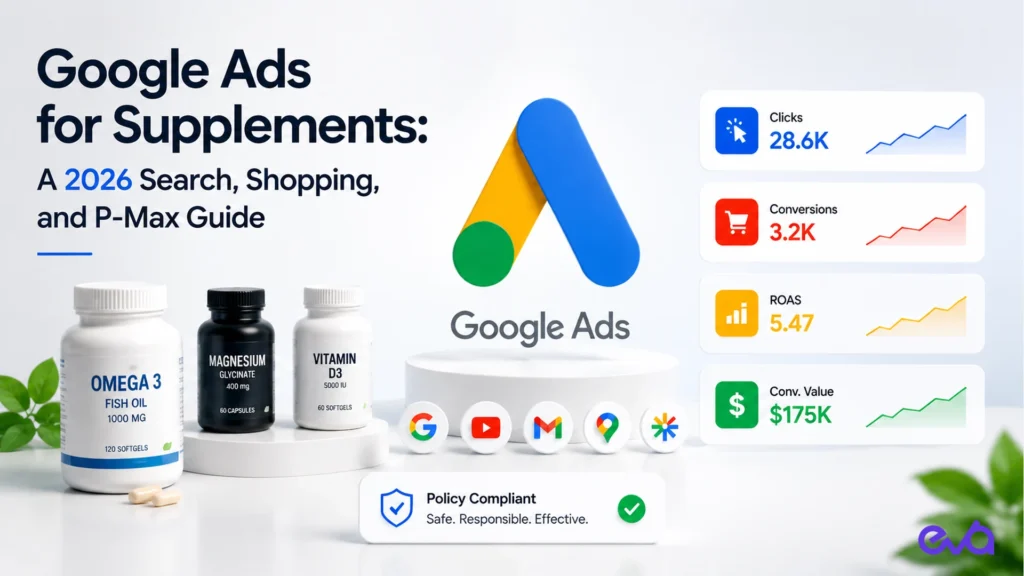
Google Ads can connect supplement brands with customers who express demand through search, compare products through Shopping, discover brands through video, and return through audience-based campaigns. The channel works best when keyword, feed, creative, landing page, product eligibility, inventory, and customer economics are managed together.
Health and medicine policies include restrictions on unapproved substances, unsafe products, and messages that imply certain disease-related outcomes. Product eligibility can vary by ingredient, claim, destination, location, and current policy. A brand should review the exact product and promotion in current official Google guidance before launch.
This guide explains an operator-led framework for Search, Shopping, P-Max, and YouTube. It focuses on qualified ecommerce demand and profit rather than traffic volume.
Quick answer
Run Google Ads for supplements by confirming product and destination eligibility, separating brand and nonbrand Search intent, maintaining a clean Merchant Center feed, giving P-Max accurate product and conversion signals, using reviewed video and image assets, and optimizing toward new-customer contribution. Treat disapprovals as a product, feed, ad, or destination diagnosis, not a bid problem.
Table of Contents
- In this guide
- Google channel roles for supplement brands
- Current primary sources
- 1. Review product, market, and destination eligibility
- 2. Build Search around real intent
- 3. Treat the product feed as advertising infrastructure
- 4. Give P-Max a controlled role
- 5. Build creative without policy shortcuts
- 6. Fix measurement before increasing automation
- 7. Connect budget with inventory and margin
- 8. Resolve disapprovals and limited delivery
- A four-week Google Ads supplement reset
- How Eva manages Google Ads for supplement brands
- Google Ads for supplements FAQ
In this guide
- 1. Review product, market, and destination eligibility
- 2. Build Search around real intent
- 3. Treat the product feed as advertising infrastructure
- 4. Give P-Max a controlled role
- 5. Build creative without policy shortcuts
- 6. Fix measurement before increasing automation
- 7. Connect budget with inventory and margin
- 8. Resolve disapprovals and limited delivery
Google channel roles for supplement brands
| Channel | Primary job | Operating control |
|---|---|---|
| Brand Search | Serve customers already looking for the brand | Separate capture from new demand |
| Nonbrand Search | Capture explicit category and product intent | Keyword, query, landing-page, and contribution fit |
| Shopping | Show eligible products for comparison | Feed accuracy, identifiers, price, and availability |
| P-Max | Allocate across Google inventory using assets and signals | Product groups, conversion quality, and exclusions |
| YouTube | Build and recapture demand with reviewed creative | Audience, message, destination, and incrementality |
| Remarketing | Help known visitors return | Consent, audience rules, frequency, and overlap |
Current primary sources
Google Ads Healthcare and medicines policy: Google publishes healthcare and medicine restrictions, certifications, country limits, and related policy categories.
Google Ads Unapproved substances policy: Google lists prohibited unapproved pharmaceuticals and supplements and describes options for correcting or appealing an ad.
FTC Health Products Compliance Guidance: FTC staff explains substantiation, implied claims, disclosures, and health-product advertising responsibilities.
1. Review product, market, and destination eligibility
Operator answer
Check the exact product, ingredients, positioning, target market, ad message, and landing page against current Google policy before building campaigns.
Create a policy profile for each SKU and market. Record product identity, ingredients and product type as reviewed by the brand, claims approvals, landing pages, Merchant Center status, Google Ads status, target countries, and restrictions. Do not assume one approved SKU or country covers the full assortment.
Review the landing page and connected site, not only ad text. Google can assess the destination and merchant. Keep product details, business identity, contact, shipping, returns, privacy, and purchase terms accessible. Check mobile speed and checkout. A broken or contradictory destination can waste traffic even when an ad remains eligible.
2. Build Search around real intent
Operator answer
Separate brand, product, category, comparison, education, and unsupported or irrelevant queries, then assign the correct destination and economic rule.
Map each keyword family to a customer question and landing page. Brand Search captures existing intent and should not hide the cost of broader acquisition. Nonbrand product or category terms need a page that directly answers the query. Educational terms may belong to an article rather than a hard-sell PDP.
Review search terms frequently. Add negatives for irrelevant, unsafe, consumer-medical, employment, research, wholesale, or other intent the brand does not serve. Do not add a high-volume phrase simply because it produced clicks. The query should match the product, approved positioning, and customer journey.
3. Treat the product feed as advertising infrastructure
Operator answer
Merchant Center data should match the real product, storefront, price, availability, identifiers, images, and reviewed product description.
Standardize product ID, title, description, brand, GTIN where applicable, product type, Google category, price, sale price, availability, link, image, shipping, and variant attributes. Keep the feed synchronized with Shopify. Avoid promotional or claims language that conflicts with the product page or policy.
Monitor item diagnostics and disapprovals by SKU and reason. Preserve the original data, change, timestamp, review request, and outcome. A feed rule can scale a correction, but it can also scale a mistake. Fix the source field when the issue belongs in Shopify or product information.
4. Give P-Max a controlled role
Operator answer
Use P-Max when conversion, product, creative, audience, and economic signals are reliable enough for automated allocation.
Group products by decision need such as margin, inventory, category, market, lifecycle, or strategic priority. Avoid one campaign containing products with very different economics and objectives if the team cannot set useful controls. Exclude unavailable or operationally constrained products promptly.
Provide reviewed text, images, and video that match the landing page. Use audience signals as guidance, not guaranteed targeting. Review search-category insights, product performance, asset evidence, and channel overlap. P-Max should not become a reporting black box that receives every remaining budget.
5. Build creative without policy shortcuts
Operator answer
Explain the real product and brand through accurate demonstrations, product facts, routine context, and supported differentiation.
Create a claims library for headlines, descriptions, images, video, testimonials, and landing pages. Review the complete message. A visual or customer quote can imply an outcome that the ad copy avoids. Preserve the approved asset and market context.
Use clear brand and product identification. Match creative to the stage: direct product information for high intent, useful education for discovery, and assortment or routine context for consideration. Avoid fear, personal diagnosis-like framing, miracle language, and unverified superlatives.
6. Fix measurement before increasing automation
Operator answer
Define primary conversions, values, new-customer logic, enhanced conversion use, consent, and offline reconciliation before optimizing bids.
Use completed purchase as the primary commerce event unless another qualified lead action has a documented economic value. Deduplicate events, verify currency and order value, and reconcile with Shopify. Separate first purchase, repeat purchase, subscription renewal, refund, and cancellation where the operating model needs them.
Import contribution or value adjustments only when the calculation is stable and understood. Automated bidding will optimize the signal supplied. A duplicated, inflated, or low-quality conversion event can make delivery look efficient while moving capital toward the wrong behavior.
7. Connect budget with inventory and margin
Operator answer
Allocate by marginal contribution, search opportunity, stock cover, replenishment confidence, and customer value.
Set product-level or group-level acquisition limits from net price, product cost, fulfillment, payment, shipping, discounts, returns, variable creative, and expected repeat contribution. Compare Shopping and Search using a shared economic model. Do not let higher-priced products win by revenue when their contribution is weaker.
Connect feed availability and campaigns with real inventory. When stock is constrained, reduce demand in a controlled sequence and protect the highest-value intent. When inventory is heavy, test a relevant offer, bundle, or audience rather than allowing automated campaigns to spend without a clear customer proposition.
8. Resolve disapprovals and limited delivery
Operator answer
Identify whether the issue belongs to the product, ingredient, claim, feed, ad, image, audience, market, account, or destination before editing.
Record the affected item or asset, exact policy reason, status, market, evidence, change, review request, and outcome. Compare ads and destination together. Do not repeatedly resubmit the same message with superficial wording changes. Repeated issues can affect account trust.
When the brand believes a decision is incorrect, use the available appeal path with a concise explanation and supporting evidence. Platform review remains outside an agency guarantee. Use every event to update the release checklist and prevent the same failure in future products or markets.
A four-week Google Ads supplement reset
- Week 1: Audit eligibility, search terms, feeds, destinations, products, conversions, inventory, and contribution.
- Week 2: Repair Merchant Center data, negative terms, landing-page alignment, event quality, and campaign roles.
- Week 3: Rebuild product groups and launch reviewed Search, Shopping, P-Max, and video tests with guardrails.
- Week 4: Review marginal contribution, new-customer quality, stock, disapprovals, and query evidence before scaling.
How Eva manages Google Ads for supplement brands
Eva connects Search, Shopping, P-Max, YouTube, feeds, landing pages, Shopify customer data, inventory, and contribution. The operating team can fix the product or destination when that is the real constraint instead of making endless bid changes.
Eva supports commerce execution and platform workflows. Product eligibility, safety, substantiation, labeling, and legal review remain with the brand and qualified reviewers.
Google Ads for supplements FAQ
Can supplements be advertised on Google?
Some products and promotions can be eligible, while Google prohibits or restricts others. Eligibility depends on product, ingredients, claims, destination, market, certification where applicable, and current policy.
Should supplement brands use P-Max?
P-Max can be useful when product data, conversions, creative, inventory, and economics are reliable. It should have a defined role and product grouping, not receive every product by default.
Why are supplement Shopping products disapproved?
Common causes can involve product eligibility, claims, feed fields, identifiers, images, price or availability mismatch, merchant information, destination content, or market restrictions. Identify the exact item and policy reason.
Should brand Search and nonbrand Search be combined?
Usually not for decision reporting. Branded demand has different intent and can make broader acquisition look more efficient than it is. Keep the business view separated even if campaign structure evolves.
What is the best bidding strategy?
The right strategy depends on conversion quality, volume, product economics, objectives, inventory, and account maturity. Reliable inputs matter more than choosing automation before the data is ready.
Related Eva resources: Supplement Ecommerce Agency, Google Advertising, Full-Funnel Commerce Playbook, Shopify Supplement Brand Growth, Supplement Marketplace Compliance.
Important scope note
This guide covers ecommerce operations, not medical or legal advice. Platform policies change, and brands remain responsible for product safety, substantiation, labeling, claims, and qualified review.
Related Eva resource: For hands-on support, explore Eva’s supplement ecommerce growth team.
Related Eva resource: For marketplace growth support that keeps operational and compliance considerations in view, explore Eva’s supplement ecommerce growth team.