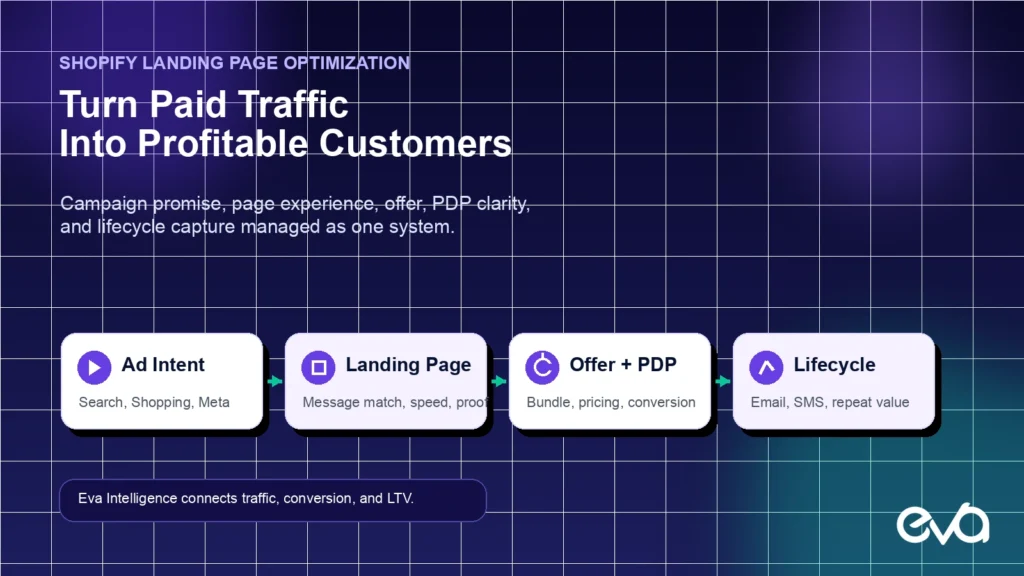
A Shopify landing page is not a prettier version of a product page. For paid traffic, the landing page has one job: continue the promise from the ad, remove uncertainty, make the next step obvious, and capture enough customer value to make the click profitable.
Most Shopify brands treat landing page optimization like a design task. They change a hero image, shorten copy, add a discount, and wait for conversion rate to improve. That is too narrow. Paid traffic landing pages need to connect campaign intent, product economics, page speed, offer strategy, PDP clarity, creative testing, and lifecycle capture as one system.
Quick answer: Shopify landing page optimization for paid traffic means aligning the ad, audience, offer, page content, product detail page, checkout path, and post-click lifecycle so more visitors become profitable customers, not just first orders.
Table of Contents
- Why paid traffic exposes Shopify landing page problems
- What Google and Meta actually care about after the click
- The Shopify paid traffic landing page framework
- 1. Match the page to the campaign promise
- 2. Choose the right landing page type
- 3. Build the page around offer economics, not only conversion rate
- 4. Connect PDP clarity to landing page performance
- 5. Use customer data to decide what to test
- 6. Measure the page like a system
- How Eva manages Shopify landing page optimization
- Is traffic mix choosing your landing-page winner?
- FAQ
Why paid traffic exposes Shopify landing page problems
Paid traffic is unforgiving because every weak step costs money. A vague Meta ad sends the wrong visitor. A Google Shopping click lands on a page that does not answer the search intent. A campaign promises a bundle, but the landing page shows a single SKU. A creator video creates urgency, but the page opens with generic brand copy. The store may still look good, but the campaign economics fail.
That is why Shopify landing page optimization should start before the page is designed. The question is not “what should this page look like?” The better question is “what does this traffic already believe, what does it need to believe next, and what order value do we need to protect profit?”
- Google Search traffic needs fast confirmation that the page answers the query and provides the product, offer, or category promised by the ad.
- Google Shopping and P-Max traffic needs strong product data, PDP clarity, pricing consistency, and content that supports the feed promise.
- Meta traffic needs creative-to-page continuity, social proof, clear offer logic, and a reason to act without over-discounting.
- TikTok and creator traffic needs the product story, use case, proof, and checkout path to match the content that created the click.
What Google and Meta actually care about after the click
Google and Meta both evaluate the experience after the click. Google describes landing page experience as the usefulness and relevance of the information on the page, ease of navigation, and how well the page matches the expectations created by the ad. Meta’s advertising standards also require ad components to be relevant to the product or service and for promoted products and services to match the landing page.
For Shopify brands, that means landing page optimization is not only a CRO project. It affects media efficiency, quality signals, conversion rate, customer trust, and the cost of acquiring demand.
Useful official references: Google Ads landing page performance, Meta Advertising Standards, Shopify theme architecture, and Shopify metafields.
The Shopify paid traffic landing page framework
A high-performing Shopify landing page is built around the customer decision path. The page should answer the visitor’s next question before that question becomes friction.
| Decision Moment | Landing Page Job | What to Measure |
|---|---|---|
| Ad click | Confirm the promise from the ad or creative | Bounce rate, scroll depth, first interaction |
| Product interest | Explain the product, use case, and reason to buy now | Click-through to PDP, add-to-cart rate |
| Value check | Make price, bundle, subscription, and offer logic clear | AOV, discount dependency, checkout starts |
| Trust check | Show proof, reviews, guarantees, press, or outcome clarity | Cart abandonment, conversion rate |
| Future value | Capture email, SMS, quiz, account, or subscription signals | Opt-in rate, repeat purchase rate, LTV |
1. Match the page to the campaign promise
The fastest way to waste paid traffic is to make the shopper reinterpret the ad after they land. If the ad is about a starter kit, the landing page should not open with a generic brand story. If the ad is about a problem, the page should not immediately show a catalog grid. If the ad promotes a seasonal offer, the landing page should not bury that offer below a general hero section.
Message match should cover the headline, hero product, proof, offer, CTA, product order, and page path. This is especially important when Google, Meta, and TikTok campaigns each send different audiences with different expectations.
- Use campaign-specific landing pages for materially different offers or audiences.
- Keep the first screen focused on the product, promise, and next action.
- Use the same product language from the ad in the headline or supporting copy.
- Route branded, category, problem-aware, and creator-driven traffic differently when intent differs.
2. Choose the right landing page type
Not every campaign needs a custom page. Sometimes the best landing page is a PDP. Sometimes it is a collection page. Sometimes it is a quiz, offer page, bundle page, or educational page that routes the shopper to the right product. The wrong page type creates friction even when the design is good.
| Traffic Type | Best Landing Page Type | Why |
|---|---|---|
| High-intent product search | PDP or collection page | The shopper already knows what they want |
| Problem-aware Meta traffic | Problem/solution landing page | The shopper needs education before product selection |
| Creator or UGC traffic | Creator-matched product page | The page should continue the content story |
| Subscription traffic | Subscription offer page | The shopper needs value, cadence, and flexibility explained |
| Gift or bundle traffic | Bundle landing page | The offer matters more than one SKU |
Shopify’s theme templates, sections, blocks, and metafields make this easier to manage at scale. Instead of building one-off pages forever, stronger Shopify teams create reusable page systems that let product data, proof, offer logic, and merchandising change by campaign or product group.
3. Build the page around offer economics, not only conversion rate
A landing page can raise conversion rate and still hurt profit if it relies on the wrong discount, pushes the wrong product, or attracts customers who do not repeat. Shopify landing page optimization should measure contribution margin, blended CAC, AOV, subscription attach rate, return rate, and LTV.
For many brands, the best landing page is not the one with the highest first-order conversion rate. It is the one that creates the best customer economics after acquisition cost, product margin, fulfillment cost, discounts, refunds, and future purchases are considered.
- Use bundles when they raise AOV without confusing the shopper.
- Use subscriptions when the product has a real replenishment behavior.
- Use discounts carefully, and compare them against gifts, bundles, shipping thresholds, and loyalty capture.
- Track product-level profit, not only campaign ROAS.
4. Connect PDP clarity to landing page performance
Many Shopify landing pages fail because the PDP does not support the promise. The campaign might create interest, but the product page lacks clear variants, product benefits, comparison detail, review structure, shipping expectations, guarantees, or usage context. The shopper clicks through, then hesitates.
This is why landing page and PDP optimization should be managed together. The landing page creates the path. The PDP closes the product decision. The checkout captures the order. The lifecycle system captures the next order.
Related guide: Shopify Product Page Optimization.
5. Use customer data to decide what to test
Landing page testing should not be random. The best test ideas come from customer data: acquisition source, first product purchased, quiz answers, email/SMS behavior, repeat purchase timing, churn reasons, review language, support tickets, and product margins.
Instead of testing button colors, test the real business questions. Which offer attracts the highest-value customer? Which product sequence improves AOV? Which proof reduces hesitation? Which landing page captures email or SMS without lowering purchase intent? Which creative angle leads to repeat purchase, not only cheap clicks?
Related guide: Shopify Customer Data Strategy.
6. Measure the page like a system
A Shopify landing page should be reviewed with media, conversion, and retention data in the same conversation. If the media team optimizes for click volume, the CRO team optimizes for page conversion, and the lifecycle team optimizes after the fact, no one owns the full customer economics.
The weekly scorecard should include:
- Spend, CPC, CPM, CTR, and traffic source quality
- Landing page engagement, scroll depth, click-through, add-to-cart, and checkout start
- Conversion rate by campaign, audience, creative, product, and offer
- AOV, contribution margin, refund rate, and discount rate
- Email/SMS opt-in rate, subscription attach rate, repeat purchase rate, and LTV
- Top friction points by device, product, source, and customer segment
How Eva manages Shopify landing page optimization
Eva does not treat Shopify landing pages as isolated CRO projects. Eva manages Shopify growth as one coordinated system across Google and Meta advertising, landing pages, PDPs, customer data, lifecycle, retention, and profit. The goal is not more traffic. The goal is more profitable customers.
Eva Intelligence connects campaign signals, product economics, conversion behavior, and customer value so operators can make better decisions each week. That means the landing page is not judged only by visual preference or a single conversion rate. It is judged by whether it helps the brand acquire customers profitably and grow lifetime value.
Related Eva resources: Shopify Management, Google Advertising, Meta Advertising, Shopify CRO Playbook, Full-Funnel Commerce Playbook, Shopify CRO Agency, Google Ads for Shopify, and Meta Ads for Shopify.
Related Eva guide: Use the Shopify conversion checklist to check the stages before and after the landing page.
Is traffic mix choosing your landing-page winner?
A page can have the higher overall conversion rate while performing worse on every major device. Before choosing a winner, compare like-for-like traffic and check whether the test allocation changed the audience. A shift toward higher-intent desktop visitors can look like a page improvement even when the page itself underperforms.
Shopify’s behavior reports define conversion as purchasing sessions divided by sessions and provide landing-page and device views. Its analytics field reference identifies landing-page URL and session device type. Confirm the available report combination or validated export before calculating a comparison.
Illustrative traffic-mix reversal
Consider two fictional pages with 2,000 sessions each. Count purchasing sessions, not order totals.
| Segment | Page A: purchases / sessions | Page B: purchases / sessions |
|---|---|---|
| Mobile | 36 / 1,800 = 2.0% | 18 / 1,000 = 1.8% |
| Desktop | 10 / 200 = 5.0% | 48 / 1,000 = 4.8% |
| Overall | 46 / 2,000 = 2.3% | 66 / 2,000 = 3.3% |
Page B appears ahead overall but is behind within both devices. Standardizing B to A’s 90% mobile and 10% desktop mix gives 0.90 x 1.8% + 0.10 x 4.8% = 2.1%, below A’s 2.3%. That calculation diagnoses mix distortion; it does not establish statistical significance or prove which page caused the difference.
Before continuing the test, check allocation by device, acquisition source, campaign, and new versus returning visitor. Keep assignment stable for returning test visitors, run comparable periods, and record changes to offers or stock. Predefine the sample and decision rule; do not stop because the aggregate rate briefly turns favorable. If traffic cannot be made comparable, label the result observational.
The Shopify CRO Playbook frames the wider testing program. Use Shopify attribution guidance to keep campaign-credit questions separate from page effects, and coordinate media allocation with page testing through Shopify management.
FAQ
What is Shopify landing page optimization?
Shopify landing page optimization is the process of improving the page a shopper sees after clicking an ad, email, creator post, or search result. For paid traffic, it should connect the campaign promise, product explanation, offer, proof, checkout path, and lifecycle capture so the brand improves both conversion and customer value.
Should paid traffic go to a landing page or product page?
It depends on intent. High-intent product search can often go directly to a PDP or collection page. Problem-aware, creator-driven, subscription, bundle, or seasonal campaigns often need a dedicated landing page because the shopper needs more context before choosing a product.
What should a Shopify landing page test first?
Start with message match, offer clarity, product order, proof, page speed, mobile layout, and CTA path. After that, test bundles, subscriptions, comparison sections, quiz routing, email/SMS capture, and PDP handoff based on customer data.
How does landing page optimization affect Google and Meta ads?
Better landing pages can improve post-click relevance, conversion rate, customer trust, and campaign economics. Google and Meta both care about the experience after the click, so a weak landing page can hurt paid media efficiency even when the ad creative is strong.
Landing-page conversion depends on how quickly the experience becomes usable. Review Eva’s Shopify Speed Optimization guide before adding another campaign component.