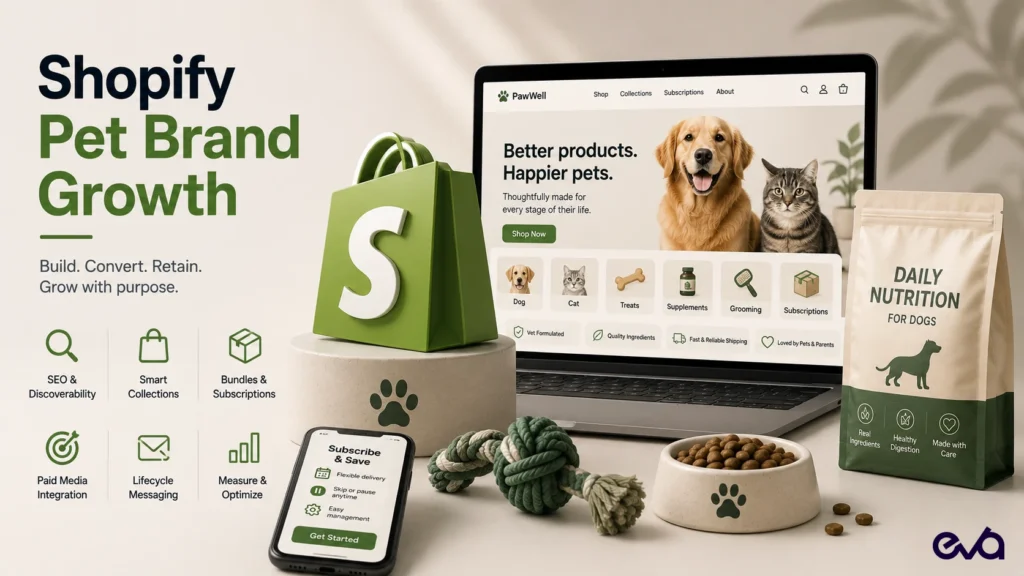
Shopify pet brand growth depends on more than a clean storefront. The site has to help pet owners find the right product, understand why it fits their pet, trust the brand, and come back at the right replenishment moment.
That is why Shopify strategy for pet brands should connect SEO, product education, subscriptions, bundles, paid media, lifecycle messaging, and measurement. When those pieces are separated, the site may look good while growth remains fragile.
Coordinate every selling channel: See how a full-service pet marketing agency connects Shopify, Amazon, TikTok Shop, acquisition, retention, replenishment, and inventory.
A Shopify pet brand should make the buying decision easier for a specific owner with a specific pet. That means the site needs clear collection architecture, helpful product pages, relevant search and filters, subscription logic, and post-purchase education.
The site should also capture learning from other channels. Amazon search terms, TikTok creator hooks, customer service questions, reviews, and paid media performance can all reveal what pet owners care about. Shopify is where those learnings should become a better owned experience.
Build collections around how pet owners shop
Pet owners do not only browse by product type. They shop by pet type, life stage, problem, ingredient, routine, size, and convenience. A strong Shopify structure turns those patterns into useful collections and internal links.
Collection angle
Example
Why it helps
Pet type
Dog dental chews, cat grooming
Matches obvious shopper segmentation.
Problem
Shedding, digestion, odor, anxiety
Captures problem-aware search intent.
Life stage
Puppy, adult, senior
Improves relevance and product fit.
Routine
Daily wellness, travel, cleanup
Supports bundles and subscriptions.
Eva’s Shopify SEO guide explains how architecture, collections, product pages, internal links, and technical signals work together.
Make product pages answer pet-owner objections
Pet product pages need to do more than describe features. They should answer safety, ingredients, sizing, usage, flavor, materials, cleaning, delivery, returns, and subscription questions. The higher the trust requirement, the more important the explanation.
A pet supplement PDP might need dosage guidance and ingredient clarity. A grooming product might need use-case images and safety notes. A toy might need size guidance and durability expectations. A subscription product should explain cadence, flexibility, and what happens if the customer needs to change the plan.
Use search and discovery as conversion tools
Internal search can show what customers cannot find. If shoppers search for “senior dog,” “sensitive stomach,” “cat odor,” or “subscription,” those terms should influence collections, filters, product copy, and content planning.
The Shopify search and discovery optimization guide covers how smarter search, filters, and merchandising can make the site easier to use and more profitable.
Build subscriptions and bundles with margin discipline
Pet brands often have natural repeat-purchase potential, but subscription and bundle offers still need careful economics. Bundles should increase average order value without hiding weak unit economics. Subscriptions should improve retention without relying only on discounts.
For replenishment products, connect subscription messaging to real usage. For cross-sell products, create bundles around routines: puppy starter kits, senior dog wellness, cat cleanup, grooming maintenance, travel, or daily dental care.
Connect paid traffic to lifecycle
Paid traffic should not end at the first order. If Meta, Google, TikTok, or Amazon demand brings in a customer, Shopify should help the brand build the next purchase. That may happen through email, SMS, product education, reorder reminders, subscription prompts, or post-purchase bundles.
This is where pet ecommerce growth becomes a system. The brand is not just trying to win a click; it is trying to build a customer relationship around a pet’s routine.
Shopify pet brand growth checklist
Create collections by pet type, problem, life stage, routine, and product format.
Make PDPs answer safety, usage, sizing, delivery, and subscription questions.
Use internal search data to find missing collections or unclear navigation.
Build bundles around routines, not random product combinations.
Connect paid traffic to lifecycle and repeat-purchase flows.
Measure Shopify performance alongside Amazon, TikTok Shop, and paid media.
Make Shopify the pet brand’s education and retention layer
Shopify can do things that marketplaces often compress. It can explain product routines, compare bundles, personalize subscriptions, capture first-party data, educate by pet type, and connect lifecycle messaging to customer behavior. For pet brands, that matters because shoppers often need reassurance before they buy and guidance after they receive the product.
A strong Shopify pet site should help customers shop by animal, problem, product type, life stage, and replenishment need. Common paths include dog, cat, puppy, senior pet, sensitive stomach, skin and coat, dental care, anxiety, grooming, odor control, toys, treats, supplements, food toppers, and subscription products. The navigation should match how pet owners think, not only how the internal catalog is organized.
The goal is not to compete with Amazon on every search. Shopify should own deeper brand education, bundles, subscription economics, email/SMS growth, and customer lifetime value. Amazon may capture category intent, while Shopify captures loyalty and margin expansion.
Build pet collections around buying decisions
Collection pages should not be thin product grids. They should explain who the collection is for, what problem it solves, how to choose between products, and when a bundle or subscription makes sense. A dog dental collection, for example, can compare chews, water additives, toothbrush kits, and reorder timing. A cat litter collection can compare odor control, dust level, tracking, household count, and delivery frequency.
Those collection pages support SEO and conversion at the same time. They can target keywords such as pet subscriptions, dog dental care, cat odor control, pet grooming products, senior dog supplements, puppy essentials, and pet brand bundles. They also create internal links to product pages, blog guides, and subscription education.
The related pet ecommerce profitability guide explains why collection strategy should be tied to contribution margin, not only search volume.
Use product pages to answer the questions pet owners actually ask
A pet product page should answer practical concerns quickly: Is this for dogs, cats, puppies, kittens, seniors, or all life stages? How often should it be used? What size pet is it for? What ingredients matter? How soon should the customer reorder? Can it be bundled? Is subscription available? What should the customer expect after the first purchase?
These answers reduce support tickets and improve conversion. They also make paid traffic more efficient. If Meta, Google, or TikTok sends a pet owner to a page that already answers the likely objection, the brand has a better chance of turning attention into a customer.
Connect Shopify subscriptions to lifecycle content
Pet subscriptions should not live only on the checkout page. They should be explained through product pages, post-purchase emails, reorder reminders, education content, and account management. Customers should know why the cadence was recommended, how to change it, and what to expect before the next order.
Lifecycle content can be pet-specific. A puppy customer may need growth-stage reminders. A senior-dog customer may need consistency and usage education. A cat owner buying litter may need delivery timing and odor-control tips. A supplement customer may need guidance about routine and expectations. Shopify gives the brand room to build that relationship.
For pet brands using TikTok Shop or Amazon as acquisition channels, Shopify can become the retention center. Creator-led demand and marketplace search can introduce the brand; Shopify can deepen the relationship through bundles, subscriptions, first-party data, and ongoing education.
Measure Shopify pet growth as a full system
Important metrics include conversion rate, average order value, bundle attach rate, subscription start rate, subscription churn, repeat purchase rate, customer lifetime value, email/SMS revenue, paid traffic quality, collection performance, and product-page engagement. The site should not be judged only by last-click revenue.
A healthy Shopify pet brand growth plan connects merchandising, SEO, paid media, lifecycle, inventory, and customer support. When those pieces work together, the store becomes more than a storefront. It becomes the brand’s operating layer for profitable customer relationships.
Final takeaway
Shopify pet brand growth improves when the site becomes a decision system for pet owners. The strongest brands use Shopify to connect product education, search, subscriptions, bundles, lifecycle, and channel learning into one owned growth engine.
Hai Mag, CEO & Co-Founder of Eva Commerce, is a visionary leader in eCommerce and AI-driven automation with 20+ years of experience in business transformation, marketplace optimization, and growth hacking.
Shopify Growth System
Full-service Shopify management across advertising, conversion, lifecycle, SEO and AEO, and store operations