Pet ecommerce profitability is not just a margin report. It is the operating discipline that tells a brand which products deserve more traffic, which channels can scale, and which growth moves create cash pressure before they create value.
That matters in the pet category because the same catalog can include heavy food, lightweight supplements, fragile accessories, grooming refills, treats, toys, litter, and subscription-friendly consumables. Each product carries a different cost profile. A campaign that looks strong on revenue can still be weak after discounts, fulfillment, returns, samples, creator commissions, and support load.
Table of Contents
- What pet ecommerce profitability should accomplish
- Build contribution margin by pet product type
- Separate first-order acquisition from repeat value
- Use subscriptions carefully, not automatically
- Define the job of each channel
- Protect inventory before scaling spend
- Pet ecommerce profitability checklist
- Model pet economics before choosing a growth channel
- Use pet-owner behavior to guide channel priorities
- Build a repeatable pet profitability review
- Use one dashboard, not six opinions
- Final takeaway
What pet ecommerce profitability should accomplish
A pet brand should use profitability work to answer a simple question: can this growth be repeated without weakening cash, customer trust, or channel performance? The answer usually requires more than platform ROAS. It requires SKU-level contribution, repeat behavior, inventory timing, and customer experience data.
For example, a dog supplement with strong repeat behavior may justify higher first-order acquisition cost than a one-time toy. A bulky litter product may need stricter shipping thresholds. A pet grooming refill may be a better subscription product than an impulse purchase. The model should reflect those differences instead of averaging them away.
Build contribution margin by pet product type
The first layer is SKU contribution. Start with net sales and subtract product cost, platform fees, fulfillment, shipping, payment fees, discounts, returns, samples, creator costs, and ad spend. Then separate pet food, treats, supplements, accessories, grooming products, and bundles because their economics behave differently.
| Product type | Profitability pressure | What to watch |
|---|---|---|
| Food and litter | Shipping weight and replenishment timing | Freight, subscription cadence, stockouts |
| Pet supplements | Education, claims, repeat behavior | Compliance, review quality, second order rate |
| Grooming and care | Usage clarity and return reasons | PDP education, bundle attach rate |
| Toys and accessories | Lower repeat frequency | AOV, cross-sell, seasonal demand |
Separate first-order acquisition from repeat value
Pet owners often build routines around products they trust. That is an advantage, but it can hide weak acquisition decisions. A brand should measure first-order contribution separately from repeat-order contribution, then decide how much customer acquisition cost the business can support.
If a customer buys a pet calming supplement once and never reorders, the economics look very different from a customer who reorders every 45 days. The same logic applies to food toppers, dental chews, waste bags, grooming refills, and litter. Strong pet ecommerce strategy connects acquisition to customer lifetime value instead of stopping at the first purchase.
Use subscriptions carefully, not automatically
Subscriptions are one of the biggest opportunities in pet ecommerce, but only when the cadence matches real usage. A generic subscribe-and-save discount can create churn if deliveries arrive too fast, too slowly, or without enough flexibility.
Subscription planning should include pet size, household count, product dosage or usage rate, refill timing, discount cost, shipping cost, and cancellation reasons. The companion pet subscription retention guide explains how to make subscriptions feel useful rather than forced.
Define the job of each channel
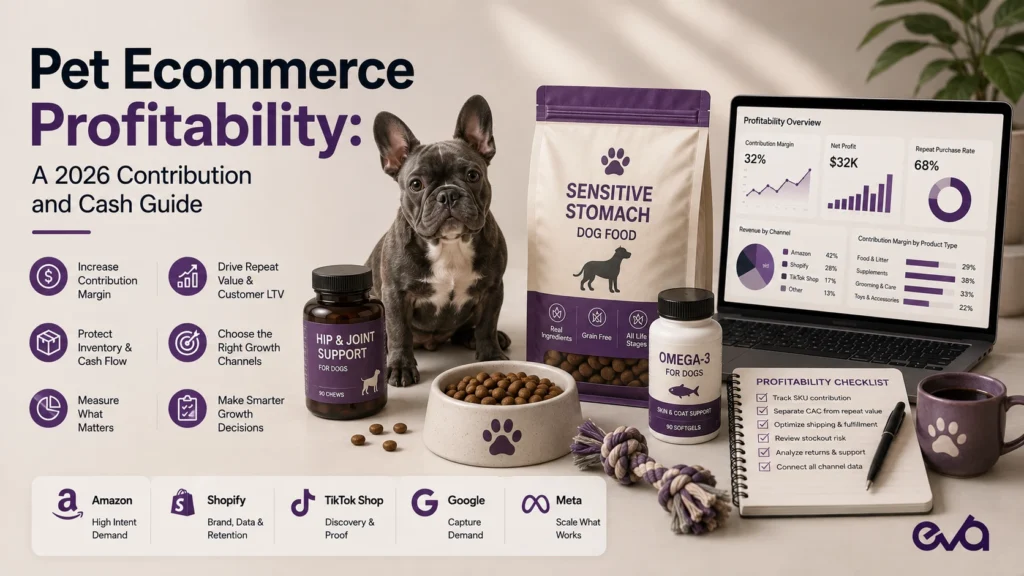
Amazon, Shopify, TikTok Shop, and paid media should not all do the same job. Amazon can capture high-intent category demand and comparison shopping. Shopify can carry brand education, bundles, subscriptions, and first-party customer data. TikTok Shop can test creator-led discovery and real pet-owner proof. Google and Meta can scale demand when the offer and conversion path are clean.
When channels are managed separately, profitable growth becomes harder to see. A TikTok video may reveal an objection that belongs on the Shopify product page. Amazon search terms may reveal a collection opportunity. Subscription churn may show that paid media is attracting the wrong customer. Eva’s full-service ecommerce agency guide covers this cross-channel operating problem in more detail.
Protect inventory before scaling spend
Pet brands can lose momentum when a winning product stocks out. Search rankings weaken, campaigns reset, subscriptions become unreliable, and customers switch to a substitute. Inventory planning is not a back-office issue; it is part of SEO, PPC, marketplace, and lifecycle performance.
Before increasing budget, confirm available units, reorder lead time, fulfillment capacity, return handling, and channel allocation. A profitable campaign becomes unprofitable quickly if the brand cannot fulfill the demand it creates.
Pet ecommerce profitability checklist
- Track SKU contribution by channel, not only blended revenue.
- Separate first-order CAC from repeat-order and subscription value.
- Measure shipping and fulfillment by product size and weight.
- Review stockout risk before increasing PPC or creator spend.
- Use return reasons and support tickets as conversion signals.
- Connect Amazon, Shopify, TikTok Shop, and lifecycle reporting in one review rhythm.
Final takeaway
Pet ecommerce profitability improves when the brand stops treating growth as isolated channel performance. The stronger model connects product economics, customer routines, subscriptions, inventory, marketplace visibility, and paid media into one operating system.