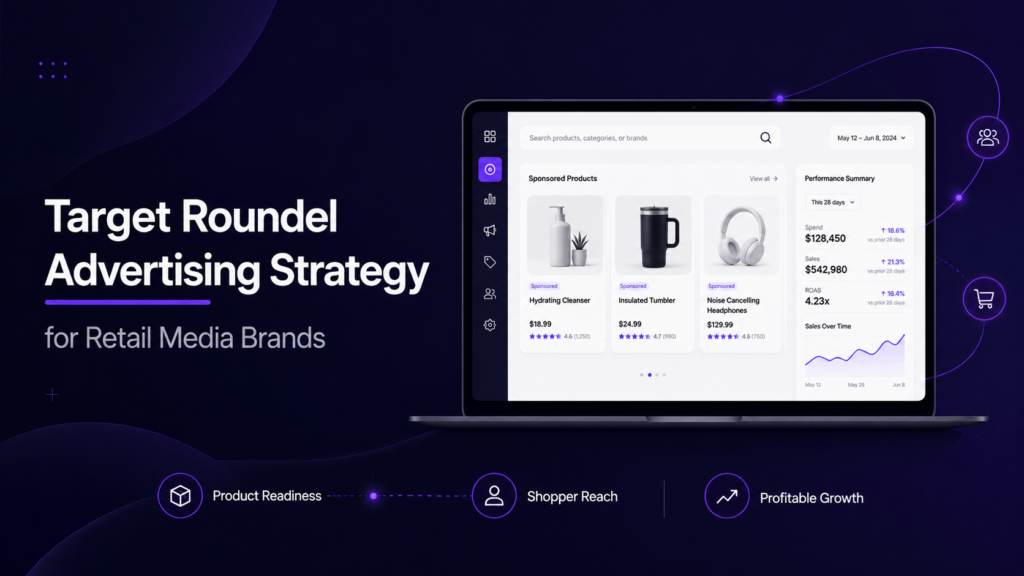
Target’s retail media network, Roundel, gives brands access to high-value shoppers across Target.com, the Target app, and premium off-site inventory. The opportunity is meaningful, but the channel works best when it is managed as part of a retail media system, not as an isolated campaign buy.
A Target Roundel strategy should start with product readiness. The brand needs the right items, content, price position, inventory, fulfillment promise, margin, and audience fit before it pushes spend. If those pieces are weak, retail media only accelerates a conversion problem.
Table of Contents
- What Target Roundel can do for ecommerce brands
- The operating checklist before spend scales
- How Eva manages Target as part of the growth system
- Target Roundel strategy by funnel stage
- How to build a Target Roundel test plan
- Measure Target retail media without false precision
- The weekly Target Roundel operating review
- FAQ
What Target Roundel can do for ecommerce brands
Roundel can help brands reach Target shoppers while they are researching, comparing, and buying. Sponsored Product style placements support bottom-funnel discovery, while display and off-site inventory can build reach across premium publishers. The strategic value is strongest when the brand knows which products deserve demand and which products need operational work first.
- Retail search: capture shoppers already looking for the category on Target.com and in the app.
- Audience reach: use Target shopper signals to reach relevant buyers across premium inventory.
- Product growth: scale products with strong content, price, availability, reviews, and margin.
- Portfolio learning: see which products deserve broader retail media support across Walmart, Instacart, Amazon, and Meta.
For grocery, household, beauty, and CPG brands that sell beyond Target, the same retail-media discipline applies to Instacart advertising strategy, where basket context, local availability, and product readiness decide whether spend creates profitable growth.
The operating checklist before spend scales
Before a brand increases Roundel spend, the team should review product content, category fit, inventory depth, price competitiveness, margin, historical conversion, review quality, and the role Target plays in the broader channel mix. Not every SKU should receive budget. The best candidates have a clear retail shopper, a strong offer, and enough operational support to handle demand.
This is where full-service management matters. Advertising, content, inventory, pricing, and marketplace expansion should not sit in separate meetings. Retail media becomes more effective when one team can decide whether a product needs better content, different pricing, more inventory, or more media pressure.
How Eva manages Target as part of the growth system
Eva manages Target advertising in the context of marketplace expansion. That means Roundel is connected to Walmart, Amazon, Instacart, Shopify, Google, Meta, and the brand’s profit goals. The goal is not simply more impressions or clicks. The goal is profitable reach across the channels where the brand’s customers already shop.
Related Eva resources: Target Advertising, Marketplace Expansion, Full-Funnel Commerce Playbook, and Walmart Connect Agency.
Target Roundel strategy by funnel stage
Quick answer: Match each media investment to a shopper objective, a retail-ready product set, a measurable outcome, and a profit guardrail instead of treating Roundel as one campaign type.
Retail media works best when advertising, item content, availability, price, merchandising, and measurement share one operating plan. Campaigns should not scale ahead of product readiness or inventory, and upper-funnel activity needs a defined path to retail outcomes.
| Objective | Operating focus | Decision signal |
|---|---|---|
| Discovery | Reach relevant shoppers with clear category and product positioning | Qualified reach, engagement and downstream retail behavior |
| Consideration | Connect audiences to useful product proof and a competitive offer | Product engagement, detail-page quality and assisted conversion |
| Conversion | Capture demand around retail-ready products and priority moments | Incremental sales evidence, conversion, margin and inventory health |
| Retention and learning | Use retail insights to improve audience, creative and assortment decisions | Repeat behavior, customer quality and next-best investment |
- Retail readiness gate: Do not scale a product with weak availability, item content, reviews, pricing, or operational support.
- Audience hypothesis: State who the campaign should influence and why the product or message is relevant.
- Creative system: Build assets for the placement and shopper context rather than recycling one generic retail ad.
- Measurement plan: Define incrementality questions, attribution limits, test design, and profit thresholds before launch.
The weekly operating review should connect media results to Target item health, inventory, retail moments, promotional pressure, and contribution profit. That is how a retail media plan becomes a growth system.
Continue with Eva: Target Advertising, Full-Funnel Commerce Playbook, Walmart Connect Agency Guide.
How to build a Target Roundel test plan
A useful test plan begins with a commercial question, not a media feature. The team should agree on the product set, audience hypothesis, campaign objective, expected customer action, measurement window, inventory limit, and contribution-profit guardrail before spend begins. This makes the result actionable even when attribution is incomplete.
- Choose the business question: decide whether the test should improve discovery, consideration, conversion, new-customer reach, or support for a retail moment.
- Define a qualified product set: include products with complete content, credible proof, stable availability, competitive offers, and enough margin to support media.
- Write the audience hypothesis: state which shopper behavior or need makes the audience relevant and which creative proof should move the decision.
- Control the test: document budget, timing, exclusions, promotions, inventory constraints, and other activity that could distort the read.
- Set the next decision: specify in advance what result would justify stopping, learning, repeating, or scaling.
Measure Target retail media without false precision
Retail media reporting can show attributed activity, but attribution alone does not prove that the campaign created incremental demand. Read platform results alongside product-level sales, organic movement, new-customer signals, inventory, promotion, margin, and the timing of other media. The purpose is not to dismiss attribution. It is to make the investment decision with the full commercial context.
For lower-funnel activity, review conversion quality, effective media cost, order economics, and whether paid demand displaced sales that likely would have happened anyway. For discovery and consideration, define the leading indicators that matter and the later retail outcome the team expects to influence. Do not force every campaign into the same short measurement window.
The weekly Target Roundel operating review
A weekly review should end with decisions. The team should identify which products need content or offer work, which audiences and creative ideas earned another test, where inventory restricts demand, which campaigns require a measurement adjustment, and how the next dollar should be allocated. Media, retail operations, and finance should work from the same product-level view.
This operating rhythm prevents a common failure: scaling a campaign because attributed revenue looks strong while availability, promotion, or margin makes the growth unattractive. Roundel becomes more valuable when it is managed as part of the brand operating system rather than as an isolated media report.
Related Eva guide: Turn the broader strategy into a media plan with the Target Roundel ad placements guide for onsite, app, offsite, and programmatic formats.
FAQ
What is Target Roundel?
Roundel is Target’s retail media network. It helps brands advertise to Target shoppers across Target.com, the Target app, and selected off-site media placements.
Should every product receive Target advertising spend?
No. Spend should prioritize products with strong content, availability, price position, conversion potential, and margin. Weak products should be fixed before budget scales.
How does Target advertising fit with Walmart and Amazon?
Target should be managed as part of the retail media portfolio. The same product, content, price, inventory, and profit signals should inform Walmart, Amazon, Instacart, and Target decisions.
Roundel investment is strongest when its retailer role and measurement are planned with the full portfolio. Read Eva’s Retail Media Strategy guide.
A Roundel program needs clear agency ownership across retailer strategy, readiness, execution, measurement, and economics. Use Eva’s Retail Media Agency guide as the selection scorecard.