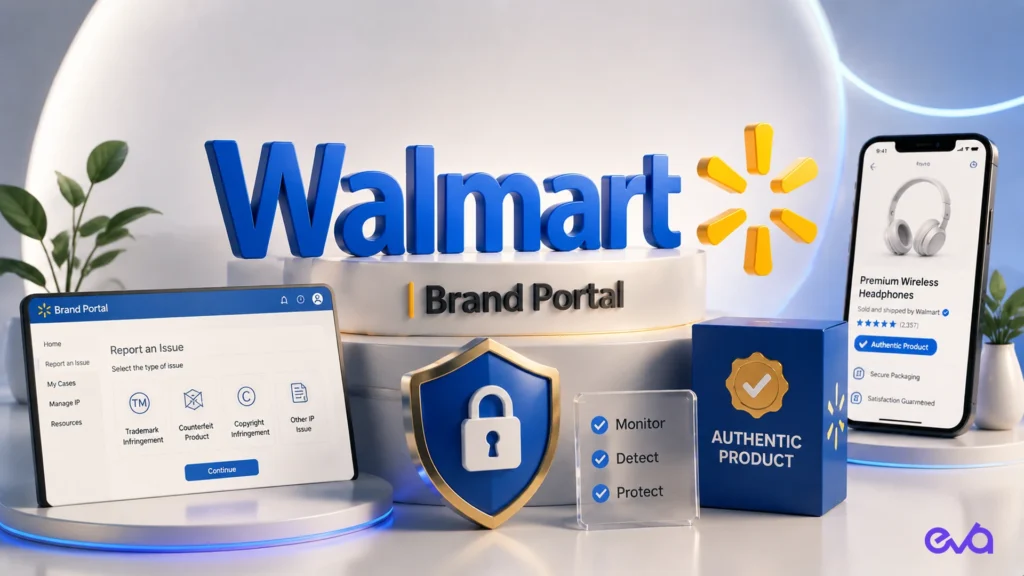
Walmart Brand Portal gives eligible rights owners and authorized representatives a channel for reporting intellectual-property concerns connected with Walmart. It can help brands organize trademark, copyright, patent, and counterfeit claims, but it does not replace accurate product setup, authorized-seller policy, catalog governance, or legal judgment. The quality of the evidence and the way the team classifies the issue still determine whether a report is useful.
Brand protection on a marketplace is also a commercial function. Incorrect content can reduce conversion. Duplicate or mismatched items can divide reviews and advertising history. Counterfeit or materially different products can create returns and customer distrust. A brand needs a process that connects rights, product evidence, catalog, operations, advertising, and customer service instead of treating every problem as a generic takedown request.
This 2026 guide explains how to prepare for Walmart Brand Portal, organize evidence, distinguish infringement from catalog or distribution disputes, submit precise claims, monitor outcomes, and connect protection with the brand’s wider Walmart Marketplace operating system.
Quick answer: Confirm the rights owner, trademark or other intellectual property, applicant authority, and product evidence before registering. Use Walmart Brand Portal for precise rights-based claims supported by item, seller, and evidence details. Keep catalog errors, unauthorized distribution, counterfeit, and infringement in separate workflows. Track every case and connect material incidents with listing, inventory, advertising, and customer decisions.
Table of Contents
- Walmart brand-protection operating framework
- 1. Establish the rights and applicant authority
- 2. Build a product and rights evidence library
- 3. Classify the problem before choosing the remedy
- 4. Monitor the products that matter most
- 5. Submit claims that are precise and reviewable
- 6. Manage outcomes and escalation
- 7. Keep catalog governance in a separate but connected process
- 8. Measure protection as part of marketplace performance
- A 30-day Walmart Brand Portal plan
- How Eva connects Walmart brand protection with growth
- Walmart Brand Portal FAQ
Walmart brand-protection operating framework
| Stage | Control | Purpose |
|---|---|---|
| Ownership | Rights record, owner, authorization, and account access | A defensible claim path |
| Evidence | Product, packaging, source files, invoices, and test buys | Reliable comparison and case support |
| Classification | Trademark, copyright, patent, counterfeit, catalog, or distribution | Correct workflow and remedy |
| Submission | Specific item, seller, content, right, and explanation | Actionable report |
| Case management | IDs, dates, outcomes, recurrence, and escalation | Consistent follow-through |
| Commerce response | Content, media, inventory, returns, and service actions | Protection of customer trust and profit |
Walmart describes Brand Portal as a tool for intellectual-property rights owners and authorized representatives to report concerns and protect brands. Review the current eligibility, registration, and claim guidance on the official Walmart Brand Portal page before registering or submitting a report.
Start with the intellectual-property record. Confirm the exact owner, mark or protected work, registration or application information, relevant territory, status, and product relationship. Compare the owner with the Walmart seller entity and applicant. If a parent company, licensing company, distributor, law firm, or agency will act, preserve written authorization and identify who can make legal representations.
Assign one accountable portal administrator and named backups. Use secure individual accounts, current contact details, and a documented recovery path. Agencies can support the workflow, but the brand should retain ownership of evidence and case history. Remove access when a relationship ends. A brand should not discover during an urgent incident that the only administrator is a former employee or vendor.
2. Build a product and rights evidence library
Organize trademark records, packaging artwork, product photographs, copyright source files, patent documents where relevant, supplier invoices, authorization agreements, product identifiers, lot information, and authentic reference samples. Preserve original files and dates. Take photographs that show the full product context and detailed differences. A cropped image without provenance is less useful than a controlled comparison tied to a real order.
Update evidence when products or packaging change. Keep prior versions because older inventory may remain in commerce. Map each protected asset to the products and geographies where it applies. Legal counsel should guide patent, ownership, licensing, and high-risk enforcement questions. The operating team should make the evidence easy to retrieve without making legal conclusions outside its role.
3. Classify the problem before choosing the remedy
Separate counterfeit, trademark misuse, copyright copying, patent concerns, catalog inaccuracy, product mismatch, duplicate items, unauthorized resale, and distribution conflict. These issues may look similar in a search result but require different facts and channels. An unwanted reseller is not automatically infringing. A catalog error may need item support rather than a rights report. Misclassification wastes time and can weaken credibility.
Create a triage checklist with the affected item, seller, content, protected right, customer risk, revenue risk, inventory exposure, and available evidence. Use test buys when the expected value and risk justify them. Record order, seller, packaging, product, lot, delivery, and comparison details. Preserve chain of custody for serious cases and escalate legal uncertainty appropriately.
4. Monitor the products that matter most
Prioritize hero items, launches, high-ad-spend products, safety-sensitive categories, products with frequent catalog changes, and items where customers could easily confuse versions. Monitor search results, item titles, images, descriptions, variants, sellers, reviews that describe a different product, duplicate pages, and material price or availability changes. Use frequency based on commercial and customer risk.
Connect monitoring with customer service and returns. Reports of unexpected packaging, quality, fit, components, or instructions can reveal a listing mismatch or different product. Advertising teams may detect unusual conversion changes before a protection system does. A shared incident queue helps catalog, legal, marketplace, media, and operations teams combine evidence and choose the correct response.
5. Submit claims that are precise and reviewable
Identify the exact protected right, the specific content or product that violates it, the location of the issue, the responsible item or seller, and the evidence supporting the conclusion. Explain the requested action without combining unrelated theories. If several sellers or items share the same fact pattern, keep enough detail to evaluate each one. Preserve the submitted text and attachments with the portal case ID.
Avoid unsupported conclusions, emotional language, and broad statements about all resellers. Use screenshots as supporting context because live pages can change, but preserve URLs, item IDs, seller details, order records, source files, and comparison photographs. Accuracy protects the brand and helps reviewers act. High-impact or disputed claims should involve qualified counsel.
6. Manage outcomes and escalation
Track submission date, case number, right, affected item, seller, response, action, rejection reason, appeal, recurrence, and commercial impact. If a report is rejected, diagnose whether the issue is eligibility, evidence, ownership, classification, or explanation before resubmitting. Opening many duplicate cases rarely fixes a weak record. Escalation should add relevant facts or correct the workflow.
Monitor whether removed content, items, or sellers return and whether the customer problem actually stops. A takedown can be temporary if the root source is unresolved. Share patterns with sourcing, distribution, packaging, and sales teams. Brand protection is stronger when the company reduces leakage and ambiguity rather than relying only on marketplace enforcement after products appear.
7. Keep catalog governance in a separate but connected process
Maintain a product source of truth for item identifiers, titles, descriptions, images, variants, dimensions, ingredients, certifications, shipping details, and category attributes. Compare expected and live values. When an item changes, determine whether the cause is an internal feed, seller contribution, category rule, duplicate relationship, identifier conflict, or rights issue. Choose the support or portal path based on that diagnosis.
Preserve every correction and case so the team can identify repeat causes. Coordinate content changes with Walmart SEO, advertising, inventory, and promotions. An item repaired after a long interruption may need search, conversion, and media monitoring before investment returns to normal. Catalog accuracy and intellectual-property protection are distinct disciplines that work best from the same evidence base.
8. Measure protection as part of marketplace performance
Track incident volume, time to detection, time to submission, outcome, recurrence, affected sales, conversion change, return reasons, advertising waste, and customer contacts. Do not judge the program by takedown count alone. Fewer incidents can reflect stronger control, while more reports can reflect improved detection. Use trends and material business effects to decide where to invest.
Review the program quarterly. Verify rights status, users, authorization, new products, packaging versions, seller relationships, evidence completeness, and recurring catalog problems. Compare the protected catalog with the expansion plan. The objective is a trustworthy Walmart offer that customers can identify and buy with confidence, supported by a team that can respond without disconnecting legal, operational, and growth decisions.
A 30-day Walmart Brand Portal plan
- Week 1: Confirm rights, owner, applicant authority, account access, recovery, and the priority product list.
- Week 2: Build the evidence library, authentic product references, catalog source of truth, and issue taxonomy.
- Week 3: Register or validate Brand Portal access, document workflows, and test case management with a real issue if available.
- Week 4: Launch risk-based monitoring, cross-functional incident review, and a quarterly rights and access audit.
How Eva connects Walmart brand protection with growth
Eva manages marketplace expansion across item setup, listing optimization, advertising, inventory, operations, measurement, and profit. When a Walmart rights or catalog issue appears, operators connect the case with the products, customer experience, and media decisions affected by it. That keeps protection work tied to commercial priorities.
Eva Intelligence helps teams detect product and performance changes, while experienced operators own evidence, diagnosis, support, and escalation. The objective is not simply submitting more claims. It is maintaining accurate, trustworthy items that can rank, convert, and scale profitably on Walmart Marketplace.
Walmart Brand Portal FAQ
What is Walmart Brand Portal?
It is Walmart’s channel for eligible intellectual-property rights owners and authorized representatives to register and report concerns. Current eligibility and workflows should be confirmed on Walmart’s official site.
Does Walmart Brand Portal remove unauthorized sellers?
Not every unauthorized seller violates intellectual property. A claim needs a valid rights or policy basis and appropriate evidence. Distribution conflict and infringement should be analyzed separately.
What evidence should a brand keep?
Keep rights records, authorization, source files, product and packaging photographs, invoices, identifiers, authentic samples, test-buy records, URLs, item IDs, seller details, and complete case history.
Should catalog errors be reported as infringement?
Only when the facts support an intellectual-property claim. Many title, image, variant, item, and identifier problems belong in catalog or partner-support workflows instead.
Can an agency manage Walmart Brand Portal?
An authorized agency can support appropriate workflows, but the rights owner should control access, evidence, authorization, recovery, and legal decisions. Use named accounts and least privilege.
Related Eva resources: Marketplace Expansion, Walmart Marketplace Agency Guide, Walmart Listing Optimization Guide, Eva Playbooks.