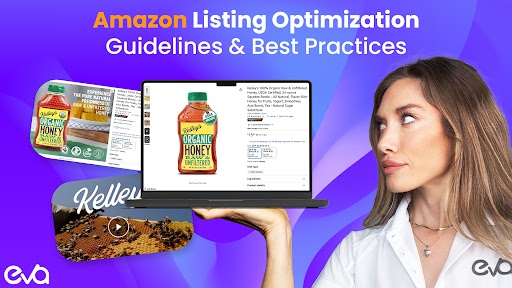
Quick answer: Amazon listing optimization in 2026 is the operating work of improving a product detail page so it can be found, understood, trusted, and converted. It is not just rewriting a title or adding keywords. A strong Amazon listing connects search intent, product positioning, images, A+ content, backend terms, catalog health, pricing, inventory, reviews, and advertising signals into one conversion system.
Related Eva guide: Use the Amazon badges guide to connect listing guidelines to Amazon’s Choice, Overall Pick, and Best Seller visibility.
Most Amazon listings are not underperforming because one keyword is missing. They underperform because the product detail page is not clear enough for the shopper, not structured enough for Amazon search, and not connected enough to the rest of the growth system. A title may get indexed, but the main image fails to earn the click. Bullets may include keywords, but they do not answer the buyer’s objections. Ads may drive traffic, but the listing cannot convert it profitably.
This 2026 guide explains how Amazon sellers and brand teams should optimize listings with a practical operator framework: discoverability first, conversion second, and profitable rank third. If you want Eva to diagnose your current listings, start with the Listing Optimizer or the Eva ecommerce tools hub.
Table of Contents
- What Amazon listing optimization means in 2026
- The 2026 Amazon listing optimization checklist
- How to optimize the title without keyword stuffing
- How to use images to improve click-through and conversion
- How to write bullets that convert
- Backend keywords, attributes, and semantic coverage
- A practical 7-step optimization workflow
- Common mistakes that hurt Amazon listing performance
- When to use Listing Optimizer or an agency
- Amazon listing optimization FAQs
What Amazon listing optimization means in 2026
Amazon listing optimization is the process of making every visible and invisible part of a product detail page support search, click-through rate, conversion rate, and customer confidence. The work includes the product title, main image, secondary images, bullet points, description, A+ content, backend search terms, product attributes, variation structure, browse nodes, brand content, review signals, price, coupons, delivery promise, and catalog accuracy.
In 2026, the best teams also think about how listings are interpreted by Amazon’s recommendation systems, retail media algorithms, and AI shopping experiences. That means the page must describe the product with semantic clarity. It should explain what the product is, who it is for, what problem it solves, what makes it different, and why a shopper should trust it.
The mistake is treating listing optimization as a one-time copywriting task. The better model is a feedback loop. You review search query data, advertising performance, conversion rate, competitor positioning, catalog health, and customer feedback, then update the page in controlled iterations. For brands that need an end-to-end operating model, connect listing work to Amazon SEO and AEO, Full-Service Amazon Management, and the Amazon Ranking Acceleration Playbook.
The 2026 Amazon listing optimization checklist
A useful checklist should be tied to the shopper journey. The listing has to win the search result, earn the click, answer the buying question, reduce risk, and support profitable traffic. Use this checklist before launching a new SKU, rebuilding an existing listing, or deciding whether an Amazon listing optimization agency is needed.
- Search intent: Identify the primary buyer intent, not only the highest-volume keyword. The listing should match the way shoppers describe the problem, product type, use case, size, material, flavor, ingredient, compatibility, or audience.
- Title structure: Lead with brand and core product type, then include the most important differentiators that help a shopper choose. Avoid stuffing repeated phrases that make the title harder to read.
- Main image: Make the product instantly recognizable at mobile search-result size. The main image often has more influence on click-through rate than the copy underneath it.
- Secondary images: Use the gallery to explain benefits, scale, usage, comparison, ingredients, compatibility, packaging, and objection handling. Every image should have a job.
- Bullets: Write bullets around buyer questions. Combine proof, benefit, and detail. Generic claims like “high quality” rarely move conversion by themselves.
- A+ content: Use A+ content to expand the story, compare variants, show proof, and make the brand more memorable. This is especially important in crowded categories.
- Backend terms and attributes: Fill search terms and product attributes with relevant language that supports indexing without repeating visible copy unnecessarily.
- Catalog health: Fix suppressed fields, variation issues, browse-node problems, image warnings, compliance flags, and stale contributions before spending more on ads.
- Price and offer: Check price, coupon, shipping promise, Subscribe and Save, and Buy Box stability. Conversion issues are not always copy issues.
- Measurement: Track CTR, CVR, organic rank, sponsored rank, session percentage, unit session percentage, TACoS, contribution margin, and search query performance after changes.
How to optimize the title without keyword stuffing
The title should help Amazon understand the product and help the shopper decide whether to click. A good title usually includes the brand, product type, primary attribute, quantity or size, and the most important use case. The exact structure depends on category rules, shopper behavior, and competitive pressure.
Do not treat the title as a dumping ground for every keyword. Repetition can reduce readability, and category style rules can create compliance risk. Instead, build the title around the highest-value phrase and use bullets, A+ content, attributes, and backend terms to support the rest of the semantic field. If you need a deeper service view, read Best Amazon Listing Optimization Services.
How to use images to improve click-through and conversion
Images are not decoration. They are the fastest way to communicate value on Amazon. The main image has to win attention in search results. The rest of the image stack should answer the questions a shopper would normally ask before buying: What is included? How big is it? Who is it for? How do I use it? What makes it different? Why should I trust it?
For many categories, image optimization has the fastest conversion impact because shoppers scan before they read. Use secondary images to show product scale, benefit hierarchy, product-in-use context, comparison charts, certifications, ingredients, compatibility, installation steps, and package contents. For regulated categories, keep claims supportable and compliant.
How to write bullets that convert
Bullets should not read like a keyword list. Each bullet should answer a buyer objection or reinforce a purchase reason. A simple structure works well: lead with the benefit, support it with product detail, and make the implication clear. For example, instead of saying “premium material,” explain what the material does for durability, comfort, taste, safety, fit, or performance.
Strong bullets also help Amazon and AI shopping systems understand the product. Cover the terms shoppers use naturally, but avoid making every line sound like search-engine copy. The best listings feel useful to the human shopper and clear to the algorithm at the same time.
Backend keywords, attributes, and semantic coverage
Backend search terms are useful, but they are not magic. Use them to include relevant synonyms, alternate phrasing, common abbreviations, use cases, and adjacent descriptors that do not fit naturally in visible copy. Avoid irrelevant competitor terms, prohibited claims, and repeated words that already appear clearly on the page.
Attributes matter because Amazon uses structured data to classify, filter, and present products. Missing attributes can limit discoverability even when the visible copy looks strong. Review item type keyword, material, color, size, count, compatibility, target audience, special features, and category-specific fields. Listing optimization should include a catalog audit, not only a copy edit.
A practical 7-step optimization workflow
- Baseline the listing: Capture current title, bullets, images, A+ content, backend terms, attributes, rank, CTR, CVR, sessions, unit session percentage, ad spend, TACoS, and margin.
- Map the search market: Identify the queries that matter by revenue, conversion, rank opportunity, and buyer intent. Do not optimize around volume alone.
- Audit the PDP: Review the main image, gallery, title, bullets, description, A+ content, reviews, price, offers, delivery promise, and catalog warnings.
- Rewrite with intent: Build copy and creative around buyer questions, differentiators, use cases, and proof. Keep Amazon rules and category style expectations in mind.
- Fix catalog gaps: Complete attributes, variation logic, browse nodes, backend terms, and listing quality warnings before pushing more traffic.
- Connect ads to the test: Use sponsored ads and search query data to see whether the new listing earns better click-through, conversion, and ranking signals.
- Iterate monthly: Listing optimization is never finished. Review query performance, competitor movement, review themes, inventory constraints, pricing, and ad efficiency on a recurring cadence.
Common mistakes that hurt Amazon listing performance
The most common mistake is optimizing only for indexing. A listing can index for the right keyword and still fail because the main image, price, reviews, or bullets do not earn the click or conversion. Another mistake is updating the listing without measuring the before-and-after impact. If you change the title, images, bullets, A+ content, and price at once, it becomes harder to know what worked.
Brands also underinvest in catalog health. A detail page can lose performance because of a suppressed attribute, broken variation, stale brand contribution, image issue, or compliance warning. This is why Eva treats listing optimization as part of a managed Amazon system, connected to Orbit, advertising intelligence, content, catalog operations, and profit measurement.
When to use Listing Optimizer or an agency
If you have a small catalog and clear issues, a listing audit may be enough to identify the next fixes. Eva’s Listing Optimizer helps sellers review listing quality, optimization gaps, and scoring signals so they can move faster. It is especially useful when the product page needs a structured before-and-after plan rather than another generic keyword rewrite.
If your catalog is larger, advertising spend is material, or ranking affects the whole P&L, listing optimization should sit inside full-service Amazon management. The right team should connect content updates to advertising, pricing, inventory, reviews, catalog health, and contribution margin. That is the difference between editing a listing and operating a growth system.
Related managed growth resources: Move from guidelines to execution with Amazon Listing Optimization Services, Listing Optimizer, Amazon SEO & AEO, the Eva ecommerce tools hub, and Full-Service Amazon Management.
Related Eva guide: Amazon listing optimization becomes more valuable when it is connected to the rest of the offer. Use Eva's 2026 digital shelf operating model for the cross-functional view.
Amazon listing optimization FAQs
How often should Amazon listings be optimized?
Review priority listings at least monthly, and review them immediately after major rank drops, conversion declines, catalog warnings, image changes, competitor movement, pricing changes, or ad efficiency problems. High-volume SKUs need a tighter operating cadence than low-volume long-tail SKUs.
What is the most important part of an Amazon listing?
The main image, title, price, reviews, and delivery promise usually create the first click decision. The bullet points, image stack, A+ content, and product details then support conversion. The most important part depends on the bottleneck: visibility, CTR, CVR, or catalog health.
Do backend keywords still matter?
Yes, but they should support the listing rather than replace good visible content. Use backend terms for relevant synonyms, alternate phrases, and search language that does not fit naturally on the page. Do not rely on backend terms to fix weak positioning or poor conversion.
Can listing optimization improve Amazon PPC?
Yes. A stronger listing can improve click-through rate, conversion rate, and relevance signals, which can make advertising spend more efficient. PPC and listing optimization should be managed together because ads expose listing weaknesses quickly.
Sources & Further Reading
- Amazon product listing guide – Amazon’s overview of creating product listings and product detail pages.
- Amazon Ads guide to improving product detail pages for advertising – Amazon’s public guidance on product detail page quality and advertising readiness.
- Amazon Seller Central Listing Quality Dashboard – available inside Seller Central for sellers reviewing listing content and discoverability issues.