Starting a supplement brand is a product, operations, finance, and customer-acquisition project. The logo and storefront are visible, but the critical work begins with product responsibility, manufacturer and supply decisions, labeling and claims review, unit economics, inventory, payment and marketplace eligibility, fulfillment, customer service, and a realistic path to repeat purchase.
A rushed founder can commit to a large minimum order before proving demand, build an ad message before approving the product positioning, or open several channels before the documentation and operating team are ready. Each shortcut moves risk into a later and more expensive stage.
This guide is a commercial launch framework. It does not tell a founder what product to formulate, whether an ingredient is appropriate, or whether a product or claim meets a legal standard. Use qualified product, manufacturing, laboratory, regulatory, finance, tax, and legal support for those decisions.
Quick answer
Start a supplement brand by defining the customer and product thesis, assigning product responsibility, selecting and qualifying a manufacturer, completing product and label review, calculating contribution and cash needs, building a controlled claims library, choosing a focused channel and assortment, preparing inventory and fulfillment, and launching with measurement, customer service, and retention from day one.
Table of Contents
- In this guide
- Supplement brand launch stages
- Current primary sources
- 1. Write the customer and product thesis
- 2. Assign product responsibility
- 3. Select a manufacturer deliberately
- 4. Build the label and claims process
- 5. Calculate the business before placing the order
- 6. Choose a focused channel sequence
- 7. Prepare inventory, fulfillment, and customer service
- 8. Launch for learning and controlled growth
- A six-stage supplement brand launch plan
- Where Eva fits in a supplement brand launch
- Starting a supplement brand FAQ
In this guide
- 1. Write the customer and product thesis
- 2. Assign product responsibility
- 3. Select a manufacturer deliberately
- 4. Build the label and claims process
- 5. Calculate the business before placing the order
- 6. Choose a focused channel sequence
- 7. Prepare inventory, fulfillment, and customer service
- 8. Launch for learning and controlled growth
Supplement brand launch stages
| Stage | Decision | Evidence before commitment |
|---|---|---|
| Thesis | Customer, routine, product role, differentiation, and channel | Demand, competition, and problem clarity |
| Product | Formula or product, manufacturer, pack, label, and records | Qualified review and documented responsibility |
| Economics | Price, MOQ, cost, fulfillment, acquisition, returns, and cash | Scenario model and downside case |
| Channel | Shopify, Amazon, TikTok Shop, retail, or sequence | Eligibility, demand, operations, and owner |
| Launch | Inventory, content, creators, ads, service, and measurement | Release checklist and stop conditions |
| Scale | Reorder, assortment, retention, and channel expansion | Repeatable contribution and operational stability |
Current primary sources
FDA Dietary Supplements Guidance and Regulatory Information: FDA organizes guidance related to supplement manufacturing practice, ingredients, labeling, claims, adverse events, and other responsibilities.
FDA Dietary Supplement Labeling Guide: FDA provides its current labeling guidance and explains its nonbinding status.
FTC Health Products Compliance Guidance: FTC staff explains truthful advertising, substantiation, implied messages, endorsements, and disclosures for health-related products.
1. Write the customer and product thesis
Operator answer
Define who the brand serves, what role the product plays in a routine, why the offer is different, and what evidence would change the decision.
Begin with customer behavior and market structure, not a trendy ingredient or a logo. Study search language, competitive products, pack sizes, price, reviews, recurring questions, channel availability, creator content, retail presence, and replacement products. Separate customer demand from the founder’s personal enthusiasm.
Write a one-page thesis with the target customer, approved problem framing, product format, use context, differentiation, price range, first channel, repeat expectation, and primary risks. Include disconfirming evidence. A launch should have a reason to stop, revise, or delay before inventory makes the decision irreversible.
2. Assign product responsibility
Operator answer
Name qualified owners for formulation or product choice, manufacturing, testing, label, claims, adverse events, and legal decisions before creative begins.
A contract manufacturer does not automatically own every brand responsibility. Document who makes each decision, who keeps records, who receives customer or adverse-event information, who reviews changes, and who responds to regulators or platforms. Obtain qualified advice for the actual product and business.
Create a product file from the beginning. Preserve formula or specification versions, ingredient and supplier records, manufacturer and facility information, production and batch documentation as applicable, testing, label versions, claims evidence, packaging, and effective dates. Ecommerce IDs and live channel assets should connect back to that file.
3. Select a manufacturer deliberately
Operator answer
Evaluate capability, documentation, quality systems, change control, capacity, communication, economics, and channel readiness, then verify rather than relying on a sales claim.
Compare the manufacturer’s relevant capabilities for the product form, sourcing, minimums, lead times, packaging, label coordination, testing arrangements, storage, capacity, quality processes, records, complaint handling, change notification, insurance, confidentiality, and commercial terms. Involve qualified reviewers in the due-diligence scope.
Ask how the manufacturer handles a raw-material change, failed specification, packaging delay, capacity constraint, customer complaint, recall-related event, or marketplace documentation request. Review sample records and references where appropriate. The cheapest unit quote can create the most expensive launch if the operating system is weak.
4. Build the label and claims process
Operator answer
Treat label, website, marketplace, advertising, creator, email, and support messages as one controlled system.
Develop the label with qualified review and current primary sources. Create a claims library with exact wording, evidence, product applicability, qualifications, visual guidance, reviewer, approval date, and next review. Give agencies and creators operational guardrails instead of asking them to interpret technical files.
Review the complete customer impression. Packaging, name, image, testimonial, demonstration, and placement can change meaning. The FTC guidance makes clear that implied messages matter. A copied disclaimer is not a substitute for an accurate and supported message.
5. Calculate the business before placing the order
Operator answer
Model contribution, working capital, inventory risk, acquisition, repeat behavior, and downside scenarios by SKU and channel.
Start with realistic net price and subtract discounts, product and landed cost, packaging, payment, marketplace, fulfillment, shipping subsidy, storage, returns, samples, creator commissions, advertising, variable creative, service, and other variable costs. Add cash timing for deposits, production, freight, channel settlement, and replenishment.
Model a base, slower-demand, higher-acquisition-cost, and delayed-production case. Calculate units required to recover setup and initial inventory. Do not use an optimistic revenue LTV to justify a weak first-order model until repeat behavior exists. A founder should know how much capital remains if the first production run sells slowly.
6. Choose a focused channel sequence
Operator answer
Choose the first channel from customer demand, product eligibility, unit economics, operating capability, learning speed, and inventory, then design the second channel without creating conflict.
Shopify provides customer and experience control but requires demand generation. Amazon provides marketplace demand but adds fees, catalog, seller, and verification complexity. TikTok Shop can accelerate creator discovery but adds eligibility, content, commission, and fulfillment demands. Retail can create reach with different terms and lead times.
Avoid launching every channel on the same day unless the team can operate them. Set price and pack architecture to reduce conflict. Standardize product identifiers and inventory views. Preserve channel-specific customer experience while keeping the product and claims foundation consistent.
7. Prepare inventory, fulfillment, and customer service
Operator answer
The launch plan should explain what happens from purchase order through customer delivery, return, complaint, and replenishment.
Map production, quality release, packaging, freight, receiving, lot or batch tracking as applicable, storage, channel allocation, order handling, shipping, returns, damaged units, and inventory reconciliation. Test packaging and representative orders. Define service levels and escalation.
Create customer-service scripts from approved product and policy information. Support should not improvise medical advice or claims. Establish a path for product-quality or adverse-event information to reach the qualified responsible team promptly. Keep the service and product records connected.
8. Launch for learning and controlled growth
Operator answer
Use a narrow assortment, clear release checklist, measured acquisition, customer feedback, and stop conditions before scaling inventory or media.
Confirm product availability, content, checkout, payment, fulfillment, service, analytics, claims approval, creator briefs, and campaign limits. Launch enough activity to learn, but protect cash and inventory. Separate useful demand evidence from a short promotion spike.
Review conversion, completed orders, customer questions, returns, delivery, product feedback, repeat signals, advertising, inventory, and contribution weekly. Record decisions. Scale only after the operation can repeat the customer promise and the economics can fund the next inventory cycle.
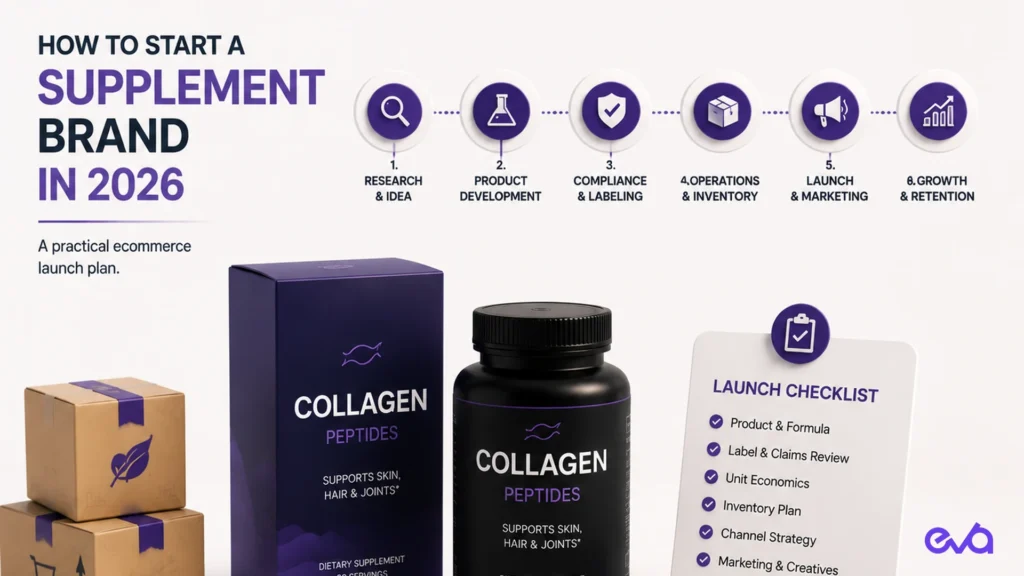
A six-stage supplement brand launch plan
- Validate: Test the customer, product, channel, and economic thesis before binding inventory commitments.
- Qualify: Complete manufacturer, product, label, claims, documentation, and responsibility work with qualified support.
- Model: Build unit, cohort, inventory, and cash scenarios with a downside case.
- Prepare: Complete channel eligibility, content, fulfillment, service, analytics, and release controls.
- Launch: Use a controlled assortment and acquisition plan with clear learning and stop rules.
- Scale: Reorder, expand assortment, and add channels only after evidence of repeatable contribution and operational stability.
Where Eva fits in a supplement brand launch
Eva manages ecommerce growth across Amazon, Shopify, TikTok Shop, Google, Meta, and retail media. Eva can build channel strategy, execute listings and advertising, coordinate creators and lifecycle, monitor inventory and account events, and connect decisions to contribution.
Eva is not a supplement manufacturer, laboratory, certifier, medical reviewer, or law firm. Product, formulation, safety, manufacturing, testing, substantiation, labeling, and legal responsibilities remain with the brand and qualified partners.
Starting a supplement brand FAQ
How much does it cost to start a supplement brand?
It depends on product development, minimums, testing and review, packaging, freight, insurance, systems, inventory, channels, creative, acquisition, and working capital. Build a complete cash model and downside case instead of relying on a generic number.
Should a new brand start on Amazon or Shopify?
Choose from customer demand, economics, product eligibility, operating capability, learning goals, and inventory. Shopify offers direct customer control, while Amazon offers marketplace demand with different operational requirements.
Can a contract manufacturer handle everything?
Do not assume so. Document the manufacturer’s scope and the brand’s responsibilities, then use qualified reviewers for product, label, substantiation, and legal decisions.
How many products should a new brand launch?
Use the smallest assortment that can test the thesis and create a coherent customer offer without spreading documentation, inventory, and media too thinly.
When should a brand hire an ecommerce agency?
An agency becomes useful when the product foundation is credible and the brand needs accountable channel strategy and execution across acquisition, catalog, conversion, retention, inventory, and profit.
Related Eva resources: Supplement Ecommerce Agency, Marketplace Expansion, Full-Funnel Commerce Playbook, Supplement Manufacturer Selection, Supplement Ecommerce Profitability.
Important scope note
This guide covers ecommerce operations, not medical or legal advice. Platform policies change, and brands remain responsible for product safety, substantiation, labeling, claims, and qualified review.
Related Eva resource: For hands-on support, explore Eva’s supplement ecommerce growth team.
Related Eva resource: For marketplace growth support that keeps operational and compliance considerations in view, explore Eva’s supplement ecommerce growth team.