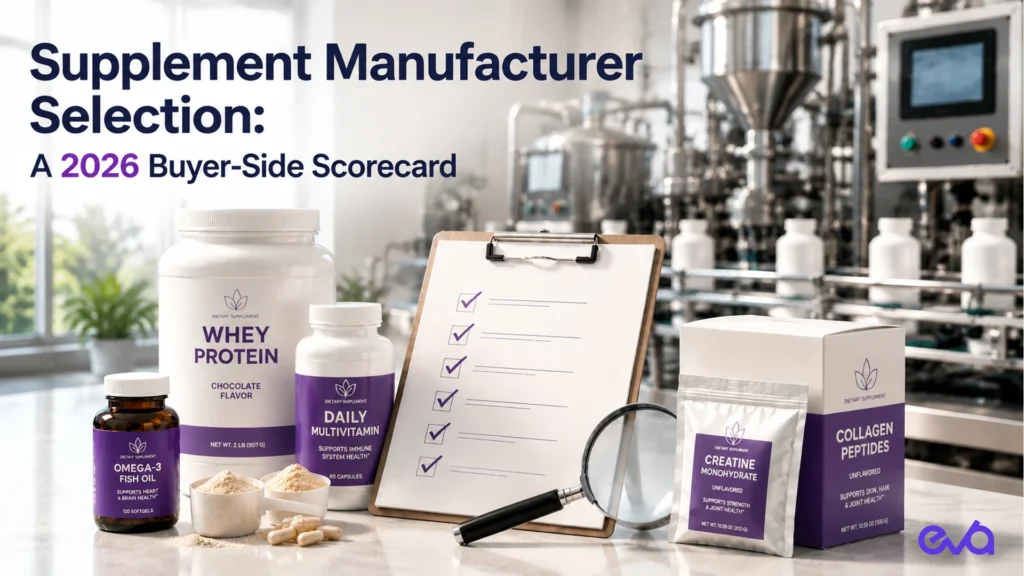
Supplement manufacturer selection is one of the highest-leverage decisions in a brand launch. It affects product consistency, records, packaging, lead time, inventory, platform readiness, customer experience, cash, and the brand’s ability to respond when something changes. A low quote or polished sales deck does not establish operating fit.
The buyer should define the product and channel requirements, create a consistent request, compare responses, verify material claims, involve qualified reviewers, and test how the manufacturer handles real exceptions. The objective is not to find a factory through an affiliate list. It is to choose a partner the brand can govern.
Eva is not a manufacturer, laboratory, auditor, certifier, or legal reviewer. This guide is a buyer-side commercial and operating scorecard that should be adapted with qualified support.
Quick answer
Choose a supplement manufacturer by scoring relevant product capability, quality and record systems, testing coordination, label and packaging support, change control, capacity, lead time, MOQ, communication, incident response, data ownership, marketplace documentation, total landed cost, and commercial terms. Verify important claims and references, involve qualified reviewers, and run a small controlled validation before scaling.
Table of Contents
- In this guide
- Manufacturer evaluation scorecard
- Current primary sources
- 1. Define the exact manufacturing need
- 2. Evaluate relevant product capability
- 3. Review quality and documentation systems
- 4. Understand testing and verification responsibilities
- 5. Test change control and incident response
- 6. Model MOQ, lead time, capacity, and cash
- 7. Evaluate communication and governance
- 8. Validate before scaling
- Manufacturer selection process
- How manufacturer selection connects to ecommerce
- Supplement manufacturer selection FAQ
In this guide
- 1. Define the exact manufacturing need
- 2. Evaluate relevant product capability
- 3. Review quality and documentation systems
- 4. Understand testing and verification responsibilities
- 5. Test change control and incident response
- 6. Model MOQ, lead time, capacity, and cash
- 7. Evaluate communication and governance
- 8. Validate before scaling
Manufacturer evaluation scorecard
| Dimension | Evidence to request | Risk if weak |
|---|---|---|
| Product capability | Relevant formats, equipment, specifications, and experience | Inconsistent output or avoidable reformulation |
| Quality system | Current records, procedures, audit or certification information, and responsibilities | Weak control or delayed response |
| Documentation | Sample product, batch, label, testing, and change records as appropriate | Marketplace and traceability gaps |
| Operations | MOQ, lead time, capacity, scheduling, packaging, freight, and communication | Stockouts, excess inventory, or launch delay |
| Change control | Notification, approval, supplier, specification, and deviation process | Unplanned product or label mismatch |
| Commercial | Pricing, deposits, terms, ownership, warranty, insurance, and exit conditions | Cash pressure or contractual conflict |
Current primary sources
FDA final rule background for dietary supplement CGMPs: FDA summarizes the final rule and its application to manufacturing, packaging, labeling, and holding operations.
FDA Small Entity Compliance Guide for dietary supplement CGMPs: FDA provides detailed guidance for smaller entities regarding dietary supplement manufacturing practice requirements.
FDA Dietary Supplements Guidance and Regulatory Information: FDA organizes current resources for manufacturing practice, ingredients, labeling, claims, and adverse events.
1. Define the exact manufacturing need
Operator answer
Write the product, pack, volume, market, channel, records, review, and timeline requirements before contacting manufacturers.
Describe the product form, specification, ingredient or sourcing responsibilities, flavor or sensory needs, serving and pack configuration, packaging, label, markets, expected volume, launch timing, channel documentation, storage, freight, and change-control expectations. Separate must-have requirements from preferences.
Use one request format so responses can be compared. A vague request produces quotes based on different assumptions. Record what is included in unit price and what is separate: development, setup, testing, packaging components, labels, freight, storage, rework, samples, documentation, and rush fees.
2. Evaluate relevant product capability
Operator answer
Ask for evidence that the facility, equipment, process, and team can handle the exact product form and expected scale.
Relevant experience matters more than a long list of possible products. Review batch ranges, line constraints, allergen or segregation needs as applicable, packaging compatibility, sensory consistency, sourcing, and the transition from pilot to commercial volume. Ask which steps are performed internally and which are subcontracted.
Request representative timelines and identify the critical path. Understand how a specification is established, reviewed, and changed. Qualified technical reviewers should assess product-specific capability. The ecommerce team should focus on whether the result and records can support the customer and channels.
3. Review quality and documentation systems
Operator answer
Verify current systems and representative records with qualified support rather than accepting an undated badge or verbal assurance.
Review the facility and responsible entity, current audit or certification information as relevant, procedures, specifications, supplier qualification, receiving, production records, release, deviations, complaints, retention samples, traceability, change control, and corrective action. Adapt the due-diligence scope to the product and legal requirements.
Ask for redacted examples that show record quality. Can the manufacturer connect a finished lot with ingredients, production, packaging, label, release, and distribution information as required for its role? How quickly can the team retrieve documents for a marketplace or customer issue?
4. Understand testing and verification responsibilities
Operator answer
Document who defines, orders, performs, reviews, pays for, and retains every test or verification activity relevant to the product and channel.
The brand should know which laboratory or provider relationships are used, how methods and specifications are chosen, how samples are controlled, who reviews results, what happens after an exception, and what records are supplied. Involve qualified experts in deciding the appropriate product-specific program.
Marketplace processes can require use of providers approved by the platform. A manufacturer’s existing report may not replace the exact channel workflow. Ask how the manufacturer supports Amazon or other platform requests, what lead time applies, and how formulation or packaging changes affect prior records.
5. Test change control and incident response
Operator answer
Ask the manufacturer to walk through realistic changes and failures, including who informs the brand, what stops production, and what evidence is preserved.
Scenarios should include ingredient or supplier change, specification exception, packaging shortage, label error, production delay, capacity constraint, complaint, damaged shipment, record request, and product recovery event. Review notification timing, decision rights, corrective action, and financial responsibility.
The contract should match the operating process. A strong procedure is not enough if the brand has no right to timely notice or records. Obtain qualified legal review for agreements, warranties, indemnity, insurance, confidentiality, intellectual property, ownership, and termination.
6. Model MOQ, lead time, capacity, and cash
Operator answer
Compare total landed and working-capital impact under base and downside demand, not unit price alone.
Record minimum order by SKU, component minimums, setup, deposit, balance timing, production window, quality release, packaging lead time, freight, storage, and reorder sequence. A low unit price tied to a large MOQ can create aging inventory and cash pressure.
Ask how capacity is reserved, what changes during peak periods, and which commitments are firm. Model slower sell-through and delayed reorder. Understand whether components are dedicated, transferable, returnable, or owned by the brand. Match pack architecture with channel demand and replenishment.
7. Evaluate communication and governance
Operator answer
Choose a partner with a clear operating cadence, named owners, response expectations, decision rights, and change records.
Meet the people who will manage quality, production, planning, and the account after the sale. Define forecast cadence, purchase-order confirmation, milestone updates, exceptions, document requests, and escalation. A quick sales response does not demonstrate production communication.
Create a shared launch and reorder tracker with product version, component status, label, production, release, freight, receipt, and open risks. Preserve decisions. The brand should be able to change a team member without losing the manufacturing history.
8. Validate before scaling
Operator answer
Use qualified review, references, samples, records, facility or audit evidence as appropriate, and a controlled first order before concentrating the business.
Score each candidate using the same weighted model and document uncertainty. Verify references that match product form and scale. Inspect samples and packaging. Have qualified experts review technical and quality evidence. Do not announce a launch date until the production and release plan is credible.
After the first run, review timeline, communication, records, product, packaging, freight, receiving, customer feedback, and channel readiness. Close corrective actions before the next increase. Maintain a second-source or contingency strategy for critical products and components where practical.
Manufacturer selection process
- Define: Create the product, market, channel, quality, documentation, timeline, and commercial requirements.
- Compare: Use one request and scorecard for capability, quality, operations, change control, economics, and governance.
- Verify: Review material evidence, references, samples, records, and agreements with qualified support.
- Validate: Run a controlled first order, document findings, and close corrective actions before scaling.
How manufacturer selection connects to ecommerce
Eva does not select, audit, certify, or legally approve a supplement manufacturer. Eva can help the brand translate channel requirements, inventory needs, pack economics, marketplace documentation, launch sequence, and customer demand into the commercial operating brief.
Once the product foundation is approved, Eva can manage ecommerce execution across Amazon, Shopify, TikTok Shop, advertising, catalog, retention, and profitability.
Supplement manufacturer selection FAQ
What is a good MOQ for a supplement manufacturer?
A good MOQ fits validated demand, cash, shelf-life and inventory risk, component minimums, unit economics, and the manufacturer’s real process. Compare total landed cost and downside sell-through, not a generic unit count.
Should a brand choose a private-label or custom product?
The decision depends on differentiation, speed, development, evidence, minimums, margin, product ownership, and customer need. Obtain qualified product and legal advice for the actual arrangement.
Does a certification prove the manufacturer is a fit?
No single badge establishes product, operational, documentation, capacity, communication, or commercial fit. Verify the current scope and involve qualified reviewers.
Who should own marketplace documentation?
The responsibility should be explicit. The brand should retain access to the records it needs, while the manufacturer supplies its agreed documentation and the marketplace operator manages the platform workflow.
Should price be the main manufacturer decision?
No. Compare total landed cost, MOQ, lead time, quality and records, change control, capacity, service, platform readiness, cash, and downside risk.
Related Eva resources: Supplement Ecommerce Agency, Marketplace Expansion, Full-Funnel Commerce Playbook, How to Start a Supplement Brand, Supplement Ecommerce Profitability.
Important scope note
This guide covers ecommerce operations, not medical or legal advice. Platform policies change, and brands remain responsible for product safety, substantiation, labeling, claims, and qualified review.
Related Eva resource: For marketplace growth support that keeps operational and compliance considerations in view, explore Eva’s supplement ecommerce growth team.