Most e-commerce brands are not losing customers because of bad products. They are losing them because the experience breaks between channels.
A shopper discovers your product on TikTok. They visit your website to check the price. They find a different price on Amazon. They add it to their cart and abandon it. They contact support, and the agent has no idea what they were looking at. That friction is not a marketing problem. It is a systems problem.
An omnichannel ecommerce strategy is how you solve it. This guide covers what it means, why it matters for modern retail and DTC brands, and how to build one that actually works across online channels, marketplaces, and physical stores.
Table of Contents
- What Is an Omnichannel E-commerce Strategy?
- Why Omnichannel Ecommerce Matters
- Core Pillars of an Omnichannel E-commerce Strategy
- Channel-to-Capability Map
- How to Build an Omnichannel E-commerce Strategy
- Omnichannel E-commerce Strategy Examples
- Common Challenges and How to Avoid Them
- Omnichannel E-commerce Strategy Checklist
- FAQs
- Conclusion
What Is an Omnichannel E-commerce Strategy?
An omnichannel ecommerce strategy is a coordinated operating model that integrates all customer-facing channels into a single, unified experience. It is not about selling in more places. It is about making those places work together so the customer never loses context or trust.
The goal is continuity across the entire journey: discovery, browsing, purchase, fulfillment, post-purchase, and retention. That means aligning your marketing, sales, inventory, data, fulfillment, and customer support, not just your storefront.
Here is what this looks like in practice. A customer sees your product on TikTok Shop, clicks through to your Shopify store, adds it to their cart, and buys it. They chose store pickup. Later, they emailed support about a return. A real omnichannel operation means that at every step, from TikTok to Shopify to your store to your support agent, the customer data, order context, and inventory status follow the customer seamlessly.
Without that connection, you have channels. With it, you have a system.
Omnichannel vs. Multichannel Ecommerce
The distinction is not how many channels you use. It is whether they are integrated.
Multichannel means your brand shows up in multiple places, website, Amazon, email, and social. But each channel may run its own inventory, pricing logic, and customer data. When someone switches from one to another, they start over.
Omnichannel means those channels share context. A cart saved on your website appears in your app. An abandoned browse triggers the right email. A return from an online order can be processed at your store. The customer profile is the same everywhere.
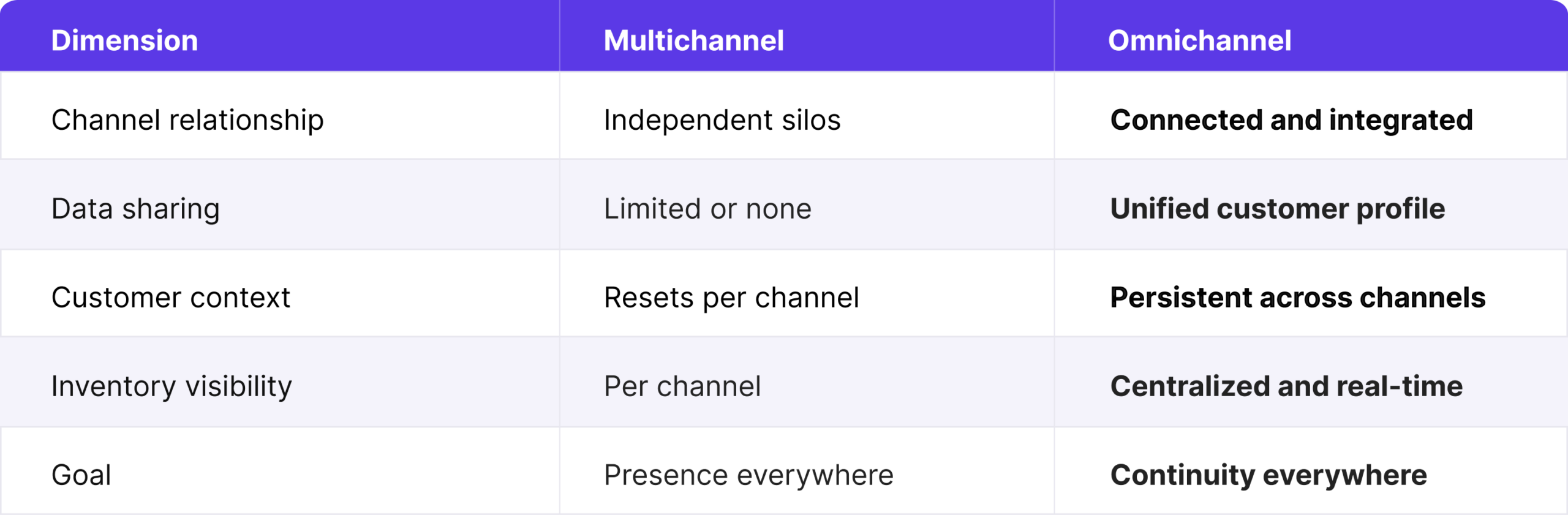
The operational difference is significant. Multichannel is a presence strategy. Omnichannel is a continuity strategy.
Why Omnichannel Ecommerce Matters
Today’s buyers do not stay in one place. They compare prices across Amazon and your DTC store in the same session. They browse on mobile and buy on desktop. They ask support questions through chat while tracking a shipment by email. Brands that treat each of those moments as separate events lose cohesion and customers.
The business case for omnichannel is not just about customer experience. It is about operational efficiency and revenue retention:
• Disconnected inventory leads to overselling, stockouts, and lost trust. When your Amazon listing shows in stock, but your warehouse is empty, someone pays the price.
• Repeated customer service conversations happen when agents cannot see what a customer has already done. Every handoff costs time and goodwill.
• Inconsistent promotions create price confusion. A discount active on your website but not on your marketplace creates friction and erodes margin.
• Poor personalization results from siloed data. If your email platform does not know what someone bought on Amazon, your recommendations are irrelevant.
The brands winning in omnichannel are not just distributing products across more channels. They are running one connected system, and that system compounds over time. Better data feeds better targeting. Better fulfillment reduces churn. Better support increases lifetime value.
Core Pillars of an Omnichannel E-commerce Strategy
A working omnichannel strategy rests on six interconnected pillars. Weakness in any one of them creates visible friction for the customer.
1. Unified Customer Data
Every interaction a customer has with your brand, a product view, a purchase, a support ticket, a loyalty redemption should add to a single profile. That profile is what makes personalization real and relevant.
This requires a CRM (Customer Relationship Management system) or CDP (Customer Data Platform) that aggregates data from your ecommerce platform, marketplace accounts, email tool, and support system. Without it, you are guessing. With it, you can send the right offer at the right time based on what someone actually did in a demographic segment.
Data must be collected with consent and used responsibly. The goal is relevance, not surveillance. A customer who bought running shoes should see running gear. That is not intrusive; that is useful.
2. Consistent Customer Experience
Your product descriptions, pricing, promotions, and brand voice should be consistent across every channel where you sell or communicate. This sounds straightforward. In practice, it breaks constantly.
The fix is centralized product information management ideally from a single source of truth that feeds your ecommerce platform, marketplaces, and print materials. Promotion rules should be enforced systematically, not manually updated on a channel-by-channel basis.
3. Inventory Visibility
Real-time or near-real-time inventory data is the backbone of any omnichannel operation. If your channels cannot see the same stock picture, you will oversell, undersell, and miss fulfillment SLAs.
An OMS (Order Management System) that aggregates inventory across your warehouses, 3PL, FBA stock, and physical stores makes this possible. Without it, channels compete for the same inventory and customers suffer the consequences.
4. Flexible Fulfillment
Customers want options. BOPIS (buy online, pick up in store) reduces shipping costs and increases store traffic. Ship-from-store expands fulfillment capacity during peak periods. Cross-channel returns, returning an online order in a store, are now an expectation for many shoppers.
Each of these requires workflow integration between your e-commerce platform, OMS, POS (point-of-sale system), and store operations. The customer experience is simple. The infrastructure that enables it is not.
5. Integrated Technology Stack
Omnichannel does not require the most complex tech stack. It requires the right integrations. At a minimum, your ecommerce platform, CRM or CDP, OMS, POS, marketing automation tool, and customer support platform need to exchange data with each other.
Technology gaps create experience gaps. If your marketing automation cannot see order data, you cannot trigger a replenishment email at the right time. If your support tool cannot pull order history, agents waste time, and customers repeat themselves.
6. Measurement Across the Journey
Most brands measure channel performance. Omnichannel requires measuring journey performance. That means tracking customer lifetime value (CLV), repeat purchase rate, cross-channel conversion, return rate by fulfillment method, and retention by acquisition source, not just ROAS or session conversion rate per channel.
If you can only see what each channel does in isolation, you cannot see how they work together. And they do work together, or they do not, and you will not know why customers keep leaving.
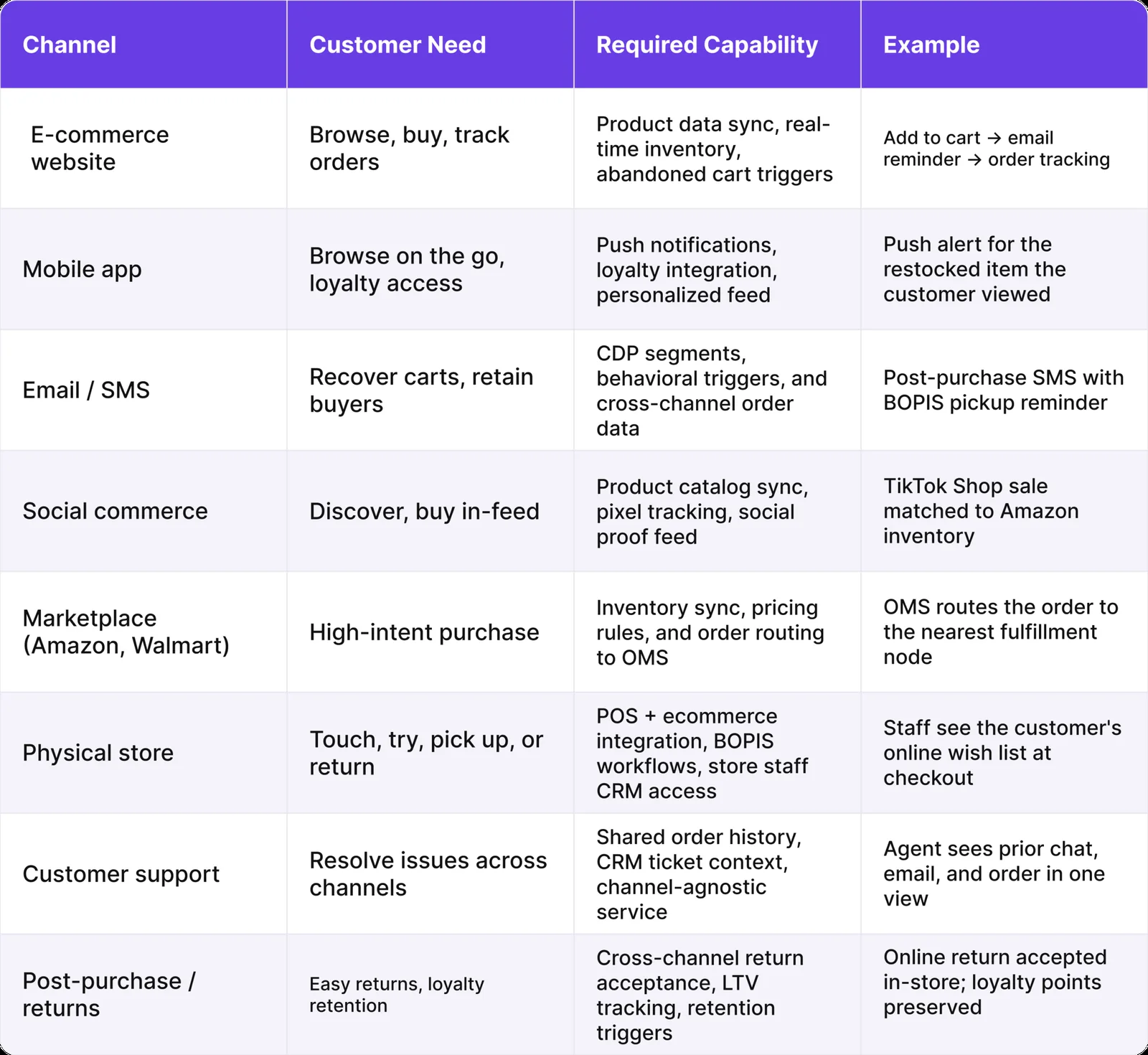
Channel-to-Capability Map
Here is a practical reference that connects each major channel to its operational requirements and to what a connected experience looks like in action.
How to Build an Omnichannel E-commerce Strategy
Most brands fail at omnichannel not because the strategy is wrong, but because they try to connect everything at once. Start with the highest-impact journey gaps and build from there.
1. Audit your current customer touchpoints. Map the full customer journey from discovery to post-purchase. Identify where channels break, where a customer loses their cart, where a support agent loses context, and where inventory data goes stale. This audit tells you where to focus first.
2. Define priority channels based on customer behavior. Do not try to integrate every channel from day one. Identify where your customers actually spend time and where conversion happens. For most e-commerce brands, the highest-priority integrations are between the website, email, and marketplace, or between the website, app, and physical store for retail brands.
3. Centralize your data. Customer data, product data, order data, and inventory data should each have a system of record that feeds every channel. This is the technical foundation that makes everything else possible. Without it, you are connecting surfaces. With it, you are building a system.
4. Align messaging and content across channels. Pricing, promotions, and product descriptions need to be consistent. This requires a documented content governance process and, ideally, a product information management (PIM) system or feed management tool that syndicates data from a single source across all channels.
5. Connect fulfillment and return workflows. Customers expect to return online orders in-store, pick up same-day, or receive accurate delivery windows, regardless of how or where they ordered. Map the fulfillment workflow for each order type and ensure your OMS and store systems can execute it.
6. Train your teams on shared customer context. Technology alone does not create omnichannel. Your support agents, store staff, and marketing team need to understand that they are all working with the same customer. Train teams to use shared tools and to communicate across functions when a customer issue or opportunity spans channels.
7. Measure performance at the journey level. Add journey-level KPIs to your dashboard alongside channel metrics. CLV, repeat purchase rate, cross-channel return rate, and BOPIS conversion tell you whether the strategy is working at the system level, not just whether each channel is hitting its individual number.
Omnichannel E-commerce Strategy Examples
Retail Brand: Connecting Online Inventory with Store Pickup
A sporting goods retailer that sells through its own website and 40 physical stores integrates its OMS with its in-store POS systems. When a customer buys online and selects BOPIS, the OMS routes the order to the nearest location with stock. The customer receives a pickup notification within two hours. If they return the item in-store, loyalty points apply automatically, and the return is processed against the original online order. At no point does the customer need to explain their situation again.
DTC Brand: Behavioral Retargeting Across Email, SMS, and Social
A skincare brand uses a CDP to build customer profiles that include browsing history from its Shopify store, purchase data from Amazon, and email engagement. When a customer browses a moisturizer but does not buy it, they receive an email featuring that product within 4 hours. If they do not open the email, an SMS follow-up goes out 24 hours later. If they buy on Amazon in the meantime, the flow stops automatically. The result is relevant, non-repetitive communication that matches real customer behavior rather than generic batch sends.
B2B Ecommerce: Consistent Pricing and Account Data Across Web and Sales Reps
A B2B distributor gives buyers access to account-specific pricing and order history through a self-serve portal. When a buyer calls their sales rep, the rep can see the same order history, current contract pricing, and open quotes. When the buyer’s order is processed, whether through the portal or by the rep, it feeds into the same OMS and fulfillment workflow. There are no pricing discrepancies between what the buyer sees online and what the rep quotes.
Common Challenges and How to Avoid Them
• Siloed teams with disconnected ownership. Marketing, ecommerce, operations, and support each own a piece of the customer, but no one owns the full journey. Fix: Appoint a cross-functional owner for the customer journey and establish shared metrics that span departments.
• Inconsistent product, pricing, or promotional data. A discount running on your website does not sync to your Amazon listing or in-store pricing. Fix: Implement a centralized product and pricing system with rules that govern how changes propagate to each channel before launch.
• Poor inventory accuracy. Promised availability that does not reflect reality destroys trust faster than any marketing misstep. Fix: Connect your OMS to every selling point and set buffer stock rules that account for sync delay between systems.
• Overcomplicated technology stacks. Adding tools to solve integration problems often creates new ones. Fix: Audit your stack against the six pillars above and prioritize integrations that close the most critical data gaps.
• Weak measurement and attribution. If every channel claims credit for the same conversion, you cannot make smart investment decisions. Fix: Adopt a measurement model that accounts for assisted conversions and maps customer paths across sessions and channels.
• Lack of employee training. A unified system fails if frontline staff do not know how to use the tools or trust the data. Fix: Build training into the rollout plan. If your store associates do not know how to look up an online order at the register, your BOPIS program will disappoint every customer who tries it.
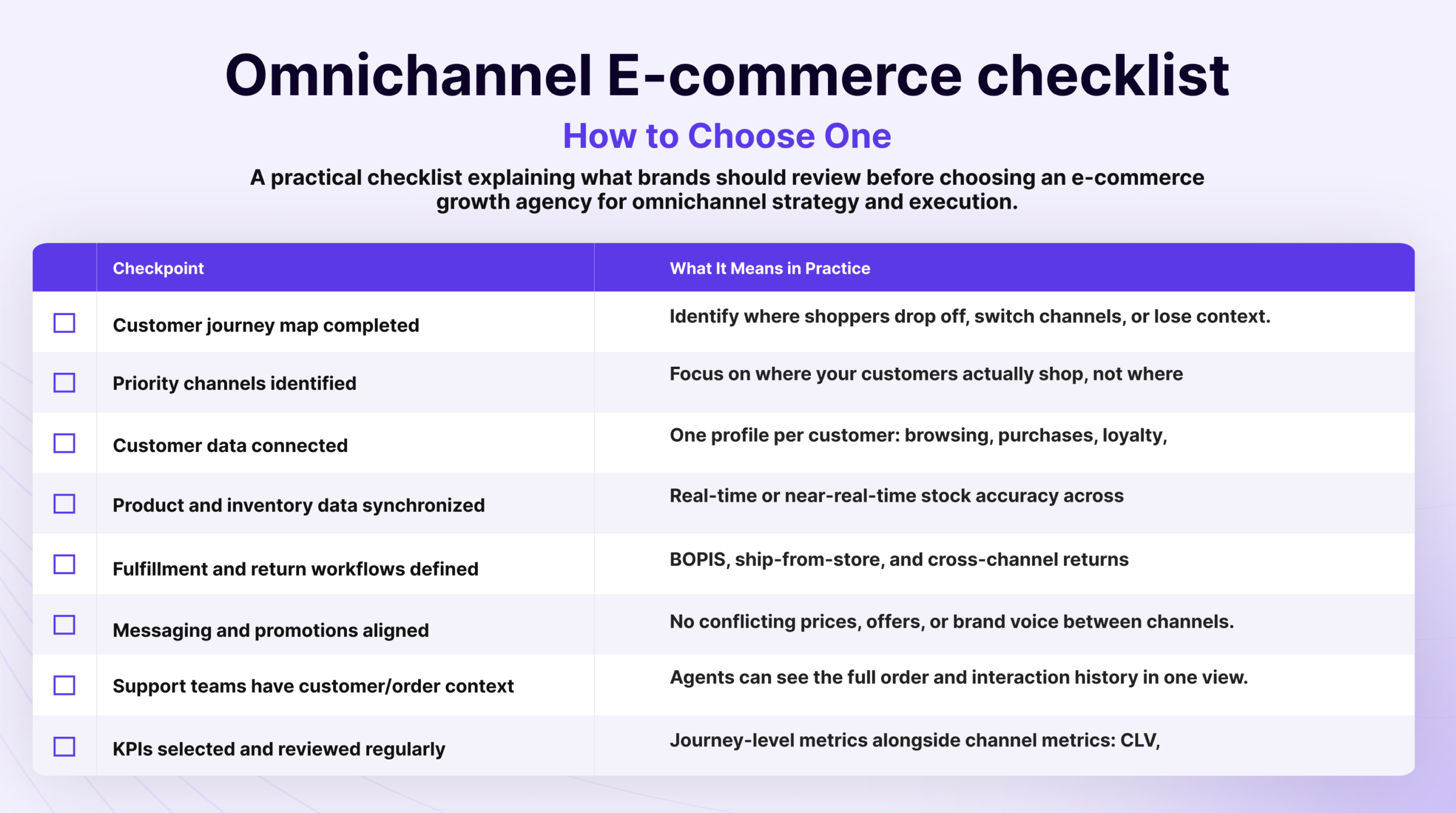
Omnichannel E-commerce Strategy Checklist
Use this as a quick reference at the start of a strategy review or before launching a new channel.
Related Eva guide: Assign each social channel a clear role using the TikTok Shop vs Instagram Shopping comparison instead of duplicating the same plan.
Need one team across channels? If you want an agency that manages Amazon, Walmart, Shopify and TikTok Shop together, see how Eva runs them as one plan. For Walmart specifically, see Eva’s Walmart Marketplace agency guide, or book a call.
FAQs
What is an omnichannel ecommerce strategy?
An omnichannel ecommerce strategy is a coordinated approach that integrates all of a brand’s digital and physical sales channels into a single, consistent experience. Customer data, inventory, marketing, fulfillment, and support are integrated, allowing shoppers to move between channels without losing context or continuity.
What is the difference between omnichannel and multichannel ecommerce?
Multichannel means selling or communicating across multiple channels. Omnichannel means those channels are connected and share data. In a multichannel setup, a customer who contacts support after buying on Amazon starts from zero. In an omnichannel setup, the support agent can see the Amazon order immediately. The difference is integration, not channel count.
Why is omnichannel ecommerce important?
Because customers move between channels and expect their experience to follow them, disconnected systems lead to inventory errors, inconsistent pricing, limited personalization, and repeated service conversations, all of which erode trust and reduce lifetime value. An integrated strategy reduces friction at every stage of the journey.
What are the main components of an omnichannel ecommerce strategy?
The six core pillars are unified customer data, consistent customer experience, real-time inventory visibility, flexible fulfillment options, integrated technology (ecommerce platform, CRM or CDP, OMS, POS, marketing automation, support tools), and journey-level measurement.
How do you build an omnichannel ecommerce strategy?
Start with a customer journey audit to identify where the experience breaks. Define your priority channels based on actual customer behavior. Centralize customer, product, order, and inventory data. Align messaging and promotions. Connect fulfillment workflows. Train your teams on shared context. Measure performance at the journey level, not only per channel.
Conclusion
An omnichannel ecommerce strategy is not a marketing tactic. It is an operating model. The brands that execute it well are not just showing up in more places; they are running one connected system that gets smarter with every interaction.
Start with the journey gaps that create the most friction. Close those first. Then build outward-facing connecting channels, centralize data, align teams, and measure what actually matters at the customer level.
The brands that build these systems do not just retain more customers. They create the kind of compounding efficiency that makes growth sustainable and increa
The media layer of omnichannel growth now extends across retailers, marketplaces, creators, publishers, and brand-owned commerce. Explore Eva’s Commerce Media guide.
Related Eva guide: An omnichannel plan needs a delivery model that can coordinate the work. Eva's 2026 full-service ecommerce agency scorecard explains how to assess one accountable partner.