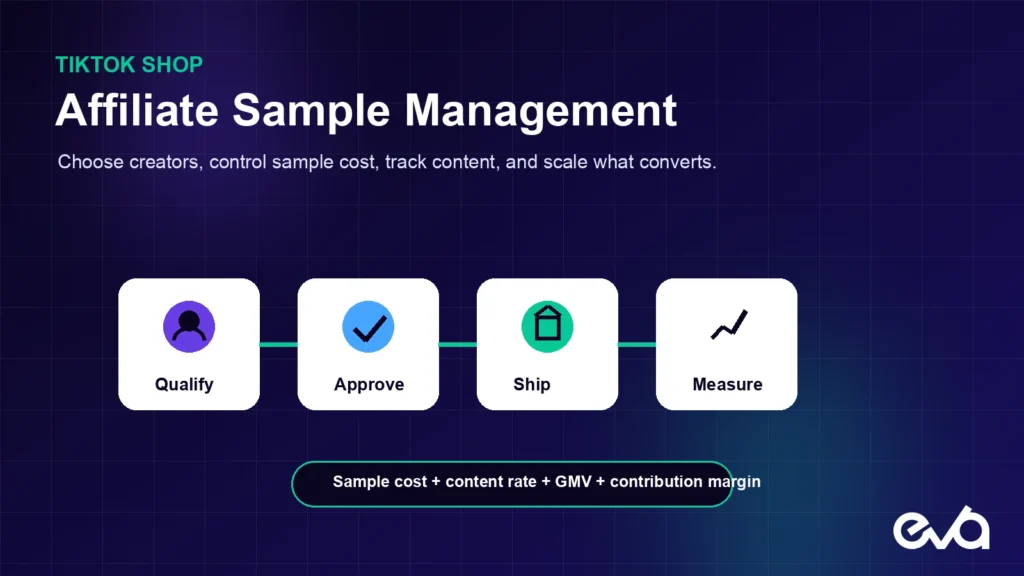
TikTok Shop affiliate sample management is the operating system behind creator seeding. It decides which products are sampled, which creators receive them, how quickly orders ship, what content is expected, how performance is tracked, and which relationships deserve more investment.
Table of Contents
- Free and refundable sample controls for 2026
- How TikTok Shop samples work
- The affiliate sample management framework
- 1. Decide which products deserve samples
- 2. Segment creators before approving requests
- 3. Choose between free and refundable samples
- 4. Set quotas from unit economics
- 5. Make fulfillment part of creator experience
- 6. Give creators a useful brief without scripting them
- 7. Track the full sample funnel
- 8. Decide when to stop, follow up or scale a sample cohort
- Use a weekly sample operating cadence
- How Eva manages TikTok Shop affiliate samples
- How many completed orders must a sample cohort generate?
- FAQ
Free and refundable sample controls for 2026
Quick Answer: Approve samples based on product and audience fit, creator evidence, content completion, sales quality, inventory, and contribution potential. Track every sample from request through delivered content and completed customer orders. More samples are not automatically more growth.
Calculate product, pick, pack, shipping, commission, and opportunity cost before setting approval rules. Protect stock needed for customers and high-confidence creators. Use auto-approval only when the qualification criteria and inventory limits are clear. Refundable samples can change the creator incentive, but current platform conditions should be confirmed before use.
Provide a product brief with accurate facts, permitted claims, disclosure, audience, use, differentiation, and prohibited language. Do not require positive opinions. Track shipment, delivery, content deadline, published content, content quality, clicks, orders, cancellations, returns, commission, and contribution. Separate creators who complete high-quality content from those who merely request products.
Review the program by creator cohort and product. Increase access where completed content and customer economics are repeatable. Reduce exposure when stock, returns, claim risk, or low completion weakens the model. Feed customer questions and returns back into creator selection, briefing, listing, and product decisions.
2026 operator checklist
- Creator and audience qualification
- Sample unit economics and stock limit
- Accurate brief and content completion
- Completed-order contribution and return review
Related Eva resources: TikTok Shop Management, TikTok Shop Profitability, Eva Playbooks.
Sending more samples does not automatically create more sales. An unmanaged program can consume inventory, create fulfillment work, and produce little usable content. A disciplined program treats every sample as a small investment with a clear hypothesis: this creator, product, audience, and content angle can generate a useful commercial signal.
A profitable TikTok Shop sampling program qualifies creators by audience and commerce fit, assigns the right sample type, controls quotas, ships quickly, tracks posting deadlines, measures content and GMV, and reinvests in creator-product combinations that improve contribution margin.
How TikTok Shop samples work
TikTok Shop lets sellers offer product samples through affiliate collaborations. Sellers can use Open Collaboration for broader creator access or Target Collaboration for selected creators. Depending on the program and eligibility, samples may be free or refundable, and the seller can manage requests, shipping, content progress, and creator performance from Affiliate Center.
TikTok’s current seller guidance describes sample settings for product quantity, request periods, creator thresholds, and collaboration type. The platform also documents content timing and sample status workflows. These controls are useful, but the brand still needs its own economic rules and creator-selection standards.
Useful official references: TikTok Shop sample setup and management, affiliate collaboration setup, and TikTok Shop affiliate growth guidance.
The affiliate sample management framework
| Stage | Operating decision | Metric |
|---|---|---|
| Product selection | Margin, visual demonstration, conversion, inventory, and repeat potential | Sample-ready SKU count |
| Creator qualification | Audience fit, category history, content quality, sales history, and reliability | Approval rate by creator tier |
| Fulfillment | Quota, address validation, pick and pack, shipping speed, and delivery tracking | Delivery time and cost per sample |
| Content | Brief, hook, use case, product proof, deadline, and disclosure | Content completion rate |
| Scale | GMV, commission, ad spend, returns, content reuse, and margin | Contribution per approved sample |
1. Decide which products deserve samples
Not every SKU should enter the sample program. Prioritize products that are easy to demonstrate, have enough gross margin, solve a visible problem, hold sufficient inventory, and convert once the customer understands the use case. The product should also have a listing strong enough to turn creator attention into a purchase.
Low-stock products, fragile items, high-return SKUs, products with unclear claims, and products that require extensive education may need a controlled test before broad seeding. Build a sample-ready checklist that covers margin, inventory, shipping, compliance, content angles, listing quality, and repeat-purchase potential.
2. Segment creators before approving requests
Follower count is not enough. Review audience fit, recent category content, shoppable content frequency, product presentation, comment quality, on-camera credibility, historical sales when available, and whether the creator reliably completes collaborations.
Use practical tiers. Discovery creators can receive a limited test allocation. Proven category creators can receive priority approval and stronger offers. Strategic creators may deserve a target collaboration, custom brief, or paid amplification plan. The tier should determine sample type, quota, commission, communication, and follow-up.
3. Choose between free and refundable samples
Free samples reduce creator friction and can help attract strong partners, but the seller absorbs the product and fulfillment cost. Refundable samples create a commitment mechanism because the creator purchases the product and can earn the amount back after meeting the program’s conditions. Availability and exact rules depend on TikTok Shop settings and program eligibility.
Use free samples for creators with a strong product fit, high content quality, or strategic value. Use refundable samples to widen discovery while controlling cost. Do not treat the formats as substitutes for qualification. A poorly matched creator remains a weak investment regardless of sample type.
4. Set quotas from unit economics
Sample quota should be a financial decision. Calculate product cost, pick and pack, shipping, expected completion rate, expected content quality, commission, likely GMV, return rate, and the value of reusable content. Then define how many samples the brand can send before the test needs to prove itself.
For example, sending 100 samples is not a meaningful goal. A better plan is to approve 20 qualified creators across four content angles, track delivery and posting, identify the creator-product combinations that generate profitable orders, and release the next quota based on evidence. Smaller controlled waves make learning visible.
5. Make fulfillment part of creator experience
Slow or inaccurate sample fulfillment reduces the time available for content and weakens the creator relationship. Confirm inventory before approval, use a reliable pick-and-pack workflow, validate shipping details, track delivery, and flag damaged or delayed orders quickly.
TikTok currently documents different content windows for free and refundable sample workflows, so teams should verify the active rules in Seller Center and monitor every deadline. The operational owner needs a daily view of approved, shipped, delivered, content due, content posted, and exception statuses.
6. Give creators a useful brief without scripting them
A creator brief should clarify the customer problem, product truth, important use cases, required claims, prohibited claims, demonstration ideas, and the action the shopper should take. It should not force every creator into the same script. The creator’s voice and audience relationship are part of the value.
Offer several tested angles instead of one rigid concept: problem and solution, routine, comparison, first use, ingredient or feature explanation, objection handling, or before-and-after process where compliant. Ask the creator to show the product clearly, connect the story to a real shopper need, and use the correct product link.
7. Track the full sample funnel
- Requests received and approval rate
- Samples approved, shipped, delivered, canceled, or delayed
- Content completion rate and days from delivery to post
- Views, clicks, product-card engagement, and add-to-cart activity
- GMV, orders, commission, returns, and contribution margin
- Reusable content rate and paid amplification potential
- Repeat performance by creator, product, angle, and audience
Do not evaluate creators only on first-post GMV. Some creators produce strong content that becomes valuable for paid media, product pages, or future campaigns. Others may generate sales with content the brand cannot safely scale. Use both direct commerce results and the quality of the creative asset.
8. Decide when to stop, follow up or scale a sample cohort
Agree on the review window before shipping samples. Use the actual collaboration conditions and distinguish sample delivery, accepted content, completed orders and paid-use permission. A creator waiting for a missing parcel is not the same as a creator who received it and missed an agreed commitment.
| Evidence at review | Next action | Release condition |
|---|---|---|
| Parcel missing, SKU inactive or product unavailable | Follow up with operations and the creator; correct the blocker. Do not classify the creator as non-compliant from an undelivered sample. | Delivery/product status resolved and current collaboration conditions checked. |
| Content posted but the product link or factual statement is wrong | Hold amplification and correct the asset. Preserve the original record and the agreed revision request. | Working SKU link, accurate demonstration, disclosure and required usage rights verified. |
| Orders are too recent for the agreed refund window | Keep the cohort pending; cap further spend at the approved test budget. | Comparable mature orders and complete costs are available. |
| Mature contribution is negative or an unresolved claim risk exists | Stop additional seeding or amplification for that cohort while diagnosing the issue; fulfill existing customer obligations. | A documented correction and bounded retest, not more volume to conceal the loss. |
| Positive mature contribution, accepted content, permission and inventory capacity | Scale in a bounded next cohort, preserving a comparison where feasible. | Named budget, inventory reserve, review date and stop threshold. |
For the illustrative $480 batch below, 60 completed orders at $8 contribution cover seeding costs. Fewer orders indicate a cohort loss; 96 leave $288 before fixed overhead. That arithmetic is not a universal TikTok benchmark or proof of incremental sales. A positive total does not override a product, fulfillment or disclosure failure.
TikTok provides sample workflow tracking and a separate free/refundable sample guide. Verify the terms that apply to the actual collaboration; do not invent one deadline for all samples. Carry the approved evidence and stop rules into the creator brief.
Use a weekly sample operating cadence
A weekly cadence keeps the sample queue from becoming invisible inventory. Start with new requests and approve only the creators who match the product hypothesis. Review unshipped and delayed orders next, then check delivered samples approaching their content deadline. Close the meeting with posted content, GMV, margin, reusable assets, and creators who should move into the next tier.
Assign one owner to every exception. A creator with a delayed package needs an operations owner. A creator who received the product but misunderstood the use case needs a program owner. A strong post that is selling profitably needs a media decision. The cadence turns sampling from a pile of requests into a repeatable creator-commerce system.
How Eva manages TikTok Shop affiliate samples
Eva manages sampling as part of full-service TikTok Shop management. Creator selection, sample approvals, product briefs, affiliate commissions, Shop Ads, GMV Max, listings, inventory, fulfillment, returns, and profit are connected in one operating system.
That connection matters because creator activity can scale demand faster than operations can respond. Eva helps brands control the sample investment, learn from every creator-product match, and move proven content into a broader growth plan while keeping contribution margin visible.
Related Eva guide: Creator-driven volume also needs a controlled TikTok Shop returns workflow to identify expectation and product-quality issues.
How many completed orders must a sample cohort generate?
A sample cohort breaks even when its completed-order contribution covers the entire seeding cost, including samples sent to creators who never publish. Divide that cost by contribution per completed order. Keep content completion and paid-use permission separate: a posted video is neither a guaranteed sale nor automatically an advertising asset.
Illustrative operating example: a 24-creator sample batch
Assume each delivered sample costs $15 for product, packing, shipping, and applicable tax. Program handling adds $120. These are hypothetical business inputs, not TikTok charges. The batch costs (24 x $15) + $120 = $480. Suppose 18 creators publish acceptable content and the mature cohort produces 96 completed customer orders.
| Measure | Calculation | Decision value |
|---|---|---|
| Cost per acceptable post | $480 / 18 | $26.67 |
| Order contribution before seeding | $8 per completed order | Use reconciled SKU economics |
| Break-even order count | $480 / $8 | 60 completed orders |
| Cohort contribution after seeding | (96 x $8) – $480 | $288 |
The assumed $8 already deducts customer-order product costs, fulfillment, platform charges, commissions, discounts, paid media, and the cohort’s return losses. Do not deduct those expenses twice. The $288 excludes fixed business overhead and does not prove incremental sales. Do not book speculative content licensing value as cash recovered.
TikTok’s sample-management documentation supports request, shipment, content, and performance tracking. Its creator sample guide distinguishes free and refundable workflows. Copy the actual order’s conditions into the cohort record; do not apply one refundable-sample deadline across every program.
- Release the next batch only after checking mature order contribution.
- Separate delivery failures from creator non-completion before changing approval rules.
- Keep outstanding sample commitments visible beside customer stock requirements.
Use the Creator and Affiliate Program Operations Playbook to assign cohort ownership. Carry its acceptance criteria into the creator brief and reconcile the $8 through the TikTok Shop profitability framework. For managed execution, include this cohort ledger in the scope of Eva’s TikTok Shop management service.
FAQ
What is a TikTok Shop affiliate sample?
It is a product offered to an eligible creator so the creator can experience it and produce shoppable content through an affiliate collaboration. TikTok Shop supports sample management inside Affiliate Center.
Should brands approve every sample request?
No. Approvals should reflect audience fit, content quality, product relevance, creator reliability, inventory, sample cost, and the goals of the test.
What is the difference between free and refundable samples?
With a free sample, the seller provides the product without requiring the creator to buy it. A refundable sample generally asks the creator to purchase first and earn the amount back after meeting the active program conditions. Brands should confirm current rules in Seller Center.
How do brands measure sample ROI?
Measure product and shipping cost, completion rate, content quality, clicks, GMV, commission, returns, contribution margin, reusable content value, and repeat creator performance.
Related Eva resources: TikTok Shop Management, Creator and Affiliate Program Operations Playbook, TikTok Shop Creator Brief Examples, TikTok Shop Affiliate Commission Strategy, and TikTok Shop Creator Selection.