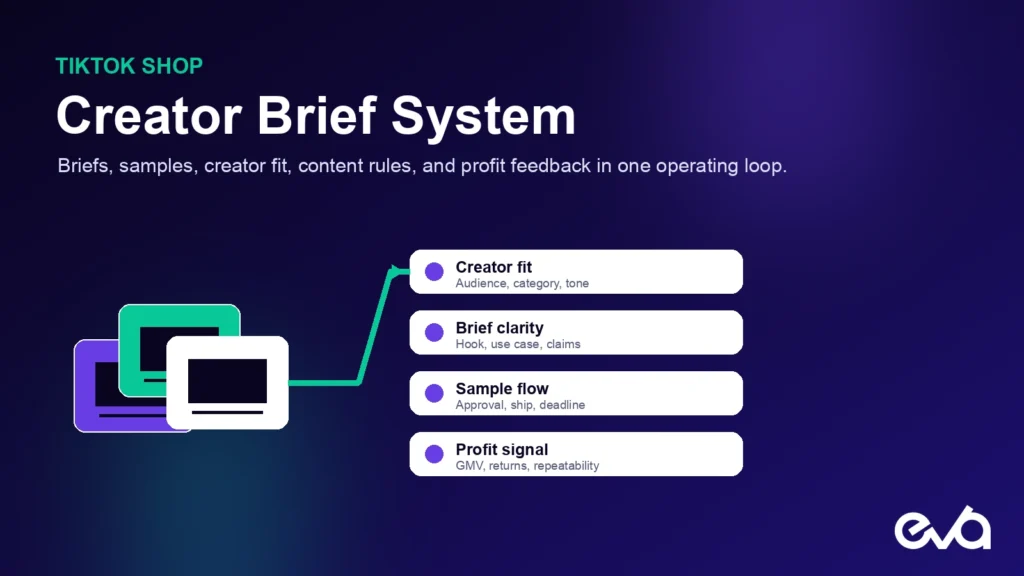
A TikTok Shop creator brief is not a mood board. It is the operating document that tells a creator what problem the product solves, what claims are safe to make, what content angle matters, how samples work, what the commercial offer is, and how the brand will judge success.
Most brands give creators too little direction, then blame the creator when the content does not convert. The opposite mistake is just as common: brands over-script every second and remove the reason TikTok works in the first place. The best creator briefs sit between those extremes. They give enough structure to protect the brand and enough freedom for the creator to make content that feels native.
Quick answer: a profitable TikTok Shop creator brief should include the product promise, target shopper, required talking points, claims to avoid, sample terms, content deliverables, posting timeline, affiliate commission, offer details, and the metrics that decide whether the creator should be scaled, coached, or paused.
Table of Contents
- Why creator briefs matter more on TikTok Shop
- The creator brief framework
- Example 1: Hero product launch brief
- Example 2: Problem-solution content brief
- Example 3: TikTok Shop LIVE brief
- Example 4: Affiliate scale brief
- Sample management belongs inside the brief
- What to measure after the brief goes live
- How Eva manages TikTok Shop creator briefs
- Three category briefs with an inspectable product demonstration
- FAQ
- Quick Answer
Why creator briefs matter more on TikTok Shop
TikTok Shop is closer to retail media plus creator commerce than traditional influencer marketing. The content is not only awareness. It can become the product detail page, the discovery path, the social proof, the coupon explanation, and the checkout nudge in one motion.
That makes the brief more important. A loose brief creates expensive noise: creators request samples, post weak videos, misunderstand the product, overstate claims, or attract buyers who return the item. A strong brief helps the brand learn which hooks, creators, claims, offers, and products are repeatable.
Useful official references: TikTok Shop affiliate collaborations, TikTok Shop product samples, TikTok Shop creator management, and TikTok Shop content policy.
The creator brief framework
| Brief Section | What It Should Answer | Why It Matters |
|---|---|---|
| Product role | What problem does this SKU solve? | Creators need a reason to care beyond a feature list. |
| Shopper context | Who is buying and what belief needs to change? | The content angle should match the buyer, not the brand team. |
| Required proof | What can the creator show, test, compare, or demonstrate? | TikTok rewards content that makes the product feel real. |
| Claims guardrails | What claims, medical language, pricing promises, or competitor references are not allowed? | Weak guardrails create compliance risk and content rework. |
| Offer and commission | What coupon, bundle, shipping promise, or commission supports the push? | Creators need a reason for shoppers to act now. |
| Success signal | What makes this creator worth scaling? | Brands need to separate views from profitable demand. |
Example 1: Hero product launch brief
Use this when: the brand has one priority product and needs creator content to create demand, not just list features.
- Objective: introduce the product to shoppers who have the problem but may not know the category.
- Hook options: “I stopped ignoring this one daily problem,” “I did not expect this to work this fast,” or “Here is what I wish I knew before buying.”
- Required product moments: show the package, open the item, demonstrate the core use case, show scale or texture, and explain who it is not for.
- Claims guardrails: avoid medical, guaranteed outcome, or competitor attack language unless approved by the brand.
- Offer: creator-specific coupon or launch bundle.
- Success metric: qualified product clicks, add-to-cart rate, GMV, return rate, and comments that reveal purchase objections.
The key is not to force a word-for-word script. Give the creator the product truth, the proof moments, and the forbidden lines. Let the creator choose the native delivery.
Example 2: Problem-solution content brief
Use this when: the product solves a specific pain point and shoppers need to see the problem before they understand the value.
- Opening: start with the pain point, not the brand name.
- Middle: show the product in the context where the problem happens.
- Proof: demonstrate the difference clearly, but do not invent before-and-after results.
- CTA: mention the TikTok Shop offer and why this is a smart time to try it.
- Feedback request: ask creators to report which comments came up repeatedly after posting.
This brief works well for beauty, home, wellness, baby, pet, food, and utility products where shoppers need a practical reason to stop scrolling.
Example 3: TikTok Shop LIVE brief
LIVE content needs a different brief because it is not a single asset. It is a selling environment. The creator needs product order, objection handling, offer timing, sample inventory, pinned product guidance, and a rhythm for repeating the value proposition without sounding mechanical.
- Product order: lead with the SKU that converts fastest, then rotate bundles or add-ons.
- Demo blocks: define short repeatable demos for each product.
- Objection handling: give approved answers for price, size, ingredients, use case, shipping, and returns.
- Offer rhythm: specify when to mention coupons, bundles, limited inventory, or free shipping.
- Post-LIVE review: compare GMV, product clicks, comments, peak moments, and repeatable questions.
Example 4: Affiliate scale brief
Affiliate scaling fails when every creator receives the same instructions and every product gets the same commission logic. A better brief separates creators by role: discovery creators, category educators, product demonstrators, review-style creators, and LIVE sellers.
For each role, the brief should change the hook, proof, incentive, and success metric. A creator who is excellent at product education may not drive immediate GMV on the first post, but that creator can still create reusable objections, content angles, and language that improves paid amplification later.
Sample management belongs inside the brief
Samples are not free inventory. They are part of the creator operating cost. The brief should state who qualifies for a sample, whether approval is required, when the item must be posted, what happens if the creator does not post, and whether the brand expects raw feedback even if the creator decides not to publish.
A sample program without a brief creates waste. A sample program with a clear brief becomes a learning system: which products creators request, which products they actually post, which products drive profitable clicks, and which products create returns or customer confusion.
What to measure after the brief goes live
- Creator acceptance: how many qualified creators accept the brief?
- Post rate: how many approved creators actually publish?
- Content quality: did the creator follow claims, proof, product, and offer guidance?
- Commercial signal: product clicks, conversion, GMV, commission cost, returns, and repeat orders.
- Learning value: comments, objections, alternate hooks, and SKU feedback.
The best creator programs do not only ask which creator sold the most. They ask which creator taught the brand what to scale next.
How Eva manages TikTok Shop creator briefs
Eva manages TikTok Shop as a growth system, not as a random creator list. The creator brief connects product selection, affiliate commissions, sample approvals, creator segmentation, content review, paid amplification, shop conversion, and return feedback.
That matters because creator activity can look successful while profit gets worse. Eva looks at the whole loop: which creators create demand, which products can support demand, which offers protect margin, and which content can become a repeatable acquisition asset.
A creator brief performs best inside a launch plan that aligns listing, samples, affiliate, content, ads, inventory, and fulfillment. Use Eva’s TikTok Shop Product Launch Strategy.
For category-specific creator, product, claims, approval, and shop controls, use Eva’s TikTok Shop supplements operating guide.
Three category briefs with an inspectable product demonstration
Original fictional briefs, not customer campaigns or performance claims. Each gives a creator room to choose the delivery while specifying what the viewer needs to inspect. Confirm the actual SKU, product facts, category eligibility and offer before use.
| Brief | Demonstration and buyer question | Evidence and boundaries |
|---|---|---|
| Beauty: one 100 ml rinse-off cleanser | Show the actual dispenser and amount on a clean surface, then the label and pack size. Answer: what arrives and how does the packaging work? | Use genuine product footage and approved directions. No skin transformation, medical promise, filter-based result or invented testimonial. Link the exact size and variant. |
| Pet accessories: adjustable travel bowl | Show it unfolded beside a ruler, the closure and the stated care process. Answer: will the size and construction suit the intended use? | Verify dimensions and included parts. No unsupported safety, durability or health claims; do not stage unsafe use to make a demonstration. |
| CPG: unscented household refill | Show the supplied refill, its measured pack quantity and the compatible reusable container. Answer: what is included, and what must I already own? | Verify compatibility and use instructions. Do not imply sanitizing, environmental benefits or savings without the supporting basis. State if the bottle is sold separately. |
Common handoff: one exact product URL, confirmed stock, allowed factual statements, excluded claims, offer expiry if any, named approver and a record of publication and paid-use permission. Do not ask creators to claim personal experience they have not had. An approval to publish is not automatically permission to run the video as an ad.
For US-facing endorsements, FTC disclosure guidance explains that payment, gifts and other material connections need a clear disclosure. Put the disclosure where viewers encounter the endorsement; review the actual video, not only the caption. A platform label alone should not be assumed sufficient in every context.
Measure accepted and correctly linked content, mature order contribution, returns and customer questions, not views alone. Use the sample cohort record and creator operations playbook to make approval and follow-up part of TikTok Shop management.
FAQ
What should be included in a TikTok Shop creator brief?
Include the product promise, target shopper, required proof points, claims to avoid, sample terms, deliverables, posting timeline, commission, offer details, and success metrics.
Should TikTok Shop creator briefs include scripts?
Use scripts only as examples. Creators usually perform better when the brand gives clear proof points and guardrails while leaving room for native delivery.
How do you know if a creator brief is working?
Track post rate, content quality, product clicks, conversion, GMV, commission cost, return rate, and comments that reveal shopper objections.
Related Eva resources: TikTok Shop Management, TikTok Shop Growth Playbook, Creator and Affiliate Program Operations Playbook, TikTok Shop Affiliate Agency, TikTok Shop Affiliate Commission Strategy, and TikTok Shop Ads Agency.
Related Eva guide: creator briefs should feed product discovery. Connect the loop with this TikTok Shop product discovery strategy.
Related Eva guide: the brief is one step in a larger creator-seeding workflow. Build the full process with this TikTok Shop affiliate sample management guide.
Quick Answer
A useful TikTok Shop creator brief defines product claims, offer, content deliverables, usage rights, tracking, and review criteria before samples are sent.
Related Eva resource: For hands-on support, explore TikTok Shop agency.