Shopify subscription retention is not a subscription app setting. It is the operating system that decides whether a customer keeps buying, skips, pauses, downgrades, churns, or expands into a higher-value relationship with the brand.
Most brands start subscriptions with a discount and a delivery cadence. That can create the first order, but it does not create retention. Retention comes from product fit, usage timing, replenishment logic, customer education, payment recovery, inventory reliability, and lifecycle messaging that arrives before the customer has already decided to cancel.
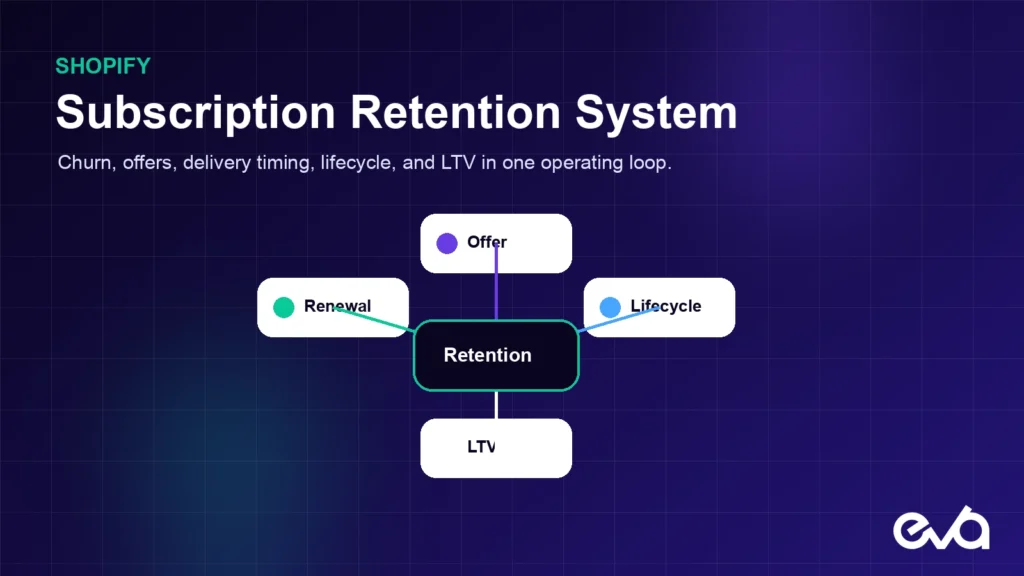
Quick answer: Shopify subscription retention means managing churn signals, offer design, renewal timing, customer portal behavior, payment retries, email and SMS lifecycle, product swaps, and margin as one system, not as disconnected app workflows.
Table of Contents
- Why Shopify subscriptions fail after the first order
- The subscription retention framework
- 1. Segment churn by reason, not only by cancellation
- 2. Build offers that protect margin
- 3. Align renewal timing with product usage
- 4. Use lifecycle messaging before the renewal decision
- 5. Measure subscription retention by profit, not just active subscribers
- A 30/60/90-day subscription cohort without mixing churn states
- How Eva manages Shopify subscription retention
- What counts as a recovered renewal after payment retries?
- FAQ
Why Shopify subscriptions fail after the first order
Subscription programs often fail because the brand optimizes the first conversion and ignores the second decision. The first decision is “should I try this?” The second decision is “do I want this again, at this cadence, at this price, with this level of control?”
Those are different jobs. The first job needs offer clarity and trust. The second job needs product satisfaction, usage timing, flexible controls, proactive reminders, and enough perceived value to avoid discount dependency.
Useful official references: Shopify custom purchase options, Shopify subscription solution model, and Shopify Subscriptions app.
The subscription retention framework
| Retention Lever | What To Manage | Why It Matters |
|---|---|---|
| Cadence | Delivery timing, usage cycle, skip and pause behavior | Wrong timing creates avoidable churn. |
| Offer | Discount, bundle, gift, threshold, and loyalty logic | Bad offers train customers to wait or cancel. |
| Lifecycle | Email, SMS, reminders, education, and save flows | Customers need context before renewal friction appears. |
| Product fit | SKU selection, replenishment need, variant swapping | Some products should not be sold as subscriptions. |
| Profit | Contribution margin, acquisition payback, support cost | Retention only matters if the repeat order is profitable. |
1. Segment churn by reason, not only by cancellation
A cancellation is the final event, not the first signal. Subscription retention improves when the brand groups churn by reason: too much product, too expensive, product did not work, shipping issue, payment failure, wanted a different variant, bad timing, or no longer needed.
Each reason needs a different response. A customer with too much product may need a skip or cadence change. A customer with a failed payment needs recovery and timing. A customer who says the product did not work needs education, support, or better product fit. Treating all churn the same turns retention into guesswork.
2. Build offers that protect margin
The easiest subscription offer is a discount. The better offer is the one that improves commitment without destroying margin. That can mean bundles, early access, loyalty gifts, free shipping thresholds, exclusive sizes, product education, or a smarter first renewal experience.
Discounting can help a shopper try the program, but it should not be the only reason to stay. If customers stay only because the product is cheap, retention looks healthy until acquisition costs, fulfillment, and support costs reveal the real economics.
3. Align renewal timing with product usage
Cadence is one of the most underrated subscription growth levers. A 30-day replenishment cycle is not right for every product. Some products need 21 days. Some need 45. Some need seasonal timing. Some need family-size or usage-based logic.
When cadence is wrong, customers skip, pause, or cancel even if they like the product. Brands should review reorder timing, inventory use, customer comments, subscription edits, and support tickets to understand when the product should arrive.
4. Use lifecycle messaging before the renewal decision
Email and SMS should not be limited to reminders. Lifecycle should educate the customer, prepare the renewal, introduce swaps or add-ons, reinforce the value, and reduce uncertainty. The best save flow happens before the customer enters the cancellation path.
- Before first renewal: reinforce how to use the product and what result to expect.
- Before second renewal: introduce usage tips, bundle logic, or variant choices.
- Before churn risk: offer cadence control, pause, skip, swap, or support.
- After cancellation: collect reason data and route the customer to the right win-back path.
5. Measure subscription retention by profit, not just active subscribers
Active subscriber count can hide weak economics. A subscription program should be judged by repeat contribution margin, payback period, customer support cost, return rate, churn reason, renewal rate, product margin, and lifetime value after discounts.
A brand can grow subscriptions and still weaken profit if the wrong products, offers, and customers are being retained. The goal is not more subscriptions. The goal is more profitable customer relationships.
A 30/60/90-day subscription cohort without mixing churn states
Hypothetical renewal cohort, not observed customer behavior. Follow the same 100 starting subscribers across three renewal windows, with no new entrants. Classify each original member once at each window close: collected and active, paused/skipped, payment failed after the recovery window, or cancelled. The states below are mutually exclusive snapshots, not newly lost customers each month.
| State or result | Day 30 | Day 60 | Day 90 |
|---|---|---|---|
| Paid renewal and active at window close | 80 | 70 | 64 |
| Paused/skipped, no paid renewal in this window | 10 | 12 | 12 |
| Payment unresolved after recovery window | 5 | 6 | 5 |
| Cancelled by window close | 5 | 12 | 19 |
| Original cohort reconciles to | 100 | 100 | 100 |
| Renewal contribution at $12 per paid order | $960 | $840 | $768 |
Assume one renewal per paid member per window, $32 net order revenue and $20 variable cost after the agreed return allowance. Across the three windows, 214 paid renewals produce $2,568 contribution. Subtract $300 of cohort-specific lifecycle cost once to leave $2,268 before fixed overhead and acquisition cost. Do not call 214 renewals 214 retained customers; the original cohort contains 100 people.
The day-90 paid-renewal share is 64%, cumulative cancellations are 19%, and another 17% are paused or unresolved. Neither 81% not-cancelled nor 64% paid is a complete LTV estimate. Record reason and timing separately: voluntary cancellation, payment failure, replenishment mismatch and stock-related deferral call for different action. Do not infer health needs from replenishment behavior.
Retain the same cohort IDs, settled payment windows and category definitions as customers move states; distinguish a pause later resumed from permanent loss. The payment-retry example below explains recovery denominators, while this table explains three-window contribution. For campaign-wide incrementality, use the separate retention comparison.
How Eva manages Shopify subscription retention
Eva manages Shopify subscription retention as part of full-service Shopify management. That means retention is connected to paid media, landing pages, PDPs, customer data, lifecycle messaging, pricing, margin, and operational feedback.
The advantage is coordination. If Meta brings in the wrong subscriber, lifecycle cannot fully fix it. If the product page oversells the subscription, cancellation will rise. If inventory creates fulfillment delays, renewal intent weakens. Eva connects the signals so growth decisions are made across the full system.
Subscription retention belongs in the wider customer-value model. Continue with Eva’s Shopify Customer Lifetime Value guide for cohorts, contribution, and payback.
Related Eva guide: Coordinate recurring-revenue partnerships with the Shopify affiliate program guide for commission, attribution, and customer contribution.
What counts as a recovered renewal after payment retries?
Count a recovered renewal once, when an initially failed billing cycle successfully collects payment within a defined observation window. Do not count each retry as a new renewal opportunity, or classify every skipped cycle as cancellation. Payment recovery, customer-directed pauses, and inventory failures require separate denominators and actions.
The Shopify Subscriptions settings guide documents retry counts, retry intervals, and the skip, pause, or cancel action after attempts fail. Payment-method failures and insufficient inventory have separate controls. These instructions apply to Shopify’s own app; confirm equivalent behavior with the provider if the store uses another subscription app.
Illustrative renewal cohort
Start with 100 contracts scheduled for a renewal window. Eight customers skip and two pause before billing, leaving 90 attempted cycles. Eighty collect payment on the first attempt; ten fail because of payment issues. Six of those ten later pay within the agreed recovery window. First-attempt success is 80 / 90 = 88.9%. Recovery is 6 / 10 = 60%. Final payment success is 86 / 90 = 95.6%, while paid cycles across the original scheduled cohort are 86 / 100 = 86%.
The four unrecovered cycles are not automatically four canceled contracts. Check the configured end action and actual contract status. Shopify’s contract-management guidance distinguishes skipping an order from pausing or canceling the relationship. Payment success also does not prove fulfillment or future retention.
- Give each contract and scheduled billing cycle a unique measurement key.
- Separate customer skips and pauses before computing attempted-cycle success.
- Group repeated failures under the original cycle, not new opportunities.
- Route payment issues to payment recovery and stock issues to inventory operations.
- Close the observation window before comparing retry policies, then check fulfillment and the next paid cycle.
Use the Shopify Retention and LTV Playbook to connect recovery with customer value. Coordinate reminders with email and SMS lifecycle planning. In Shopify management, review recovered payment, delivered order, and subsequent renewal as distinct outcomes rather than one retention claim.
FAQ
What is a good Shopify subscription retention strategy?
A good strategy manages churn reasons, renewal timing, lifecycle messaging, payment recovery, product swaps, customer education, and contribution margin together.
How do you reduce Shopify subscription churn?
Start by segmenting cancellation reasons. Then fix cadence, product fit, offer logic, lifecycle timing, payment recovery, and support friction based on the actual reason customers leave.
Are discounts the best way to keep subscribers?
No. Discounts can help, but retention is stronger when the product, timing, education, flexibility, and customer value make the subscription worth keeping.
Related Eva resources: Shopify Management, Shopify Retention and LTV Playbook, Shopify Subscription Agency, Email and SMS Marketing for Shopify, Shopify Customer Data Strategy, and Shopify Landing Page Optimization.
Related Eva guide: bundles can improve retention when product mix, replenishment timing, and margin work together. Use this Shopify product bundles strategy to build the offer.