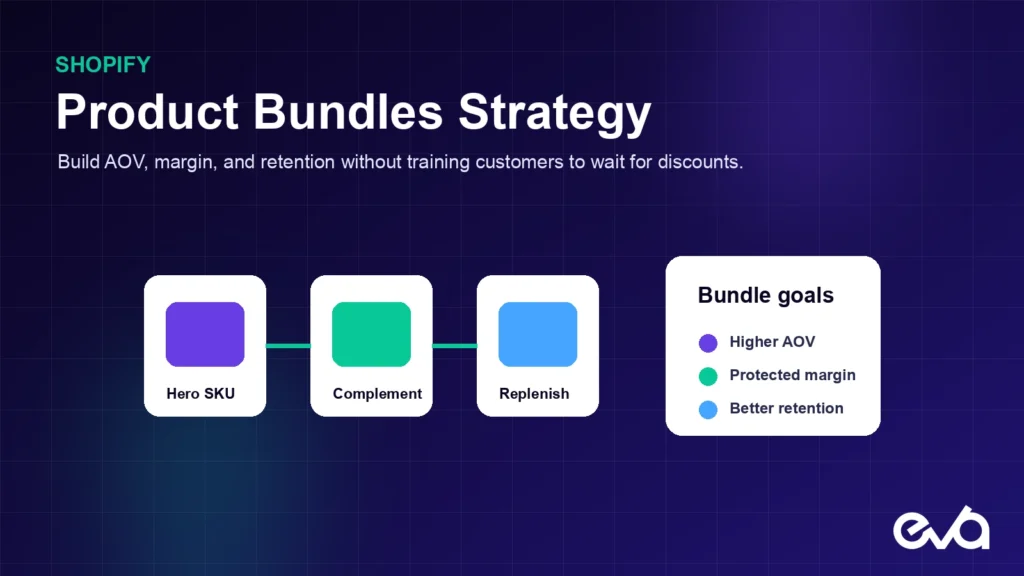
A Shopify product bundles strategy should do more than raise average order value. The right bundle helps a shopper make a faster decision, introduces complementary products, protects contribution margin, improves product discovery, and creates a more natural path to the next purchase.
Many brands approach bundles as a discount mechanic. They combine three products, reduce the price, and assume the higher cart value proves the offer works. That view misses the full economics. A bundle can increase revenue while weakening gross margin, raising fulfillment cost, creating inventory imbalance, or attracting customers who never return.
Quick answer: A profitable Shopify bundle connects a clear customer use case with complementary products, accurate component inventory, disciplined pricing, simple product-page choices, reliable fulfillment, and retention messaging. Measure contribution margin and repeat behavior, not only bundle conversion rate.
Table of Contents
- What product bundles can do for a Shopify brand
- The Shopify product bundle operating model
- 1. Start with the customer decision, not the catalog
- 2. Choose the right bundle type
- 3. Price from contribution margin backward
- 4. Treat component inventory as a shared constraint
- 5. Build a PDP that explains the bundle in seconds
- 6. Connect bundles to paid media and merchandising
- 7. Use bundle data to improve retention
- Metrics that reveal whether a bundle is profitable
- How Eva manages Shopify bundle growth
- FAQ
What product bundles can do for a Shopify brand
Shopify describes a bundle as two or more related products sold together. The platform identifies common benefits such as increasing average order value, offering curation, passing discounts to customers, clearing older inventory, and creating more visibility for products. Those are useful outcomes, but a brand still needs to decide which outcome matters for each bundle.
A launch bundle may reduce decision friction for a new customer. A regimen bundle can teach the shopper how products work together. A replenishment bundle can improve repeat purchase. A discovery bundle can introduce a slower-moving SKU beside a proven hero. A gift set can capture a seasonal buying occasion. Different jobs require different pricing, merchandising, inventory, and lifecycle rules.
Useful official references: Shopify product bundles, Shopify Bundles, and bundle eligibility and operating considerations.
The Shopify product bundle operating model
| Decision | What the brand must define | Risk if ignored |
|---|---|---|
| Customer job | Discovery, regimen, replenishment, gifting, trial, or clearance | The offer feels arbitrary and converts only through discounting. |
| Product mix | Hero SKU, complementary items, variants, and substitution rules | Weak products dilute the value of the bundle. |
| Economics | Component COGS, discount, pick and pack, shipping, returns, and payment cost | Higher AOV produces lower contribution margin. |
| Inventory | Component availability, location, safety stock, and replenishment | One component blocks the entire bundle. |
| Retention | Post-purchase education, replenishment timing, cross-sell, and lifecycle | The bundle creates a larger first order but no customer value. |
1. Start with the customer decision, not the catalog
The fastest way to build a weak bundle is to begin with products the brand wants to move. Start with the customer decision instead. What is the shopper trying to accomplish? Which products are genuinely needed together? What question is the bundle answering that separate product pages do not answer clearly?
A skincare brand may bundle a routine because the shopper needs help choosing compatible steps. A nutrition brand may build a starter pack around a use case. A home brand may pair the core product with the refill or accessory required to use it. In every case, the value comes from reducing uncertainty, not merely adding more items to the cart.
2. Choose the right bundle type
Fixed bundles work when the product set is predetermined. Multipacks work when the shopper needs more units of the same item. Mix-and-match bundles give customers more choice, but they also create more operational and merchandising complexity. Shopify notes that mix-and-match experiences may require a compatible third-party app, while Shopify Plus brands can build custom bundle offers with bundle APIs.
Choice is helpful only when it improves confidence. Too many options can recreate the decision problem the bundle was supposed to solve. Use a fixed bundle when the regimen or use case is clear. Use controlled choice when preference matters, such as flavor, shade, size, or scent. Use mix-and-match only when the added flexibility is worth the extra testing and support burden.
3. Price from contribution margin backward
Do not set the bundle price by adding the component prices and choosing a visually attractive discount. Build the economic model first. Include product cost, discount allocation, payment fees, pick and pack, packaging, shipping, expected returns, support cost, and the marketing cost required to acquire the order.
A bundle does not always need the largest discount. Curation, convenience, exclusive packaging, an added sample, free shipping, education, or a product that is available only inside the set can create value without giving away margin. The offer should make the customer’s decision easier while leaving enough contribution to fund growth.
Bundle availability depends on the components required to fulfill it. Shopify explains that bundle inventory is calculated from component availability and the quantity of each component required. That means one constrained item can stop sales for the entire bundle even when the other products have abundant inventory.
Brands should model bundle demand alongside individual SKU demand. A successful bundle can unexpectedly consume the hero product, create a stockout on the standalone PDP, or leave complementary products stranded when the hero is unavailable. Use safety stock, component-level forecasts, location rules, and merchandising controls so the bundle does not compete blindly with the rest of the catalog.
5. Build a PDP that explains the bundle in seconds
The bundle PDP should answer five questions quickly: what is included, who the set is for, why the products belong together, how much value the customer receives, and how to choose the correct option. Show component images, quantities, variants, usage order, savings, and any important exclusions.
Do not force the shopper to open each component PDP to understand the offer. Use concise product education, comparison tables, routine steps, and clear selection controls. Mobile usability matters because a bundle with several components can become visually dense. Keep the choice architecture simple and verify that the add-to-cart state accurately reflects every selected option.
6. Connect bundles to paid media and merchandising
A bundle can be a strong paid-traffic landing offer when the ad promise and bundle use case match. It can also fail quickly when broad traffic lands on a complex set with no clear reason to buy. Build campaigns around the customer problem, not the word bundle. Use creative that shows the products working together and send the shopper to the most relevant configuration.
On site, place bundles where they support the journey: collection pages, product recommendations, cart offers, gift guides, routine builders, and post-purchase flows. Avoid showing the same generic bundle everywhere. A first-time visitor, a returning customer, and a subscriber may need different sets.
7. Use bundle data to improve retention
The first bundle order should create a retention signal. Track which component drives satisfaction, which item causes returns, whether customers reorder the entire set or only one product, and how long each component lasts. Those behaviors should shape replenishment reminders, subscription offers, cross-sells, and customer education.
A routine bundle can become a strong acquisition product when lifecycle messaging helps the customer use it correctly and reorder at the right time. Without that follow-through, the brand may pay to acquire a larger first order while missing the reason bundles can be valuable: introducing more of the product system and increasing long-term customer value.
Metrics that reveal whether a bundle is profitable
- Bundle conversion rate by traffic source and audience
- Average order value compared with non-bundle orders
- Contribution margin after discount, fulfillment, shipping, and returns
- Component stockout rate and stranded inventory
- Return rate by component and bundle configuration
- Second-order rate, time to next order, and products repurchased
- Customer acquisition cost and payback period
- Attach rate from hero PDPs, collections, cart, and lifecycle campaigns
Review the metrics together. A high-converting bundle with low margin and weak repeat purchase is not a growth engine. A modestly discounted bundle that improves product adoption, raises the second-order rate, and protects inventory can be far more valuable.
How Eva manages Shopify bundle growth
Eva manages bundle strategy inside the broader Shopify growth system. The work connects merchandising, PDP conversion, Google and Meta advertising, customer data, lifecycle messaging, inventory, pricing, and contribution margin. That coordination helps the brand decide which bundles should acquire customers, which should increase basket size, and which should improve retention.
The advantage is accountability across the full result. If a paid campaign scales a bundle but component inventory fails, growth is not working. If the bundle increases AOV but repeat purchase falls, the offer needs to change. Eva connects those decisions so the brand optimizes the customer and profit outcome, not one isolated metric.
Related Eva guide: Use the Shopify email and SMS guide to merchandise bundles through the right lifecycle moments.
Related Eva guide: Adapt bundles, pricing, and product fit by market with the Shopify international expansion strategy before committing local inventory.
FAQ
Do Shopify product bundles increase average order value?
They can, especially when the products solve one clear use case. The increase is useful only when the bundle also protects contribution margin and does not create excessive returns, fulfillment cost, or inventory pressure.
Should every Shopify bundle include a discount?
No. Curation, convenience, exclusive products, education, gifts, and shipping value can make a bundle compelling. Price the offer from contribution margin and customer value rather than using discount as the only reason to buy.
What is the difference between a fixed and mix-and-match bundle?
A fixed bundle contains a predetermined product set, sometimes with controlled variant choices. A mix-and-match bundle lets shoppers assemble their own set from eligible products. More flexibility can improve fit, but it also increases merchandising and operational complexity.
How should Shopify brands measure bundle performance?
Track conversion, AOV, contribution margin, component inventory, return rate, acquisition cost, second-order rate, reorder timing, and products repurchased. Bundle revenue alone is not enough.
Related Eva resources: Shopify Management, Shopify CRO Playbook, Shopify Product Page Optimization, Shopify Subscription Retention, and Shopify Landing Page Optimization.
Bundles are one part of how a store organizes discovery and product relationships. Eva’s Shopify Merchandising Strategy guide connects them with collections, search, margin, and inventory.
For supplement bundles, evaluate discount, COGS, fulfillment, returns, repeat purchase, and inventory together using Eva’s supplement ecommerce profitability model.