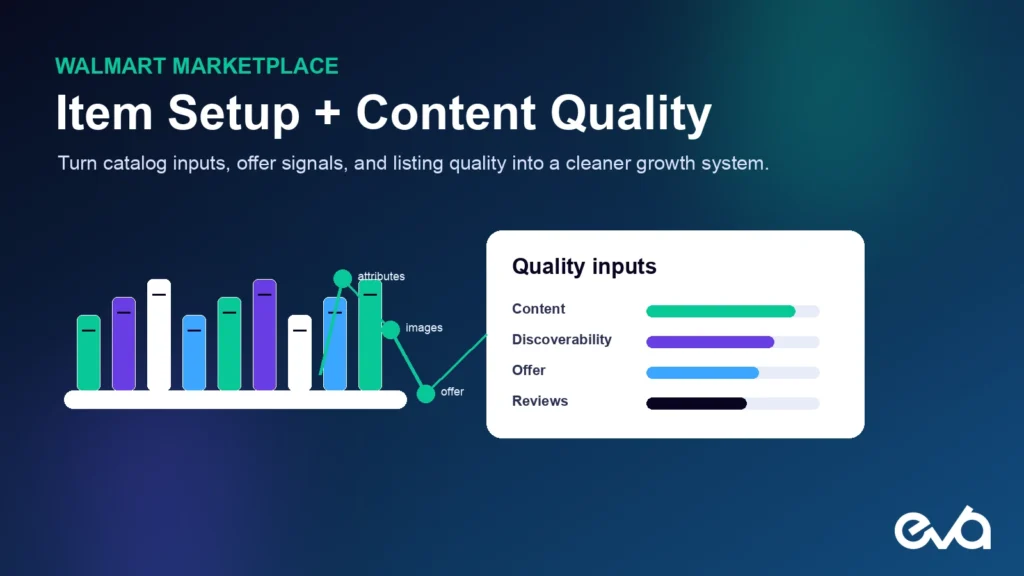
Walmart item setup is not a clerical task. It is the foundation for discoverability, conversion, offer performance, and operational scale on Walmart Marketplace. If the catalog is weak, advertising has to work harder. If attributes are missing, shoppers and algorithms get less context. If content quality is ignored, the brand may win traffic but lose the sale.
Brands often treat Walmart as a copy of Amazon. That is the wrong starting point. Walmart has its own taxonomy, item setup process, content requirements, listing quality signals, fulfillment expectations, and marketplace rhythm. The brands that grow treat Walmart as its own managed channel.
Quick answer: Walmart item setup should connect product identifiers, taxonomy, required attributes, images, title, key features, description, offer, price, fulfillment, inventory, and Listing Quality Score as one operating system.
Table of Contents
- Why item setup affects Walmart growth
- The Walmart item setup framework
- Step 1: Start with clean product identity
- Step 2: Build content for the Walmart shopper
- Step 3: Treat attributes as growth inputs
- Step 4: Understand Listing Quality Score as a system
- Step 5: Connect item setup to advertising
- Weekly Walmart item quality cadence
- How Eva manages Walmart item setup and content quality
- When is a Walmart content-quality fix actually complete?
- FAQ
Why item setup affects Walmart growth
Item setup determines how Walmart understands the product. It also affects how shoppers understand the product. Weak setup creates downstream issues: missing attributes, wrong category placement, low-quality titles, unclear product pages, poor discoverability, lower conversion, and harder advertising optimization.
Walmart makes listing quality visible because the marketplace wants complete, trustworthy, competitive listings. The Listing Quality Dashboard helps sellers see where item content, discoverability, offer strength, availability, ratings, and reviews need attention.
Useful official references: Walmart Listing Quality Dashboard, Walmart Seller Center getting started, and Walmart Listing Quality Score API documentation.
The Walmart item setup framework
| Area | What To Control | Growth Impact |
|---|---|---|
| Product identity | GTIN, UPC, brand, variant structure, pack size, and category | Prevents setup errors and catalog confusion. |
| Content | Title, images, key features, description, and product story | Improves shopper confidence and conversion. |
| Attributes | Required and recommended specs by category | Supports filters, search, and item discoverability. |
| Offer | Price, shipping speed, fulfillment method, and availability | Helps the item compete beyond content alone. |
| Feedback | Ratings, reviews, returns, and item-level issues | Shows where the product page or offer needs correction. |
Step 1: Start with clean product identity
Before writing content, confirm the product identity. The wrong identifier, category, brand value, variant setup, or pack-size logic can create problems that are much harder to fix later. Walmart item setup should begin with a clean source of truth for each SKU.
- Confirm GTIN or UPC accuracy.
- Map the right Walmart category and product type.
- Separate single units, bundles, multi-packs, and variations clearly.
- Standardize brand spelling, color, size, count, flavor, material, and compatibility fields.
- Check whether the product already exists in Walmart’s catalog before creating a duplicate path.
Step 2: Build content for the Walmart shopper
Walmart shoppers often compare value, availability, trust, and convenience quickly. The content should make the product easy to understand without forcing the shopper to decode a brand story. Titles should be clear. Images should explain use, scale, pack count, and differentiators. Key features should answer purchase questions before they become objections.
Do not simply copy Amazon bullets into Walmart. Walmart’s marketplace has different page structure, shopper expectations, search behavior, and quality signals. Reusing raw Amazon content may be faster, but it usually misses Walmart-specific attributes and merchandising opportunities.
Step 3: Treat attributes as growth inputs
Attributes are not backend busywork. They help Walmart classify, filter, compare, and display products. Missing attributes can weaken discoverability and make listings feel incomplete. For many categories, attributes also help shoppers make decisions faster.
A strong Walmart operating process reviews required attributes, recommended attributes, category-specific specs, variant-level details, and customer-facing decision points. If customers ask the same question in reviews or returns, that question may belong in the item content or attribute set.
Step 4: Understand Listing Quality Score as a system
Walmart’s developer documentation describes Listing Quality Score as being based on metrics that gauge item listing quality across content, discoverability, offer, ratings, and reviews. That is important because content is only one part of the growth equation.
- Content: product title, descriptions, images, key features, and completeness.
- Discoverability: category fit, searchable attributes, and listing relevance.
- Offer: price, shipping, fulfillment, availability, and competitiveness.
- Ratings and reviews: shopper confidence and item-level feedback.
If the score is weak, the answer is not always “rewrite the title.” The issue may be fulfillment, availability, reviews, price competitiveness, or a missing attribute that limits how the item appears in Walmart discovery.
Step 5: Connect item setup to advertising
Walmart Connect campaigns perform better when the product page can convert the traffic. Before scaling spend, review the item page like a shopper: Does the title match the product? Do images answer the obvious questions? Is the offer competitive? Is inventory stable? Are reviews strong enough for the category?
Advertising can expose catalog problems quickly. If clicks rise but conversion does not, the problem may live in the listing, offer, pricing, fulfillment promise, or review base. That is why Walmart item setup and advertising should not be managed in separate silos.
Weekly Walmart item quality cadence
| Cadence | Action | Owner Question |
|---|---|---|
| Weekly | Review Listing Quality Dashboard issues | Which high-value SKUs need content, offer, or attribute fixes? |
| Weekly | Check inventory and fulfillment promises | Are we sending traffic to SKUs that can actually scale? |
| Biweekly | Refresh content for priority SKUs | What shopper objections are still unanswered? |
| Monthly | Compare ad performance to item quality | Are campaigns exposing listing or offer problems? |
| Monthly | Review ratings, reviews, and returns | What feedback should change the PDP or operating plan? |
How Eva manages Walmart item setup and content quality
Eva manages Walmart as part of marketplace expansion, not as a side upload project. The work connects setup, taxonomy, attributes, content, offer, fulfillment, advertising, and reporting. That gives brands one operating view instead of scattered catalog tasks.
For profitable brands, Walmart growth is not about “getting listed” and hoping traffic arrives. It is about building a channel that can be discovered, trusted, converted, fulfilled, and scaled.
Related Eva guide: Continue with the Walmart listing optimization guide after the item foundation and content-quality fields are complete.
Related Eva guide: New sellers can prepare the full account foundation with this Walmart Seller Center setup guide before item setup begins.
Related Eva guide: Compare platform-specific catalog and ranking controls in the Amazon vs Walmart SEO guide instead of copying one listing between channels.
When is a Walmart content-quality fix actually complete?
A content-quality fix is complete when the correct attribute is accepted, appears accurately on the customer-facing item, and has a documented follow-up against the relevant quality component. A successful submission alone is insufficient. Separate content errors from pricing, shipping, availability, and review issues before assigning the work.
Walmart’s current Listing Quality overview identifies five components: Content quality, Price competitiveness, Shipping, Published & in stock, and Ratings & reviews. Use those current labels when interpreting the broader content, discoverability, and offer concepts discussed above.
Illustrative operating example: triaging twelve item issues
Suppose twelve storage-box listings appear in an internal improvement queue. Five have inaccurate capacity descriptions, three lack available inventory, two show uncompetitive prices, and two have limited review coverage. This hypothetical queue does not mean twelve listings need rewritten titles.
| Issue group | Assigned work | Closure evidence |
|---|---|---|
| Five capacity descriptions | Verify specifications and submit accurate content | Accepted value matches the live item |
| Three unavailable items | Investigate supply and publication status | Verified sellable availability |
| Two pricing issues | Validate comparison and contribution floor | Documented offer decision |
| Two review gaps | Assess permitted review programs and product readiness | Documented compliant next action, not a promised score |
For each of the five content changes, retain the item ID, GTIN, old value, approved specification, submitted value, feed or submission reference, processing result, and live-page check. Inspect sibling variants using the Walmart variation setup guide so the corrected capacity does not migrate to the wrong size.
Walmart’s content troubleshooting guidance explains that brand-owner and authorized-reseller content has priority in its unified catalog. If a valid correction is not displayed, investigate content authority rather than repeatedly uploading identical values.
The Listing Quality fix guide also warns that scores may not refresh immediately. Track submission, live accuracy, and score observation as separate states; do not promise a particular point increase.
Continue shopper-facing improvements through Walmart listing optimization. Put component ownership into the Walmart.com Growth Playbook and specify catalog verification in the deliverables for marketplace expansion management.
FAQ
What is Walmart item setup?
Walmart item setup is the process of creating or matching products in Seller Center with the correct identifiers, category, attributes, content, images, offer details, fulfillment settings, and inventory signals.
What affects Walmart Listing Quality Score?
Walmart describes Listing Quality Score as being based on metrics across content, discoverability, offer, ratings, and reviews. A weak score can come from content gaps, offer issues, missing attributes, availability problems, or low customer confidence.
Should brands copy Amazon listings to Walmart?
No. Amazon content can be a starting input, but Walmart needs its own taxonomy, attributes, content structure, offer logic, and marketplace operating cadence.
Related Eva resources: Marketplace Expansion, Walmart.com Growth Playbook, Walmart Marketplace Agency, Walmart Marketplace Management Services, and Walmart Connect Agency.
Related Eva guide: once item setup is clean, expand into ranking factors with this Walmart Marketplace SEO guide.
Related Eva guide: variant structure is a critical item-setup dependency. Use this Walmart product variants setup guide for group IDs, GTINs, attributes, images, and error prevention.
Accurate item setup supports customer expectation, returns, feedback, and seller standing. Eva’s Walmart Seller Performance Standards guide connects catalog quality with the full operating scorecard.